
Retail News CRM

Tag: Assembly

  • Vietnam Preps for Gold Trading Revolution: National Assembly Mandates Roadmap for Gold Exchange Amid Surging Prices

    Vietnam Preps for Gold Trading Revolution: National Assembly Mandates Roadmap for Gold Exchange Amid Surging Prices

    The National Assembly of Vietnam has directed the government to construct a strategic plan for establishing a gold trading exchange. This endeavor is in response to the escalating prices of gold and aims to control and regulate the bullion market.

    The Need for a Gold Exchange

    Lawmakers have been emphasizing the importance of such an exchange in order to guarantee transparency in gold trading. This concern arises from the current market situation where the gold price in Vietnam is approximately 15% more than the global rates.

    The State Bank of Vietnam’s Plan

    The State Bank of Vietnam has introduced a plan to instigate a gold trading platform in three successive phases. The first phase involves trading raw gold, followed by trading gold bars in the second phase. The final phase will encompass trading gold certificates and derivatives.

    Current Gold Market in Vietnam

    The Saigon Jewelry Company recently listed the price of gold slightly lower than the highest peak recorded on Dec.1, at VND154.7 million (US$5,873.31) per tael of 37.5 grams. Furthermore, the price of gold in Vietnam has increased by more than 80% since the start of the year.

    In an effort to liberalize the market, the government in October lifted its monopoly on gold production. Private firms meeting specific financial criteria are now allowed to produce bullion.

    Questions & Answers

    What is the new directive given by The National Assembly of Vietnam?
    The National Assembly has directed the government to establish a gold trading exchange to control the bullion market and ensure transparency amid rising gold prices.

    What is the plan of the State Bank of Vietnam regarding the gold trading platform?
    The State Bank of Vietnam intends to set up a gold trading platform in three phases. These include trading raw gold initially, followed by gold bars, and finally gold certificates and derivatives.

    What changes have occurred in the gold market in Vietnam recently?
    Two significant changes have taken place. First, gold prices have risen by more than 80% since the start of the year. Second, the government has lifted its monopoly on gold production, now allowing private firms, that meet certain financial conditions, to produce bullion.
  • Bus-assembly line fire inflicts $11m loss

    Bus-assembly line fire inflicts $11m loss

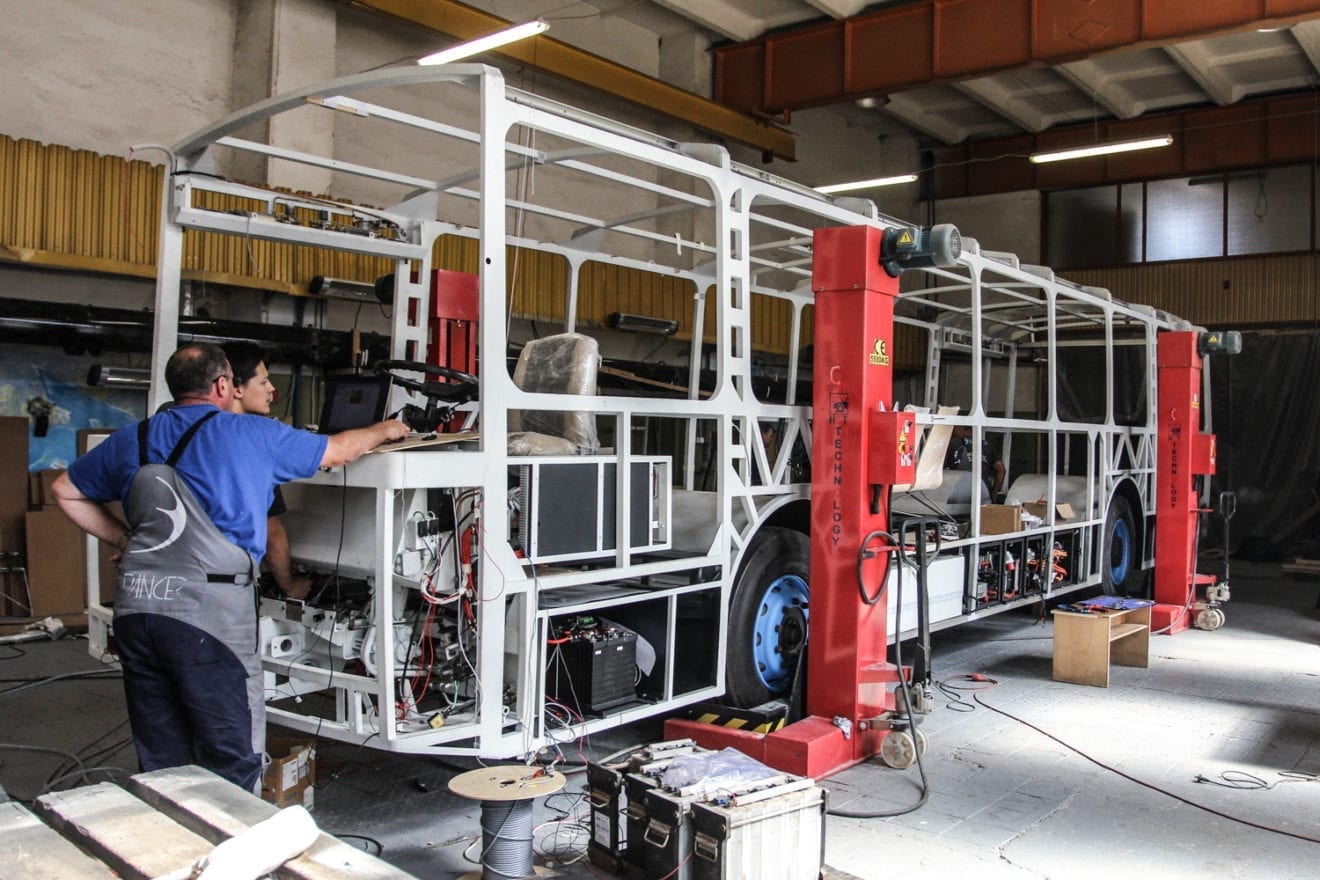
    A fire that broke out at two sites of a bus assembly plant early this month destroyed spare parts and components worth VND250 billion (US$11 million). A bus is assembled at its plant by the Truong Hai Automobile joint stock company (Thaco) in Quang Nam Province. Production was resumed nine days after a fire broke out at the plant on February 2.

    The assessment was revealed by Chairman of the Truong Hai Automobile Joint Stock company (Thaco), Tran Ba Duong, at a press conference on Sunday in central Quang Nam Province, where the plant is located.

    He said initial investigations point to the fire being caused by short-circuits.

    The fire broke out on February 2 after working hours at around 6pm at the Chu Lai-Truong Hai Auto Manufacture and Assembly Complex and blazed for around three hours.

    Components and accessories stored in the 5,400sq.m assembly workshop were burnt, Duong said.

    He said over 1,000 workers in the complex and firemen from Quang Nam, Quang Ngai, Da Nang, soldiers and staff of the Chu Lai Airport joined hands to stamp out the fire and remove components out the workshop.

    The plant resumed operations on Sunday after an initial investigation and recovery, he added.

    “The fire was out of reach of the plant’s automatic extinguishing system. It took four hours to mobilise a large fire-fighting force and extinguish the blaze,” Duong said.

    ‘Our fault’

    “It’s our fault that we collected components and accessories to service big orders while a new production line was under construction,” he said.

    Duong said Thaco had an insurance deal with the HCM City-based Bank of Investment and Development Bank (BIC) and Da Nang-based PVI for a total of VND638 billion ($28.2 million).

    He said BIC had asked an independent unit, Viet Nam International Adjuster (VIA) to assess the damage.

    The accident is still under investigation and final results will be announced after the probe is completed, he said.

    Also present at the conference was Dinh Van Thu, Chairman of the provincial People’s Committee. He said the fire was a lesson in fire prevention not only for Thaco, but other companies in the province’s industrial zones.

    Thu said Prime Minister Nguyen Xuan Phuc had asked the province to speed up the investigation and help the business resume production soon.

    The Thaco chief said the fire had delayed delivery of buses by three days to seven days.

    Thaco has invested US$400 million in constructing the Chu Lai-Truong Hai Industrial Complex, which has a logistics centre, car production factories, a vocational training college, a seaport, storage facilities and shipping services.

    Last year, Thaco earned total revenues of VND65 trillion ($2.8 billion), a 40 per cent growth, contributing VND18 trillion ($796 million) to the State budget.

    The nation’s biggest automaker plans to build three more plants with the total annual capacity of 215,000 trucks, vans, commercial cars, and achieve a localisation ratio of 16 per to 46 per cent.

    It currently manufactures and distributes Korea’s Kia model, Japan’s Mazda and France’s Peugeot. It has exported its cars to Laos, Cambodia, Myanmar and Columbia.

    Thaco plans to earn revenues of VND71 trillion ($3.1 billion) this year, equivalent to two per cent of the country’s Gross Domestic Product.

  • Honda eyes efficiency with new assembly line format in Thailand

    Honda eyes efficiency with new assembly line format in Thailand

    Honda Motor has installed a new type of production line that is about 10% more efficient at an automobile plant in Thailand, the company said Thursday.

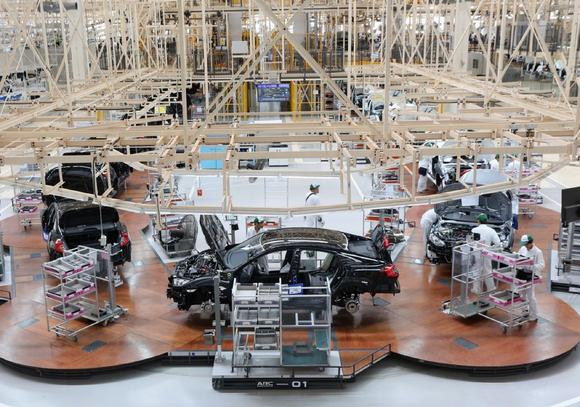
    Until now, each worker was typically responsible for adding one type of part to a vehicle, and had to walk between the conveyor and the parts shelf whenever work on one vehicle was completed. With the new system, four workers ride a unit that moves on a conveyor, with boxes of parts at the ready, allowing them to continuously install multiple parts. This reduces walking to get parts.

    Known as an ARC line, the new format was introduced at a plant in the eastern Thai province of Prachinburi that began turning out finished autos in March and makes some 60,000 Civic sedans annually. It is being applied to about 20% of total assembly procedures, including the attaching of wiring and interior parts after the body has been painted.
    Layout changes for conventional production lines required considerable time and investment, whereas with the new method the conveyor that moves the line can be flexibly lengthened or shortened as needed. Production is easily raised or lowered by adjusting the number of units, and a smaller investment is required when adding vehicle models or changing production volumes.
    After monitoring performance under the new approach, Honda will consider expanding its use.