Retail News CRM

Tag: car sales

  • SUVs are selling more in Korea

    SUVs are selling more in Korea

    Korea’s domestic car market moved in two different directions this year. The rising popularity of large sedans and sport utility vehicles (SUVs) stood in sharp contrast to weaker demand for smaller vehicles, industry data showed Sunday. In the January-November period, Hyundai Motor, Kia Motors, GM Korea, Renault Samsung Motors and SsangYong Motor sold a combined 698,326 units, up 0.3 percent from 696,403 cars sold a year earlier, the data showed.

    Demand for medium SUVs, such as Hyundai’s all new Santa Fe, reached 207,269 units, up a sharp 29.5 percent from the same 11 months in 2017.

    The total so far is expected to push medium-sized SUVs to become the country’s top-selling vehicle type on an annual basis in 2018. This will mark the first time such crossovers have taken the top spot in Asia’s fourth-largest economy, where car buyers generally tended to favor mid- to large-size sedans.

    In regard to larger crossovers, the popularity of SsangYong’s G4 Rexton caused sales of such cars to jump 12.9 percent on year to 46,734 units, further pushing up overall SUV numbers.

    Industry watchers said the release of Hyundai’s three-row Palisade and a longer version of SsangYong’s G4 will further fuel sales going into 2019, with numbers likely to get a further boost once Kia releases its own large SUV that is expected to get the Telluride name.

    Besides SUVs, sales of large sedans, centered on Kia’s K9 luxury sedan, caused total numbers to rise a respectable 5.7 percent to 52,945 units up till November despite drop in demand for Hyundai’s luxury Genesis EQ900 falling off compared to the year before.

    On the other hand, sales of midsize and smaller vehicles dipped 0.9 percent on year to 481,542 units, with demand for small city cars dropping 7.5 percent to 115,647 units.

    “Vehicles like the Sante Fe clearly bolstered demand this year, with this trend likely to continue with the release of the Palisade and new versions of the G90 and G80 to further contribute to sales growth for bigger cars going into 2019,” an industry source said.
  • CGS-CIMB sees strong vehicle sales in December, raises 2018 TIV growth forecast

    CGS-CIMB sees strong vehicle sales in December, raises 2018 TIV growth forecast

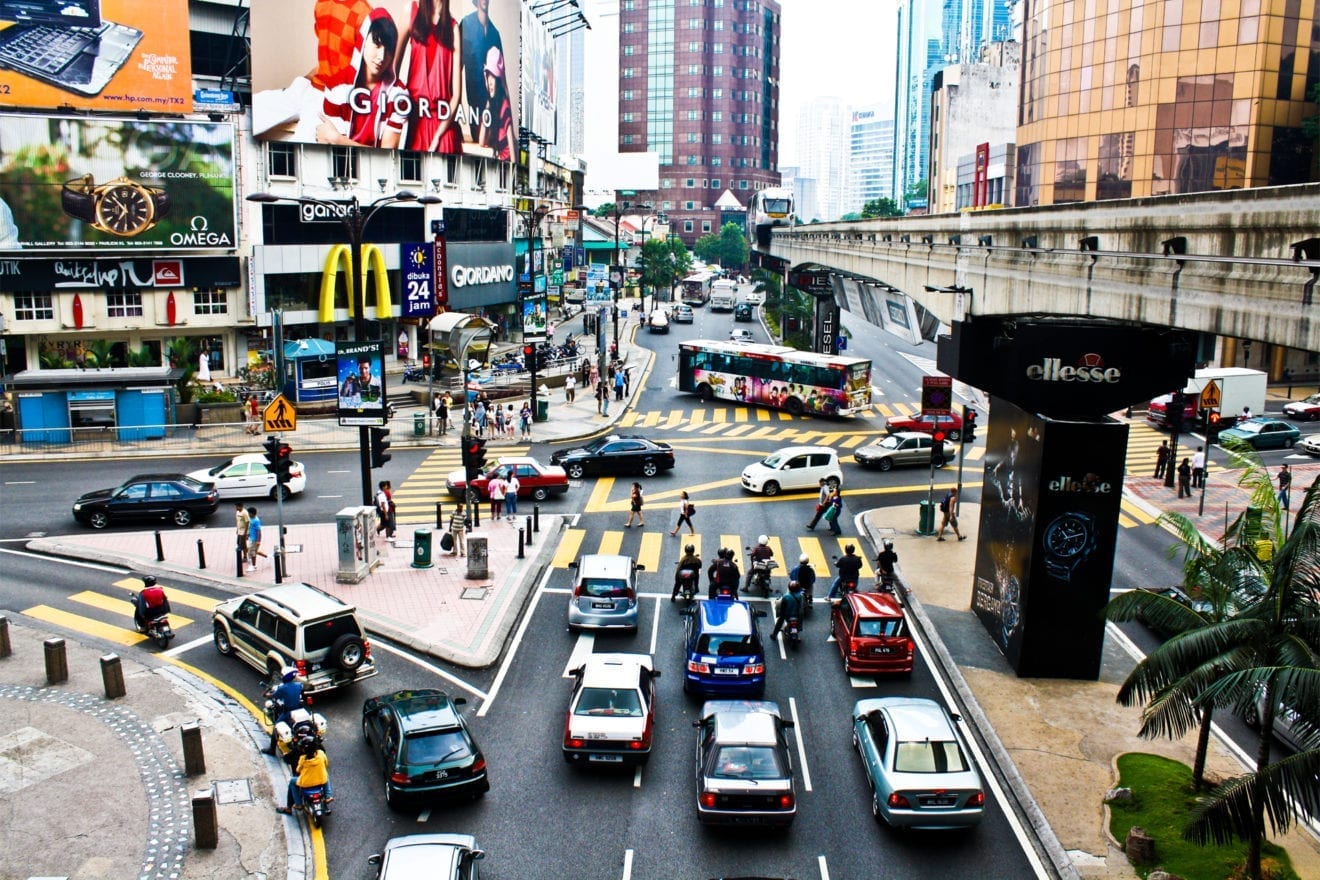
    CGS-CIMB expects vehicle sales to be stronger in December and has raised its 2018 total industry volume (TIV) growth forecast from 2.5% to 4% on the back of stronger-than-expected TIV year-to-date. “We expect stronger sales in December in view of year-end promotions and multiple new models that were recently launched. For example, Proton launched its first SUV, the X70 on Dec 12 and we learned that it has started delivery to showrooms. Proton has so far received encouraging bookings of over 12,000 units since the end of November,” it said in its sector note today.

    On Wednesday, the Malaysian Automotive Association (MAA) announced that TIV grew 2.1% month-on-month to 48,282 units in November due to higher passenger vehicles (PV) sold. Perodua and Mazda recorded 8% and 14% month-on-month growth respectively.

    For the 11 months ended November, TIV rose 5.5% year-on-year to 550,526 units due to stronger PV and commercial vehicles (CV) demand on the back of the tax holiday period. PV and CV recorded healthy 5% and 8% year-on-year sales growth respectively during the period.

    For 2019, it expects resilient sales in PV on the back of new model launches in the passenger car and SUV segments from Perodua, Proton, Honda and Toyota but overall, TIV delivery is expected to be flat next year.

    “We project a 10% sector net profit growth in 2019, driven by positive earnings growth from all companies, led by Sime Darby. However, we see downside risk to earnings from the depreciation in ringgit versus US dollar and Japanese yen, as this will increase the distributors’ costs of imported complete knocked-down kits and complete built units,” it said.

    Bermaz Auto Bhd (BAuto) is CGS-CIMB’s top pick, in view of the company’s undemanding valuation, attractive yield and proxy to export sales growth. It has an “add” rating on the stock with a target price of RM2.65.

    “We expect BAuto to deliver robust sales volume in FY19-20, driven by the popular Mazda CX-5 and upcoming new model launches of Mazda 3 and CX-8,” it added.

  • Malaysia’s October vehicle sales up 0.5% to 47,273 units in Oct

    Malaysia’s October vehicle sales up 0.5% to 47,273 units in Oct

    Vehicle sales in October 2018 were up marginally 0.5% to 47,273 units from 47,041 units in the same month a year ago, according to the Malaysian Automotive Association (MAA). However, MAA said the sales volume in October 2018 was 51% higher than September 2018, due to availability of stocks replacing the depleted post-zero Goods and Services Tax (GST) period.

    In addition, it said year-to-date, the total industry volume (TIV) was 6% higher than the similar corresponding period in 2017.

    The sales volume for November 2018 is expected to be slightly better than October 2018 on the back of new model launches and aggressive year-end promotional campaigns, it added.

  • Vietnam’s 2018 monthly car sales highest in October

    Vietnam’s 2018 monthly car sales highest in October

    October sales of 28,899 cars made it the best month of the year so far, according to Vietnam Automobile Manufacturers’ Association (VAMA). This was 3,811 cars more than the 25,088 sold in September or a 15 percent rise, a VAMA report says.

    October sales of passenger cars by VAMA members climbed 25 percent month-on-month to 21,288.

    During the same period, sales of commercial vehicles dropped 7 percent to 7,096 and that of special-purpose vehicles were up 31 percent to 515, the report says.

    While 17,599 domestically assembled cars were sold in October, up 2 percent, the number of imported completely built units (CBUs) sold was 11,300, up 46 percent over September.

    Toyota remained the leading brand last month, with sales rising 30 percent over the previous month to 8,426 units.

    Truong Hai (Thaco) group, local assembler and distributor of brands such as Kia, Mazda, Peugeot and Hyundai, and a significant player in the commercial vehicle segment, reported a 29.2 percent rise over September in group sales to 8,175 units.

    Compared to September, Ford’s sales were 9.2 percent higher at 2,574 units; while Honda sales rose 12.4 percent to 3,475 units.

    In the first 10 months of the year, VAMA members sold a total of 223,326 vehicles, up one percent over the same period last year.

  • Automotive sales in September to be lower than in August: Research

    Automotive sales in September to be lower than in August: Research

    Kenanga Research expects sales volume for the automotive sector in September to be lower than the August 2018 level with the end of the tax holiday, despite certain makes seeing reduction in prices under the sales and service tax (SST) regime.

    “With the new SST gazetted on September 1, 2018, vehicles are charged 10% sales tax. Nevertheless, from the recent announcement by certain car makers, the prices for the locally-assembled and completely-knocked-down (CKD) units have dropped by 1% to 3% (compared with 6%-rated goos and services tax), whereas the prices for the completely-built-up (CBU) units have increased by 1% to 3%,” it said in a research note last Friday.

    Kenanga Research believes the unexpected price decrease in locally-assembled and CKD units was attributed to the better compliance of Industrial Linkage Programme regulation, which provides incentives and duty exemption to the original equipment manufacturers that use local components under the National Automotive Policy 2014.

    The research house is maintaining a “neutral” rating on the automotive sector, with Tan Chong Motor Holdings Bhd being the top pick for its turnaround in earnings after two consecutive years of losses with focus on high-margin vehicles, and expected expansion of its Indochina operations for larger market share volume.

    “Our other top pick for the sector is MBM Resources Bhd, which is trading at an undemanding 6.3 times FY18 PER (price-to-earnings ratio) compared with the five-year forward average of 11 times.”

    According to the Malaysian Automotive Association, Malaysia’s vehicle sales increased 27% year-on-year to 65,551 units in August, ending the historic three-month zero-rated tax holiday.

    However, on a month-on-month basis, car sales dropped 4% due to Perodua’s supply disruption and run-out of popular passenger vehicle models during the first two months of the tax holiday.

  • European car sales up 6.8 percent in January, led by French gains

    European car sales up 6.8 percent in January, led by French gains

    Sales of passenger cars in Europe rose twice as fast in January as in the whole of 2017, helped by strong gains at France’s PSA Group and Renault, industry data showed.

    Registrations increased 6.8 percent to 1.29 million cars last month in the European Union (EU) and European Free Trade Association (EFTA) countries, Brussels-based industry body ACEA said on Thursday, from 1.20 million a year earlier.

    By comparison, sales in the region climbed for a fourth straight year in 2017 by 3.3 percent to 15.6 million vehicles.

    “January is usually a strong month, people resorted to buying after holding back on purchases at the end of last year,” a spokeswoman for ACEA said, adding the number of selling days was unchanged compared to the same month a year earlier.

    Sales by PSA including the newly-acquired Opel-Vauxhall brands surged 73 percent to 211,097 vehicles and were still up 12 percent if figures for the former General Motors division were excluded, the data showed.

    French rival Renault posted a 9.5 percent gain to 118,405 models, marginally beating Europe’s biggest automotive group Volkswagen which grew 8.7 percent to 316,783 cars with its volume brands Skoda and Seat contributing a major part to the increase.

    Four of Europe’s five biggest auto markets posted higher sales with only Germany and Spain managing double-digit advances while France and Italy recorded lower single-digit gains.

    Europe’s No. 2 market Britain suffered its tenth consecutive monthly drop, with sales down 6.3 percent in part due to customers being put off from buying diesels, which politicians have targeted over air pollution concerns.

  • Vietnam car market slump continues

    Vietnam car market slump continues

    Việt Nam spent more than US$2.15 billion importing 94,000 cars last year, marking a year-on-year decrease of 16.8 per cent in volume and 9.6 per cent in value.

    This was revealed by the General Statistics Office.

    The domestic automobile market witnessed many uncertainties last year. Notably, in the first half of the year, after the tax rate of complete built-up units (CBUs) import from ASEAN countries dropped to 30 per cent, the auto import turnover remained constantly high. However, in the second half of the year, the import turnover fell to low levels in both quantity and value.

    The uncertainty of CBUs auto import turnover in 2017 clearly reflects the evolution of the market.

    The decline in turnover shows a paradox. The car import market in 2017 benefited from the import tax of Southeast Asian-origin vehicles down by 10 per cent (to 30 per cent) and car import tax from countries enjoying the status of the Most Favoured Nation decreased by five per cent. With such a decrease, the auto import turnover should have accelerated; however, the figures remarkably reduced.

    Meanwhile, the tax rate of CBUs imported from ASEAN countries has officially reduced to zero per cent from January 1. But the market is yet to recover.

    According to Nikkei Asian Review, Toyota said on Tuesday that it has halted all production for export to the Vietnamese market. The Japanese automaker manufactures locally in Việt Nam, but imports from Thailand, Indonesia and Japan account for some one-fifth of what it sells in the market, or 1,000 units every month. Models imported include the Hilux pickup trucks, Yaris subcompacts, sports utility vehicle Fortuner and luxury car Lexus.

    “The Vietnamese market slowed down last year clearly because consumers refrained from buying as they waited for the tariff removal at the end of 2017,” Toyota Motors Thailand President Michinobu Sugata told reporters in Bangkok.

    Indeed, auto sales in Việt Nam between January and November last year slumped 10 per cent to 245,000 units. “We were anticipating a big jump in 2018, but due to the non-tariff barriers set by the Vietnamese government we cannot export to the market at all,” he said.

    Announced in October, Decree 116 requires emission and safety tests to be conducted on every batch of automobile to be imported. In the past, only the first shipment of each model would be tested. One emission test could take two months and cost up to $10,000, according to a statement of the Japanese Chamber of Commerce and Industry in Việt Nam.

    The decree also requires all models to obtain a Vehicle Type Approval certification issued by authorities of the exporting country. VTA certifications are to show that the vehicle meets standards of the country it will be sold in and is normally issued by domestic entities of the exporting country.

    Since the decree was announced, major exporters from Japan, Thailand and the United States have expressed concerns that it would become impossible for them to sell in Việt Nam.

    Phạm Anh Tuấn, head of the Vietnam Automobile Manufacturers’ Association (VAMA)’s Policy Subcommittee, told Việt Nam News that car manufacturers had not imported cars since January 1. The Vietnamese automobile market currently had only a few vehicles that were imported by the end of 2017, he said.

    For Toyota Motor Việt Nam, the latest import was towards the end of October last year.

    Tuấn also said VAMA had sent a letter of petition four times to the government regarding the content related to Decree 116.

    “VAMA would like the Government to delay the enforcement of the regulations on the import of cars in Decree 116 for six months to help its members prepare well in time. In addition to this, VAMA also proposed to revise the regulation that requires auto importers to submit Vehicle Type Approval certification of automakers as well as changing the requirements for conducting tests on each batch of imported cars,” said Tuấn.


  • Toyota downshifts Lexus view

    Toyota downshifts Lexus view

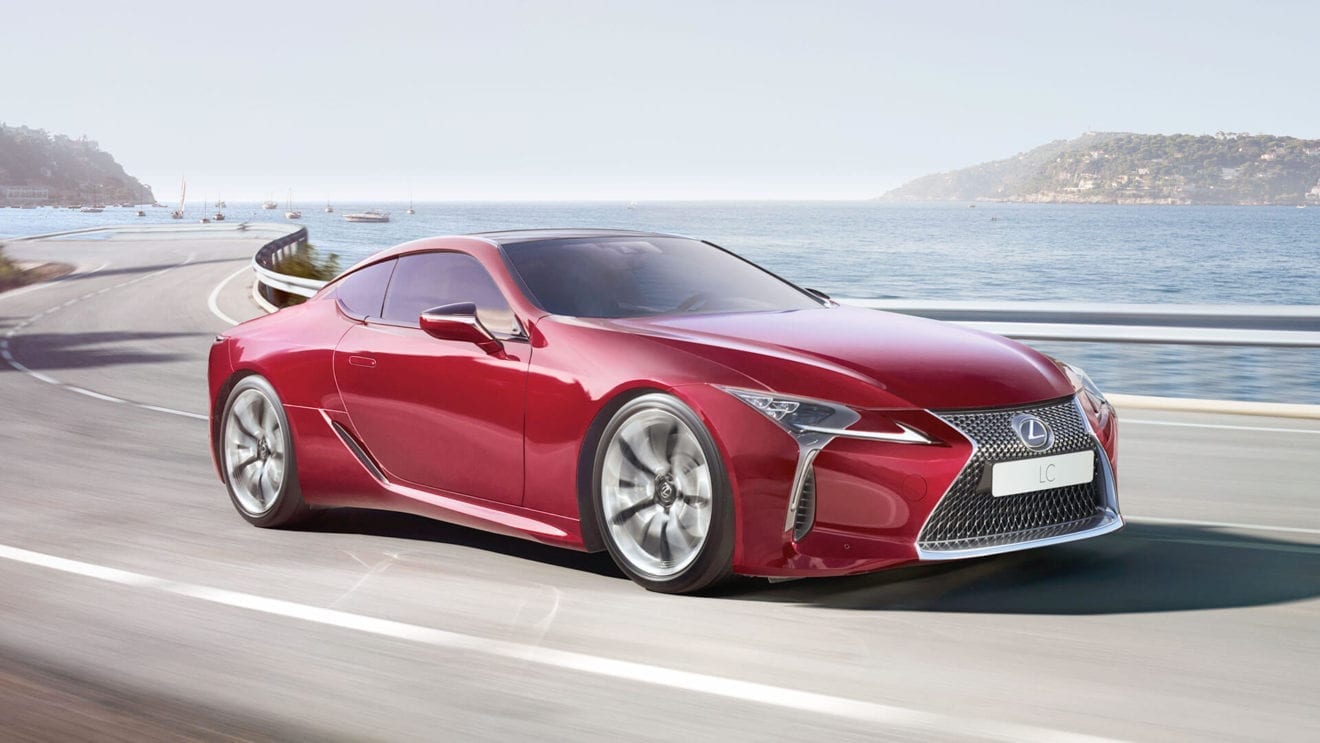
    Japanese car maker Toyota Motor Thailand is downbeat about sales prospects of its luxury brand Lexus this year, saying the price of imported cars make them less able to compete with locally made luxury brands.

    Toyota expects to sell 650 Lexus cars in 2017, a 24% drop year-on-year, said executive vice-president Vudhigorn Suriyachantananont.

    “We admit the Lexus brand is at a disadvantage in the luxury car market because they are imported from Japan, so their retail prices are much higher than local luxury brands,” he said.

    Cars imported from Japan are subjected to an import duty of 60% under the Japan–Thailand Economic Partnership Agreement, compared to the normal duty of 80%.

    Mr Vudhigorn said Lexus also has launched fewer models in the Thai market. It introduced the Lexus RX sport utility vehicle about two years ago, while the new Lexus LS sedan was launched locally yesterday, priced from 11.5-15.8 million baht, available with either an internal combustion engine or hybrid-electric platform.

    “For the new LS, we aim to sell about 30-40 cars annually,” he said.

    Lexus recorded its Thai sales record in 2015, selling 834 cars, up sharply by 46% from the previous year. But sales dropped to 770 cars in 2016.

    Lexus has sold 8,455 cars total in Thailand as of September this year.

    Mr Vudhigorn forecast the luxury market to grow by 20% to 26,000-27,000 cars sold in 2017 after sales from January to September tallied 20,056 cars.

    Two German brands — Mercedes-Benz and BMW — now control over 90% of the luxury car segment because both companies have their local assembly plants in Thailand, he said.

    Third-ranked is Sweden’s Volvo, while Lexus is in the fourth spot in the Thai luxury market.

    President Michinobu Sugata said Toyota does not have plans to localise Lexus’s assembly plant at Toyota’s passenger car factory in Chachoengsao, even though it would make retail prices more competitive in the Thai market.

    Lexus has three showrooms and service centres in Bangkok and 10 service centres in upcountry provinces.

    Toyota expects to sell 265,000 units this year, up 8% in line with the local car market, which is projected to grow by 8% to 830,000 units.

    Toyota plans to export 291,000 units from its Thailand operation, down by 9% from last year mainly because of a drop in sales from the Middle East and Latin America.

    On Friday, Toyota is scheduled to announce its plan to ship the Hilux Revo pickup to Japan for the first time.

  • China October vehicle sales rise 20% at 2.2 million

    China October vehicle sales rise 20% at 2.2 million

    Passenger vehicle sales in China to retail customers rose 20 percent in October from a year earlier, the China Passenger Car Association (CPCA) said on Tuesday.

    Auto retail sales totalled 2.2 million vehicles in October, CPCA said in a statement on its website. For January-October, passenger car sales rose 15.2 percent versus the same period in 2015, it said.

    The China Association of Automobile Manufacturers, whose statistics are generally viewed as the benchmark for the industry, is due to report wholesale data for October on Thursday.

    The CPCA predicted 13 percent growth in passenger car sales for 2016, state media reported earlier on Tuesday.

  • Retail sales up 0.9% on-year in June, boosted by vehicle sales

    Retail sales up 0.9% on-year in June, boosted by vehicle sales

    Retail sales in Singapore rose 0.9 per cent in June compared with the previous year, mainly due to a jump in sales of motor vehicles, the Department of Statistics (SingStat) said on Monday (Aug 15).

    However, excluding motor vehicles, retail sales dipped 3.0 per cent compared with the same period a year ago.

    On a month-on-month basis, retail sales were down 1.5 per cent in June. Excluding motor vehicles, retail sales dropped 3.7 per cent.

    The total retail sales value in Juune was estimated at S$3.6 billion, similar to a year ago.

    Retailers of motor vehicles recorded a sales increase of 17.1 per cent compared to the previous year, the highest increase of all sectors. The next best performing sector was furniture and household equipment, which saw a 5.8 per cent increase. The medical goods and toiletries sector also recorded an increase of 3.0 per cent.

    Other than the mini-marts and convenience stores section, which was unchanged, all other sectors were in the red.

    According to SingStat, the telecommunications apparatus and computers sector fell the most at 25.1 per cent, compared with the previous year. This was followed by petrol service stations, which fell 14.1 per cent, and recreational goods, which saw a 11.8 per cent dip.

    Sales of food and beverage services rose 0.4 per cent from the previous year. The total sales value of food and beverage services in June was estimated at S$649 million, higher than the S$646 million in June 2015.

    The Retail Sales Index and the Food and Beverage Services Index measure the short-term performance of retail and F&B service industries based on their sales records. The sales figures exclude taxes such as GST and COE.

  • Retail sales surge in Singapore as demand for vehicles grows

    Retail sales surge in Singapore as demand for vehicles grows

    Singapore’s retail sales for the month of April surged 3.8 percent, taking cues from a boost in vehicle sales for the same period. However, the figures missed market expectations of a 6.1 percent rise in April.

    Singapore’s total retail sales rose 3.8 percent in April from a year earlier, helped by higher sales of motor vehicles, data released by the Department of Statistics showed Wednesday.

    The increase in retail sales moderated from a revised 5.2 percent year-on-year rise seen in March. On a month-on-month and seasonally adjusted basis, total retail sales rose 1.1 percent in April, an improvement from a revised 1.3 percent decline in March.

    Meanwhile, sales of motor vehicles jumped 43 percent on a year-on-year basis. Total retail sales value in April this year was estimated at SGD3.5 billion, higher than the SGD3.3 billion in April 2015. Motor vehicle sales experienced the largest increase, while mini-marts and convenience stores saw sales grow 3.9 per cent in April, year on year.

    Telecommunications apparatus and computers witnessed the sharpest decline, with sales falling 17.1 percent year on year. During the same period, sales of watches and jewellery also fell, declining by 11.3 percent. However, excluding motor vehicles, retail sales grew by a meager 0.1 percent compared to that in March 2016.

    However, sales of food and beverage services fell 1.7 percent from the previous year. The total sales value of food and beverage services in April was estimated at SGD658 million, higher than the SGD647 million the previous year.


  • Astra car sales down 2.7 percent to 208,804 units in Q1

    Astra car sales down 2.7 percent to 208,804 units in Q1

    The countrys largest automotive company PT Astra International recorded a 2.7 percent decline year-on-year in car sales to 208,804 units in the first four months of the year.

    Based on data at the Indonesian Association of Motor Vehicle Industries (Gaikindo), Low Cost Green Cars (LCGC) contributed 34,209 units to the total sales by Astra Group.

    The sales in the first four month, however, was on the rise from 47,159 units in January to 49,933 units in February, to 54,508 units in March and to 57,204 units in April.

    The Astra group produces and sells Toyota, Daihatsu, Isuzu, Peugeot cars and UD Trucks. Sales have continued to be dominated by Toyota with sales reaching 111,710 units in the January-April period.

    Peugeot sales were the lowest in number reaching only 14 units. Sales of Daihatsu cars totaled 56,854 units, Isuzu 5,490 units, and UD Trucks 527 units.

    Sales of motorcycles produced by PT Astra Honda Motor (AHM) reached 1,439,241 units, down 13.5 percent from 1,664,395 units in the same period last year.

    Sales of non Astra cars in the first four months of the year totaled 177,316 units down 1.67 percent from 180,340 units in the same period last year.

    Sales of non Astra motorcycles totaled 543,263 units.

  • Singapore retail sales up 4.7% year-on-year, boosted by car sales

    Singapore retail sales up 4.7% year-on-year, boosted by car sales

    ONCE more, a massive double-digit surge in motor vehicle sales pulled up Singapore’s retail sales in November. In year-on-year terms, retail sales grew 4.7 per cent, according to data released by the Department of Statistics on Friday.

    Excluding the significant 59.7 per cent jump in car sales, retail sales would have actually fallen 2 per cent.

    The total retail sales value in November 2015 was estimated at S$3.5 billion, higher than the S$3.3 billion in November 2014.

    Apart from car sales, only two other segments – department stores and medical goods and toiletries – experienced growth. The former rose 1.3 per cent year-on-year in November, and the latter, 9.6 per cent.

    All other segments reported a slippage in retail sales, with the worst-performing category being petrol service stations, with a 15.8 per cent drop. Food and beverages followed, with a 11.4 per cent decrease.

    On a seasonally-adjusted basis, retail sales increased 1.4 per cent in November over the previous month.

    Excluding motor vehicles, however – sales of these fell 0.6 per cent month-on-month – retail sales would have increased a larger 1.9 per cent from October.

  • Autos drive solid China retail sales report

    Autos drive solid China retail sales report

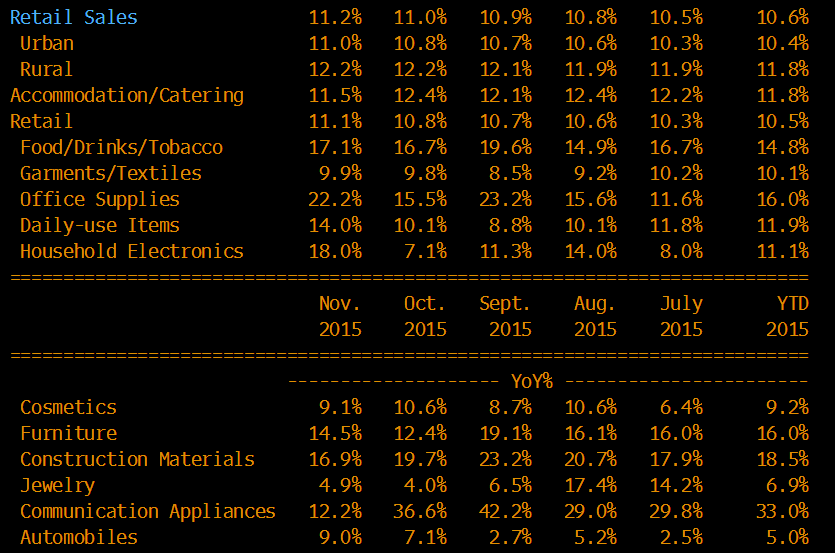
    Retail sales rise 11.2% y/y in November vs 11.1% expected

    Chinese retail sales were slightly stronger than estimates as auto sales picked up. Vehicle sales climbed 9% y/y in November compared to 7.1% in October.

    A strong automotive sector also boosted industrial production.

    The strength in auto sales and manufacturing was likely due to a sales cut tax in September for small and medium-sized cars.

  • China November Auto Sales Surge 18% as Tax Cut Bolsters Demand

    China November Auto Sales Surge 18% as Tax Cut Bolsters Demand

    An unseasonably cold November and heavy smog prompted Chinese consumers to step up their vehicle purchases, driving automobile sales to their biggest gain in nine months and underlining the challenge the government faces in controlling air pollution.

    SUVs continued to be the most popular choice last month, followed by minivans, while sedan sales fell, according to the China Passenger Car Association. Total retail sales of passenger vehicles rose 18 percent last month to 2.02 million, the fastest increase since February.

    “Adverse weather conditions played a role in November’s strong sales showing,” according to the association in a presentation accompanying the sales statistics. “The unusual cold was followed by off-the-charts smog levels. Those with children are more inclined to buy cars, given the perception that the air inside a vehicle is cleaner.”

    A correlation between auto sales and smog levels adds to the challenge that China faces in cleaning up its dirty air. A surge in car ownership in the past decade has been cited, together with coal-fired power plants, as leading contributors to air pollution, prompting the government to impose vehicle registration quotas in major cities and promote emission-free electric vehicles. Even so, the government slashed a purchase tax in October to protect economic growth after auto demand slowed in the first nine months.

    “It is ironic that the smog is making people more interested to buy cars,” said Jochen Siebert, Shanghai-based managing director at JSC Automotive Consulting. “It’s funny but it’s logic that we probably won’t understand.”

    Air Pollution

    Thick smog covered Beijing and much of north China last month in what the official Xinhua News Agency labeled the worst period of air pollution this year, with levels of the most harmful PM2.5 particulates registering beyond what is considered hazardous to human health.

    The smog has yet to abate. Beijing raised a red alert to warn of the dangers associated with extreme pollution levels Monday, the first time the alarm has been raised to its highest level since introduction of an emergency air-pollution response system in 2013. The warning prompted the city government to order schools and some factories to shut and about half of the cars off the roads.

    Still, some analysts see the tax cut and discounts by automakers as the primary driver for November’s surge in sales. The government in October cut a 10 percent purchase tax by half for vehicles with engines with displacements that are 1.6 liters or smaller.

    “I don’t believe pollution is a factor, as there was pollution in previous years,” said Yale Zhang, Shanghai-based managing director at Autoforesight Shanghai Co. “It’s the purchase tax cuts that made sales go up so much.”

    Great Wall Motor Co., the country’s largest SUV maker, is benefiting from the resurgent demand. Sales of its sport utility vehicles, many of which qualify for the tax cut, surged 25 percent in November from a year earlier.