Retail News CRM

Tag: mondelez

  • Mondelez Injects $8M into Melbourne Candy Plant for Technological Boost: Celebrating 50 Years of Sweet Success

    Mondelez Injects $8M into Melbourne Candy Plant for Technological Boost: Celebrating 50 Years of Sweet Success

    Mondelez International recently commemorated the 50th anniversary of its Scoresby confectionery factory in Melbourne’s east, coinciding with a $8 million investment in new packaging technology. This crucial advancement will bolster the production of over 120 products, including snack-sized bags from brands like Cadbury Pascall Clinkers, Sour Patch Kids, and The Natural Confectionery Company.

    This new funding takes the total investments in the Scoresby location to $30 million since 2022. The company has clarified that this financial boost is specifically aimed at sparking regional innovation across various aspects like product flavours, range, and packaging. It will also enable the plant to accommodate ever-evolving consumer trends.

    A Commitment to Local Production

    Toby Smith, the president of Mondelez International for Australia, New Zealand, and Japan, highlighted the strategic importance of the packaging upgrade. He stated that it lay the groundwork for securing the future production at the local facility.

    This move falls in line with the company’s long-term growth projections. By 2035, Mondelez International anticipates an equal split in business growth between chocolate and non-chocolate products.

    Smith expressed immense pride in the Scoresby factory’s 50-year manufacturing history and the numerous employment opportunities it has created for Victorians in Melbourne’s east.

    Mondelez International currently employs over 1200 individuals across its operations in Victoria. Their reach extends to locations in South Melbourne, Ringwood, Scoresby, Dandenong South, and a national distribution centre in Truganina.

    Of note is the Scoresby plant’s commitment to sustainable operations, running on 100% renewable electricity. The plant is responsible for manufacturing jelly candies such as Snakes and Party Mix.

    Earlier this year, Mondelez International reintroduced its In A Biskit Crispy Potato flavour in the Australian market, a product that initially gained popularity in the 1990s.

    Questions & Answers

    What was the purpose of the $8 million investment by Mondelez International?
    It was directed towards new packaging technology, with the intention of enhancing the production of over 120 products and to adapt to changing consumer trends.

    What is the future business growth expectation for Mondelez International?
    By 2035, Mondelez International expects to see an equal split in business growth between chocolate and non-chocolate products.

    What is significant about the Scoresby plant’s operations?
    The Scoresby plant, which manufactures various jelly candies, operates on 100% renewable electricity, underlining the company’s commitment to sustainability.

  • Mondelez Revives ’90s Classic: In A Biskit Crispy Potato Hits Australian Shelves Again!

    Mondelez Revives ’90s Classic: In A Biskit Crispy Potato Hits Australian Shelves Again!

    Mondelez International, the multinational snack and food conglomerate, has reintroduced its In A Biskit Crispy Potato flavor into the Australian market, a product that first gained popularity in the 1990s.

    Reviving a Vintage Snack

    The revived snack is made from genuine potato flakes and has a thin, baked texture, offering consumers a delightful crunch with every bite. This classic flavor holds a fond memory for many Australians, serving as a favorite snack during leisurely afternoons spent solving Rubik’s Cubes or rewinding VHS tapes.

    Modern Packaging for a Classic Product

    In an effort to appeal to both original consumers and a new generation of customers, the product’s packaging has been updated to a more modern design. The classic snack is available in 145g packs with a recommended retail price of $4. The packs are available nationwide at IGA, Woolworths, and Coles retail stores.

    Mondelez Performance

    In the recent past, Mondelez has reported growth in its annual sales. However, this positive trend was somewhat offset by a decline in profit margins due to the high cost of cocoa, a key ingredient in many of the company’s products.

    Questions & Answers

    What is the key feature of the reintroduced In A Biskit Crispy Potato flavor?
    The reintroduced snack is made from real potato flakes and offers a thin, baked texture.

    How has Mondelez updated the product for modern consumers?
    Mondelez has modernized the packaging of the product to appeal to both original consumers and a new generation of snack lovers.

    What factors affected Mondelez’s recent financial performance?
    While the company reported growth in annual sales, its profit was impacted by the high cost of cocoa, a key ingredient in many of its products.

  • Sweet Fusion: Mondelez Unveils New Cadbury Dairy Milk Biscoff Blend, Takes Australia By Storm

    Sweet Fusion: Mondelez Unveils New Cadbury Dairy Milk Biscoff Blend, Takes Australia By Storm

    Mondelez International has recently unveiled its latest offering, Cadbury Dairy Milk Biscoff, in a collaborative endeavour with Lotus Bakeries. This unique product presents a delightful blend of Cadbury Dairy Milk’s creaminess and the distinct crunchiness of Lotus Biscoff’s caramelised biscuit.

    Early Success

    The novel fusion of the two popular treats has generated significant consumer interest. Indeed, the much-anticipated product’s early success has seen the shelves of stores nationwide quickly clearing of the tasty chocolate blocks. Katrina Watson, a representative from Mondelez International, attests to the impressive reception of Cadbury Dairy Milk Biscoff.

    Local Production

    Mondelez International is proud to produce this unique chocolate variety right in Tasmania. The company further supports local Australian businesses by sourcing the sugar used in the chocolate bars from growers in Queensland. This commitment to local suppliers underscores Mondelez’s dedication to supporting and uplifting local communities.

    Where to Buy Cadbury Dairy Milk Biscoff

    Fans of Cadbury and Biscoff can find the Cadbury Dairy Milk Biscoff block, weighing 170g, in major retail outlets. If you’re looking for a smaller indulgence, a 70g bar is also available in convenience stores across Australia.

    Questions & Answers

    What is Cadbury Dairy Milk Biscoff?
    Cadbury Dairy Milk Biscoff is a new product launched by Mondelez International. It is a mixture of Cadbury Dairy Milk chocolate and Lotus Biscoff caramelised biscuit.

    Where is Cadbury Dairy Milk Biscoff produced?
    Cadbury Dairy Milk Biscoff is produced in Tasmania, Australia. The sugar used in its production is sourced from Queensland growers.

    Where can I buy Cadbury Dairy Milk Biscoff?
    The Cadbury Dairy Milk Biscoff block can be found in major retail stores, while a smaller 70g bar is available in convenience stores across Australia.

  • Mondelez Set to Sweeten US Market with Sugar-Free Oreo – A Healthier Twist to Iconic Snacks

    Mondelez Set to Sweeten US Market with Sugar-Free Oreo – A Healthier Twist to Iconic Snacks

    Mondelez International, recognized worldwide for its Oreo brand, is set to broaden its range of offerings with the introduction of Oreo Zero Sugar and Oreo Double Stuf Zero Sugar in the U.S market, with a planned launch in January.

    This is a first-of-its-kind initiative for the U.S. market, with earlier successful launches of sugar-free Oreo products recorded in regions of Europe and China.

    The new products have been designed to maintain the quintessential Oreo taste and texture but without any added sugar. Mondelez has revealed that the cookies will be sweetened using a specially crafted blend of sugar substitutes, specifically formulated to cater to the health-conscious segment of consumers.

    This strategic move is in line with the evolving trends in the Fast-Moving Consumer Goods (FMCG) sector, where companies are steadily shifting their focus towards creating “better-for-you” snack products. This is in response to the rising consumer interest and increased demand for healthier snack alternatives.

    Questions & Answers

    What are the new products that Mondelez International is launching?
    Mondelez International is launching Oreo Zero Sugar and Oreo Double Stuf Zero Sugar.

    How are these new Oreo products different from the traditional ones?
    The new products maintain the classic Oreo taste and texture but they do not contain any added sugar. They are sweetened using a blend of sugar substitutes.

    Why is Mondelez launching these sugar-free products?
    The launch of these sugar-free Oreo products aligns with the broader industry trends where FMCG companies are responding to growing consumer interest in healthier, “better-for-you” snack options.

  • San Francisco Makes Legal Moves Against Kraft & Mondelez: An Obesity, Cancer Link to Ultra-Processed Foods at Stake?

    San Francisco Makes Legal Moves Against Kraft & Mondelez: An Obesity, Cancer Link to Ultra-Processed Foods at Stake?

    The city of San Francisco has lodged a legal complaint against multiple ultra-processed food manufacturers, including Kraft, Mondelez, and Coca-Cola. The city claims these companies have knowingly endangered the health of Californians with their addictive and damaging products.

    A Public Health Crisis

    San Francisco’s City Attorney, David Chiu, filed the lawsuit in San Francisco Superior Court. The suit alleges that these corporations implemented strategies mirroring those of the tobacco industry, deliberately creating and promoting products to induce consumer addiction. The city accuses these companies of contravening California’s public nuisance and misleading marketing laws.

    In a statement, Chiu commented, “These companies have manufactured a public health crisis, profited substantially, and must now be held accountable for the damage they’ve inflicted.”

    The city argues that the surge in ultra-processed foods has precipitated a rise in obesity, cancer, and diabetes rates. Chiu’s office has underscored that heart disease and diabetes – both connected to ultra-processed foods – are among the principal causes of death in San Francisco, with low-income and minority communities experiencing higher diagnosis rates.

    Industry Response

    At the time of reporting, representatives for Mondelez, Coca-Cola, and Kraft Heinz had not yet provided comment on the lawsuit. However, Sarah Gallo, the Senior Vice President of Product Policy for the Consumer Brands Association, countered that there is currently no universally accepted scientific definition of ultra-processed foods. She suggested that categorizing foods as unhealthy based purely on their processed nature, or vilifying food by disregarding its complete nutrient content, can mislead consumers and exacerbate health disparities.

    Implications and Precedence

    The city aims to obtain restitution and civil penalties to alleviate its healthcare costs and is seeking a court order to prevent these corporations from engaging in misleading marketing and mandate changes in their practices.

    While the classification of ultra-processed foods is still disputed, researchers typically refer to many packaged snack foods, sweets, and carbonated drinks made using processing methods, additives, and industrial ingredients, which primarily contain little whole foods.

    The lawsuit is significant as it is the first instance of a municipality suing over allegations that food companies have knowingly advertised and sold harmful and addictive ultra-processed foods.

    This lawsuit follows a similar case brought forward by a man from Philadelphia, who alleged that he was diagnosed with Type 2 diabetes and non-alcoholic fatty liver disease at the age of 16 due to his consumption of ultra-processed foods. However, this lawsuit was dismissed in August after a federal judge in Pennsylvania stated the plaintiff failed to link specific products to his health conditions.

    Questions & Answers

    What is the basis of San Francisco’s lawsuit against ultra-processed food manufacturers?
    The city alleges that these companies have knowingly endangered Californians with their addictive and harmful products, contributing to a public health crisis.

    What is the city’s objective in filing this lawsuit?
    The city aims to obtain restitution and civil penalties to offset its healthcare costs. It is also seeking a court order to prevent these corporations from engaging in deceptive marketing and mandate changes in their practices.

    What is the significance of this lawsuit?
    This lawsuit marks the first time a municipality has sued over claims that food companies have knowingly marketed and sold harmful and addictive ultra-processed foods.

  • GrapeCo and Mondelēz Triumph at Woolworths New Zealand’s Annual Supplier Awards: Celebrating Innovation and Sustainability

    GrapeCo and Mondelēz Triumph at Woolworths New Zealand’s Annual Supplier Awards: Celebrating Innovation and Sustainability

    Woolworths New Zealand recently honoured its partners and innovators in the food and grocery industry, handing out 20 awards at its annual Supplier Awards event at the Auckland War Memorial Museum. GrapeCo and Mondelēz were the illustrious recipients of the ‘Supplier of the Year’ titles.

    Supplier Excellence and Innovation

    The awards, which included 54 finalists, celebrated the ingenuity and collaborative efforts within the industry.

    GrapeCo, a grape supplier for Woolworths NZ, was awarded the ‘Fresh Supreme Supplier’ title for its novel grape varieties and its commitment to sustainability.

    Pieter De Wet, commercial director for Woolworths New Zealand, commended GrapeCo’s environmentally-friendly practice of testing reusable crates which could potentially eliminate more than 60 tonnes of packaging from the Woolworths supply chain.

    “GrapeCo’s dedication extends beyond the norm. Their impactful strategic partnership and their innovation makes them the worthy recipients of our ‘Fresh Supreme Supplier of the Year’ award,” De Wet stated.

    Mondelēz: Packaged Food Supreme Supplier of the Year

    Snack manufacturer Mondelēz was named the ‘Packaged Food Supreme Supplier of the Year’. This accolade represents Mondelēz’s resilience, innovation, and their significant contribution to growth in the industry.

    “Mondelēz has truly distinguished itself this year with exceptional performance and strategic ingenuity,” De Wet said. “Their consistent high performance over the past three years, along with their long-term leadership, makes them the rightful winners of the Supreme Award.”

    Other award recipients included Breadcraft Wairarapa, MaxFoods, Fonterra, Darren Lobb – Hellers, Vitaco, Hancocks, Simplot, Mondelez New Zealand, Amanda Collier (Suntory Oceania), Taryn Aspeling (Heinz Watties), Essity Australasia, Body Science (BSc), and Harriet Butler (Scalzo).

    Questions & Answers

    Who were the ‘Supplier of the Year’ winners at the Woolworths New Zealand Supplier Awards?
    The winners of the ‘Supplier of the Year’ titles were grape supplier GrapeCo and snack manufacturer Mondelēz.

    Why was GrapeCo awarded the ‘Fresh Supreme Supplier’ title?
    GrapeCo was awarded for its introduction of new grape varieties and its commitment to sustainability, specifically for testing reusable crates which could potentially reduce packaging by over 60 tonnes.

    What contributed to Mondelēz being named the ‘Packaged Food Supreme Supplier of the Year’?
    Mondelēz was recognized for its resilience, innovation, and significant contribution to growth within the food and grocery industry.

  • Mondelez Harnesses Ai To Cut Marketing Costs And Revolutionize Tv Advertising

    Mondelez Harnesses Ai To Cut Marketing Costs And Revolutionize Tv Advertising

    Mondelez, the renowned snack producer, has taken a step forward in leveraging artificial intelligence (AI) to reduce the expenses involved in creating marketing content by 30% to 50%. They have collaborated with advertising firm, Publicis Groupe, and IT company, Accenture, to develop an innovative AI tool.

    Revolutionizing TV Ads with AI

    Jon Halvorson, Mondelez’s global senior vice president of consumer experience, revealed the company’s ambitious plan to use this tool for generating short TV commercials which can be broadcasted as early as the upcoming holiday season. Notably, the company also has its sights set on creating ads for the 2027 Super Bowl.

    The manufacturer of Cadbury chocolate has invested more than $40 million into this AI initiative. Halvorson predicts the tool’s ability to create more intricate videos would lead to an increase in cost savings.

    Adopting AI amid Economic Challenges

    Like many consumer goods companies dealing with tariffs and decreasing customer budgets, Mondelez is turning to AI as a solution to reduce the fees associated with advertising agencies and accelerate product development and sales cycles.

    Other industry players such as Kraft Heinz, the maker of macaroni and cheese, and beverage giant Coca-Cola have also been experimenting with AI for their advertising efforts.

    AI-Powered Social Media Content

    Mondelez has been using the AI-generated content on social media platforms for their Chips Ahoy cookies in the US and Milka chocolate in Germany. A short eight-second Milka video featuring waves of chocolate flowing over a wafer has been used, with varying backgrounds tailored to the specific consumer group being targeted.

    The costs for creating such animations usually run into hundreds of thousands of dollars. With the new AI tool, however, Halvorson suggests the expenses are significantly lower.

    Upcoming AI Initiatives

    In November, Mondelez’s Oreo will utilize the tool for product pages on Amazon and Walmart in the US. The company also plans to use the tool in the near future for its Lacta chocolate and Oreo lines in Brazil, as well as Cadbury in the UK.

    Tina Vaswani, VP of digital enablement and data for the company, assures that the content created by the AI tool will be manually reviewed to prevent any potential issues. Mondelez follows strict rules against promoting unhealthy eating habits, vaping, overconsumption, emotionally manipulative language, and offensive stereotypes in their content.

    Questions & Answers

    How much has Mondelez invested in the AI tool?
    Mondelez has invested over $40 million in the development of the AI tool.

    How does Mondelez plan to use the AI-generated content?
    Mondelez has utilized AI-generated content for social media promotions and plans to use it for TV commercials, as well as product pages on Amazon and Walmart.

    What measures has Mondelez taken to ensure the quality of AI-generated content?
    Every piece of content generated by the AI tool is reviewed by humans to prevent any inappropriate or offensive content, adhering to company guidelines.

  • Mondelēz opens regional snacks research lab in Singapore

    Mondelēz opens regional snacks research lab in Singapore

    Mondelēz International has inaugurated its US$5 million regional biscuit and baked snacks lab and innovation kitchen in Singapore that will serve its Australasian, Asia Pacific, Middle East, and Africa businesses.

    Chan Ih-Ming, EVP of the Singapore Economic Development Board, opened the facility. Mondelēz says it reaffirms its commitment to innovation and product development across Southeast Asia, Australia, New Zealand, and Japan.

    The lab and innovation kitchen expands on the capabilities of the food manufacturer’s existing Singapore Technical Centre established in 2006.

    In 2018, the company expanded the centre to focus on gum and candy innovation and product development.

    “This expansion further enhances the capabilities of our Singapore Technical Centre and reaffirms our commitment and contribution to the country, which serves as the headquarters for our Asia Pacific, Middle East and Africa business,” said Deepak Iyer, EVP and president of Mondelēz International AMEA.

    “The establishment of the biscuit and baked snacks lab and innovation kitchen marks a significant step in Mondelēz’s commitment to mindful snacking, including developing products that encourage portion balance and mindful indulgence whilst exploring flavour innovation and different product formats.”

  • Mondelez boosts Gourmet Food with $13m state-of-the-art packaging line

    Mondelez boosts Gourmet Food with $13m state-of-the-art packaging line

    Snackfoods giant Mondelez has introduced a $13 million state-of-the-art packaging line at its Gourmet Food manufacturing site as part of its $25 million investment plan since acquiring the business in 2021.

    The new packaging line aims to increase production of the Olina’s Bakehouse Artisan crackers range by 35 percent, open up export opportunities, and drive more demand for locally sourced ingredients.

    Fully operational, the facility is powered by 100 percent renewable electricity through Mondelez International’s renewable power purchase agreement with Pacific Blue Retail.

    The initiative will reduce the carbon footprint from the facility by 44 percent (against a 2023 baseline) and complement the company’s Ringwood and Scoresby factories already powered by renewable energy.

    Bevan Tippet, MD, Gourmet Food, says the investment demonstrates the brand’s commitment to providing consumers with an “exceptional range” of biscuits and premium crackers.

    “The investment will increase the production of our prominent Olina’s Artisan range by a third, as we meet growing local and export demand,” he added.

    “Already, twenty percent of our volumes are exported overseas, and this investment will equip us to explore and capture opportunities to showcase our Australian-made products to the world.”

  • Mondelez Int’l appoints new president for Southeast Asia unit

    Mondelez Int’l appoints new president for Southeast Asia unit

    Mondelez International, the maker of iconic brands including Cadbury Dairy Milk, Oreo, Ritz and Toblerone, has appointed Hemant Rupani as president for its Southeast Asia (SEA) Business Unit.

    Hemant, previously Managing Director of Mondelez Kinh Do Vietnam, replaces Glenn Caton who has moved to another position in the company’s global operations.

    In his new role, Hemant will be responsible for the SEA cluster of markets including the exports business in the broader Asia Pacific, Middle East and Africa (AMEA) region, leading growth and end-to-end business.

    He said: “The SEA business has been on an accelerated growth path driven by increasing consumption, digital penetration, talented population, and cultural diversity in the region.”

    “We have built a reign as category leaders across segments with our portfolio of iconic global brands and local jewels. Combining our solid team, local-first strategy, and robust investments, we are in a strong position to lead the future of snacking and drive sustainable growth forward.”

    He added: “Over the years, we have learned to adapt in making the business more agile, resilient, and competitive. Digitalization will play an increasing role to help us speed up innovation, strengthen proximity to consumers, and spearhead progress towards creating snacks the right way.”

    Hemant is an accomplished leader with over 20 years of experience working in India, the U.S. and Vietnam, covering various industries including food and beverage (F&B), telecommunications, and consulting.

    Throughout his career journey, Hemant has enabled multiple business turnarounds, driven operational excellence, and built high-impact teams. Prior to joining Mondelez International in 2016, he worked with several leading organizations including PepsiCo, Vodafone, Britannia, and Infosys Technologies.

    Mondelez International commands a long-standing heritage in SEA. The region also houses ten manufacturing facilities and two technical centers that support its world-class supply chain capabilities and product innovation.

    Early this year, Mondelez International invested $23 million to expand its OREO production line in Cikarang, Indonesia, which also uses the latest technologies in reducing energy, water and carbon emissions. The company has also integrated solar panel rooftops on two of its manufacturing plants in Malaysia, including the Cadbury chocolate production factory which has a 48-year-old heritage locally.

  • Mondelez falls short in China with Zero-sugar Oreos pitch

    Mondelez falls short in China with Zero-sugar Oreos pitch

    Initial reaction from the launch of Oreo Zero sugar-free cookies in China has been disappointing, Mondelez International Inc’s CEO said, underscoring some of the challenges facing the global snack giant as it makes a big push in the market.

    Mondelez launched Oreo Zero in China in August, taking a cue from social media trends showing reduced-sugar and sugar-free diets as a key trend, and the limited availability of zero-sugar biscuits in the country.

    “The reaction of the consumer has been a little bit disappointing … for one reason or the other, the consumers feel it is not the real thing,” Chairman and Chief Executive Officer Dirk Van de Put told Reuters.

    “This indicates the dilemma,” he said. “We can offer the products to the consumer, but it’s not given that the consumer will buy and eat them.”

    Mondelez, which also makes Ritz crackers, belVita biscuits, Cadbury chocolates and Trident gum, has set a target to grow Oreo sales by $1 billion by the end of 2023. The brand surpassed $3 billion in global sales in 2019.

    Oreo Zero cookies contain maltitol instead of traditional sugars like sucrose and glucose, and the tweak gives a very slight difference in taste that only heavy consumers of regular Oreos would be able to identify, according to the company.

    The lukewarm consumer response underscores a challenge for global snack firms with a well-known brand and product. Mondelez varies the amount of sugar it includes in Oreos in different markets around the world. In China, Oreos have less sugar than do Oreos in the United States, which could make for an easier transition to no-sugar cookies.

    Chinese consumers, however, remain cautious about packaged foods’ no-sugar claims, said Michael Norris, research and strategy manager at Shanghai-based consultancy AgencyChina.

    For example, sugar-free drinks commanded only 1.25% of China’s soft drinks market in 2019, according to a June Dongxing Securities report, though Genki Forest’s sugar-free fizzy drinks and Suntory’s Oolong tea are gaining popularity.

  • Shift to New Retail ‘imperative’

    Shift to New Retail ‘imperative’

    A shift by brands to a New Retail model is imperative to remain relevant and competitive in China, according to a joint report from AliResearch and Bain & Co.

    The report, the most complete to date, offers a look at the blueprint for how companies and brands can seamlessly meld their online and offline channels, providing a better customer experience and making their own operations more efficient.

    It notes the challenge laid out by Alibaba Group CEO Daniel Zhang in a letter to investors, whereby companies need to tap big data analytics to redefine the core of retail – consumers, merchandise and stores – as well as the ties among them, to upgrade formats and create new retail occasions. And it cites a list of brands, including Mondelez, Friso, Estee Lauder and Bestseller, as “leading the charge to shape tomorrow’s retailing.”
    A fundamental change in thinking by companies and brands needs to happen with respect to the customer, viewing them “in the role of co-producers,” the report said. More than just identifying target consumers and their needs, more-comprehensive and dynamic profiles allow brands to find “ways to stimulate consumer needs, identifying look-alike consumers and turning consumers into brand ambassadors who effectively co-create the brand.”

    At the same time, products morph from mere commodities to becoming part of the consumption process and consumer experience. In the world of New Retail, products and delivery are inspired by consumer data and they’re highly personalized. Moreover, with a fully integrated, omnichannel experience, it’s no longer about simply spending time in an online or offline store. It’s about consumers shopping while enjoying content or spending time on social networks, the report said.

    “The best brands are determining how to integrate products with the overall experience of not only shopping, but learning about a product, using it and recommending it,” the report said.

    In all, the report highlights six steps “winning brands” are taking “to reshape the future and make the most of New Retail.” They are:

    • Identifying new governance principals for a customer-centric model
    • Developing new flexibility and efficiency in R&D and supply chains
    • Reimagining marketing and consumer management
    • Modernising route-to-market and retail formats
    • Transforming the organisation and operating model for digital
    • Investing in new technology development.

    The 24-page report covers each step in detail and offers case studies of the above-mentioned and other brands in their quest to reimagine and redefine their business through New Retail.

    While the report’s focus is on China, it telescopes outward and concludes that the changes Jack Ma predicted when he coined the “New Retail” term in 2016 “are arriving so swiftly and dramatically that each month seems to bring with it a big, new preview of what retailing will look like everywhere, as China sets a pace for the rest of the world.”

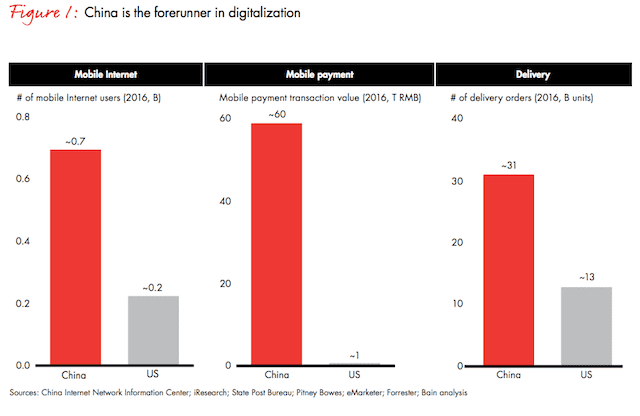
    New Retail in China has already taken hold in numerous sectors, transforming small, disparate shops and businesses into “order-and-delivery stations for e-commerce.” Food-delivery platform Meituan, for example, fulfills more than 18 million orders a day. And China is well ahead of other countries, such as the US, with 60 times more mobile payments.

    “Wherever retailing is headed, China is already there,” the report said. “For brands hoping to sell in China, survival means moving equally fast to capture this future ahead of competitors, both incumbents and digitally savvy upstarts. It will not be enough merely to keep up. Brands will be required to get ahead and help shape the vast changes, even as they completely overhaul the rules of engagement.”

    That means adopting a big-data-based approach to business, along with a new type of customer-centric experience that involves much-higher levels of engagement and personalisation than ever before. Businesses, themselves, need to erase any existing cross-unit barriers, investing in the technology and process redesign to make that happen, as well as changing their mindset.

    The results for brands that get it right are both clear and gratifying. Citing a case study from Mondelez, the report delves into what happened when the cookie company focused on customisation for Tmall’s Super Brand Day 2017. Its goal was to make Oreos more popular among teenagers.

    To do so, Mondelez partnered with third-party vendors and Tmall to create, launch and market a music box that played tunes when an Oreo cookie was placed on a turntable-like device. Taking a bite of the cookie and putting it back on the turntable changed the tune. Consumers could record their own voices on the music box and decorate it, customising it by scanning a QR code. Relying on a flexible supply chain, Mondelez brought the music box to market in just seven days, rather than a more-traditional two to three months.

    “It has been a New Retail success story,” the report said. “The singing biscuits generated 80 times more sales on Mondelez’s site than normal, with 90 per cent of the purchases made by new consumers.”

    Brands need to act now to adapt to a New Retail reality, though the changes they make to their operating models and the introduction of new capabilities won’t necessarily bear fruit right away.

    “New Retail is a work in progress that will require brands to constantly refine and reinvent themselves for new occasions, new formats and the steady flow of new ideas that will define retailing tomorrow,” the report concluded.

    You can read the full AliResearch/Bain report here.
  • Mondelez Malaysia Wins Regional Award for Halal Excellence

    Mondelez Malaysia Wins Regional Award for Halal Excellence

    Mondelez Malaysia, part of Mondelēz International and owner of iconic brands such as Cadbury Dairy Milk, Toblerone, Oreo, Chipsmore and Twisties recently won the Best Halal Chocolate Bar under Heritage Brand for its Cadbury Dairy Milk Chocolates at the Asia Halal Brand Awards 2017 (AHBA). The prestigious award recognises the company’s long-term legacy in making Halal Cadbury chocolates in Malaysia and catering to the local consumers, with its commitment in manufacturing processes and supply chains that are internationally-compliant and halal-certified. Cadbury Dairy Milk chocolates are certified Halal by Jabatan Kemajuan Islam Malaysia (JAKIM) since 2004.

    Swadheen Sharma, Managing Director of Mondelez Malaysia said, “2017 has been an outstanding year for Mondelez Malaysia and being recognised as a prominent Halal brand not only further validates our position, but also demonstrates our continued responsibility towards meeting consumer needs and preferences. We understand how important Halal is to our consumers. Ensuring that all our products made here in Malaysia are Halal is something that we take very seriously.”

    The Asia Halal Brand Awards 2017 (AHBA) aims at promoting prominent Halal brands in Asia that elevate the significance of the brands in the global market. Mondelez Malaysia was awarded because of its stringent manufacturing process to ensure the highest standard of quality, while being compliant to the Halal guidelines. All Mondelez products in Malaysia are certified Halal by JAKIM and 20 percent of products manufactured here are exported to 16 countries worldwide.

    Mondelez Malaysia reinforced its focus on Halal by strengthening its collaborations with authorities and certification bodies, including Halal Industry Development Corporation (HDC), as well as carrying out proactive audits on its products. These initiatives have collectively strengthened consumers’ confidence in Cadbury Dairy Milk Chocolates as a Halal-certified product.

    Mondelez Malaysia maintained its strong presence in the country in three core categories; chocolate, biscuit and salty snacks. Currently ranked number one in the biscuits category and number two share position in Salty Snacks and a sizeable Candy business, the owner of famous brands such as Cadbury Dairy Milk and Cadbury 5 Star is confident that it would gain back its category leadership in chocolates because of its strong plans and execution roadmaps.

    “Mondelez Malaysia’s positive growth in the chocolate category is driven by our product innovation and portfolio diversification. Over the years, we have had great success with the new products we introduced to the market, such as Marvellous Creations, Cadbury Honey Comb & Nuts, Cadbury 5 Star and Cadbury Dairy Milk Oreo to suit the Malaysian consumers’ taste. These efforts are important for us to keep up with the evolving needs of consumers, while catering to a variety of taste profiles and flavour preferences,” said Vikram Karwal, Associate Director Marketing Chocolates SEA.

    The market will continue to be uncertain in view of the changing dynamic of consumers’ purchasing habits. In sustaining this leadership, Mondelez will focus on building excellence in its sales execution to drive category growth. This includes even deeper partnerships with retailers to improve the shopping experience, faster speed to market, improved freshness and availability.