Retail News CRM

Tag: partnerships

  • Vicca Ng Steps into COO Role at Hextar Retail: Driving Expansion and Strategic Partnerships

    Vicca Ng Steps into COO Role at Hextar Retail: Driving Expansion and Strategic Partnerships

    Vicca Ng has been appointed as the Chief Operating Officer (COO) of Hextar Retail, a Malaysian retail conglomerate. Ng’s new role takes effect immediately and she will continue to supervise the group’s retail operations, in addition to serving as an executive director.

    Vicca Ng’s Role in Hextar Retail

    Ng has been instrumental in the expansion of Hextar Retail. She has successfully managed the brand’s growth, fostered strategic partnerships, and developed retail operations across a growing portfolio. Her background encompasses business expansion, retail operations, and commercial development. In her new role as COO and Executive Director, Hextar Retail looks forward to Ng’s continued leadership as the company evolves and expands.

    Hextar Retail, initially established in 1988 as Classic Scenic Berhad, was rebranded in 2024. The company is a subsidiary of the larger Malaysian conglomerate, the Hextar Group. The Hextar Retail portfolio covers a range of sectors, including lifestyle, apparel, food and beverage, as well as convenience retail sectors.

    Questions & Answers

    What is the new role of Vicca Ng in Hextar Retail?
    Vicca Ng has been appointed as the Chief Operating Officer and will function as an Executive Director. She will supervise the group’s retail operations.

    What role has Vicca Ng played in the expansion of Hextar Retail?
    Ng has been instrumental in the company’s expansion, overseeing brand growth, fostering strategic partnerships, and developing retail operations across the growing portfolio.

    What sectors does Hextar Retail’s portfolio cover?
    Hextar Retail’s portfolio spans a wide range of sectors, including lifestyle, apparel, food and beverage, and convenience retail sectors.

  • Cathy Sparks Ascends to Nike’s VP and GM Role in Greater China: A New Era of Athletic Partnerships

    Cathy Sparks Ascends to Nike’s VP and GM Role in Greater China: A New Era of Athletic Partnerships

    Nike has recently made several key changes to its top-tier executives across various geographical territories. Cathy Spark has been promoted to the position of Vice President (VP) and General Manager (GM) of Greater China.

    Replacing Angela Dong, a seasoned Nike executive since 2005 who served in a variety of senior-level positions throughout the region, Spark plans to solidify collaborations and reaffirm Nike’s long-standing dominance in the Chinese market.

    Spark’s journey with Nike spans a quarter-century, initially starting as a store athlete at Niketown in Portland. Over the years, she assumed leadership roles across all geographical areas. Prior to her current position, she served as VP and GM of APLA, where she spearheaded the company’s strategy for marketplace transformation and consumer growth.

    Elliot Hill, Nike’s President and CEO, praised Spark for her ability to connect athletics, consumers, and Nike’s role at the crossroads between sports and culture. He highlighted her ability to build high-performing teams, act decisively, and effectively harness the unique appeal of the Nike brand.

    Cristin “Crissy” Campbell, a Nike employee with 15 years of experience, is slated to fill Spark’s former position as VP and GM of APLA.

    In the EMEA region, Carl Grebert will relinquish his duties as VP and GM. César Garcia will take over the role, with his tenure starting on February 2nd.

    Questions & Answers

    Who is the new VP and GM of Greater China for Nike?
    Cathy Spark has been appointed as the new Vice President and General Manager of Greater China for Nike.

    What role did Cathy Spark previously hold at Nike?
    Before her promotion, Cathy Spark was the Vice President and General Manager of APLA, leading the company’s strategy in marketplace transformation and consumer growth.

    Who will succeed Cathy Spark as VP and GM of APLA?
    Cristin “Crissy” Campbell, a 15-year veteran at Nike, will take over as the Vice President and General Manager of APLA.

  • Facer Revolutionizes Smartwatch World: New Partnerships Expand Customization Options to Reebok and Affordable Brands

    Facer Revolutionizes Smartwatch World: New Partnerships Expand Customization Options to Reebok and Affordable Brands

    Facer, the leading platform for smartwatch customization, has made significant announcements at CES 2026. The company unveiled three major partnerships aimed at extending smart functionality to watch faces and broadening its colossal library to millions of cost-effective devices.

    Facer’s Expansion

    Facer is a well-known platform for those who enjoy personalizing their smartwatches. It’s a popular choice for Apple Watch and Wear OS users. At the 2026 CES, Facer shared plans for a massive expansion. Specifically, the company revealed a collaboration with LVGL, a graphics library employed by numerous embedded devices.

    What does this mean for consumers? Facer’s extensive library of over 500,000 watch faces will soon become available to RTOS (Real-Time Operating System) watches. These watches, known for their battery efficiency and cost-effectiveness, come from brands like Xiaomi and IDO. These brands traditionally offer limited customization options.

    Furthermore, Facer is set to become available on the new Reebok watch. Vitalist, the creator of the wearable, has engaged Facer for its VitalOS platform. This means that the new Reebok watch will directly support Facer’s comprehensive customization options.

    Transforming Watch Face Functionality

    Facer isn’t just broadening its availability; it’s redefining what a watch face can do. The company is teaming up with Citizen to incorporate “Riiiver” technology. This innovative technology enables watch faces to trigger actions, such as controlling smart home appliances, or showcasing live data from external services like the stock market. This development moves watch faces far beyond simple aesthetics.

    This represents a notable shift in the smartwatch field. Previously, when purchasing a budget-friendly RTOS watch, consumers were limited to a few pre-installed faces. Facer’s partnerships with LVGL and Vitalist mark a significant step towards democratizing customization. Now, there’s no need for an expensive Apple or Galaxy Watch to express individual style.

    Moreover, for those desiring more functionality from their watches, the Citizen Riiiver integration offers a solution to a longstanding issue. Generally, watch faces have been limited to displaying time and step counts. By transforming them into interactive hubs that communicate with other devices, they become genuinely useful, not just aesthetically pleasing.

    Personal Experiences

    RTOS watches have always evoked mixed feelings. While their battery life is commendable, their software often feels rigid and impersonal. Facer’s introduction to these devices is exactly what the platform needed to feel premium.

    Personally, the integration of Riiiver technology is the most exciting prospect. The possibility of having a custom button on a watch face that performs a specific action—like switching on living room lights—without having to navigate an app menu, is a revolutionary development. It marks a significant maturation in the capabilities of watch faces.

    Questions & Answers

    What does Facer’s partnership with LVGL imply for consumers?
    Facer’s collaboration with LVGL means that its extensive catalog of over 500,000 watch faces will become available to RTOS (Real-Time Operating System) watches. These are typically cost-effective, battery-efficient watches from brands like Xiaomi and IDO.

    How will the integration of “Riiiver” technology change watch faces?
    In partnership with Citizen, Facer is integrating “Riiiver” technology into watch faces. This will enable watch faces to trigger actions like controlling smart home devices, or display live data from external services like the stock market.

    What is the significance of Facer’s expansion in the smartwatch landscape?
    Facer’s expansion is democratizing customization in the smartwatch industry. The partnerships with LVGL and Vitalist mean that consumers no longer need to purchase expensive watches to access a wide array of customization options. Additionally, the integration of “Riiiver” technology transforms watch faces into interactive hubs, making them more functional rather than just aesthetically pleasing.

  • HelloFresh Innovates with Recipe Partnerships: Turning Meal Kits into Powerful Marketing Platforms

    HelloFresh Innovates with Recipe Partnerships: Turning Meal Kits into Powerful Marketing Platforms

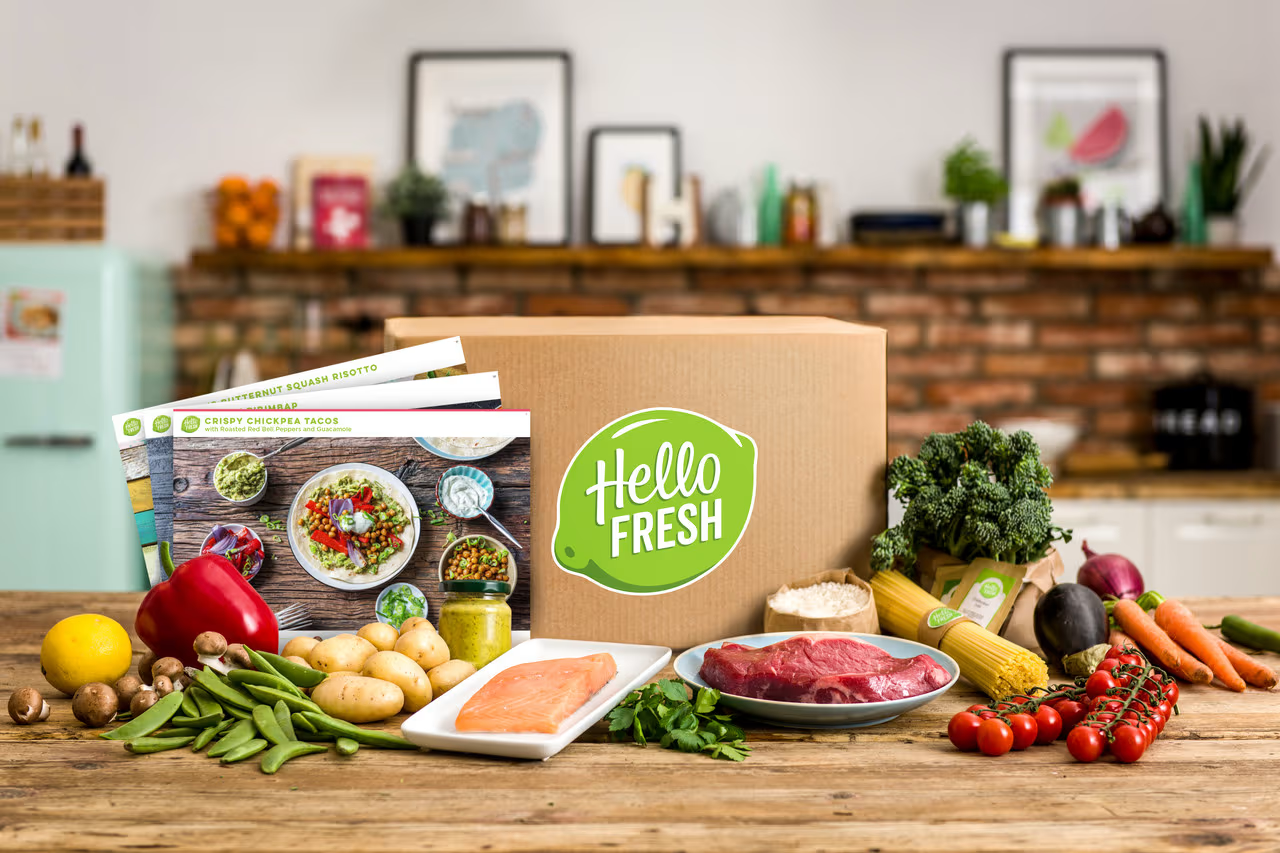
    HelloFresh, a renowned meal kit company, is innovating its service by transforming its packages into a platform for partner brands to interact with customers. Using a series of recipe integration campaigns, HelloFresh has collaborated with brands such as Birch & Waite and McCormick’s Cholula Hot Sauce to promote their products within the meal kit recipes. This strategy enables brands to engage with hundreds of thousands of customers in a natural and contextual manner, while also providing customers with new taste experiences and meal inspiration.

    Creating Mutual Value

    Andreas Dinkel, CMO and MD of HelloFresh ANZ, described the model as one that delivers significant value to both parties. “Our culinary experts work closely with each brand to craft recipes that highlight their product, ensuring that it is integrated seamlessly into the meal and not just an extra addition,” Dinkel stated. This approach gives partner brands a presence at dinner tables, providing a unique engagement opportunity during an intimate part of the day. Dinkel also noted that customers have expressed their delight at discovering unexpected items in their boxes.

    Originally established in Australia by former MasterChef contestant, Tom Rutledge in 2012, HelloFresh has become a significant player in the food and grocery industry. The company has quickly expanded, delivering millions of easy-to-prepare meals annually across five states and both territories. The company aims to provide an enjoyable cooking experience for customers, relieving the stress of meal planning and shopping.

    Recipe Integration Campaigns

    The collaboration with Birch & Waite focuses on its Green Goddess Dressing, featured in two recipes: The Parmesan Pork Cotoletta and the Cheesy Zucchini Fritters. The full-sized product is also available through HelloFresh’s add-ons menu, allowing customers to extend their gastronomic experience beyond dinner.

    Cholula Hot Sauce is another brand utilizing the concept. Its hot sauce is featured in six recipes over four weeks as part of HelloFresh’s Taste of Mexico campaign. Each campaign is promoted through various channels, including printed and digital recipe cards, CRM placements, organic social media posts, and flyers in delivery boxes.

    Enhancing Consumer Experience

    While the current campaigns are ongoing, Dinkel reported that previous recipe integrations have led to significant sales increases and boosts in brand awareness. “In one campaign, 65 per cent of customers were unfamiliar with the product until they received it in their meal kit, and over half went on to purchase it afterwards,” he said.

    Each campaign includes a detailed post-campaign report for the partner brand, providing valuable data on customer engagement, recipe ratings, and purchase intent. These insights can aid brands in refining their marketing and product strategies.

    Apart from the marketing benefits for brands, Dinkel mentioned that these collaborations also enhance HelloFresh’s offering. “We introduce customers to exciting new flavors and cuisines they might not otherwise try, making dinner a moment of discovery and inspiration instead of a chore,” he said.

    Looking ahead, HelloFresh plans to extend its collaboration model across its broader portfolio, including Youfoodz, EveryPlate, and HelloFresh New Zealand. Dinkel sees brand partnerships as a prime example of innovation in the grocery industry and is exploring ways to integrate non-food brands into the program.

    Questions & Answers

    How does HelloFresh’s partnership model benefit brands and consumers?
    HelloFresh’s unique partnership model allows brands to interact with customers in a natural and contextual setting. It provides an opportunity for brands to showcase their products through recipe integration in HelloFresh meal kits. On the consumer side, customers get to discover new flavors and products, making their cooking experience more exciting and enjoyable.

    How does HelloFresh plan to expand its brand partnership model in the future?
    In the future, HelloFresh aims to expand its collaboration model across its broader portfolio, which includes Youfoodz, EveryPlate, and HelloFresh New Zealand. The company is also exploring ways to integrate non-food brands into the program.

    What impact have the recipe integration campaigns had on consumer behavior?
    According to Andreas Dinkel, previous recipe integrations have led to significant increases in sales and brand awareness. In one instance, 65% of customers were unfamiliar with a product until they received it in their meal kit, and over half of them went on to purchase it afterwards.
  • JD Super Boosts Meat Imports with Dynamic New Global Partnerships

    JD Super Boosts Meat Imports with Dynamic New Global Partnerships

    Bringing Premier International Meat Brands to Chinese Consumers

    JD Super, the supermarket arm of JD.com, is stepping up its game by forming strategic alliances with Argentina’s Beef Promotion Institute (IPCVA) and the influential frozen meat importer, Linking Fresh. This initiative aims to broaden the supply of high-quality imported meat throughout China.

    The partnership with IPCVA will enhance the distribution of Argentine grass-fed beef on JD’s platform, capitalizing on its expansive logistics network and a loyal customer base of over 600 million.

    In addition, JD Super’s collaboration with Linking Fresh, which boasts ties to over 300 global meat suppliers and annual imports surpassing RMB15 billion, will usher in a selection of notable international brands, including Brazil’s BRF and Marfrig, Australia’s Kilcoy, Argentina’s Arre Beef, and Chile’s Agrosuper.

    To raise awareness and stimulate sales, JD Super and Linking Fresh will launch vibrant marketing campaigns, featuring special events like “Argentine Beef Week.” After all, who could resist a week dedicated to delectable beef?

    Questions & Answers

    What is JD Super’s recent initiative focused on?
    JD Super’s initiative is aimed at expanding the supply of high-quality imported meat into China through partnerships with the Argentine Beef Promotion Institute and Linking Fresh.

    What international brands will be introduced to the Chinese market?
    The partnership will bring prominent brands such as BRF and Marfrig from Brazil, Kilcoy from Australia, Arre Beef from Argentina, and Agrosuper from Chile.

    How does JD Super plan to promote these products?
    JD Super will employ targeted marketing campaigns, including themed events like “Argentine Beef Week,” to enhance consumer awareness and drive sales.

  • The future of direct carrier billing and carrier-OTT partnerships

    The future of direct carrier billing and carrier-OTT partnerships

    Increased smartphone penetration and a rise in demand for over-the-top (OTT) content have driven the growth of the global direct carrier billing (DCB) market. Valued at US$29.8 billion in 2019, the global DCB market is estimated to reach US$70 billion by 2025, fuelled by a surge in video and audio streaming, as well as consumers’ preference for seamless, secure, and accessible payment modes.

    Linked directly to consumers’ mobile phone bills, consumers can enjoy fuss-free transactions in the absence of a bank account or credit card with DCB. This is in contrast with credit card payments that require consumers to input their credit card number and name. In comparison, a simpler checkout process results in lower abandonment rates and higher conversion rates for merchants. This payment method is also more secure as personal information is not being shared.On top of offering convenience, DCB presents unprecedented opportunities for carriers to tap into Asia-Pacific’s (APAC) unbanked population – totaling more than 1 billion. In Southeast Asia, where financial inclusion is particularly low, about 75% of the population does not have access to formal banking services.

    A flurry of lockdowns and stay-at-home measures have resulted in the rise in video and audio streaming in the past year. According to The Trade Desk, 180 million consumers stream 8 billion hours of over-the-top (OTT) content per month in Southeast Asia, making its OTT market one of the fastest-growing in APAC.

    By 2025, Media Partners Asia predicts that video-on-demand subscriptions will reach 417 million in the APAC region, up from 269 million in 2019. Of which, China will account for 65% of the total subscriptions.

    This trend in increased streaming is expected to persist in a post-pandemic environment driven by more affordable subscriptions, quicker download speeds and a growing DCB market, which in turn spurs more partnerships between carriers and OTT providers.

    Carriers have an advantage in delivering content with a billing mechanism already in place. This gives consumers an added incentive to subscribe to services by OTT providers such as Netflix, Disney+ and Spotify, bundled into carrier subscriptions so that consumers can have all their content needs met by a single source in a single bill. According to Ovum, carrier billing is also the most popular method of revenue sharing in such partnerships.

    For carriers, it means providing added value and better brand positioning in a competitive landscape. For OTT media providers, it means higher conversion rates. The result is win-win as both parties achieve the benefits of increased user acquisition, retention and essentially, revenue.

    Apart from OTT giants like Netflix, Disney+ and Amazon Prime, APAC has a diverse market that includes regional and even local OTT providers. In South Korea, for instance, home-grown Wavve is the leading OTT media provider. This is followed by Netflix. When LG UPlus entered into an exclusive deal with Netflix in 2018, its subscriptions for its IPTV grew by 20%. More recently, it was reported that LG UPlus is now exploring a partnership with Disney+, which has amassed more than 100 million global subscribers just 16 months after its launch. SK Telecom, on the other hand, is reportedly signing a partnership with Apple TV+.

    In India, one of the fastest-growing markets for OTT content in the world estimated to reach US$5 billion by 2023, partnerships are highly coveted to court a burgeoning smartphone population. Worldwide Mobile Data Pricing also noted that India has the cheapest average cost of mobile data in the world, at Rs 6.7 (US$0.09) per gigabyte. According to Ovum, about 56% of Indian consumers are already paying for more than one online video service, with the pay-per-use model being more well-received as compared to monthly subscriptions. To attract more consumers, OTT providers are turning to subscription video on demand or advertising video on demand. Amazon’s miniTV is one such provider that offers its content free.

    Moving forward, the onus is on carriers and OTT providers to better curate content suited for the respective markets and attract consumers consumption. This is on top of overcoming challenges such as integrating seamless back-end systems and ensuring that streamed content is high quality without comprising on profit margins.