Retail News CRM

Tag: saving

  • Google To Enhance Photo Access And Privacy In Messages App With Android 16 Update

    Google To Enhance Photo Access And Privacy In Messages App With Android 16 Update

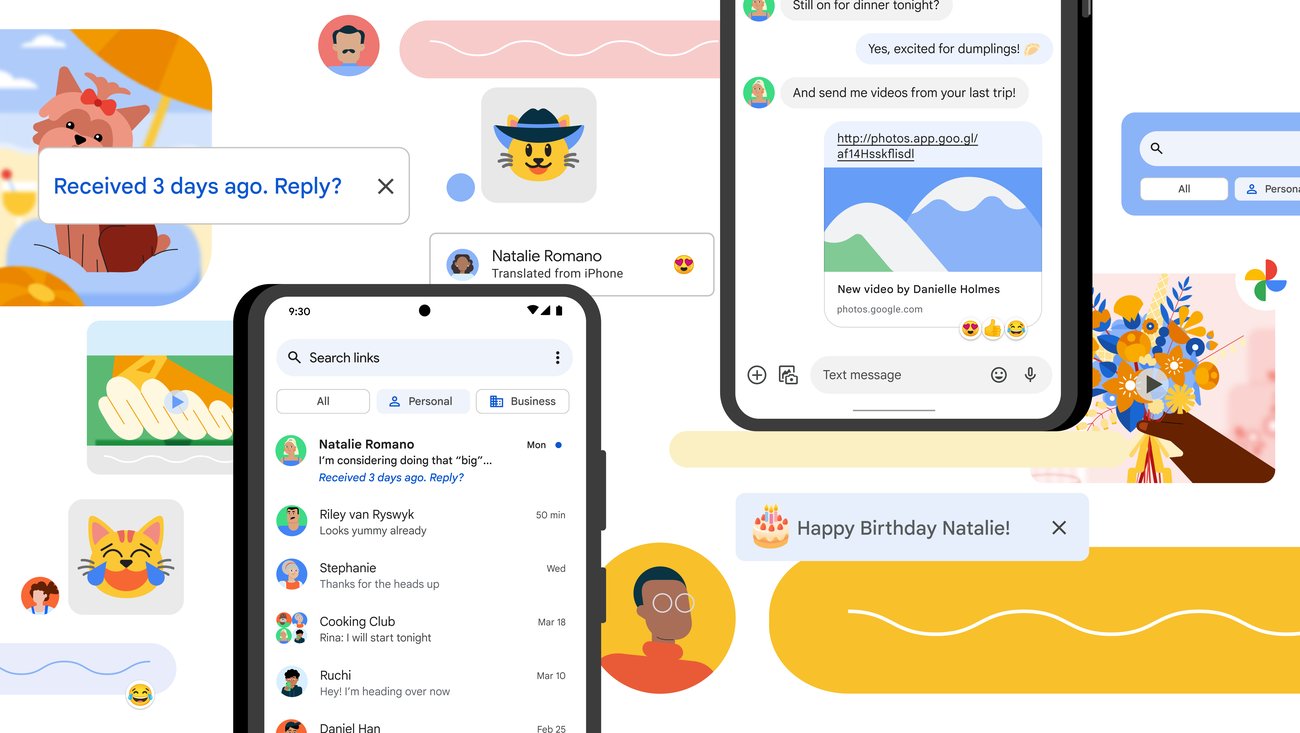
    Navigating to your photos in the Google Messages app for Android is simple, though it could be more streamlined. To begin, you’ll have to open Google Messages and select any prior message. A round button with a “plus sign [+]” icon is located to the left of the text input area. Clicking on this button reveals a range of options, including:

    – Gallery
    – Camera
    – GIFs
    – Stickers
    – Files
    – Location
    – Contacts
    – Schedule Send

    When you choose the Gallery option, the most recent images and videos stored locally on your device, as displayed by the Google Photos customized media selector, will be visible. However, if you need to access your photos via the Google Photos app using the Android System photo selector, you’ll have to press the Folders button situated at the bottom of the screen. This represents an additional step if you want to see the photos stored in the cloud rather than just on your device.

    Google is reportedly developing a solution to this issue, aiming to erase the additional step required to access your photos from the Google Photos app within Google Messages.

    Security and Access Concerns

    While the additional step may not bother some, it does raise a significant security concern. Google’s custom picker requires access to your full media gallery to function effectively. In contrast, Android’s photo picker allows applications to access only the photos and videos that you select. However, there is promising news — Google is said to be working on a way to allow users to access their photos from the Photos app via Google Messages without the need for the extra tap on the Folders button.

    New Developments in Android 16

    Android 16 introduces a new integrated photo picker equipped with its APIs, enabling apps to incorporate this photo picker directly into their interface. This provides app developers with a media gallery that feels native to their app, while also offering the security and privacy inherent in the Android system photo picker. This is because comprehensive media permissions no longer need to be sought. It was discovered that this embedded photo picker was present on a OnePlus 13 running OxygenOS 16.

    The Gallery button, when pressed, displays cloud-hosted photos and videos together with photos and videos stored on the local device. Before the introduction of the embedded photo picker with Android 16, users would have had to take the extra step and tap the Folders button to see their cloud-hosted photos and videos from the Google Photos app.

    Privacy Improvements

    Once the embedded photo picker is rolled out, there will be no need to grant the Google Messages app “Photos and videos” permission to share photos or videos. In fact, this permission can be revoked once the embedded photo picker is available.

    Questions & Answers

    What is the embedded photo picker in Android 16?
    The embedded photo picker in Android 16 is a new feature that allows apps to integrate a photo picker directly into their interface. This provides a media gallery that feels native to the app while also offering improved security and privacy.

    Does the Google Messages app require access to all my photos and videos?
    Currently, to function effectively, Google’s custom picker requires access to your entire media gallery. However, with the forthcoming embedded photo picker feature in Android 16, this will no longer be necessary.

    What is the benefit of the embedded photo picker?
    The embedded photo picker will eliminate the need for users to make an extra step when accessing cloud-hosted photos and videos from the Google Photos app. Additionally, it will enhance privacy as broad media permissions will no longer be required.


  • Gold prices hit 7-year high

    Gold prices hit 7-year high

    Vietnam’s gold prices hit a seven-year high Friday as the coronavirus outbreak pushed investors to seek safer assets.

    The country’s second-largest jewelry company, DOJI, was selling gold at VND45.59 million ($1,964) per tael (1.2 ounces), up 1.3 percent from Thursday, the highest since January 2013.

    Phu Nhuan Jewelry, meanwhile, sold its gold at VND45.75 million ($1,971), up 1.7 percent.

    The domestic price surge followed a global rise in gold prices of 0.9 percent to $1,635 per ounce Friday, the highest in seven years.

    Gold has become a more attractive investment option as the ongoing novel coronavirus outbreak will have negative impacts on the global economy.

    The gold price rise has happened alongside a fall in stocks. On Friday, Vietnam’s benchmark VN-Index fell 3.5 percent from the beginning of the year to 933.09 points.

  • Gold prices rise on trade talk optimism; Fed stance limits gains

    Gold prices rise on trade talk optimism; Fed stance limits gains

    Gold prices edged higher on Friday as optimism over U.S.-China trade talks pressured the dollar, but signs of the U.S. Federal Reserve raising interest rates again this year capped gains. Spot gold inched 0.1 percent higher to $1,324.59 per ounce at 0408 GMT. The metal was headed for a second straight weekly rise, up almost 0.3 percent. The precious metal had hit a 10-month high on Thursday, but later erased the gains.

    U.S. gold futures were subdued at $1,327.7 per ounce.

    “On a day-to-day basis, gold is a function of changing currency markets and the U.S. dollar. Medium outlook is a lot more to do with geopolitical issues and yields,” said Kyle Rodda, a market analyst with IG Markets.

    The dollar index against a basket of six major currencies was set to decline about 0.3 percent this week, which could be its biggest weekly fall in a month..

    “The fact that gold was overbought-driven very much by a new yield environment and tensions around the world has helped keep gold prices elevated,” Rodda said.

    Gold had hit a 10-month high of $1,346.73 on Wednesday, but minutes from the Fed’s January policy meeting indicated there might in fact be a rate hike this year, erasing gains in gold.

    “Dovish signals from U.S. Federal Open Market Committee officials for the shorter term have kept global equities steady whilst applying bearish pressures on the non-interest bearing asset,” Phillip Futures said in a note.

    Higher interest rates reduce investor interest in non-yielding bullion.

    Markets were looking for further indications of progress on trade talks with U.S. and Chinese negotiators resuming high-level talks on Thursday to hash out a deal that could end their trade war, just over a week before a U.S.-imposed deadline.

    The United States and China have started to outline commitments in principle on the stickiest issues in their trade dispute, marking the most significant progress yet toward ending a seven-month trade war, according to sources familiar with the negotiations, Reuters reported exclusively.

    Indicative of investor sentiment toward bullion, holdings of SPDR Gold Trust, the world’s largest gold-backed exchange-traded fund, fell 0.63 percent to 789.51 tonnes on Thursday.

    Meanwhile, palladium was up 0.3 percent to $1,473.00 per ounce, having surpassed the key $1,500 level for the first time on Feb. 20.

    The autocatalyst metal was on track for a third straight week of gains, up nearly 3 percent. Platinum gained 0.6 percent to $824, and was set for its best week since early January.

    Silver was little changed at $15.81 per ounce. It was on course to snap two consecutive weekly losses.

  • DHL Express Australia extends partnership with Surf Life Saving Australia

    DHL Express Australia extends partnership with Surf Life Saving Australia

    DHL Express remains committed to deliver safer beaches, by extending its partnership with Surf Life Saving Australia for another three years, till 2021. This year marks 15 years of continued support from DHL Express for Surf Life Saving Australia (SLSA). Since 2003, DHL Express has featured prominently on the uniforms of more than 42,000 surf lifesavers each patrolling season, alongside the iconic red and yellow flags that guide beach-goers to safe swimming zones.

    Gary Edstein, CEO and Senior Vice President at DHL Express Oceania said, “At DHL Express we are incredibly passionate about connecting people and improving lives – and we are proud to support Surf Life Saving Australia in doing exactly that for many years to come.”

    Graham Ford AM, President, Surf Life Saving Australia said, “On behalf of Surf Life Saving Australia I would like to thank DHL Express for their ongoing commitment and enthusiasm to the movement. As an organisation, we aim to form partnerships that echo our own values and vision for the future and indeed DHL Express do this, bringing to life the shared values of speed, passion and a can do attitude.”

    Since the establishment of the partnership there have been 2.2 million Surf Life Saving members, performing more than 14.4 million preventive actions and 180,000 rescues. In addition to surf lifesaving services, SLSA works to educate children and the greater community on coastal safety awareness.

    “From the beginning, our partnership has been built on a strong foundation of shared core values that make our missions a success. Surf lifesavers around Australia display the four key attributes our own DHL employees uphold – passion, speed, pride in getting things right first time and a can-do spirit. This, combined with Surf Life Saving’s advocacy for cultural diversity, collaboration and empowerment make a winning formula for success,” Edstein concluded.

  • Hong Kong consumers favour saving over fun

    Hong Kong consumers favour saving over fun

    Hong Kong consumers lead the world for their saving and investment mindset, while savers outnumber fun-lovers overall in Asia Pacific.

    Market research company GFK has found that 54 per cent of online consumers in Hong Kong “disagree completely” or “disagree somewhat” with the notion of enjoying life today and worrying about savings and investments later.

    At the other end of the scale, China has the highest proportion of consumers of the APAC countries surveyed (38 per cent) who favour having fun now, followed by Australians at 32 per cent.

    GFK polled more than 27,000 internet users across 22 countries, including Australia, China, Hong Kong, Korea and Japan, to find how strongly they agree or disagree with the statement “I want to enjoy life today and will worry about savings and investments later”.

    Internationally, people in favour of saving slightly outnumber the “have fun now” respondents – but the numbers are very close. Hong Kong stands out as the only state where more than half of the online population puts up its hand for saving.

    Though 33 per cent of women internationally are happy to worry about financial security later, 40 per cent disagree. Men, however, are more evenly split with 36 per cent agreeing and 35 per cent disagreeing.

    Respondents in their 20s are the highest percentage of fun-lovers of any age group, with 41 per cent happy to worry about saving later. Teenagers (15 to 19 years old) and those in their 30s come next, almost equal at 37 and 36 per cent respectively. Of respondents in their 50s and older, 26 per cent also agree with living for today.

    Meanwhile, the numbers with a “save now” attitude increase fairly steadily with each age group, starting at 34 per cent for both teenagers and those in their 20s, and peaks at 43 per cent of those in their 50s, and 42 per cent of those older.

    “These findings give financial service brands a useful, top-level picture of the differences in attitude toward the concept of savings and investments across countries, age groups and genders,” says GFK APAC chief commercial officer Frans Janssen.

  • Cost of living here makes cosy retirement an elusive goal: HSBC

    Cost of living here makes cosy retirement an elusive goal: HSBC

    The cost of living makes Singapore one of the toughest countries to retire in, according to a new report.

    It found that about two in three workers here who are 45 or older would like to retire in the next five years but 48 per cent of them say they would not be able to. The global average is 38 per cent.

    Moreover, 30 per cent of pre-retirees predict that they will never be able to retire fully, compared with the global average of 18 per cent.

    Respondents here said the main impediment is a lack of savings or the burden of having dependants to look after.

    Having a lot of debt was raised by 26 per cent of respondents here, compared with the global average of 22 per cent.

    TOUGH FINANCIAL REALITIES

    The HSBC Future of Retirement survey shows that the financial realities of retirement make it an elusive goal for many Singaporeans.

    MR MATTHEW COLEBROOK, head of retail banking and wealth management, HSBC Singapore.

    HSBC surveyed 1,008 respondents – people aged 25 and above as well as retirees – here as part of a survey spanning 17 countries.

    START SAVING TODAY

    Even small amounts saved by starting today can lay the groundwork for a comfortable retirement tomorrow, placing retirement dreams squarely within reach.

    MR IAN MARTIN, chief executive of HSBC Insurance (Singapore).

    Mr Matthew Colebrook, head of retail banking and wealth management at HSBC Singapore, said: “The HSBC Future of Retirement survey shows that the financial realities of retirement make it an elusive goal for many Singaporeans.

    “This can be rectified with early financial planning and by seeking help from professionals who can provide advice on how to protect and grow your wealth.”

    Pre-retirees surveyed said they were anxious that events such as bad health and the need to care for elderly parents could interfere with saving for retirement.

    In spite of these concerns, retired life still offers much promise for some.

    The poll found that 62 per cent of Singapore respondents aged 45 and above who would like to retire in the next five years want to travel or pursue other interests.

    Also, 42 per cent of them would like to spend more time with family once they retire.

    Pre-retirees also expect relationships with friends, their partner and their children to improve.

    Mr Ian Martin, chief executive of HSBC Insurance (Singapore), said: “People should consider their personal aspirations when planning for retirement and ensure they are making sufficient financial provisions for this new chapter in life.

    “Even small amounts saved by starting today can lay the groundwork for a comfortable retirement tomorrow, placing retirement dreams squarely within reach.”

    HSBC also noted that about 56 per cent of pre-retirees here do not know how to predict how much they will spend on healthcare in retirement, even though 74 per cent believe that poor health will make saving for their golden years more difficult.

    To help individuals assess financial preparedness in realising their retirement aspirations, HSBC has launched the Retirement Profiler, an online tool to help individuals assess financial preparedness in realising their retirement aspirations.