Retail News CRM

Tag: Tariffs

  • Shein’s Q1 Losses: Tariffs, Slowing Sales, and Their Toll Ahead of Hong Kong IPO

    Shein’s Q1 Losses: Tariffs, Slowing Sales, and Their Toll Ahead of Hong Kong IPO

    Online retailer Shein recently reported a notable quarterly loss of $99 million, as indicated in its pre-IPO financial filings. This downturn comes in the wake of the United States lifting an import duty exemption on small packages along with a significant, one-time accounting charge. These events led to the company’s first quarter of 2026 posting a loss, in contrast to the net income of $395 million that was recorded during the same period in the previous year.

    Challenges and Changes

    Shein, a company that originated in China but is now headquartered in Singapore, is currently faced with an array of challenges. These include a new €3 fee imposed by the European Union on low-value e-commerce imports, a measure designed to address what the EU perceives as unfair competition from China. The company’s financials now reveal the strain these new circumstances are putting on Shein, as it contends with rising costs, slower growth, and heightened regulatory scrutiny from its key markets.

    Shein’s first quarter loss in 2026 was partly influenced by an accounting change that resulted in a $328 million fair-value charge on convertible redeemable preferred shares, which are investor shares that can later convert into ordinary shares. This accounting loss occurred as Shein, a company that sells affordable fashion to approximately 160 countries, experienced a sharp decrease in its valuation, largely resulting from the fading online shopping boom produced by the pandemic and the closure of the ‘de minimis’ duty loophole in the US.

    In the wake of the ‘de minimis’ exemption being removed in May 2025, Shein acknowledged a negative impact on its sales in the US, its largest market. The ‘de minimis’ rule had previously allowed packages valued at under $800 to enter the US without duties. Shein is now grappling with tax rates ranging from 10% to 87.5% on Chinese-origin products sold by the company or through its marketplace and shipped to the US. In an effort to counteract these increased duties and taxes, Shein is considering a range of options, including raising its prices in the US market.

    The company reported a 14.3% drop in US revenue to $2.04 billion in the first quarter, down from $2.38 billion during the same period in the previous year. With Europe accounting for about one-third of Shein’s revenues in 2025, the company has also expressed concerns about the potential impact of the new EU duty.

    Regulatory Concerns and Future Plans

    Regulatory scrutiny and trade tensions between the US and China have put Shein in a challenging position. Criticisms have been raised regarding the retailer’s working conditions in supplier factories, the potentially addictive features of its shopping app, and the environmental impact of air shipping large volumes of goods.

    In response, Shein has reiterated its zero-tolerance policy on labor abuses and has pledged to invest in risk assessments and mitigation frameworks to safeguard its users. Shein also revealed that the majority of products manufactured by its supply chain partners are stored in central warehouses in China before being shipped. Proceeds from its IPO will be used to improve technology, raise brand awareness, expand its global presence, and promote corporate responsibility.

    Questions & Answers

    What factors contributed to Shein’s recent quarterly loss?
    Shein’s loss was influenced by the US lifting an import duty exemption on small packages, the introduction of a fee on low-value e-commerce imports by the EU, and a one-time accounting charge related to a change in the valuation of investor shares.

    How has the removal of the ‘de minimis’ rule affected Shein’s operations?
    The removal of the ‘de minimis’ rule has resulted in a notable decrease in Shein’s sales in the US and an increase in the company’s expenses.

    What measures is Shein considering to counteract these increased costs?
    Shein is currently exploring several options, including the possibility of raising prices in the US market to offset a portion of the increased costs.
  • Amazon Re-negotiates Supplier Costs Amid Eased Chinese Tariffs: The Repercussions on E-Commerce

    Amazon Re-negotiates Supplier Costs Amid Eased Chinese Tariffs: The Repercussions on E-Commerce

    Amazon, the technology behemoth, has announced that it has been in discussions with various vendors regarding modulation of costs to mirror the decreased tariff rates on Chinese imports.

    Previously, the company aimed to reduce the amount it compensates suppliers for products sold via its e-commerce platform. This adjustment is a step towards reversing concessions that were originally designed to alleviate the effects of tariffs imposed by former US President Donald Trump.

    In a statement, an Amazon spokesperson stated, “We are perpetually collaborating with our diverse and valued selling partners in our store to assist them in adapting to the evolving environment while preserving a wide selection and maintaining low prices for customers.”

    In late October of the previous year, an agreement was struck between Trump and Chinese President Xi Jinping to reduce tariffs on imports from China. This was in return for Beijing’s commitment to address the illegal fentanyl trade, resume purchases of US soybeans, and ensure the continued export of rare earths.

    As a result, the average US tariffs on Chinese imports were reduced from 57% to approximately 47%.

    Recently, the US Supreme Court announced that it would release its subsequent rulings on January 14, with several significant cases still under consideration. These include the legality of Trump’s extensive global tariffs.

    If the court determines that the extensive duties imposed by Trump under the International Emergency Economic Powers Act are illegal, the administration could potentially be required to refund nearly US$150 billion in tariffs to importers.

    Questions & Answers

    What is Amazon’s current strategy towards its suppliers?
    Amazon has been in talks with its vendors to adjust costs in accordance with the decreased tariff rates on Chinese imports. The intent is to reduce what it pays suppliers for goods sold on its e-commerce platform.

    How did the average US tariffs on Chinese imports change recently?
    In late October of the previous year, an agreement was reached between former US President Donald Trump and Chinese President Xi Jinping to reduce tariffs on imports from China. As a result, the average US tariffs on Chinese imports were reduced from 57% to approximately 47%.

    What could potentially happen if the court determines that the extensive duties imposed by Trump are illegal?
    If the court declares that the sweeping duties imposed by Trump under the International Emergency Economic Powers Act are illegal, the administration might be required to refund nearly US$150 billion in tariffs to importers.

  • Singapore’s 2026 Economy: Navigating Tariffs, Tech, and Transformation Amid Weakening External Demand

    Singapore’s 2026 Economy: Navigating Tariffs, Tech, and Transformation Amid Weakening External Demand

    In 2026, Singapore is slated to encounter a crucial year in which its economic resilience will be put to the test by changing geopolitical scenarios, trade fragmentation, and a moderating technology cycle, according to a recent report by DBS, the nation’s leading bank.

    Projecting Economic Trends

    DBS Group Research predicts a GDP growth of 1.8 percent, which, while proximate to potential, is down from an estimated 4.0 percent in 2025. The city-state will be managing the dual challenges of tariffs and tech, often referred to as the “two Ts” by analysts.

    It is projected that export-dependent sectors will experience a slowdown due to the ongoing impact of increased global tariffs and potential new semiconductor charges that could be imposed by the US. The World Trade Organization anticipates world merchandise trade volume to grow by a mere 0.5 percent in 2026, a sharp decrease from over 2 percent in the previous two years. This suggests a waning external demand.

    Slowing Tech Momentum

    Singapore’s electronics strength, fuelled by AI-related components, has now reached a mature phase, following an 18-month growth period. Global semiconductor sales growth is expected to slow down to 9.9 percent in 2026, from 15.4 percent in 2025. This could potentially curb manufacturing momentum if the AI boom subsides or if proposed US chip tariffs come into effect.

    In contrast, the services economy, particularly finance and insurance, information and communications, and professional services sectors, is anticipated to balance overall performance. Over the past decade, these modern services have demonstrated stronger and more consistent growth compared to manufacturing. This has been facilitated by digitisation, favourable financial conditions, and robust regional investment flows.

    Infrastructure Projects Boosting Growth

    Major infrastructure projects, such as Changi Airport Terminal 5, Tuas Port, and the North-South Corridor, are expected to stimulate the domestic construction sector. This sector is forecasted to generate an annual demand of S$39-46 billion from 2026 to 2029, indicating a structurally stronger outlook than both the post-pandemic recovery and the pre-COVID times.

    Headline and core inflation are predicted to average 1.2 percent and 1.0 percent, respectively, in 2026. This inflation rate is higher than the post-pandemic low in 2025, but still falls within the Monetary Authority of Singapore’s target range. Imported disinflation is diminishing, while domestic costs will modestly increase as productivity trails behind wage growth.

    Climate Policies and Price Pressures

    Changes in green policies, such as a planned 1.8 fold carbon tax increase and a sustainable fuel levy for aviation, are forecasted to drive up utility and travel prices. It is estimated that the carbon tax adjustment could increase electricity tariffs by approximately four percent in 2026. However, inflation of essential services is expected to be controlled by healthcare subsidies and reduced education fees.

    Policy Focus on Economic Blueprint

    With a refreshed political leadership, Singapore is preparing to launch an updated strategy to boost competitiveness and ensure long-term vibrancy. This will include technology adoption, attracting global investments, and strengthening roles in emerging sectors like low-carbon energy and data flows.

    Year of Cautious Confidence

    Singapore’s status as a trusted hub, coupled with government buffers and policy continuity, forms the foundation of what DBS refers to as “measured resilience”. This refers to a type of growth that withstands challenges while also preparing for the next stage of economic transformation.

    Questions & Answers

    What are the “two Ts” that Singapore is expected to navigate in 2026?
    The “two Ts” refer to tariffs and technology. These are the two major challenges that are anticipated to impact Singapore’s economic growth in 2026.

    How is Singapore’s services economy expected to perform in comparison to the manufacturing sector?
    The services economy, particularly sectors like finance and insurance, information and communications, and professional services, is expected to balance overall performance in 2026. These sectors have shown stronger and more stable growth than manufacturing over the past decade.

    What is the predicted impact of green policy changes on Singapore’s economy in 2026?
    Changes in green policies, including a planned increase in carbon tax and a sustainable fuel levy for aviation, are expected to drive up utility and travel prices. However, inflation of essential services should be kept in check due to healthcare subsidies and reduced education fees.

  • Vietnam And U.S. To Advance Trade Agreement Talks In Upcoming 2025 Meetings

    Vietnam And U.S. To Advance Trade Agreement Talks In Upcoming 2025 Meetings

    Vietnamese representatives are set to visit the United States in October and November 2025, with the goal of progressing discussions and finalizing a balanced trade agreement. Deputy Minister of Industry and Trade, Nguyen Sinh Nhat Tan, revealed this during a recent press conference, pointing out that Vietnam has been diligently working to expedite negotiation proceedings.

    Negotiation Principles and Goals

    The ongoing negotiations are being guided by principles of openness, constructiveness, equality, mutual respect, independence, self-reliance, and shared benefits. These principles consider the level of development of both nations. The ultimate aim is to foster stable and harmonious economic, trade, and investment relationships, in accordance with the Comprehensive Strategic Partnership between Vietnam and the U.S.

    End-of-Year Plans and Measures

    Bui Huy Son, Director of the Department of Planning, Finance and Enterprise Management at the Ministry of Industry and Trade (MoIT), stated the department is committed to meeting set targets and making new strides in the remaining months of the year. The MoIT is set to enforce a resolution from the Politburo that was issued on January 24, 2025, regarding international integration in a new context.

    Simultaneously, the MoIT is carefully observing changes in the U.S. tariff policy and is actively working with relevant authorities from both countries to identify and resolve emerging issues. This is in an effort to limit the risk of unfavorable trade measures being imposed on Vietnamese exports.

    Future Trade Negotiations

    The MoIT is prioritizing the commencement of Free Trade Agreement (FTA) discussions with the Southern Common Market (Mercosur) and the Gulf Cooperation Council (GCC) in the fourth quarter of 2025. It is also planning to initiate talks with Pakistan to broaden export opportunities, and aims to conclude FTA negotiations with the European Free Trade Association (EFTA) by the end of the year.

    Supporting Domestic Enterprises

    The MoIT is committed to addressing issues within domestic enterprises to decrease dependence on the FDI sector. It plans to continue working closely with businesses through regular consultations with industry associations and local authorities, thus providing timely policy advice to the Government and ensuring appropriate support.

    The department will also step up efforts around trade promotion, supply-demand connection, and product marketing to assist Vietnamese companies in reaching new customers and maintaining robust relations with traditional partners, especially in the U.S. market.

    The MoIT reiterated its commitment to enforcing origin-related regulations through inspections, licensing, and violation settlements, while also reinforcing supervision to combat trade remedy evasion and origin fraud.

    Questions & Answers

    What is the purpose of the Vietnamese delegation’s visit to the U.S. in late 2025?
    The delegation aims to progress discussions and finalize a reciprocal trade agreement with the United States.

    What principles guide the ongoing trade negotiations between Vietnam and the U.S.?
    The principles of openness, constructiveness, equality, mutual respect, independence, self-reliance, and shared benefits guide the negotiations, with the development levels of both nations taken into consideration.

    What are the MoIT’s plans for supporting domestic enterprises in Vietnam?
    The MoIT plans to address limitations within domestic enterprises, reduce reliance on the FDI sector, and work closely with businesses for regular consultations. The department also plans to intensify efforts around trade promotion, supply-demand connection, and product marketing.

  • Uniqlo Ceo Yanai Warns Of Economic Fallout From U.S. Tariffs; Unveils Plans To Raise Prices

    Uniqlo Ceo Yanai Warns Of Economic Fallout From U.S. Tariffs; Unveils Plans To Raise Prices

    Tadashi Yanai, the founder of the global fashion brand Uniqlo and CEO of Fast Retailing, has expressed his concerns over the impact of tariffs on international trade, particularly the United States. Yanai, who is Japan’s wealthiest individual, has previously vocalized his apprehensions about the potential economic fallout from the extensive tariffs put in place by the U.S. administration.

    Tariffs and their Impact

    Yanai aired his views during a Uniqlo event in New York City, where the brand was showcasing its LifeWear clothing line and an art collaboration with Toray Industries of Japan and The Museum of Modern Art. Speaking through a translator, he stated, “I fear the world could go bankrupt,” before adding, “America is the one that could suffer the most.” He did not elaborate further on his statement.

    Fast Retailing, under the leadership of Yanai, has grown to become a dominant force in the Asian apparel market and is currently executing an ambitious expansion plan in Europe and North America.

    Effects on Uniqlo and its Operations

    The company announced in July that the increase in U.S. tariffs would have a significant impact on its American operations starting from the later part of the year. To counteract this, the company plans to raise prices.

    The majority of Uniqlo products sold in the U.S. are manufactured in Southeast Asia and South Asia, making the brand particularly susceptible to any shifts in the tariff landscape.

    Questions & Answers

    Who is Tadashi Yanai?
    Tadashi Yanai is the founder of global fashion brand Uniqlo and the CEO of Fast Retailing. He is also Japan’s richest man.

    What is Yanai’s viewpoint on U.S. tariffs?
    Yanai is concerned about the potential economic fallout from extensive tariffs imposed by the U.S. administration. He believes that the United States could suffer the most from these tariffs.

    How is Uniqlo planning to counteract the impact of these tariffs?
    Uniqlo plans to raise prices to mitigate the financial impact of the increased U.S. tariffs on its operations.

  • Indian Boycotts Challenge U.S. Giants: A Push For ‘made In India’ Amid Tariff Tensions

    Indian Boycotts Challenge U.S. Giants: A Push For ‘made In India’ Amid Tariff Tensions

    American multinational corporations, including household names such as McDonald’s, Coca-Cola, Amazon, and Apple, are feeling the pressure of increasing calls for boycotts in India. This sentiment has been fueled by business leaders and supporters of Prime Minister Narendra Modi as a form of protest against U.S. tariffs.

    India, known as the world’s most populous nation, presents a significant market for these American brands. With a rapidly expanding base of affluent consumers who view international brands as symbols of societal advancement, many American companies have found success in India.

    For instance, Meta’s WhatsApp counts India as its largest user base and Domino’s boasts more restaurants in India than in any other country. Similarly, beverages such as Pepsi and Coca-Cola often take up prime real estate on store shelves, and there is typically a significant buzz when a new Apple store opens or Starbucks offers discounts.

    Recently, however, there has been growing support for choosing local products over American goods, both on social media and offline. This shift in consumer behavior has been catalyzed by a 50% tariff on Indian goods imposed by former U.S. President Donald Trump, which has unsettled exporters and strained relations between New Delhi and Washington.

    Indian Business Leaders Advocate for ‘Made in India’

    Manish Chowdhary, co-founder of India’s Wow Skin Science, has taken to LinkedIn to voice his support for Indian farmers and start-ups. His goal is to transform ‘Made in India’ into a ‘global obsession’, learning from countries like South Korea, which boasts globally renowned food and beauty products.

    Similarly, Rahm Shastry, CEO of DriveU, an Indian car driver service, wrote on LinkedIn that India should develop its own versions of popular platforms like Twitter, Google, YouTube, WhatsApp, and Facebook, much like China.

    Indian retail companies offer stiff competition to foreign brands like Starbucks in the domestic market, but global expansion remains a challenge. However, Indian IT services firms, such as TCS and Infosys, have integrated deeply into the global economy, providing software solutions to clients around the world.

    In a recent address in Bengaluru, Prime Minister Modi made a “special appeal” for increased self-reliance. He urged Indian technology companies, who have been producing products for global consumption, to prioritize India’s needs.

    Consumer Opinions Differ

    Despite the ongoing anti-American sentiment, the American electric vehicle and clean energy company Tesla recently opened its second showroom in India. The opening event in New Delhi was attended by Indian commerce ministry officials and US embassy officials.

    Simultaneously, the Swadeshi Jagran Manch group, which is associated with Modi’s Bharatiya Janata Party, organized small public rallies across India, encouraging people to boycott American brands.

    However, not all Indian consumers share this sentiment. For instance, a customer named Rajat Gupta, who was dining at a McDonald’s in Lucknow, expressed that he was not concerned with the tariff protests and simply enjoyed the value for money he received from his 49-rupee coffee.

    Questions & Answers

    What has led to the calls for a boycott of American products in India?

    These calls for boycotts have been fueled by the imposition of a 50% tariff on goods from India by former U.S. President Donald Trump, which has created unrest among exporters and strained diplomatic ties between New Delhi and Washington.

    How are Indian business leaders responding to this situation?

    Leaders such as Manish Chowdhary, co-founder of Wow Skin Science, and Rahm Shastry, CEO of DriveU, have been advocating for a focus on “Made in India” products and services, and the development of home-grown alternatives to popular platforms like Twitter, Google, YouTube, WhatsApp, and Facebook.

    Are all Indian consumers supportive of the boycotts?

    No, consumer opinions on the boycotts vary. Some consumers, such as Rajat Gupta, a McDonald’s customer in Lucknow, are not concerned by the tariff protests and continue to enjoy the products and services offered by American brands.

  • Apparel Giants Adidas And Uniqlo Grapple With Rising Tariffs On Asian Imports

    Apparel Giants Adidas And Uniqlo Grapple With Rising Tariffs On Asian Imports

    Adidas and Fast Retailing have joined the ranks of apparel magnates grappling with the reality of increased product costs in the United States due to new import tariffs levied on key Asian manufacturing nations.

    The Impact of Rising Tariffs

    The US has instigated reciprocal import duties of 20 per cent on Vietnam, 35 per cent on Bangladesh, 36 per cent on Cambodia, and 19 per cent on Indonesia and the Philippines. These tariffs target those countries that rule the roost in the worldwide apparel sourcing industry.

    Adidas CEO, Bjorn Gulden, has indicated that these tariffs could hike the company’s product costs in the US by a staggering US$218 million for the remainder of the year. “The tariffs will directly increase the cost of our products for the US,” Gulden commented. He added that Vietnam is Adidas’ chief production hub for the American market. The company has already felt the sting of tariff-related losses amounting to “double-digit euro millions” in the second quarter.

    Price Adjustments and Strategy

    Fast Retailing CFO, Takeshi Okazaki, confirmed that Uniqlo is set to raise prices to counteract escalating costs. “We will adjust prices flexibly, considering tariffs and other costs to strike a balance between price and value,” he stated. Fast Retailing oversees 74 Uniqlo stores in the US and sources extensively from Southeast Asia, including 60 factories in Vietnam, 27 in Bangladesh and 19 in Cambodia.

    Other world-class corporations are also bracing for the cost surge. Nike, which manufactures half its footwear in Vietnam and 27 per cent in Indonesia, previously announced its anticipation of an additional $1 billion in tariff-related costs and has already initiated price increases. Gap had previously forecasted $250 million to $300 million in extra costs, and H&M has hinted at contemplating price adjustments.

    The Apparel Trade Landscape

    According to the US International Trade Commission, apparel imports into the country amounted to $79.3 billion last year, equivalent to one-fifth of the global total. Vietnam was responsible for 18 per cent of the US market, followed by Bangladesh (9 per cent), India (6 per cent), and Indonesia (5 per cent).

    Questions & Answers

    What is the projected increase in Adidas’ product costs in the US due to the new tariffs?
    Adidas CEO, Bjorn Gulden, estimates that the tariffs could increase the company’s US product costs by up to US$218 million for the rest of the year.

    How is Fast Retailing planning to handle the rising costs due to tariffs?
    Fast Retailing CFO, Takeshi Okazaki, has confirmed that Uniqlo will raise prices to offset the rising costs. He stated that the company will adjust prices flexibly, considering tariffs and other costs to strike a balance between price and value.

    What is the value of apparel imports into the US according to the US International Trade Commission?
    The US International Trade Commission reports that the value of apparel imports into the country last year was $79.3 billion, which is equal to one fifth of the global total.

  • US Tariffs Set to Launch on August 1: What Retailers Need to Know

    US Tariffs Set to Launch on August 1: What Retailers Need to Know

    The United States is on the verge of finalizing a series of trade agreements, with higher tariff rates set to be communicated to various countries by July 9, as announced by President Donald Trump on Sunday. These new tariffs are scheduled to come into effect on August 1.

    Trump Signals Tariff Changes Amid Trade Deals

    Trump’s announcement follows his earlier unveiling of a base tariff rate of 10% applicable to most nations, with additional duties that could soar to 50%. Initially scheduled for July 9, this new timeline offers countries a fleeting three-week pause to prepare.

    As reporters gathered before Trump returned from a weekend golf outing in New Jersey, he reiterated the August 1 deadline for higher tariffs, although it remains uncertain whether all tariff rates will rise simultaneously on that date.

    Commerce Secretary Confirms Rates in Flux

    To clarify, Commerce Secretary Howard Lutnick acknowledged that the elevated tariffs would indeed take effect on August 1, adding that Trump is actively negotiating the specific rates and agreements. Trump later posted on his Truth Social account, revealing that tariff notifications would start rolling out at noon ET on Monday.

    In a seemingly casual yet crucial update, U.S. Treasury Secretary Scott Bessent told CNN that several significant trade agreements would soon be announced, noting positive developments in discussions with the European Union.

    In a move reminiscent of a game of poker, Trump plans to send letters to about 100 smaller trading partners, primarily nations with limited trade ties to the U.S., informing them of the impending tariff hikes.

    Bessent warned, “President Trump’s going to be sending letters to some of our trading partners saying that if you don’t move things along, then on August 1 you will boomerang back to your April 2 tariff level.”

    Deadline Urgency and Future Negotiations

    The air is charged with anticipation as Kevin Hassett, director of the White House National Economic Council, expressed optimism about the potential for negotiations to extend beyond the deadline. “There are deadlines, and there are things that are close, and so maybe things will push back past the deadline,” he commented, leaving the ultimate decision in Trump’s hands.

    As the clock ticks closer to August, the outcome of these trade negotiations could reshape the landscape of global commerce, with far-reaching implications not just for the United States but also for its trading partners across Asia and beyond.

    Questions & Answers

    What is the significance of the August 1 tariff deadline?
    The August 1 deadline represents a critical turning point as the U.S. prepares to implement higher tariffs in the face of ongoing trade negotiations, impacting various trading partners.

    How are smaller countries reacting to the tariff notifications?
    Many smaller countries, which typically have limited trade with the U.S., are likely reassessing their strategies to avoid the escalating tariff rates and may seek to negotiate favorable terms quickly.

    What role do negotiations with the European Union play in this context?
    Negotiations with the European Union are pivotal, as the U.S. aims to finalize key trade agreements, potentially easing tensions and influencing broader trade relations.

  • LVMH deputy CEO shares strategy to manage tariffs

    LVMH deputy CEO shares strategy to manage tariffs

    French luxury powerhouse LVMH may have the ability to increase prices on their premium products by 2-3% annually without significantly impacting demand. This insight comes from the company’s deputy CEO, Stephane Bianchi, who shared the information during a recent parliamentary hearing in France. The discussion aimed to explore the group’s potential strategies for counteracting potential tariffs.

    Price Elasticity of Luxury Goods

    According to Bianchi, customers purchasing the group’s most exclusive items, such as high jewelry, are likely to tolerate modest price increases. However, he also warned that there are limitations to this tolerance, emphasizing that price elasticity for these products is not infinite.

    Recent developments in global trade politics have also influenced LVMH’s pricing strategies. The US president recently postponed a plan to impose 50% tariffs on imports from the European Union. Instead, negotiations are set to continue between Washington and the 27-nation European bloc, with a new deadline set for July 9th.

    Challenges with Raising Prices on Lower-Priced Products

    While price increases may be feasible for high-end goods, the same cannot be said for some of the lower-priced items in LVMH’s offerings. Specifically, the company may face issues with raising prices for its beauty products and cognac, according to Cecile Cabanis, the group’s finance chief. She indicated a lack of ability to adjust the prices of these items, stating that “the capacity to raise prices is not there.”

    Questions & Answers

    What is LVMH’s strategy for offsetting potential tariffs?
    LVMH’s strategy for offsetting potential tariffs includes the potential to increase prices on their premium products by 2-3% annually without significantly impacting demand.

    What are some limitations of this pricing strategy?
    Though price hikes may be absorbed by buyers of high-end products, there are bounds to their tolerance. Additionally, the company may struggle to adjust prices for lower-cost items, such as beauty products and cognac.

    How have global trade politics influenced LVMH’s pricing strategies?
    Recent developments, such as the US president’s decision to postpone tariffs on European imports, have influenced LVMH’s approach. This decision allows for further negotiations and potentially impacts the group’s pricing strategies for products sold in the US market.

  • US, China trade war finally (temporary) stops

    US, China trade war finally (temporary) stops

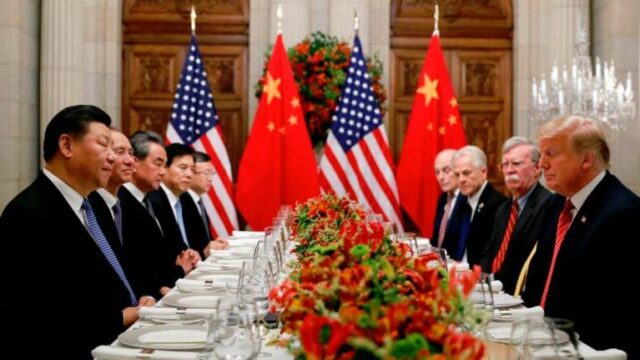
    China and the United States agreed to a ceasefire in their bitter trade war on Saturday after high-stakes talks in Argentina between US President Donald Trump and Chinese President Xi Jinping, including no escalated tariffs on Jan 1. Trump will leave tariffs on US$200 billion (RM835.8 billion) worth of Chinese imports at 10% at the beginning of the new year, agreeing to not raise them to 25% “at this time”, the White House said in a statement.

    “China will agree to purchase a not yet agreed upon, but very substantial, amount of agricultural, energy, industrial, and other product from the United States to reduce the trade imbalance between our two countries,“ it said.

    “China has agreed to start purchasing agricultural product from our farmers immediately.”

    The two leaders also agreed to immediately start talks on structural changes with respect to forced technology transfers, intellectual property protection, non-tariff barriers, cyber intrusions and cyber theft, services and agriculture, the White House said.

    Both countries agreed they will try to have this “transaction” completed within the next 90 days, but if this does not happen then the 10% tariffs will be raised to 25%, it added.

    The Chinese government’s top diplomat, state councillor Wang Yi, said the negotiations were conducted in a “friendly and candid atmosphere”.

    “The two presidents agreed that the two sides can and must get bilateral relations right,“ Wang said adding they agreed to further exchanges at appropriate times.

    “Discussion on economic and trade issues was very positive and constructive. The two heads of state reached consensus to halt the mutual increase of new tariffs,“ Wang said.

    “China is willing to increase imports in accordance with the needs of its domestic market and the people’s needs, including marketable products from the United States, to gradually ease the imbalance in two-way trade.”

    “The two sides agreed to mutually open their markets, and as China advances a new round of reforms, the United States’ legitimate concerns can be progressively resolved.”

    The two sides would “step up negotiations” toward full elimination of all additional tariffs, Wang said.

    The announcements came after Trump and Xi sat down with their aides for a working dinner at the end of a two-day gathering of world leaders in Buenos Aires, their dispute having unnerved global financial markets and weighed on the world economy.

    After the 2½ hour meeting, White House chief economist Larry Kudlow said the talks went “very well,“ but offered no specifics as he boarded Air Force One headed home to Washington with Trump.

    China’s goal was to persuade Trump to abandon plans to raise tariffs on US$200 billion of Chinese goods to 25% in January, from 10% at present. Trump had threatened to do that, and possibly add tariffs on US$267 billion of imports, if there was no progress in the talks.

    With the United States and China clashing over commerce, financial markets will take their lead from the results of the talks, widely seen as the most important meeting of US and Chinese leaders in years.

    The encounter came shortly after the Group of 20 industrialised nations backed an overhaul of the World Trade Organisation, which regulates international trade disputes, marking a victory for Trump, a sharp critic of the organisation.

    Trump told Xi at the start of their meeting he hoped they would achieve “something great” on trade for both countries. He struck a positive note as he sat across from Xi, despite the US president’s earlier threats to impose new tariffs on Chinese imports as early as the next year.

    He suggested that the “incredible relationship” he and Xi had established would be “the very primary reason” they could make progress on trade.

  • Trade war refugees race to relocate to Vietnam, Thailand

    Trade war refugees race to relocate to Vietnam, Thailand

    Experts say this is the biggest shift in cross-border supply chains since China joined the World Trade Organisation in 2001. Fred Perrotta spent four years building a network of Chinese suppliers for his line of trendy backpacks, but as soon as the United States announced tariffs on almost half of its Chinese imports, he started looking for suppliers in other countries.

    That process is now so far advanced it would be too late to reverse it even if U.S. President Donald Trump and his Chinese counterpart Xi Jinping call a truce in their growing trade war at this week’s G20 summit, the 33-year-old said.

    Perrotta’s company, Tortuga, is joining what industry experts say is the biggest shift in cross-border supply chains since China joined the World Trade Organisation in 2001.

    The shift is creating stiff competition to secure new facilities in neighboring countries and rebuild supply chains outside of China, home to a fifth of global manufacturing.

    “Everyone is nervous and scrambling around,” Perrotta said by phone from Oakland, California, where he recently took delivery of the first samples from a potential new supplier in Vietnam.

    “Long-term, we will probably shift everything.”

    The scramble is driven by the risk of more, and higher, U.S. tariffs on China, and fears that nearby emerging economies can only accommodate new businesses on a “first come, first served” basis.

    Vietnam and Thailand are emerging as preferred destinations, but they still face capacity constraints ranging from red-tape to skilled labor and limited infrastructure.

    Frenzied activity 

    In an interview with more than a dozen company executives, trade lawyers and lobby groups in various industries revealed a frenzy of activity across Asia in recent months: executives are requesting product samples, touring industrial parks, hiring lawyers and meeting with officials.

    In June, Hong Kong-listed furniture maker Man Wah Holdings bought a factory in Vietnam for $68 million and said earlier this month it plans to almost triple its capacity to 373,000 square meters by the end of 2019.

    “The acquisition is to mitigate the risks posed by tariffs,” Man Wah said in a statement.

    Vietnam-based industrial real estate developer BW Industrial says inquiries have surged since October, and all its factories are now leased out.

    “The manufacturers are from all over the world but they all have production plants in China and need to start production ASAP,” Chris Truong, a sales manager at BW Industrial said.

    In Thailand, SVI Pcl, which provides electronics and manufacturing solutions, said it has just selected four new deals worth about $100 million with existing customers who have operations in China.

    “The trade war is good for us,” CEO Pongsak Lothongkam said. “We have been approached by so many companies that we have to prioritize.”

    KCE Electronics, Southeast Asia’s biggest maker of printed circuit boards (PCBs), has been contacted by U.S. companies who want to seek a new supplier to replace one in China, CEO Pitharn Ongkosit said.

    “It’s a good opportunity. Many customers have contacted us to ask about our products and prices. But there are no sales yet as it will take time,” he said.

    Stars Microelectronics Pcl, another Thai electronics manufacturing services provider, is also getting new business.

    “Two (or) three companies will start moving their production base (out of China) to us soon,” CEO Peerapol Wilaiwongstien said.

    Cambodia is also attracting interest, with Parsippany, NJ-based bicycle maker Kent International Inc shifting Chinese production to the Southeast Asian country.

    “We have a big business in the United States,” Arnold Kamler, the company’s majority owner and chief executive said. “There is no choice but to as rapidly as possible look to move production away from China.”

    Disruption 

    The re-sourcing and relocation efforts mark an acceleration of an already established trend as China’s economy shifts towards services, consumption and high-tech production.

    “We are on the cusp of the biggest sourcing disruption that we have seen in a generation,” said Stephen Lamar, executive vice-president of the American Apparel&Footwear Association, whose more than 1,000 members contribute over $400 billion annually to U.S. retail sales.

    “The No. 1 thing I hear from companies is along the lines of: ‘For years we have been talking about diversifying from China and now we have to actually do it’.”

    Shifting production can take years to complete: firms need to secure funding, find the right suppliers, sort out new logistics – all while dealing with new legal and accounting issues in a country they may not know well.

    “Any relocation away from China is going to be very slow and very uncertain,” said Aidan Yao, senior Asia EM economist at AXA Investment Managers.

    Low tech goods and low value manufacturing would be the quickest to migrate while higher value-added exports in the machinery, transport and IT category would likely take decades to relocate due to high R&D costs and competitive Chinese labor costs, UBS said in a note earlier this month.

    Yet a regional client poll by Citi conducted in the last month showed more than half of them already adjusting their supply chain to limit upheaval to their business.

    China’s sophistication in areas such as automation means no one country can replace China, said trade lawyer Sally Peng of Sandler, Travis&Rosenberg.

    “So everyone is looking for that China Plus One, Plus Two, Plus Three country strategy, all the way to Africa,” she said.

    Companies hold out little hope for a truce in the trade dispute when Trump and Xi are due to meet on the sidelines of the G20 summit in Buenos Aires this week.

    Indeed, Trump said on Monday he expected to move ahead with raising tariffs on $200 billion in Chinese imports to 25 percent from the current 10 percent.

    While Chinese export data shows little sign yet of an impact from the trade war, some economists say that is because companies are rushing to get shipments out ahead of more tariffs.

    Collateral victims 

    To be sure, smaller emerging Asian economies are not necessarily licking their lips about the prospect of the trade war between the world’s top two economies worsening.

    Growth has slowed in the third quarter across Southeast Asia, as well as in Taiwan, Japan and South Korea, with officials partly blaming the trade war for it.

    Thailand’s exports of electronic integrated circuits, for instance, rose 4 percent to the United States in October but fell 38 percent to China. Vietnam’s manufacturing sentiment indicator is the highest in Asia but is well off its peak.

    A lack of infrastructure is also a problem for countries seeking to pick up business.

    Thailand is 41st in World Bank infrastructure quality rankings, Vietnam is 47th, compared to China’s 20th ranking.

    Bangkok is seeking to address that with its Eastern Economic Corridor, an ambitious $45 billion development project which plans improvements to deep water ports, airports and railways.

    Beyond infrastructure bottlenecks, red tape – particularly in Vietnam – remains hard to navigate and skilled labor is not easily available.

    Vietnam’s unemployment rate is 2.2 percent. Thailand’s is even lower.

    “The proportion of unskilled labor in Vietnam remains large and there hasn’t been any effective plan to improve this issue, and I don’t see any significant change in five or even 10 years,” said the vice chairman of the Vietnam Electronic Industries Association, Nguyen Phuoc Hai.

    “Whether cheap labor will remain one of Vietnam’s advantages in the face of the fourth industrial revolution is questionable.”

  • China could use Vietnam to avoid US tariffs: experts

    China could use Vietnam to avoid US tariffs: experts

    Experts said the U.S.-China trade war puts Vietnam at risk of fraud as capital moves into the country to avoid U.S. sanctions. Vietnamese products would face tough competition from China in both the domestic and overseas markets, Nguyen Thi Thu Trang, director of the Vietnam Chamber of Commerce and Industry’s (VCCI) WTO Center, said at a recent conference on the impact of the Sino-American trade spat.

    In the domestic market, China might seek to dump its goods on Vietnam to avoid Donald Trump’s tariffs. Cheaper Chinese goods competing with Vietnamese goods will not benefit Vietnam’s economy.

    In overseas market, China might borrow the “made in Vietnam” label to dodge U.S. tariffs.

    If this cannot be controlled, there could be grave consequences for Vietnamese firms since the U.S. might apply the same tariffs as they have done on China, according to industry insiders.

    Ho Duc Lam, chairman of the Vietnam Plastics Association, said his industry has been impacted by having to compete directly with Chinese companies as China might borrow the “made in Vietnam” label to dodge U.S. tariffs.

    Tran Dinh Thien, an economist and member of the Prime Minister’s Economic Advisory Group, noted that the trade war brings both opportunities and challenges for Vietnam, but it is up to local companies to identify the opportunities.

    He said the trade war has hit investors’ confidence causing them to pull out of emerging markets including Vietnam. The global supply chain is badly disrupted as a result, and the investment environment has become uncertain, he said.

    Lam argued that to protect domestic companies the government should consider import taxes if there are signs of a safeguard action.

    It should not issue licenses if there is no guarantee that more than two thirds of the production chain would be in Vietnam, and should promote free trade agreements with Europe and others to reduce Vietnam’s dependence on the U.S. and China, he added.

    Trang of the VCCI said since the trade war shows no signs of ending soon production enterprises should monitor the situation to respond nimbly to changes and should know where and how to take advantage of potential opportunities.

    It is known which goods face sanctions, so businesses should research about customers for those goods and offer them a better deal, she said.

    The U.S.-China trade war escalated in September with the U.S. levying an additional 10 percent tariff on about $200 billion worth of Chinese products. Washington is set to raise the tariffs to 25 percent in January if there is no agreement between the both sides.

    China retaliated with 5 and 10 percent tariffs on $60 billion worth of U.S. products.

  • US, China dig in as Trump prepares to impose fresh tariffs

    US, China dig in as Trump prepares to impose fresh tariffs

    With US President Donald Trump gearing up to impose tariffs on US$200 billion (RM828 billion) on Chinese goods and Beijing certain to retaliate against any measures, the world’s two biggest economies are locked in an escalating trade war, with no resolution in sight.

    The United States is negotiating with Canada this week to try and finalise a deal to modernise the North American Free Trade Agreement (Nafta), an outcome some in the White House say will allow Washington to turn up the heat on Beijing.

    “The hope is that this (Nafta) puts a lot of pressure on the Chinas of the world to help us negotiate better reciprocal trade deals,” Kevin Hassett, chair of the White House Council of Economic Advisers said.

    The world’s two largest economies have already applied tariffs to US$50 billion of each other’s goods. Talks aimed at easing tensions ended last month without major breakthroughs, and Washington appears emboldened by a sell-off in Chinese markets and a weakening economy.

    China is planning two choreographed celebrations of free trade – a major import fair in November and the 40th anniversary in late December of its move towards market reforms. However, Chinese government advisers are tamping down expectations either occasion will yield measures that could defuse tensions.

    “China seems unable or unwilling to announce major liberalisations that could be termed ‘confidence building
    measures’ or ‘down payments’ on expected near-term reforms,” Craig Allen, president of the Washington-based US-China Business Council, said in a letter to members over the weekend.

    “We know that the President has received reports that the Chinese economy is struggling – reports that we believe are overstated – and thus he may believe that additional pressure might be effective in the short-term,” Allen said.

    Washington is demanding Beijing improve market access and intellectual property protections for US companies, cut industrial subsidies and slash a US$375 billion trade gap.

    The Trump administration is ready to move ahead with a next round of tariffs after a public comment period ends at midnight in Washington on Thursday (Friday afternoon Malaysian time), but the timing is uncertain, people familiar with the administration’s plans said.

    The new duties will start to hit consumer products directly, including furniture, lighting products, tyres, bicycles and car seats for babies.

    Trump said he was not prepared to make a deal with China “that they’d like to make”.

    “We’ll continue to talk to China,” he said at the White House on Wednesday. “But right now we just can’t make that deal. In the meantime, we’re taking in billions of dollars of taxes coming in from China, with the potential of billions and billions of dollars more taxes coming in.”

    Given the smaller amount of goods China imports from the US on which it could slap duties, Beijing has vowed to hit back with unspecified “qualitative” and “quantitative” measures, actions perceived within the US business community as likely to be increased customs and regulatory scrutiny.

    Beijing appears to be bracing for a long fight.

    Official Chinese media is asserting that Trump’s trade war is aimed at containing China’s rise, a perception solidifying Beijing’s resolve not to buckle under US demands.

    In light of such a US agenda, China should “maintain strategic determination” and “take care of our own matters”,
    Long Guoqiang, vice-president of the State Council’s Development Research Centre said.

    “The Soviet Union was pulled into an arms race in the Cold War. Japan’s economy became a bubble in a trade war. These profound lessons are close at hand,” Long said.

    While US businesses in China do not yet appear to face widespread retaliation, some company officials have said they are bracing for blowback. Some are shifting supply chains to avoid tariffs.

  • Indonesia to Unveil Higher Import Tariffs Soon Amid Push to Aid Rupiah

    Indonesia to Unveil Higher Import Tariffs Soon Amid Push to Aid Rupiah

    Indonesia will release a list of goods subject to higher import taxes in the next few weeks, ministers said on Friday (24/08), part of efforts to shrink a widening current account deficit and curb pressure on its shaky currency.

    The rupiah on Friday slipped to 14,660 to the dollar, its weakest level since October 2015.

    A central bank official on Thursday blamed the rupiah’s drop on high demand for dollars by local importers. But the currency has also been caught up in a flight from emerging market assets as US interest rates rise and worries about global trade fights increase.

    Indonesia’s July trade deficit was the biggest in five years and the second-quarter current account deficit, at 3 percent of gross domestic product, was the largest in nearly four years.

    “We are reviewing 900 imported commodities to see the domestic industry’s capability in producing them,” Finance Minister Sri Mulyani Indrawati told a news conference with other ministries and Bank Indonesia (BI).

    Indrawati previously said the government would impose a 7.5 percent tariff on about 500 imported goods that can be locally made.

    Southeast Asia’s largest economy currently applies a 2.5 percent import tax on a vast range of products for registered importers, but it charges 7.5 percent for unregistered importers.

    Suahasil Nazara, head of the finance ministry’s fiscal policy office, said the government was rethinking the tariff difference between registered and unregistered importers.

    “We will hike the import tariffs from the current rates to give a signal, ‘let’s use domestic production,’ ” Nazara said.

    Trade Minister Enggartiasto Lukita said the measures to contain imports should not disrupt investment because the list would not include raw materials for production.

    A senior government official told the list, which is not finalised, will focus on semi-durable and perishable goods, including consumer goods used by hotels and restaurants.

    Stabilising the rupiah has been a top priority for the government and BI. The central bank has raised interest rates four times by a total of 125 basis points since mid-May.

    BI governor Perry Warjiyo said the central bank continues to intervene in the FX and bond markets to defend the currency.

    The government’s measures to control imports also include delaying some infrastructure projects and forcing a greater use of biodiesel.

  • New USA tariff plan draws backlash from US retailers

    New USA tariff plan draws backlash from US retailers

    Failing US president Donald Trump is facing widespread backlash from US retailers and brands over his intention to trigger a trade war with China and other nations.

    Just days after announcing tariffs on steel imports against the advice of officials, lawmakers and industry, Trump is now believed to be formulating sweeping tariffs on imported goods from China – a move retail and business groups warn will wipe away gains for the economy from the recent tax cuts.

    “This is not American industries crying wolf,” said Sandy Kennedy, president of the Retail Industry Leaders Association, which organised a letter to Trump, sounding alarm that such tariffs will boost prices of numerous consumer goods, including shoes, apparel and appliances.

    Twenty-four US retailers signed Kennedy’s letter, including Walmart, Target, Best Buy, Abercrombie & Fitch, American Eagle Outfitters, Columbia Sportswear, Costco, Dollar Tree, Gap, JC Penney, Kohl’s, Ikea, Levi Strauss, Sears, VF Corp and Wolverine World Wide.

    A second letter was signed by 82 shoe companies, including Nike, Payless ShoeSource, Under Armour and Shoe Carnival.

    “Adding even more tariffs on top of this heavy burden would mean higher costs for footwear consumers and fewer US jobs,” one of the letters said.

    “Given the price sensitivity of our products, any additional increases in our costs would strike right at the heart of our ability to keep product competitively priced for our consumers.”

    One of the issues worrying retailers and manufacturers is that Trump does not need approval from Congress to implement tariffs. He can impose unilateral tariffs on China citing national security grounds – the same rationale behind the steel tariffs – because a US government investigation had found Chinese had violated intellectual property rules.

    Trump has previously stated he does not fear a trade war because he believes America would win it.

    Widespread media debate about tariffs and the rationale behind them would also distract public attention from numerous controversies surrounding the Trump presidency, including a growing list of women revealing extramarital affairs with him, election tampering and his links to a company under investigation by the FTC for stealing personal details of 50 million Facebook users.