Retail News CRM

Tag: YOOX

  • BlinQ to offer Yoox catalogue in SE Asia

    BlinQ to offer Yoox catalogue in SE Asia

    Bob Chua, founder and CEO of BlinQ​, says the partnership will give Southeast Asian consumers easy access to thousands of new products from high-end brands. “We have been growing quickly, and this partnership provides a greater depth of brands and products to our users in the Southeast Asian region.”

    Chua says BlinQ has more than 30,000 users joining the platform every month and it now boasts high-end brands including Prada, Off-White and Kenzo.

    For Yoox, which has 3 million customers worldwide, the deal will allow it to expand its Southeast Asian customer base.

    The Yoox deal closely follows BlinQ’s launch of a pre-loved offer and Asean Houz – a collection of high-end fashion brands from around the region.

  • Alibaba denies links to luxury e-tailer Yoox Net-A-Porter

    Alibaba denies links to luxury e-tailer Yoox Net-A-Porter

    the Chinese conglomerate, led by founder and chairman Jack Ma, had contacted Yoox Net-a-Porter over possible capital cooperation or even a takeover, adding it had not ruled out buying shares. This news was quickly denied by sources in the company, who stated this was “not true”.

    The suggested tie-up between Alibaba and YNAP comes just days after a mega deal that saw JD.com spend a whopping US$397 million on luxury fashion e-commerce site Farfetch.

    Dubbed by some the Amazon of fashion, YNAP saw its shares jumped 9.24 per cent on Monday and Tuesday on the back of the Alibaba rumour – its biggest two-day rise since last September.

    The rally was just in time to mitigate investor concerns over mounting short interest in the stock, as the luxury e-commerce market became increasingly crowded.

    “Alibaba should still be looking into cultivating its luxury e-commerce businesses at home,”said Tang Xiaotang, founder of luxury retail consultancy Nofashion. “The market is overwhelmed by noise right now.”

    YNAP is the result of a merger between Yoox and Net-A-Porter, two of the biggest Western online luxury fashion retailers, boasting of a client base of more than 2.9 million high-splenders.

    It booked a 16 per cent increase in adjusted net profit of 69 million (US$77.6 million) last year, with a market capitalisation of 3.48 billion euros.

    Online luxury sales are predicted by Bain & Co to be the fastest-growing channel for retailing of premium goods, and top luxury fashion houses such as Prada and Burberry have been scrambling to ramp up their own online offerings.

    The most notable of all is 24 Sevres, a multi-brand online retailer launched in June by LVMH, the world’s largest luxury conglomerate that owns Louis Vuitton and Dior.

    Competition has also heated up with an influx of new market share grabbers including Shopbob and Zalando, both of which are gaining popularity for their designer fashion clothing offerings.

    However, analysts believed Alibaba could still be eyeing overseas deals in an attempt to build up a global logistics network, following the move to set up an e-hub in Kuala Lumpur as well as the buyout of Southeast Asian e-commerce operator Lazada, last year.

    “After all, Alibaba still has a ‘go global’ agenda, which can be pursued through M&As”said Ray Zhao, an analyst with Guotai Junan Securities.

  • YNAP pins hopes on expansion

    YNAP pins hopes on expansion

    Italian online fashion retailer Yoox Net-A-Porter (YNAP) aims to double sales and boost profits by 2020 as it expands in new markets, including Asia, but says it is still committed to Britain despite the vote to leave the European Union.

    The group says it is expanding its London headquarters and hiring several hundred new staff members despite Brexit. About a sixth of its total revenue comes from Britain.

    “We believe in this market. We believe in London and we continue to grow here,” says chief executive Federico Marchetti. “We have a very resilient business model thanks to our geographies being global.”

    YNAP says it plans to more than double revenues to around 4 billion euros (US$4.4 billion) by 2020. Its growth plans include further expansion in China and the rest of Asia.

    It also plans to offer jewellery and watches – Swiss watchmaker Richemont is a major shareholder – targeting sales of 100 million euros by 2020. This is part of a strategy to focus more on premium customers and fast-growing brands, as well as investing heavily in mobile. It says three-quarters of sales are set to come from mobile devices by 2020, from 41 per cent now.

    YNAP, a merger of Italy’s Yoox with upmarket rival Net-A-Porter, has its own multi-brand shopping websites but also runs online stores for luxury brands including Armani and Valentino. It added Prada this week.

    Finance chief Enrico Cavatorta says he expects synergies from the merger to take full effect from 2018, improving margins, and says the group should be cash positive from 2018.

  • Online store merger prods luxury goods makers towards internet

    Online store merger prods luxury goods makers towards internet

    The merger of the world’s two biggest online fashion stores, Net-a-Porter, or NAP, and Yoox, sends a warning to luxury brands to embrace the Internet with more vim after years of resistance.

    Top brands such as Prada and LVMH’s Christian Dior still baulk at the idea of selling clothing online as well as through their plush boutiques.

    “Considering the level of sophistication and image of our ready-to-wear, we feel the shopping experience has to remain immaculate and in-store,” says Stefano Cantino, head of marketing and commercial development at Prada.

    “You need the physical environment to try the product on and you need an exclusive service which you can only get in a boutique.”

    But as more people choose to buy through a website instead of going to Rue St Honore or New Bond Street, that position looks increasingly untenable. Brands whose goods are not available online risk losing customers to rivals.

    Luxury executives understand the Internet will be vital for future sales, particularly to so-called Millennials — web-savvy customers born between 1980 and 2000.

    Yet top brands such as LVMH’s Louis Vuitton, Hermes, Prada and Chanel have been slow to invest in e-commerce as other retail sectors have done in the last decade.

    Some have focused as much on the shopping experience as on the products themselves, spending heavily on worldwide expansion and revamping stores with help from famous designers.

    “Many luxury brands have not figured out yet how to be innovative and creative online,” said Anant Sharma of consultancy Matter of Form. “It looks like they are scared to try things out.”

    Sharma said many brands’ websites mimicked the appearance of Net-a-Porter’s black-and-white portal. “If they had the same approach to physical retail, we’d all be shopping in whitewashed rooms with clothes lined up against the four walls.”

    Immediately after the Yoox/NAP deal was unveiled last month, Chanel said it would start retailing online next year. This month, it is selling a new jewelry line exclusively through NAP for just three weeks.

    “The merger between Yoox and NAP sends the message that you need to be online or you may be out of the game,” Euromonitor luxury goods analyst Fflur Roberts said.

    Euromonitor expects 40 percent of all luxury goods sales will be made via the Internet in less than five years.

    Online annual luxury goods sales have been growing at 15-25 percent while the industry’s average growth rate has slumped to 5 percent this year from above 10 percent four years ago as brands have completed big global roll-outs.

    Analysts estimate that 5-6 percent of luxury goods are purchased online, although that jumps to around 8 percent for leather goods such as shoes and handbags.

    Designer websites vary in usability but few offer customers as much help as sites like NAP, which shows clothes on models, gives details of fit and sizing and carries styling tips.

    Prada’s e-commerce site carries no ready-to-wear, sticking to bags, shoes and other accessories.

    Kering’s Saint Laurent and Gucci have slicker sites, offering a wide range of clothing and proposing complete looks. Saint Laurent also features designer Hedi Slimane’s black and white photographs of musicians such as Marilyn Manson and Marianne Faithful.

    But Hermes’s iconic 8,000 euro Birkin or Kelly bags still cannot be bought online — and may take more than year to arrive after being ordered from a store.

    ?????????????????Department stores push

    While many big luxury brands are still figuring out an Internet strategy, high-end department stores already sell their products online.

    The Neiman Marcus chain, which includes New York’s Bergdorf Goodman, does 24 percent of its business online, up from 15 percent five or six years ago. Last year, it acquired German online fashion retailer My Theresa, aiming to better serve customers outside the United States.

    London’s Harrods, whose website gets 3 million visitors a month and sells brands such as Valentino and LVMH’s Givenchy, is also stepping up online investment.

    “Our customer demands an omni-channel shopping experience, and to remain at the forefront of luxury retail we need to respond to this,” Harrods managing director Michael Ward said.

    Chief Executive Bernard Arnault said at LVMH’s annual general meeting last week that “more and more products would be sold online” and the group was “currently adapting to this situation”.

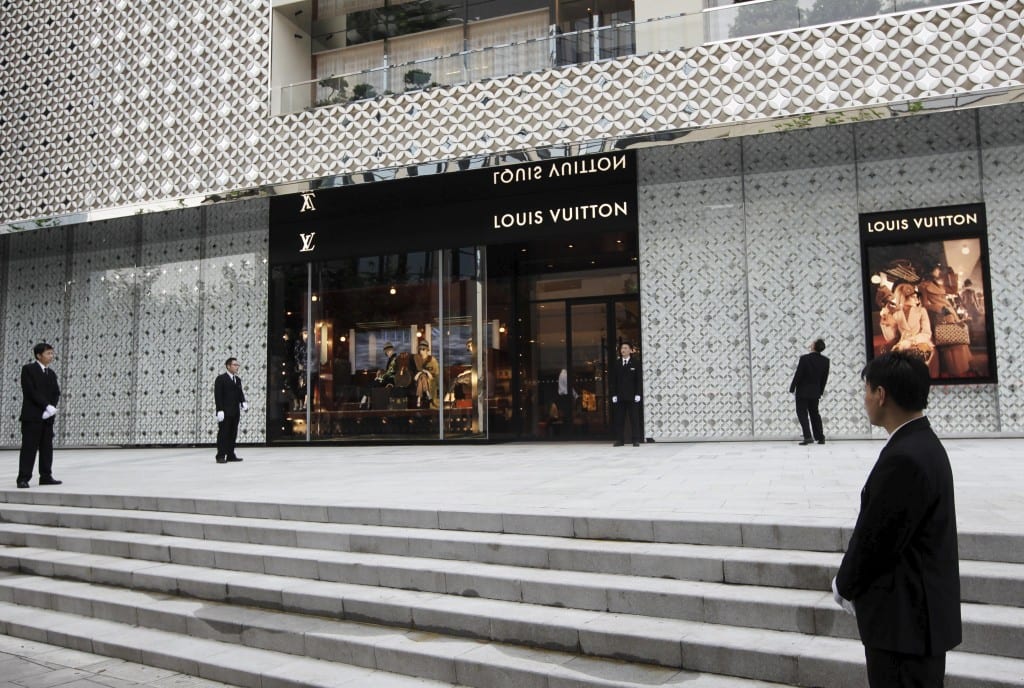
    LVMH labels such as Fendi, Kenzo and Emilio Pucci already offer many products online — Fendi sells 750 euro baguette bags and 6,180 euro blue feathered dresses — but Louis Vuitton sells only accessories, pens, watches and jewelry.

    Richemont’s Cartier brand has sold jewelry online in the United States since 2010 and its online store now ranks third behind its two main flagships in terms of sales.

    Privately owned Patek Philippe, does not sell any of its 10,000 euro plus timepieces on the Internet, however, and told Reuters last month it has no intention of doing so.