Retail News CRM

Tag: Zegna

  • Zegna’s Power Duo: Brothers Edoardo and Angelo Take the Helm as Co-CEOs of Luxury Fashion Giant

    Zegna’s Power Duo: Brothers Edoardo and Angelo Take the Helm as Co-CEOs of Luxury Fashion Giant

    Italian luxury fashion label Zegna recently appointed Edoardo and Angelo Zegna as its co-CEOs. The appointment is effective immediately and represents a significant shift in the company’s leadership structure.

    Former CEO Gildo Zegna has transitioned into an executive chairman role in the company. In this new capacity, Gildo Zegna will oversee the management of the three major brands under the company’s umbrella: Zegna, Thom Browne, and Tom Ford Fashion. His responsibilities will also include supervising the textile division, the general counsel’s office, which includes internal audit, as well as the external relations department. The latter encompasses sustainability, investor relations, and corporate communications.

    Gildo Zegna expressed his confidence in the new co-CEOs, stating, “Edoardo and Angelo’s complementary strengths and clear vision will make them a highly effective team to lead the Zegna brand. They continue the family legacy and have demonstrated their business leadership in recent years. Together, they will not only carry forward the brand’s timeless heritage but will further strengthen it.”

    In his role as co-CEO, Edoardo Zegna, who previously served as the group’s chief marketing and digital officer and group chief sustainability officer, will now lead the brand’s strategy. His responsibilities will include overseeing everything from brand image to marketing, as well as looking after design elements, including store design, alongside artistic director Alessandro Sartori.

    Angelo Zegna, the former CEO of Zegna’s Emea region and global client strategy director, will handle product development, merchandising, and commercial strategy as a co-CEO.

    Regarding their new roles, the brothers commented, “Our father passed the baton to lead a brand and protect its integrity, values, and long-term vision. As the fourth generation, our role is not to rewrite this story, but to move it forward with clarity, respect, and ambition.”

    Zegna, established in 1910 in Trivero, Italy, is celebrated for its high-quality tailoring and textiles. The brand is also recognized for its innovative fabrics, such as the Oasi cashmere and Trofeo wool.

    Questions & Answers

    Who are the new co-CEOs of Zegna?
    Edoardo and Angelo Zegna have been named as the new co-CEOs of the Italian luxury fashion brand.

    What role will Gildo Zegna play in the new leadership structure?
    Gildo Zegna will now serve as the executive chairman of the group, overseeing multiple brands and departments including sustainability, investor relations, and corporate communications.

    What is Zegna known for?
    Established in 1910 in Italy, Zegna is renowned for its premium tailoring and textiles, and for producing innovative fabrics like Oasi cashmere and Trofeo wool.
  • Temasek Boosts Stake In Zegna Group: A Strategic Move In Global Ultra-luxury Market Amid Volatility

    Temasek Boosts Stake In Zegna Group: A Strategic Move In Global Ultra-luxury Market Amid Volatility

    Singapore’s state investment firm, Temasek, is set to raise its stake in the Ermenegildo Zegna Group to 10 percent. This move, announced by both companies on Tuesday, is part of Zegna’s strategy to expand globally in the robust ultra-luxury market.

    Investing in Volatile European Markets

    Temasek is currently identifying investment opportunities in Europe, a region experiencing market volatility due to the international trade war initiated by the former US President, Donald Trump. This volatility has resulted in more appealing valuations for certain businesses.

    Insiders familiar with the deal indicated that Temasek views Zegna, a company increasingly receptive to foreign investors, as a promising investment prospect.

    Details of the Deal

    The deal, expected to be completed by July 30, involves Temasek acquiring 14.1 million Zegna treasury shares at $8.95 each, amounting to a total of $126.4 million. This purchase, combined with the 12.7 million shares Temasek previously procured on the open market, results in a total stake of 10 percent for the investment firm.

    Zegna’s Chairman and CEO, Ermenegildo “Gildo” Zegna, believes that this partnership with Temasek will strengthen their global organic expansion.

    Influence of Luxury Consumers

    Despite worldwide economic uncertainty, top-tier luxury consumers, those who spend more than 50,000 euros ($57,660) annually, continue to consume. Though this group represents less than 1 percent of the market, they contribute to 23 percent of the industry’s value. Their expenditure remains constant even as less affluent consumers reduce their spending.

    Future Developments

    Nagi Hamiyeh, Temasek’s head of Europe, the Middle East, and Africa, is expected to join Zegna’s board as a non-executive director at Zegna’s annual general meeting in June 2026. He expressed that this investment illustrates Temasek’s faith in Zegna’s positioning and potential for long-term value creation.

    Funds from this transaction will bolster Zegna’s balance sheet and facilitate their expansion into new markets, particularly Asia. Temasek’s regional expertise is anticipated to play a crucial role in this expansion.

    Questions & Answers

    What is the percentage of Temasek’s stake in the Ermenegildo Zegna Group?
    After the completion of the deal, Temasek’s stake in the Ermenegildo Zegna Group will increase to 10 percent.

    What is the primary purpose of Temasek’s investment?
    The proceeds from the transaction will be used to improve Zegna’s balance sheet and aid their expansion into new markets, particularly in Asia.

    Who are the top-tier luxury consumers?
    Top-tier luxury consumers are individuals who spend over 50,000 euros ($57,660) annually. These consumers continue to spend consistently, despite global economic uncertainty.

  • Luxury brands Gucci & Zegna shutting shop as Chinese buyers turn thrifty

    Luxury brands Gucci & Zegna shutting shop as Chinese buyers turn thrifty

    It’s already happened to middle-of-the-road stores across high streets and main streets. Now the world’s biggest luxury stores are starting to shutter outlets. The culprit is the Chinese consumer, who is starting to rein in spending at home and abroad. The effect will be no less severe: expect more closures to come.

    Over the past decade, Chinese consumer demand and new store openings together turbo-charged luxury sales. New store space accounted for 55% of global luxury revenue growth over the past eight years, according to analysts at Mainfirst.

    As for Chinese nationals, they powered about two-thirds of luxury market’s growth over the past decade, according to Exane BNP Paribas.

    Now both of these forces are running out of steam. Given the slump in Hong Kong and the slowdown in China, stores there are the main focus of attention.

    MIXED BAG

    Gucci and Zegna were among luxury brands to cut their store footprint in the first quarter.

    Hugo Boss has already announced plans to close 20 of the 131 stores it directly owns on the mainland. It’s reviewing as many as another 20 of its least-profitable 430 stores globally.

    The company is in talks with its landlords, so not all of these outlets will close but it expects to announce a sizeable number of exits later this year.

    Prada won’t say where its selective store cuts might fall, but as it expanded aggressively in Asia, it’s a good bet that some will be there.

    And last week, Richemont, maker of Cartier jewelry and Jaeger-LeCoultre watches, said it was also reviewing its retail network in Hong Kong and Macau.This could include closures, moving to cheaper premises or lease renegotiations. Indeed, seeking rent reductions is an alternative to outright closure. Bloomberg Intelligence’s Patrick Wong ays rent reductions of as much as 50% says rent reductions of as much as 50% are possible in some locations in Hong Kong. But demand remains strong for space in premium malls, limiting the scope for discounts.

    In mainland China, tenants have the most bargaining power in new malls, particularly in second-tier cities , hit by a slump in demand and plentiful new supply, Wong notes.

    While the most attention might be on China, globally, brands are focusing on making their existing stores work harder. Rather than planning large scale openings, existing outlets are being refurbished.

    The luxury groups are right to halt their dizzying expansion, and start to cut back. As they do, there could be opportunities for more niche upmarket brands to expand. Kering’s Saint Laurent, LVMH’s Givenchy Fendi and Celine, and Swatch’s Harry Winston could all open stores at more attractive rents.

    Pandora, the affordable luxury chain, is one retailer that is still growing its store base, including in China. And here’s another trend that mirrors what is happening on high streets and main streets. As mid-market brands retrench, discount players move in. Pandora is hardly the same as Primark (its jewelry can cost 60 ($87) rather than 6 at its less upscale cousin). But the Danish jeweller offers cheaper, more accessible luxury.

    That’s still a winning formula in China, whether it is LVMH’s cosmetics and fragrance brands -or Pandora’s charms.

  • Cambodia duty-free store opened by DFS

    Cambodia duty-free store opened by DFS

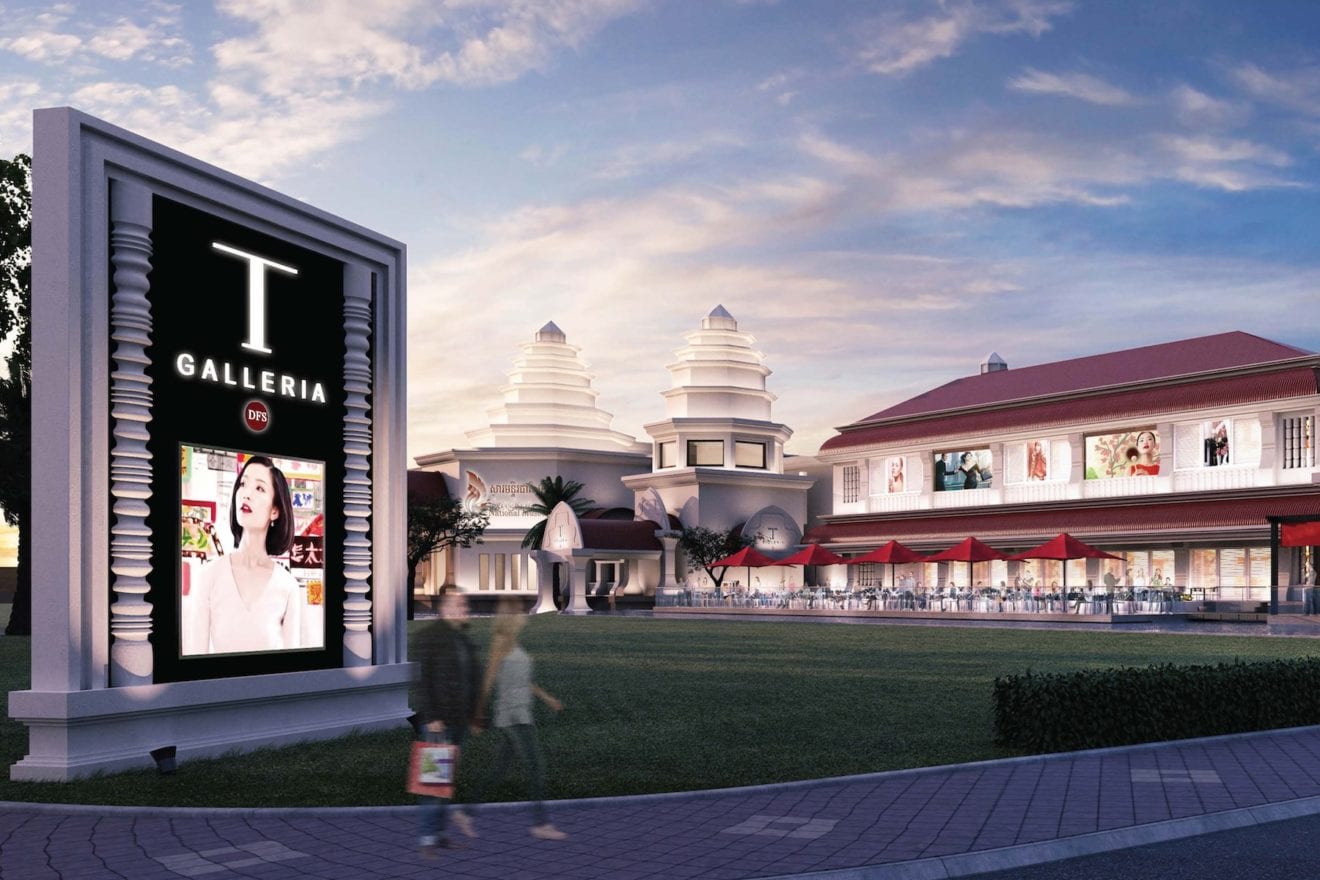
    Luxury travel retailer DFS Group has opened its first T Galleria by DFS store for Cambodia in the resort town of Siem Reap.

    Near the ancient temple of Angkor Wat, T Galleria by DFS, Angkor is the largest Cambodia duty-free luxury department store, offering an integrated retail, hospitality and leisure experience.

    The store is opening in phases until June, bringing 170 brands to the 86,000 sqft (7990 sqm) space, including fashion and accessories, watches and jewellery, wines and spirits, and beauty and fragrances as well as locally handcrafted artisan products.

    Next to Angkor National Museum and overlooking a park, the new outlet features traditional Khmer motifs and carvings by Cambodian artisans. Stone columns feature panels carved in styles reflecting the nearby temples and palaces of Angkor Wat, intricately patterned wall screens and floor tiles evoke local architecture, and a 20m art installation suspended above the store’s vaulted atrium, was inspired by the hues of Buddhist monks’ robes. More than 200 local sales associates will welcome customers.

    Several firsts for Cambodia duty-free come with the opening of the store, such as watches and jewellery brands Bulgari, Carl F Bucherer and Tiffany & Co and international fashion brands Burberry, Bottega Veneta, Fendi, Gucci, Ralph Lauren, Saint Laurent and Zegna. There are also 12 exclusive beauty and fragrance brands such as Bobbi Brown, Cle de Peau Beaute, Mac and Sulwhasoo.

    Among Cambodian artisans featured are Angkor Artwork, whose master craftsmen Eric and Thierry Stocker produce lacquer and straw marquetry using traditional techniques. There is also Golden Silk, one of the last fully integrated silk producers in the world to use the rare yellow silkworm indigenous to Cambodia, and Samatoa, an eco-friendly accessories brand that has revived the technique of lotus-fibre weaving.

    T Galleria by DFS, Angkor has also teamed up with Artisans d’Angkor, a socially conscious business aimed at revitalising Cambodia’s traditional craftsmanship while pioneering a sustainable working environment. Its exclusive collection of handwoven silks and fine crafts were designed by and will benefit local artisans.

    An onsite restaurant, Crystal Jade, will open in June, the first outlet in Cambodia for the Singapore brand. It will serve traditional Chinese cuisine and dim sum dishes in a casual setting overlooking gardens and reflecting pools.