Retail News CRM

Tag: M1

  • StarHub has no plans to buy M1

    StarHub has no plans to buy M1

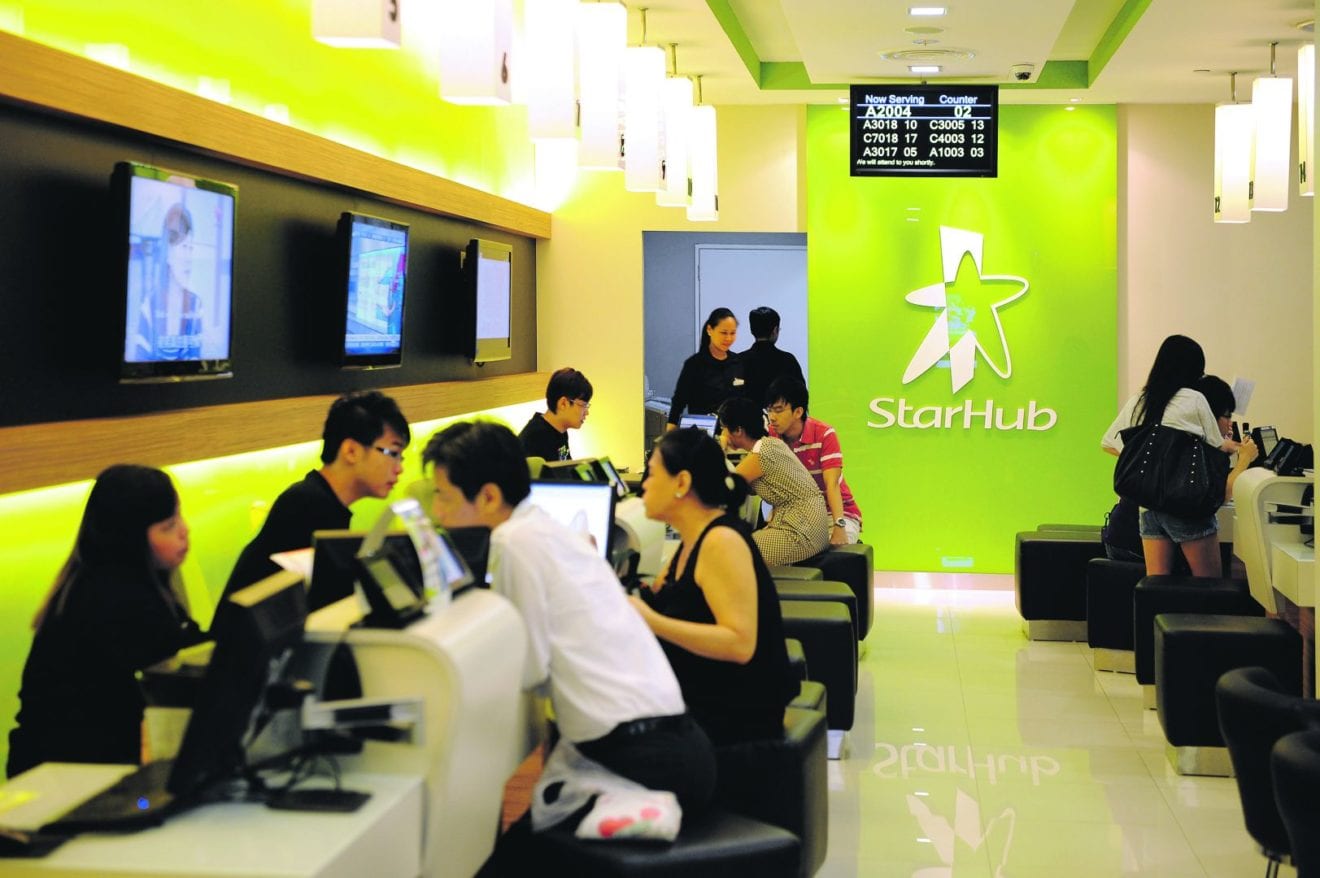
    Despite speculation, Singapore operator StarHub has no intention of acquiring or merging with struggling rival M1, according to reports.

    StarHub’s management does not plan to acquire M1, Singapore’s smallest major operator whose major shareholders recently revealed are conducting strategic reviews of their ownership.

    But the research report noted that it will be up to StarHub’s majority owner ST Telemedia to decide whether to pursue a purchase or merger.

    ST Telemedia owns 56% of StarHub, and is itself wholly owned by Singapore state investment company Temasek Holdings.

    But even if ST Telemedia is interested in a deal, the report notes that Singapore’s regulator is not likely to permit a deal that would result in spectrum holding even if it would allow another operator to acquire M1.

    Maybank Kim Eng has maintained a sell rating for StarHub shares due to what it says are structurally poorer margins.

    StarHub has separately recently announced the appointment of a new chief for its enterprise business group – former Integrated Health Information Systems CEO Chong Yoke Sin.

  • M1 profit falls 16.1% in 2016

    M1 profit falls 16.1% in 2016

    Singapore’s M1 has reported a 16.1% slump in net profit for 2016 to S$149.7 million ($105.3 million), blaming lower international call and roaming revenues as well as rising expenses.

    The operator’s service revenue for the year fell 2% to S$805.5 million, due to the ongoing impact of OTT substitution. But fixed-line revenue grew a strong 21.4% to S$104.2 million, growing to account for 12.9% of service revenue.

    Besides the decrease in revenue, M1 said depreciation and amortisation expenses grew due to an increasing 4G network fixed asset base, and additional spectrum acquisition costs also contributed to the profit decline.

    M1 added 52,000 postpaid customers and 39,000 prepaid customers during the year, bringing its total mobile customer base up to 2.02 million. Mobile churn meanwhile stayed flat at 1%.

    During the year, mobile data consumption grew to account to more than half of M1’s total service revenue, increasing 7.7 percentage points year-on-year during the fourth quarter to 54%.

    M1 meanwhile added 32,000 fiber customers during the year, taking its total to 160,000 and contributing to the growth in fixed service revenue.

    Capex for the year grew to S$140.5 million, up from $133.5 million a year earlier,

    “We continue to invest and innovate to enhance our service offerings to better serve our customers, as well as capitalize on new opportunities in the digital economy such as solutions for smart nation and  IoT services,” M1 CEO Karen Kooi said.

    “These initiatives, together with the foundation that we have laid over the years, will enable us to create and deliver long-term value to our stakeholders.”

  • M1, Huawei complete 5G mmWave demo

    M1, Huawei complete 5G mmWave demo

    M1 and Huawei have completed a 5G demonstration over 73-GHz E-band spectrum, achieving Singapore’s highest 5G transmission speeds of 35Gbps.

    The demonstration at M1’s main operating center in Jurong has validated the performance of 5G using millimeter wave high frequency bands, the companies announced.

    M1 CTO Denis Seek said 5G will support the massive number of low-latency connections critical to driving the next wave of technological development in areas including virtual and augmented reality, the connected car and autonomous vehicles as well as IoT applications.

    “Singapore’s mobile networks are widely acknowledged as amongst the most advanced worldwide, and M1 is committed to staying at the forefront of 5G technology to ensure our consumers enjoy the best experience and latest smart applications,” he said.

    In Hong Kong, SmarTone and Ericsson recently conducted the city’s first 5G demonstration using millimeter wave spectrum.

  • M1, StarHub may share more mobile infrastructure

    M1, StarHub may share more mobile infrastructure

    Singapore’s M1 and StarHub are considering expanding their mobile infrastructure sharing arrangements to gain a greater competitive edge against new market entrant TPG Telecom.

    The companies announced they have signed a memorandum of understanding covering the evaluation of potential further collaboration in network infrastructure sharing.

    M1 and StarHub have been sharing infrastructure including combined antenna systems, in-building fiber and tunnel cables for many years.

    Now the operators are exploring a deeper collaboration focused on sharing radio access network, backhaul and access assets.

    The collaboration is aimed at enabling both operators to optimize the use of a number of network elements while improving coverage and capacity for customers. The companies plan to continue to manage network traffic independently.

    StarHub CEO Tan Tong Hai said pooling network resources will allow both operators to roll out more cost effective next-generation networks to manage the exponential growth in demand for mobile data.

    “We are cooperating to bring the Singapore infocomm industry to the next level, to compete not on pure infrastructure ownership, but at a higher level of customer service and innovative value creation,” he said.

    “Sharing mobile network radio elements with M1, but keeping our individual mobile core networks, will allow StarHub to provide better mobile service (in particular, mobile coverage) and still be able to differentiate ourselves.”

    M1 CEO Karen Kooi added that the agreement could lower both operators’ operational and capital expenditures, allowing them to invest in the future technologies needed to keep Singapore at the forefront of the ICT industry.

    Singapore recently granted a fourth mobile license to TPG Telecom, after the Australian fixed line operator won a new entrant spectrum auction with a bid of S$105 million ($72.8 million).

    The terms of the allocation call for TPG to provide nationwide street level 4G coverage within 18 months of the license coming into effect, meaning the company will soon be a competitive threat for StarHub, M1 and incumbent Singtel.

  • M1 equips first building with fiber under FRS

    M1 equips first building with fiber under FRS

    Singapore’s M1 has been selected as the Fibre Ready Scheme (FRS) partner for property developer Ascendas-Singbridge, and has completed the first commercial fiber upgrade installation under the deal.

    The companies have equipped seven-storey integrated business park Ascent with fiber, making the Singapore Science Park facility the first FRS-enabled building.

    M1 and Ascendas-Singbridge plan to install and enhance fiber infrastructure at 70 commercial deals by 2018 as part of the alliance.

    “M1 was the first to launch commercial fiber broadband service in 2010, and we are pleased to build on that effort to partner Ascendas-Singbridge to install and upgrade the fiber infrastructure across its commercial buildings island-wide,” M1 chief corporate solutions and sales officer Willis Sim said.

    “This will enable even more corporates to rapidly enjoy M1’s innovative, competitively priced, and highly effective business connectivity service and corporate solutions such as cyber security and unified communications.”

    The FRS is an initiative of the Infocomm Media Development Authority (IMDA) as part of an S$200 million fund to help owners of commercial buildings enhance the location’s telecoms infrastructure. It involves offering a one-time subsidy to defray the costs of an upgrade.

    “With the addition of Ascendas-Singbridge’s 70 buildings, close to 200 buildings have applied for FRS to date,” IMDA assistant CEO Khoong Hock Yun said.

    “We strongly encourage more commercial building developers and owners to leverage on the FRS to enhance and future-proof its buildings’ fiber infrastructure before the program and funding ends in March 2018.”

    strongly encourage more commercial building developers and owners to leverage on the FRS to enhance and future-proof its buildings’ fibre infrastructure before the programme and funding ends in March 2018,”

  • M1 nine-month profit falls 12.6%

    M1 nine-month profit falls 12.6%

    Singapore’s M1 has reported a 12.6% decline in net profit for the first nine months of the year, due to slowing service revenue and depreciation and amortization costs associated with the operator’s 4G network.

    Net profit fell to S$117.9 million ($84.7 million), while service revenue decreased 1.4% to S$604.5 million as a result of the ongoing impact of OTT substitution on traditional telecoms services revenue.

    Mobile data revenue grew by 6.2 percentage points year on year to account for 54.2% of service revenue, with average postpaid smartphone data usage growing to 3.4GB per month in the third quarter from 3.3GB a month a year earlier.

    Fixed service revenue for the nine-month period meanwhile increased 26.1% year-on-year to S$77.1 million, or 12.8% of service revenue. M1’s fiber customer base increased by 7,000 to 152,000.

    Looking ahead, M1 said barring unforeseen circumstances, the operator expects a similar percentage decline in net profit for the full year as reported for the first nine months.

    Announcing its results, M1 said its planned of Singapore’s first nationwide commercial NB-IoT network, announced n August, will help open up a new growth market for the operator.

    “The needs and behavior of our consumers and corporates are changing rapidly. We will continue to make network investments to provide our customers with a superior and all-encompassing experience while also tapping into new growth areas in data analytics, IoT and other solutions,” M1 CEO Karen Kooi said.

  • Axiata may lift stake in Singapore’s M1

    Axiata may lift stake in Singapore’s M1

    Malaysia’s Axiata Group is considering increasing its stake in Singapore’s M1 as a strategic investment.

    Axiata CEO Tan Sri Jamaludin Ibrahim told that the company would “seriously consider” lifting its stake in M1 “if the price is right”.

    Axiata is already M1’s largest shareholder with a 28.5% stake. M1’s second largest shareholder Keppel Corp’s parent company Temasek Holdings is meanwhile reportedly considering selling Keppel’s stake in the operator.

    But the prospect of heightened competition in Singapore’s mobile market arising from the award of the nation’s planned fourth mobile license may limit the attraction of a potential deal.

    Jamaludin told that the company is not pursuing any major mergers and acquisitions, noting that even if the group wanted to expand into another country, the opportunity is not there.

  • M1 adds three managed security partners

    M1 adds three managed security partners

    Singapore’s M1 has added three cybersecurity vendors to its list of managed security partners, as part of efforts to enhance its suite of cloud-based cybersecurity offerings.

    The three vendors are Red Sentry, Palo Alto Networks and Proficio, who join Trend Micro, Blackberry and Radware as partners in M1’s cybersecurity solutions suite.

    Red Sentry will provide cyber security consultancy services including vulnerability assessment and penetration testing while Palo Alto Networks will offer its next-generation firewall.

    Proficio will provide a 24/7 network monitoring service, courtesy of its recently opened security operations centre (SOC) in Singapore. The cloud-based services are hosted out of M1’s data center in Singapore.

    The offerings are available to M1’s business fiber broadband customers, with SMEs expected to benefit most from the cybersecurity suite’s pay-as-you-use model.

    According to M1’s chief corporate sales and solutions officer Willis Sim, customers who sign up for services in the cybersecurity solutions suite need only deal with a single M1 client servicing representative, regardless of the number of services subscribed to.

    To encourage uptake, M1 is offering promotional packages for early adopters. Registered businesses who either recontract or sign up for 24-month business fiber broadband contracts will be offered free VSA and three months subscription to Palo Alto’s virtualized next-generation firewall.

    A free 12-month subscription to Proficio’s SOC service will also be offered to customers on 24-month contacts.

    Customers will be able to opt out of any managed security service at any time without incurring financial penalties.

  • M1 to deploy NB-IoT network by 2017

    M1 to deploy NB-IoT network by 2017

    M1 and Nokia have teamed up to roll out the first nationwide commercial narrowband Internet of Things (NB-IoT) network in Singapore by 2017.

    When completed, the deployment – Nokia’s first large-scale deployment with an operator partner in Asia – is expected to be among the world’s first commercial NB-IoT deployments.

    NB-IoT networks and devices are designed to deliver improved network performance for M2M (machine-to-machine) communications – low-bandwidth, robust indoor penetration, and low power consumption, while delivering the benefits of licensed spectrum such as network reliability and security.

    The NB-IoT standards were finalized by the GSMA Standards body 3GPP in June 2016. Commercial NB-IoT devices are expected to be available by mid-2017.

    According to Bell Labs Consulting, there will be up to five billion IoT devices connected through mobile networks by 2020. In Singapore, NB-IoT deployment will support the nation’s journey to become a Smart Nation underpinned by data to deliver anticipatory services to its people.

    “NB-IoT is emerging to be a potentially promising technology for smart city’s machine-to-machine type of applications and services. We look forward to working with NB-IoT partners to explore the use of NB-IoT in developing innovative Smart Nation services that improve our citizens’ lives and make our businesses more productive,” said Jacqueline Poh, Chief Executive-designate, Government Technology Agency (GovTech).

    Sandeep Girotra, Nokia’s Senior Vice President of Asia-Pacific and Japan, said Nokia’s joint collaboration of NB-IoT deployment with M1 lays an important groundwork for further application of LTE-based IoT services.

    M1 also recently announced it is working with Nokia on Singapore’s first commercial HetNet deployment.

  • M1 commences Singapore’s first HetNet rollout

    M1 commences Singapore’s first HetNet rollout

    Singapore’s M1 has announced it has commenced Singapore’s first commercial HetNet rollout in collaboration with Nokia.

    As part of the rollout, M1 plans to progressively deploy Nokia’s Flexi Zone small cells and Wi-Fi equipment at hundreds of high-traffic hotspots across Singapore, including mass transit stations, malls and popular outdoor areas.

    The operator will also use small cell technology to bring connectivity to hard-to-reach areas including car parks, basements and parks.

    M1 plans to use LTE-WiFi Aggregation (LWA) technology to deliver peak download speeds of more than 1Gbps over its 4G+ network by 2017.

    The rollout follows HetNet trials earlier in the year at multiple locations including three MRT stations. During the trial, download speeds were improved by 60%.

    M1, MyRepublic, Singtel and StarHub have all been working with the Infocomm Development Authority (IDA) of Singapore on nationwide HetNet trials. M1’s participation has included trials of HD VoWiFi, as well as Wi-Fi on public buses.

    “The results from our HetNet technology trials were positive. 90% of users enjoyed a better mobile experience, with faster download and upload speeds. We are pleased that the trials have given our partners such as M1 useful insights and confidence to further enhance the mobile experience through commercial HetNet deployment,” IMDA chief executive designate Gabriel Lim said.

    The IMDA is due to be formed through the merger of IDA with the Media Development Authority (MDA) of Singapore.

    “As Singapore moves towards a Smart Nation, we look forward to working closer with companies in the tech, engineering and R&D space to develop solutions that can enhance connectivity and improve Singaporeans’ lives,” Lim added.

  • M1 profit falls 7.2% in H1

    M1 profit falls 7.2% in H1

    Singapore’s M1 has reported a 7.2% year-on-year decline in net profit for the six months ended in June, partly as a result of a 44% slump in handset sales.

    The operator reported a net profit of S$83.5 million ($61.8 million), on the back of flat revenue of S$407.3 million.

    While M1 added 14,000 postpaid and 24,000 prepaid customers during the six month period, bringing its total mobile customer base to 1.98 million, total handset sales fell to S$91 million. For the second quarter, handset sales declined by 50% year-on-year to S$36 million.

    Mobile data’s contribution to total revenue increased by 9.1 percentage points to 54%, with average postpaid mobile data usage growing by 100MB year-on-year to 3.3GB.

    On the fixed line front, service revenue grew 26.7% to S$50 million, or 12.3% of service revenue. M1 added 9,000 residential and corporate fiber customers in the first half, bringing its base to 145,000.

    Based on the current economic outlook, M1 announced that it now expects a single-digit decline in net profit for the full year 2016.

    “We are investing in new technologies and capabilities, and building up a portfolio of digital solutions to enhance our service propositions and cater to changing customer needs,” M1 CEO Karen Kooi commented.

    “While expenditure is incurred upfront, meaningful contribution will only be upon achieving scale in service adoption over future years.”

  • M1 launches carrier billing for BES12

    M1 launches carrier billing for BES12

    Singapore’s M1 has become the first operator in Southeast Asia to offer BlackBerry’s BES12 Cloud bundled with new or renewed business mobile plans.

    The operator is the first in the region to take advantage of BlackBerry’s Enhanced SIM-Based Licensing, which offers multi-OS support from a single console, including for personal and company-issued devices.

    The platform supports remote provisioning of corporate applications and the setting of usage rights over the portal.

    M1 will also offer upgrade options including more advanced EMM features, billed via a monthly subscription model using carrier billing.

    “M1 is pleased to be the first in Southeast Asia to bring the benefits of BES12 to customers with easy deployment through Cloud,” the company’s chief product development and corporate solutions officer Willis Sim said.

    “This partnership with BlackBerry simplifies the way customers buy and use mobility, driving efficiencies and ultimately helps businesses enhance the way they service their own customers.”

    Operators including Vodafone India, Taiwan’s Chunghwa Telecom, Malaysia’s Maxis and Celcom Axiata agreed to support carrier billing for BES12 last year.

  • M1 will launch Apple Pay in Singapore

    M1 will launch Apple Pay in Singapore

    The operator will allow its customers to use the mobile payment service to make purchases at M1 Shop outlets and branches.

    Apple has meanwhile revealed it has extended the reach of Apple Pay to include holders of credit and debit cards issued by five banks in the country – DBS Bank, OCBC Bank, POSB Bank, United Overseas Bank (UOB) and Standard Chartered Bank.

    The five banks combined account for more than 80% of credit and debit cards issued in the country.

    Apple Pay, which launched last month in Singapore, was previously only available to holders of credit cards issued by American Express in the nation.

    The service is currently available in six markets – Australia, Canada, China, United States, United Kingdom and Singapore, with planned launches for Hong Kong and Spain this year.

    The service can be used on Apple’s iPhone SE, iPhone 6s, iPhone 6s Plus, iPhone6, iPhone 6 Plus and Apple Watch devices for payments at physical retail outlets.

    Banks are likely hoping Apple Pay transactions will increase adoption of contactless payments and eat into a chunk of the small payments pie currently dominated by cash transactions.

    OCBC Bank Singapore is offering its credit and debit card customers a 3% rebate for Apple Pay transactions island-wide in the first month of activation, with a cap of up to S$15 ($11).

    UOB is meanwhile aiming to lift the S$100 transaction limit for contactless payments at all its POS terminals island by the end of next year. The limit has been removed from 2,000 of the bank’s 10,000 terminals so far.

    Figures from a recent MasterCard study have revealed an appetite for digital wallets among consumers in the Asia Pacific, with 19.5% using such wallets, a two-fold increase from two years ago.

  • M1 trials HD VoWiFi over HetNet technology

    M1 trials HD VoWiFi over HetNet technology

    Singapore’s M1 has launched the nation’s first public native HD voice over Wi-Fi (VoWiFi) trial using HetNet technology.

    The trial service supports calls to and from fixed numbers without having to use a separate calling app, and allows for two-way mobility between Wi-Fi and mobile networks for seamless handover.

    M1 is using smart network prioritization technology to ensure quality voice calls over Wi-Fi even during periods of heavy network usage.

    The operator is working with the Infocomm Development Authority (IDA) of Singapore on the deployment as part of the authority’s HetNet Trials initiative.

    The service is currently available to HetNet Trials users at M1’s Wi-Fi deployment sites in the Jurong Lake District. The company has deployed six HetNet hotspots throughout the district, at locations including train stations and bus interchanges.

    In addition to VoWiFi, M1 is working with IDA on the trial of Wi-Fi services on public buses.

    Last month mobile operator 3 Hong Kong launched a premium voice over Wi-Fi service that supports the use of up to five devices, including smartwatches tablets and PCs, along with a smartphone connected to the same account.

  • M1, IDA launch trial Wi-Fi service for public buses

    M1, IDA launch trial Wi-Fi service for public buses

    The Infocomm Development Authority of Singapore (IDA) and M1 have launched a trial Wi-Fi service for public buses.

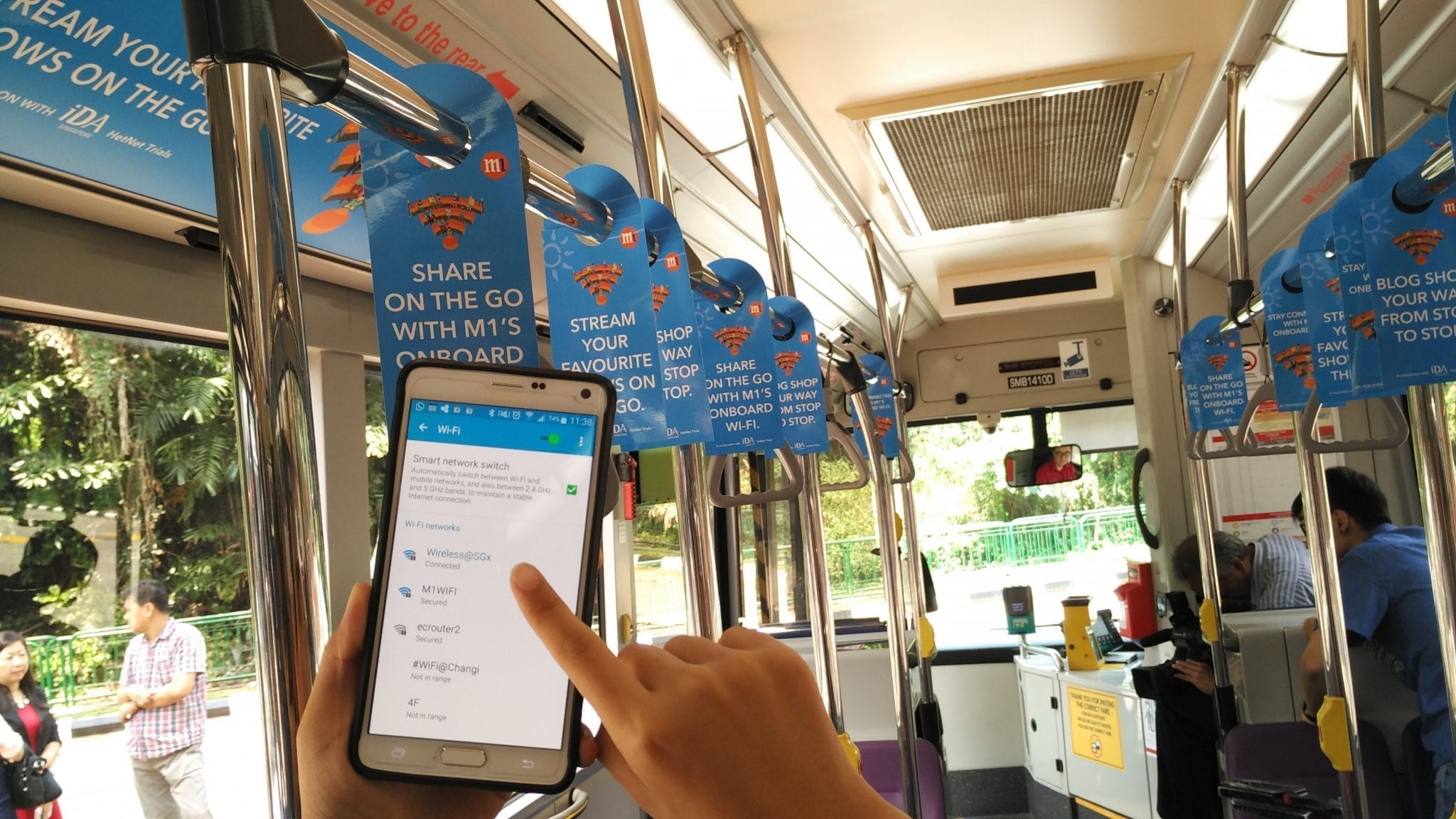
    Commuters on selected SMRT Service 176 buses can now use Singapore’s first WiFi-On-The-Go service, as part of the heterogeneous network (HetNet) trials.

    The HetNet Trials are meant to validate advanced telecommunication technologies, and a network’s capabilities in providing pervasive and seamless connectivity in a real-life setting.

    Each connected bus is linked to M1’s 4G+ network through an intelligent in-vehicle unit that boosts the bandwidth available to the on-board wireless network.

    Commuters on the buses, a trunk route service linking Bukit Merah Interchange and Bukit Panjang Temporary Bus Park can go online by connecting to the “Wireless@SG” network on their smart devices. Commuters will be able to identify the two WiFi-enabled buses through on-board signages highlighting the service.

    M1’s carrier WiFi service will also be available on the buses by end-April. The M1WiFi service, with download speeds more than ten times faster than available through Wireless@SG, will seamlessly handover customers between M1’s mobile network and the WiFi-On-The-Go service before, during and after their journey, to enable them to able to enjoy activities such as streaming HD video content without interruption.

    In addition to passenger benefits, WiFi-On-The-Go can help business by enabling new applications. For instance, inbound tour operators can now provide tourists with WiFi on board their tour buses. Vehicle fleet operators can also use the enhanced connectivity to stream live video and collect other relevant information from the vehicle, as well as provide transactional services.

    “HetNet technological innovation is expected to bring about immediate and long term benefits for citizens. With the enhanced infrastructure, as a start, users in trial areas such as MRT stations and selected buses powered by M1, can now experience better coverage with seamless connectivity, IDA assistant CEO Khoong Hock Yun said.

    “Beyond the trials, we look forward to working closer with companies in the tech, engineering and R&D space to develop solutions that can meet pressing connectivity challenges.”