Retail News CRM

Tag: pork

  • Vietnam Tops Southeast Asia in Pork Consumption: A Look at the Nation’s Soaring Demand

    Vietnam Tops Southeast Asia in Pork Consumption: A Look at the Nation’s Soaring Demand

    Based on a report from the Ministry of Industry and Trade’s Department of Domestic Market Management and Development, Vietnam holds fourth place globally and tops the ranks in Southeast Asia in terms of pork consumption. Forecasts predict that by 2025, each individual in the country will be consuming nearly 39 kg of pork.

    The Role of Pork in Vietnamese Diet

    Pork remains a significant part of diets in Vietnam, as the country’s high consumption rate reflects. In addition, it significantly influences the national Consumer Price Index (CPI). Recent data illustrates a continuous rise in domestic pork consumption annually. In 2021, the average person consumed approximately 30 kg, which increased to around 37 kg in 2024 and further rose to nearly 39 kg the following year. Currently, the consumption of pork makes up over 63% of the total consumption of livestock products.

    Impact on the Market and CPI

    Pork is a food item that significantly affects the food market and the CPI, according to the department. As the Lunar New Year, or Tet, approaches, pork demand typically surges by around 10-15%. Last year, there was strong growth in the livestock industry, producing 8.6 million tonnes of various meats, of which 5.4 million tonnes were pork. This amount is sufficient to ensure an adequate supply for the upcoming Tet holiday.

    Pham Kim Dang, the Deputy Director of the Department of Animal Husbandry and Veterinary Medicine, expressed concerns over a potential supply shortage due to natural disasters and disease outbreaks the previous year. However, she assures that the current pig population of 31.4 million is more than enough to meet the demand for the Tet holiday.

    Current Pork Pricing

    Presently, the market price for live pigs is around VND71,000-74,000 (US$2.73-2.85) per kg. Despite being slightly lower than the previous month, experts consider this price to be still quite high. There were instances in January when the price reached up to VND81,000 per kg, which was unusual.

    Nguyen Xuan Duong, the Chairman of the Vietnam Livestock Association, believes that the prices of pork are swayed by speculative trading and the behaviours of small traders. Pork plays a large part in the Vietnamese consumer basket and is deemed an essential good. Therefore, a significant rise in pork prices could directly impact the people’s livelihoods and the national CPI.

    Questions & Answers

    What is the annual per capita consumption of pork in Vietnam?
    The annual per capita consumption of pork in Vietnam is predicted to reach nearly 39 kg by 2025.

    How does pork consumption affect the Vietnamese economy?
    Pork consumption significantly impacts Vietnam’s food market and the Consumer Price Index (CPI), particularly because it makes up over 63% of the total consumption of livestock products.

    What factors influence the price of pork in Vietnam?
    The price of pork in Vietnam is influenced by speculative trading, the behaviours of small traders, and the supply and demand dynamics, particularly during the Lunar New Year when demand typically surges by around 10-15%.
  • Allegro Funds Invests In Be Campbell: A Strategic Move To Modernise And Expand Operations

    Allegro Funds Invests In Be Campbell: A Strategic Move To Modernise And Expand Operations

    BE Campbell, an Australian pork processing company, has recently obtained an investment from Allegro Funds as part of their growth strategy. The Sydney-based, third-generation family business employs over 750 individuals and provides services to supermarkets, butchers, foodservice operators, and distributors throughout Australia.

    Investment for Expansion

    The capital acquired from Allegro Funds will be utilized to modernise BE Campbell’s processing operations, diversify its product offerings, and enhance its commercial platform. Ted Campbell, the company’s chairman, expressed that the investment is seen as an avenue to fortify the company whilst preserving its legacy and long-standing relationships within the supply chain.

    “Over the past 55 years, our business has seen consistent growth,” he said. “We are eager to continue working closely with our dedicated growers, suppliers, customers, and staff to deliver top-tier products to Australian consumers.”

    Stake Ownership

    Allegro Funds will hold the majority stake in BE Campbell. However, the Campbell family will maintain a significant but undisclosed stake and continue to participate in the company’s management.

    Jeffrey Largier, Managing Director of Allegro Funds, expressed their excitement at the prospect of the partnership with Ted Campbell, the Campbell family, and the entire BE Campbell team. According to Largier, BE Campbell’s established market position and strong track record were key attractors for the investment firm.

    Questions & Answers

    What will the investment from Allegro Funds be used for within BE Campbell?
    The investment will be used to modernise BE Campbell’s processing operations, diversify its product offerings, and expand its commercial platform.

    Who will hold the majority stake in BE Campbell post-investment?
    Allegro Funds will hold the majority stake in the company post-investment.

    Will the Campbell family remain involved in the company’s management post-investment?
    Yes, the Campbell family will retain a significant stake and continue participating in the company’s management.

  • C.P. Vietnam Acknowledges Diseased Pork in Viral Image Originated from Its Site, But Denies Selling It

    C.P. Vietnam Acknowledges Diseased Pork in Viral Image Originated from Its Site, But Denies Selling It

    A recent Facebook post by Jonny Lieu—who claims to be a former C.P. employee—has ignited significant concern regarding the safety of meat products produced by C.P. Vietnam, a major player in the country’s meat industry. The post, which circulated widely, featured alarming images of diseased pork, triggering a wave of discussions about food safety across Vietnam.

    Confession from C.P. Vietnam

    On Monday, a representative from C.P. Vietnam confirmed that the disturbing images were taken on March 26, 2022, at the Dung Nga slaughterhouse in Hau Giang province—an establishment that operates under C.P.’s own stringent standards. Arresting the growing tide of concern, the owner, Tran Thi Nga, clarified that her facility slaughters between 30 and 40 pigs daily. On the specific day in question, several pigs exhibited signs of skin disease. These infected pigs were never sold to consumers; instead, they were repurposed as fish feed after being inspected by C.P. executives.

    Conditions at the Slaughterhouse

    The two pig pieces featured in Lieu’s post, weighing in at a hefty 72.7 kilograms, were declared safe for processing as fish feed, denying any allegations of risky meat entering the consumer market.

    Lieu further alleged that during his time working at a C.P. retail outlet in the nearby Soc Trang Province, he observed numerous instances of diseased meats being sold to consumers—products he described as having lumps, abscesses, bad odors, or pus. Backing up his claims, he shared photos and screenshots of internal communications to illustrate the alarming situation.

    Regulatory Actions Unfold

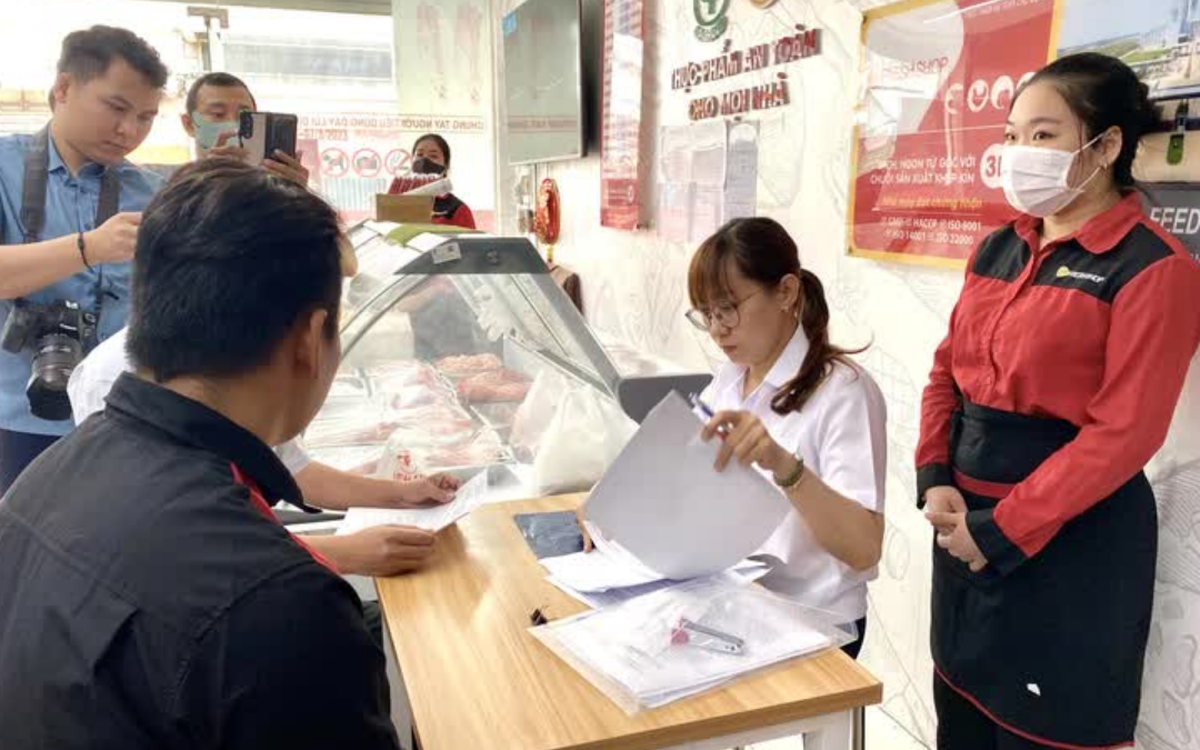
    Despite these serious allegations, a recent raid of multiple C.P. outlets in Soc Trang revealed no major safety violations. However, one particular store was found to have let its food safety certificate lapse back in early March, lacking the necessary documentation for food safety training of its staff. The inspection team swiftly sealed the store, issuing an ultimatum to present the required certifications within five days.

    Established in 1993 as a subsidiary of Thailand’s Charoen Pokphand Group, C.P. Vietnam has developed extensive operations across the country, specializing in poultry, pork, eggs, seafood, and processed foods. The company is well-known for its sausages, pre-marinated chicken, and an array of convenience items. While C.P. leads in the market, it now faces a challenge to restore consumer trust following these alarming revelations.

    Questions & Answers

    What sparked the concern over C.P. Vietnam’s meat products?
    A Facebook post featuring images of diseased pork allegedly from a C.P. facility raised significant concerns about the company’s meat safety.

    What actions did authorities take in response to the allegations?
    Authorities raided several C.P. stores in Soc Trang, though no major safety violations were found; one shop was closed for not renewing its food safety certificate.

    What is C.P. Vietnam known for?
    C.P. Vietnam specializes in poultry, pork, eggs, seafood, and processed foods, including popular convenience items like sausages and marinated chicken.

  • Pork producers struggle with losses last quarter

    Pork producers struggle with losses last quarter

    Major pork producers posted losses in the last quarter of 2022 as animal feed costs rose and consumer demand dropped as people tightened spending.

    Dabaco Vietnam, the country’s biggest husbandry firm, recorded a VND79 billion ($3.34 million) loss in the last quarter, the first quarterly loss in five years.

    BaF Vietnam saw expenses exceed revenue by VND6 billion for the first time since 2021, but thanks to selling some assets the company posted an overall profit of nearly VND7 billion.

    Masan MeatLife posted a loss of VND170 billion during the last quarter of the year, and recorded a loss of VND230 billion for the entire year, the first loss since it started releasing financial figures in 2016.

    Since the end of 2021 the company stopped producing animal feed and focused only on meat, contributing to its losses.

    Hoang Anh Gia Lai recorded VND110 billion in profit from its pork sales in the last quarter, a 36% drop from the third quarter.

    Hoa Phat Group’s agriculture and husbandry business was in the red with more than VND34 billion in losses in the last quarter.

    For the whole year, the company saw this business posting a profit of VND22 billion, its lowest profit since 2016.

    BaF said that pig diseases, disruptions in supply and rising input costs negatively impacted the company’s earnings. Dabaco added that the decline in consumer demand also contributed to the losses.

    Pork prices in December dropped 15%-20% from October to VND50,000 per kilogram as supply exceeded demand.

    Last year, pig supply rose 11% from 2021.

    Analysts of brokerage expect pork prices to rise 5% this year as demand recovers and input costs begin to stabilize globally.

    However, SSI Research forecast that pork prices are set to rise 20% to VND60,000 per kilogram this year, with the reopening of China helping to pump up demand.

    However, the strong U.S. dollar and the African swine fever will remain possible risks to the sector, they added.

  • Imported pork prices dip to record low over low demand

    Imported pork prices dip to record low over low demand

    Import pork prices have fallen to a record low at half their domestic equivalents due to modest demand at restaurants and hotels.

    Import pork prices have fallen by 36-40% year-on-year with ribs costing around VND88,000 ($3.76) per kilogram, half the domestic figure.

    Hanh, a pork seller in Ho Chi Minh City’s District 12, said that there has been weak demand for imported pork since the beginning of the year.

    “We sell imported pork mostly to restaurants, but consumption has been falling there, causing prices to drop.”

    Hanh has lowered her import by 30% year-on-year.

    Thanh, a seller in Go Vap District, stopped selling imported pork from Russia two weeks ago.

    “Only a few customers come by each day, and I was recording losses. I decided to stop selling it.”

    Tran Hoan, a media representative for a pork importer in HCMC, said that restaurants and hotels are the biggest buyers of this product, but they have not been buying because consumption is week.

    In the first six months, pork imports fell 48.7% in value to $96 million, according to Vietnam Customs.

    Brazil accounted for 35.1% of the value, followed by Russia, 25.7%, and Germany, 16.6%.

    An average kilogram of imported pork is priced at VND50,000-60,000, compared to domestic fresh pork prices of VND100,000-170,000.

  • Vietnamese fork out less for pork

    Vietnamese fork out less for pork

    Vietnamese families have been consuming less pork in recent months as prices increased, switching to other sources of protein like chicken and eggs.

    Ngoc Thao from HCMC, 32, said that one kilogram of bacon now costs between VND150,000-180,000 ($6.43-7.72), depending on whether it is purchased at a traditional wet market or a supermarket.

    Cheaper cuts of pork, such as cutlet and thigh, range from VND100,000-130,000 per kilogram, which is twice or thrice the price of chicken.

    “The prices of vegetables, spices and many other things have skyrocketed, but my salary remains unchanged, so I must cut back on my spending on expensive stuff,” she said, sighing.

    “Now our family has meat only for one or two meals per week.”

    A survey of livestock farms at the end of June found that the price of live pigs had crossed VND60,000 per kg, a slight increase from previous days.

    The majority of farmers said the price has increased because the cost of animal feed has increased. Prices of new born pigs have also increased by 20 percent compared to two months ago.

    According to the Organization for Economic Cooperation and Development (OECD), the majority of Vietnamese people have been eating less pork, like Thao’s family.

    From 2016-2018, Vietnam had one of the highest average pork consumption rates in the world at 30-31 kg per person per year. However, during the first two years of the pandemic, this fell to 26 kg.

    Data from Ipsos, a multinational market research firm based in France, showed similar results by compiling statistics on the entire supply of cattle and poultry farms in 10 key livestock provinces and cities, in conjunction with official import and export volume, quotas, and meat products.

    It calculated that each Vietnamese person used to consume about 30 kg of pork per year, but by 2021, this had dropped to 23.5 kg.

    According to Phong Quach, director of Ipsos Vietnam, per capita meat consumption in Vietnam has been increasing as living standards improve, and consumers have more meat sources to choose from.

    He said there were three reasons why pork was no longer the top priority.

    First, the African swine fever got people worried and also severely impacted global supply.

    Second, the price of pork kept rising sharply, albeit intermittently, as input costs like that of logistics rose significantly.

    Third, people were cutting back on spending in the post-Covid period and seeking cheaper animal protein sources than pork.

    For several years now, per capita consumption of poultry (primarily chicken) has increased rapidly – from 12 kg in 2016 to 20 kg now.

    Seafood has surpassed pork as the most important source of protein for Vietnamese people, accounting for per capita consumption of 29 kg per year.

    Per capita consumption of beef, which is more expensive than other meat, has increased slightly from 4.3 kg to 5 kg per year.

    The VNDirect Securities Company said in a meat industry analysis published at the end of May: “We believe that demand for meat is likely to increase when kids are on their summer break while restaurants and industrial kitchens continue to consume at the same rate as the first quarter of this year.”

    Quach said the fact that some local pig farms have sold their complete stock after the African swine fever outbreak will further decrease supply and increase prices in the coming months.

    The price of live pigs for slaughter is expected to remain at above VND60,000 per kg, higher than the VND51,000-54,000 range recorded between October 2021 and April 2022.

    The pressure to balance spending amidst rising prices makes short-term consumption recovery difficult, market observers say. But they add that despite the current situation, the pork market has a lot of room for future growth.

    According to the CEO of a publicly traded food company, the pork market is worth about $10 billion, but 90 percent of the products sold are unbranded.

    Meanwhile, consumers are becoming more health-conscious, and demand for branded, traceable meat products will rise once the price storm passes.

    According to the OECD, each Vietnamese person will consume approximately 27.7 kg of pork by 2023, a 7 percent increase over last year.

    By 2029, this figure could rise to 32.7 kg, higher than the pre-pandemic period, and surpass South Korea and China to take the lead in global per capita consumption.

  • Pork imports nearly triple

    Pork imports nearly triple

    Frozen pork imports nearly tripled in the first 10 months of this year to 332,000 tons, according to the General Department of Vietnam Customs.

    Also imported were 350,000 pigs on the hoof from Thailand, a 50 percent increase year on year.

    Together they cost US$617 million. Its five biggest pork suppliers were Russia, Germany, Brazil, the Netherlands, and Canada.

    Vietnam also imported 50,000 tons of beef worth $220 million, half of it from Australia, the department added.

    Over 800 enterprises from 19 markets have been allowed to export pork to Vietnam, according to the Ministry of Agriculture and Rural Development.

  • Pork imports surge 382 percent

    Pork imports surge 382 percent

    Vietnam has imported 141,140 tons of pork and related products in 2020, up 382 percent year-on-year, the General Department of Vietnam Customs has reported.

    The import value in 2020 increased 503 percent to $334.44 million, it said.

    The rising pork imports are attributed to the low domestic supply caused by the Covid-19 pandemic, African swine fever, and the central Vietnam floods, according to the Ministry of Industry and Trade.

    Brazil is the largest pork supplier with 24.5 percent of the total pork import value, followed by Russia with 24.1 percent and the U.S. with 13.7 percent.

    Over 800 enterprises from 19 markets have been allowed to export pork to Vietnam, according to the Ministry of Agriculture and Rural Development.

  • Pork prices keep rising to new highs

    Pork prices keep rising to new highs

    Low supplies courtesy of the African swine flu epidemic have pushed pork prices up 29.6 percent from a month earlier.

    Small-scale farmers in the northern region were selling pork at VND92,000 ($4) per kilogram, up 29.6 percent from the five-year high of VND70,000 ($3) that was reached last month.

    Industry insiders said the rise followed price increases by major pork producers. The C.P. Group, which has been increasing its pork prices steadily, has a sales price of VND81,000 ($3.5) per kilogram now.

    At the Hoc Mon wholesale market in Ho Chi Minh City, pork supply has fallen by 23.5 percent from earlier this month to 287 tons a day.

    Nguyen Tri Cong, chairman of the Dong Nai Livestock Association, said farmers in the southern province were unable to increase supply despite a high profit margin of around 50 percent at current high prices.

    Authorities have been seeking to stabilize pork prices as Tet, the Lunar New Year, approaches (last week of January 2020). This is a time when demand for pork soars. One of the solutions proposed was to increase imports.

    But Doan Ngoc Tho, CEO of meat importer THO Group, said at a recent meeting that global supply of pork has also reduced. The FOB (freight on board) prices at Vietnamese ports have doubled to $4 per kilogram, excluding taxes, he said.

    Vietnamese importers also have to contend with China importing large quantities of pork from Europe, he said.

    Furthermore, Tho said, selling imported pork has become difficult because their prices are higher than domestic pork.

    The African swine flu has claimed the lives of 5.9 million pigs since it broke out in Vietnam in February, according to the General Statistics Office. As of October, the number of pigs in stock had fallen by 20 percent year-on-year, it said.

    The country will likely face a pork shortage of 200,000 tonnes by Tet 2020, according to the Ministry of Industry and Trade.

  • Pork prices push November inflation to 9-year high

    Pork prices push November inflation to 9-year high

    Rising prices of pork and processed meat raised the November consumer price index (CPI) a record 0.96 percent over the previous month.

    Dwindling supply of pork following the African swine flu outbreak in Vietnam saw prices of pork and other processed meat products to soar in November, leading to the biggest CPI increase in 9 years, according to the latest report by the General Statistics Office (GSO).

    However, over the last 11 months, the CPI had only risen by 2.57 year-on-year, the lowest increase in the last three years. The CPI in November, compared to December-end 2018, had increased by 3.78 percent.

    Speaking to VnExpress, merchants in Ho Chi Minh City said that prices of pork substitutes such as beef and seafood rose as customers made the switch, coupled with heightened demand as the New Year approaches.

    Vietnam has had to cull 5.9 million pigs infected with African swine fever since the beginning of the year, equivalent to 337,000 tons of pork, according to Phung Duc Tien, Deputy Minister of Agriculture and Rural Development.

    This has resulted in pork prices rising by 19 percent since last November and could rise by a further 10-15 percent by the end of this year with an expected shortage of 200,000 tons, according to the GSO.

  • Pork price hikes drive up related food costs

    Pork price hikes drive up related food costs

    Pork prices have surged following the African swine flu outbreak in Vietnam, driving up prices of related food in supermarkets and restaurants.

    Over the last two months, the prices of pork products at many supermarkets and food stores in Ho Chi Minh City rose 5-25 percent.

    For instance, the price of pork sausages has risen from around VND120,000 ($5.2) to VND150,000 ($6.5) per kilogram, and that of higher-end sausages from VND150,000 ($6.5) to VND210,000 ($9.1).

    Hoa, the owner of a food store in HCMC, said that over the past week, all suppliers have announced price increases of VND3,000-20,000 (13-86 cents) on each kilogram of pork, forcing her to adjust prices accordingly.

    “Many merchants have advised me to buy in bulk now and store the pork because prices will rise even further as demand rises and supply dries up,” Hoa said.

    Similarly, restaurant owners in HCMC have raised the prices of rice and noodles dishes with pork as an ingredient, which on average cost around VND30,000 ($1.3), by VND2,000-5,000 (9-22 cents) each.

    “I can’t raise prices too much or it will shock my guests, so I have to do a balancing act of cutting smaller portions of pork, finding cheaper suppliers,” said Hue, a restaurant owner in Go Vap District, HCMC.

    Vietnam has had to cull 5.9 million pigs infected with African swine fever since the beginning of the year, equivalent to 337,000 tons of pork, according to Phung Duc Tien, Deputy Minister of Agriculture and Rural Development.

    This has resulted in pork prices rising by 19 percent since last November, and could rise by a further 10-15 percent by the end of this year with an expected shortage of 200,000 tons, according to the General Statistics Office (GSO).

    While the consumer price index in November is forecast to reach 0.8-1 percent, pork alone is expected to contribute 0.75 percentage points to this increase, GSO officials said at a government meeting urgently called Monday to find ways to limit the surge in pork prices.

    At the meeting, the government assigned the Ministry of Industry and Trade to monitor and forecast upcoming pork shortages every month, so that the government could import enough quantities to ensure balance in demand and supply and control prices.

  • Vietnam considers more pork imports as prices surge

    Vietnam considers more pork imports as prices surge

    The government has asked the agriculture ministry to look into increasing pork imports as supply plunges and prices reach 3-year high.

    The order, signed by Deputy Prime Minister Vuong Dinh Hue, seeks to stabilize pork prices, which have been surging since earlier this month and are now at a 3-year high of VND60,000-70,000 ($2.6-3) per kilogram.

    Experts have also expressed concerns that the recent price surge follows increasing exports to China. In January-August the country exported $449 million worth of meat, up 3.6 percent year-on-year from 2018, mostly because of the rise in pork exports to China.

    Domestic supply has been falling since the African swine fever broke out in February and spread to all localities. Almost 5 million pigs have been culled because of the virus, the Ministry of Agriculture and Rural Development estimated.

    In January-September, pig stock in the country dropped 19 percent year-on-year, while pork supply fell 9 percent, according to the General Statistics Office.

    Vietnam, the world’s fifth-largest pork producer last year, is at risk of a 500,000-ton shortage of pork, or 20 percent of total demand, between July and next February, according to global market research firm Ipsos Business Consulting.

    In the first seven months, Vietnam imported $22.1 million worth of pork, 4.3 times that of the same period last year, according to the Ministry of Agriculture and Rural Development. Major import markets were Brazil, the U.S. and Poland.

    About 70 percent of all meat consumed last year in Vietnam was pork, according to the ministry.

  • Increasing pork prices in China a magnet for Vietnamese traders

    Increasing pork prices in China a magnet for Vietnamese traders

    Vietnamese traders are exporting pork to China despite forecasts of declining domestic supply due to outbreaks of the African swine fever.

    Tam, who buys pork in the south, said his exports to China have increased in the last two months, and fetch a margin of VND500,000-1 million ($22-43) per pig. “Prices are high in China because it stopped buying from the U.S.”

    Nguyen Kim Doan, deputy chairman of the Dong Nai Breeding Association, said traders are selling Vietnamese pork to China because of the large gaps in prices in the two countries.

    Pork costs CNY26.67 ($3.7) in China and just VND50,000 ($2.2) in Vietnam, a 43 percent difference.

    China, the world’s top pork consuming nation, earlier this month canceled orders to buy 14,700 tonnes of U.S. pork as the trade war between the two largest economies continued. Industry insiders have forecast prices in China to increase by 70 percent from last year in the coming months.

    In Vietnam, they have risen by up to 28 percent to VND50,000 ($2.2) in the north and VND40,000 ($1.7) in the south since supply has been falling after African swine fever swept the country.

    Some 4.7 million pigs have been culled since the disease was first detected in February this year.

    Producers are reluctant to return to the business after having to cull infected animals, the Department of Processing and Market Development of Agriculture Products said.

    It estimated prices to rise further, especially during Lunar New Year Festival (Tet) next January.

    Vietnam could face a shortage of 500,000 tons in the second half of this year, or 20 percent of demand, according to market research firm Ipsos Business Consulting.

    In January-August the country exported $449 million worth of meat, up 3.6 percent year-on-year from 2018, mostly because of the rise in pork exports to China.

    All provinces and cities have reported the disease, which does not pose a risk to humans but is fatal to pigs.

    Pork accounts for three-quarters of meat consumption in Vietnam, a country of 95 million.

    African swine fever was first detected in Asia last year in China, the world’s largest pork producer. Half of its breeding pigs have died or been slaughtered because of the disease, twice as many as officially reported.

  • Chicken rice eatery Liao Fan opens in Malaysia

    Chicken rice eatery Liao Fan opens in Malaysia

    Michelin-starred chicken rice restaurant Liao Fan has opened its first Malaysia outlet. Located in Ipoh, Chan Hon Meng’s birthplace, the outlet attracted a big crowd and all the food sold out on the soft-opening day last week.

    Singapore’s street food hawker Chan Hon Meng made headlines in 2016 when his soy-sauce chicken rice dish received a Michelin star. The Liao Fan Hawker Chan stall became one of the first street-food stands in the world to receive the award and also the cheapest Michelin-star meal in the world.

    The Liao Fan Hawker Chan Malaysia is non-halal as the restaurant also sells pork dishes.

  • Vietnamese pork banned in several countries

    Vietnamese pork banned in several countries

    Some countries and terriories are banning pork imports from Vietnam following the recent outbreaks of African swine fever in the country. Violators of the ban face fines and even imprisonment. Taiwan has announced that Vietnamese people coming in with pork products would be fined about $6,500, according to Vietnam’s Ministry of Foreign Affairs.

    The fine will go up to $33,000 if a passenger is caught for a second time and denied entry if they do not pay the fine in full.

    A Vietnamese woman was fined $6,500 for bringing a pork snack into Taichung airport in central Taiwan on February 27.

    Vietnam Airlines has been warning passengers against carrying pork items into Japan and Australia.

    Passengers carrying raw or processed foods to Japan from Vietnam must have a certificate of safety, failing which they face three years’ imprisonment or a fine of JPY1 million ($8,900).

    In Australia, passengers must declare all foods made from plant or animal ingredients or face a fine of AUD420,000 ($298,032).

    Dubai, the U.K. and the U.S. also prohibit pork products from Vietnam.

    Following China and Mongolia, Vietnam has become the third Asian country hit by the incurable African swine fever, which has been detected in the cities of Hanoi and Hai Phong, and four provinces of Thai Binh, Hung Yen, Ha Nam, Thanh Hoa and Hai Duong.

    The flu is a viral disease that infects all pig species through bodily fluids such as blood and mucus. It causes hemorrhagic fever with a 100 percent mortality rate.

    Humans are not affected by the disease.