Competing visions for the future of Pomelo have seen several founders forced out of the company in recent months amid allegations of physical intimidation, threatening emails and defamatory public statements. The Myanmar Times‘ RJ Vogt investigates what went wrong at Yangon’s best-loved social enterprise.
One of Yangon’s most popular social enterprises, Pomelo, is being torn apart by an ownership dispute built on fundamental questions over how it should develop in the future.
The founder, general manager and lead designer say they have been forced out of the business, locked out of the store and even physically intimidated in recent weeks as the dispute has escalated.
According to the original Myanmar partner, however, the recent registration of the business as Pomelo Company Limited (PCL) and subsequent changes in management were necessary to protect its local partners from the business being placed “under a foreign entity”.
In an interview with The Myanmar Times, Daw Thea Thea said she registered PCL in order to preserve what she believed was Pomelo’s original purpose: to create a producer-focused marketplace.
“The worst part during the process of reforming governance was when they decided to register as a foreign company,” she said. “It felt like foreign people were taking over the shop. A lot of people raised the question – why does a foreigner want to be the owner of the shop?”
But Pomelo co-founder Rachael Storaas says Pomelo was never going to be solely foreign-owned. She and her team had planned to set up a joint-venture in order to expand the company so it could provide more training and profits to a growing number of producers. It was always going to be a non-profit, Myanmar-focused business, she insists.
“Pomelo is not about foreigners against Myanmar nationals,” she said. “It is about working together. It is to show that Myanmar products are successful, well-made, ethically produced products. And we helped to design, develop and sell these products.”
During a messy and tumultuous February, both sides have sought legal counsel. The Myanmar Times was provided with threatening emails from a PCL adviser, in which the person suggested the recipient could face a protracted court case and deportation. Surveillance cameras at the store also showed the PCL adviser pushing Ulla Kroeber, the former lead designer, during an altercation on February 17.

The store remains open, but the website notes that those running it are not the ones who directed its growth for the last four years.
Amid the dispute, the 50-plus producer groups who sell goods at Pomelo have been largely relegated to the sidelines, waiting to find out the future of the business that offered them an opportunity to sell their goods.
Pau Son, from the upcycling group Shin Thant, said he was not consulted about the recent personnel changes. Other producer groups he has contact with were also in the dark, he said.
“It’s really rude … It’s horrifying,” he said in an interview on February 24. “This is not Myanmar people’s style. The one thing I’m disappointed in is that they should have met with us before they did this.”
Seeds of contention
The struggle has roots dating back to the company’s establishment as a souvenir shop in 2013. Rachael Storaas and Annie Bell, the co-founders, envisioned Pomelo as a social enterprise that would offer Myanmar people a marketplace for sustainably sourced goods, such as recycled notebooks and decorative art. But because Myanmar lacked – and still lacks – the legal infrastructure to licence a social enterprise, Storaas and Bell teamed up with Daw Thea Thea to register the company as a souvenir shop with Yangon City Development Committee.
Pomelo needed to be registered to a local because foreigners are not allowed to conduct retail operation in Myanmar, so the shop was set up under Daw Thea Thea’s name only.
Daw Thea Thea says she had been considering setting up Pomelo as far back as 2008. She also organised the early discussions in 2012 that led to its registration the following year, she said.
“This is a dream we all started together,” she said.
In just two years, Pomelo rapidly grew from one producer group to more than 50. Ulla Kroeber, an architect from Germany, joined the team as the lead designer. Paula Camba served as a general manager before stepping down to be a volunteer, with Natalie Ortiz as her replacement. The company began to offer training in product design to its producer groups, as well as English lessons and other services. A location within, and then later next to, the popular Monsoon restaurant ensured a steady flow of tourist foot traffic. The shop was soon featured in The New York Times, Lonely Planet and TripAdvisor.

It appears that producer groups may soon have a choice between Pomelo Company Limited and a new store, to be created by the ousted foreigners.
By 2015, Pomelo was clearly outgrowing its souvenir shop status. Filling bulk orders from the United Nations proved near-impossible when the business bank account was technically that of a private individual. Exporting goods overseas required an export licence, which souvenir shops cannot apply for. The souvenir shop had only an unofficial board, comprising Ms Storaas, Ms Bell, Daw Thea Thea and other volunteers, that was often split on issues such as exclusivity agreements with producers. Ms Storaas even admits to harbouring concerns that Pomelo was not paying the appropriate amount of taxes because it was technically just a souvenir shop.
Ms Storaas and her team began consulting with international law firm Baker & McKenzie for advice on changing the company’s structure.
“I approached the law firm for assistance so that Pomelo could be, as properly as possible in Myanmar today, registered correctly with myself, Ulla Kroeber, Paula Camba and of course Daw Thea Thea as shared owners,” she said on February 25.
British Council adviser Don MacDonald told the Pomelo leadership to consider starting two new companies in tandem. One would be a foreign-domestic joint venture, to handle all of Pomelo’s product development, producer training and expansion; the other, purely domestically owned, would handle the retail shop.
“The aim of our work was to produce a draft constitution, which would involve local producers, along with a marketing plan and a plan for sharing ‘profits’ with local producers,” Mr McDonald said.
But this proposal did not sit well with Daw Thea Thea and some others involved in Pomelo. She says she was not involved in the process – something that Ms Storaas refutes – and felt excluded from decision making. Bringing foreign ownership to Pomelo, in her mind, was a step away from the original purpose of serving local Myanmar people. She advocated splitting power three ways, between producer groups, Myanmar owners and foreign advisers. That’s when she says the foreign side increasingly began to freeze her out.
But Ms Storaas says that the proposed changes came with several key stipulations to preserve local producers’ interests, including that the company would only benefit locals, that profits would always be channelled to develop production and that the new arrangement would be temporary until Myanmar laws allowed a better way to register a social business.
She says Daw Thea Thea was explicitly promised at a December 11 meeting that “all profits would be reinvested back into the company” and given a week to think it over. The follow-up meeting never occurred, and by mid-January a new version of Pomelo had been registered with the Directorate of Investment and Company Administration. According to the DICA website, PCL was registered to the address of Helping Hands, a producer group run by Ms Bell, and had two board members: Daw Thea Thea and Daw Htar Htar of Akhaya Women’s Association.
A hostile transition
Two weeks later, Daw Thea Thea and Daw Htar Htar delivered letters of notice to Ms Kroeber, Ms Camba, Ms Bell and Ms Storaas, thanking them for their time and informing them that their expertise was no longer needed.
Ms Kroeber described her firing at the store on February 4 as “aggressive”. Daw Thea Thea and Daw Htar Htar were accompanied by Ms Bell and Neil MacIntyre, who is listed online as the founder of a children’s nutrition drink company but had not previously been involved with Pomelo.
The letter Ms Kroeber received gave her just four hours to hand over all company information, passwords and keys. Having been living in the Pomelo office while on extended work visits in Yangon, she was also forced out of her accommodation. Ms Ortiz – Pomelo’s only full-time, salaried foreign employee – received a similar letter, though her position was not terminated. Instead, she was instructed to report directly to the PCL board on all PCL-related matters.
Pomelo’s iconic vinyl bags owe design influence to Ulla Kroeber, one of several foreign members of Pomelo’s team who has been forced out of the company.
The first many people heard about the dispute was when Ms Storaas sent a mass email on February 7 giving her side of the dispute and explaining there had been a “difference of opinion” over the future direction of the store.
The email said that the formation of PCL and the terminations were “in no way originating from the current Pomelo team. The team was furthermore not in any way consulted, nor were the community of producers.
“There is a great risk of harm to Pomelo, a great risk to undo what has been achieved and at the end of the day a great risk to the income generated for an increasing number of vulnerable groups of producers,” she wrote.
Shortly afterward, the threats began, Ms Storaas said. She received an email, signed as the “Pomelo Board”, telling her she could expect to face legal action, including defamation and charges under the Electronic Transactions Act.
Mr MacIntyre followed up with an email on February 15, written in Norwegian, which Storaas speaks.
“We are determined to ensure that you are kept in this country so that we can have a court case against you to reinstate our reputation,” he wrote. “This will be a slow process. Today, while you still can, you might want to get yourself out of the country.”
Mr MacIntyre refused to confirm whether defamation charges had been filed.
The Myanmar Times was also shown security camera footage of Mr MacIntyre pushing Ms Kroeber as well as her husband, Mr Hans ten Feld, in the Pomelo store on February 17.
Asked for comment, Mr MacIntyre wrote in an email, “There are provisions in the Myanmar Penal Code where a person is allowed to use non-excessive force to prevent a crime against, or to safeguard the damage to property or person; himself or another.”
He also explained that drawing distinction between “former management” and the “new Pomelo Company Limited” is incorrect.
“There is no new Pomelo Company Limited. Let me emphasise that there was never a former management. There were usurpers who, by criminal use of force, took over illegal possession of the premises. This required the rightful entity to legally take repossession,” he wrote.
A few days after the alleged altercation, local police contacted the shop staff, instructing them to hand over the keys to the store to the PCL board members. The lease to the shop was in the name of a Myanmar employee, rather than Daw Thea Thea or Pomelo. On February 20, this person was called to a meeting at Botahtaung police station, so she brought Ms Kroeber and Ms Storaas with her. They refused to give the keys without a written explanation from the police as to why PCL had the right to take over the premises.
The police refused to put anything in writing and Daw Thea Thea and Daw Htar Htar left without the keys. By Monday, February 22, the shop’s locks had been removed and changed, according to the ousted foreign sides.
Daw Thea Thea, Ms Storaas and an independent local lawyer confirmed the meeting with police took place. But multiple police officers at Botahtaung police station said they knew nothing about any dispute at Pomelo.
What’s next?
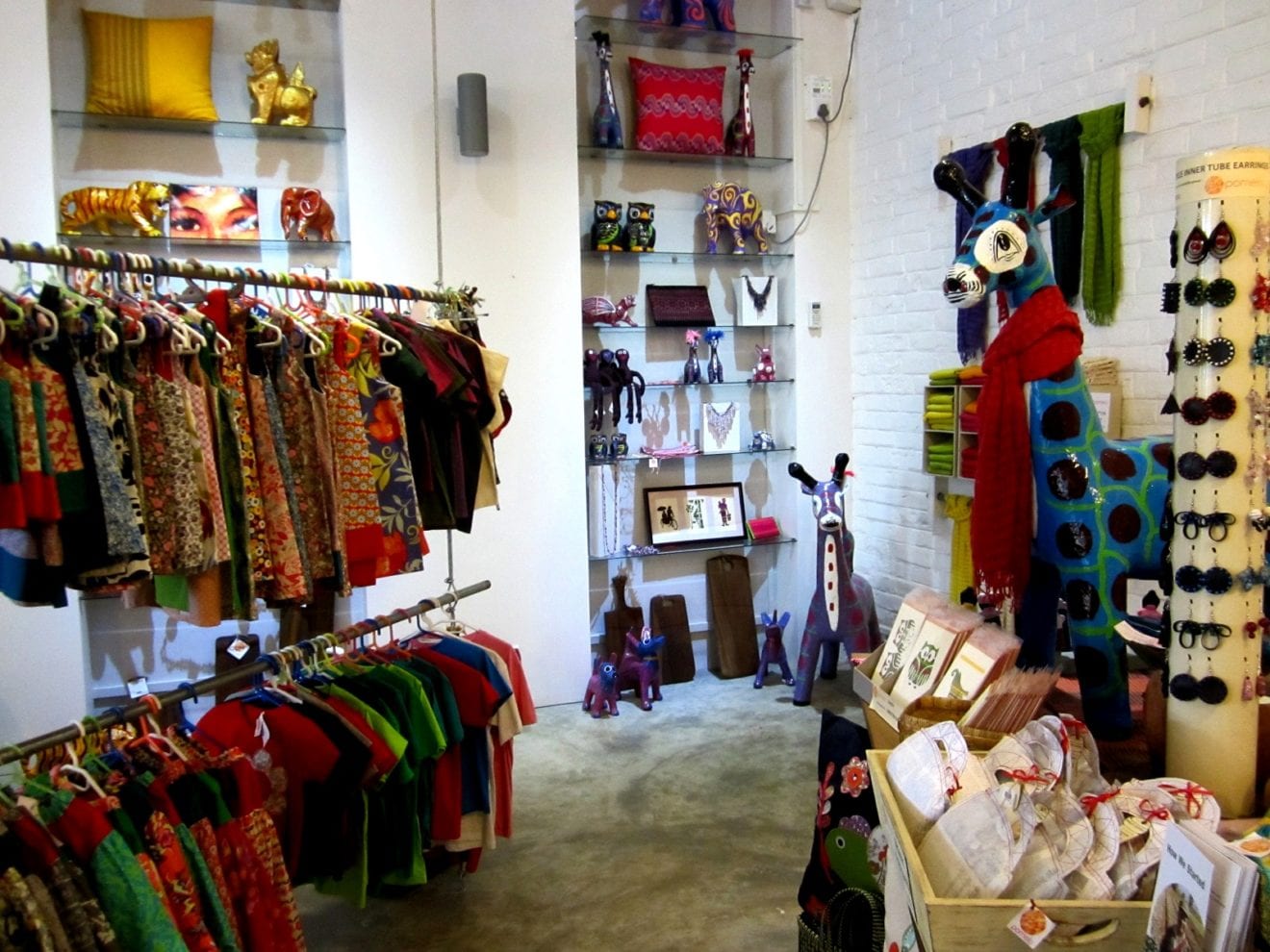
For Pomelo Company Limited, it looked like business as usual yesterday afternoon. Tourists browsed papier mâché giraffes and trendy seat cushions, oblivious to the recent turmoil. Only the website shows signs of change, with a note pinned to the top stating that emails coming from “pomelopartnerships” are not from the group who ran the day-to-day operation for the past four years.
Daw Thea Thea describes the past year as “a nightmare” and insists she does not “want to be in this situation”. She is sad that the foreigners have left their former roles, but feels it is necessary to preserve the mission of Pomelo.
“No one is right or wrong but this is what has happened,” she said.
In an earlier press statement, the PCL board said, “At this time when Myanmar transitions to a more open and just society, Pomelo can act as a strong example for Myanmar social business across the country.
“Pomelo is in good hands and the Board wishes to thank its staff and producer groups for their great work, and the community for its ongoing support.”
Ms Storaas, Ms Ortiz and Ms Kroeber have no legal claims to the Pomelo store, the products in the shop or the money that had been accumulated.
Because Pomelo was always registered as a souvenir shop under Daw Thea Thea’s name, they have been advised by legal counsel to give up on Pomelo and start over with a different business.
Ms Storaas, who says she never took a salary from Pomelo and did not get back the US$6000 she originally invested, said that K119 million ($95,967) is now under the control of PCL.
But she insists that the “services, the ideas, the designs, the support and the training provided by the Pomelo team are no longer part of the shop” that is run by PCL.
This Pomelo team is already laying plans for a new social business and is looking for partners and support. Some of that support may come from their producers, 24 of whom penned a letter on February 22 objecting to recent changes at the business.
“We rely on the expertise of Pomelo foreign members in developing new items … This is what made Pomelo successful and we wish not to jeopardise this success through relying on local expertise only,” it states. “We wish to propose that the shop will be run again in the same manner as it was done before the 4th of February.”
Pau Son reiterated that support in an interview with The Myanmar Times on February 24.
“I will definitely not join these new Burmese guys,” he said. “You see, Ulla [Kroeber] is like a mother to us all. She is so kind and so sweet. She really does care about us. And what they did to her is really unacceptable. I would rather keep working with Ulla.”