Retail News CRM

Tag: Philippines

  • Index Living Mall plans ASEAN expansion

    Index Living Mall plans ASEAN expansion

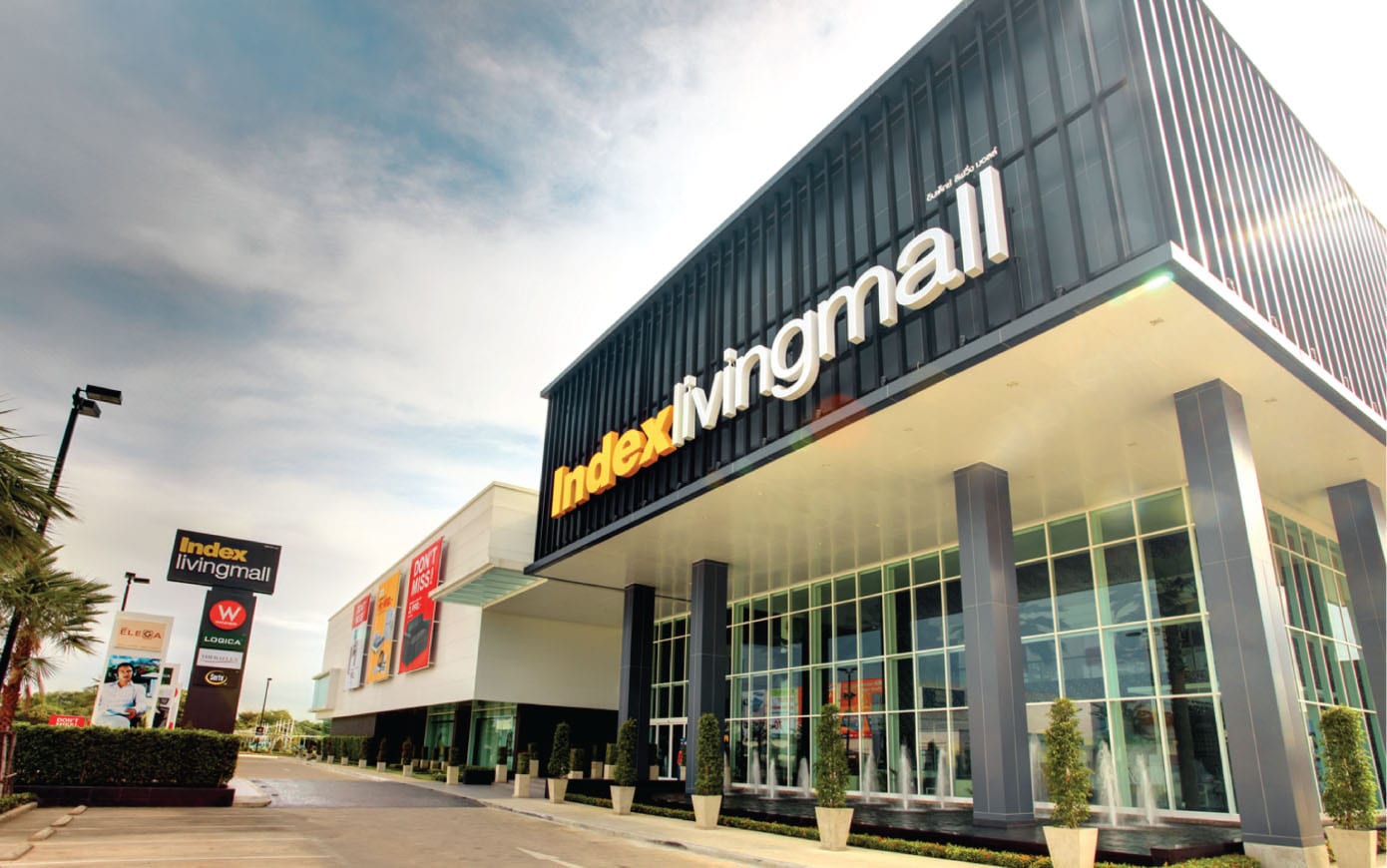
    Home-furnishing retailer Index Living Mall has announced its 2020 vision to continue its push beyond Thailand into other ASEAN countries.

    With franchised stores already trading in Malaysia, Thailand and Vietnam, the company believes the region’s urbanisation has shifted consumers toward a more modern lifestyle, including the way they buy and use home-furnishing products. It also notes a rise in the number of middle-income earners throughout the ASEAN Economic Community.

    MD Kridchanok Patamasatayasonthi says the company aims to double the present 5 per cent contribution to its total revenue from AEC markets by 2020. The company’s total revenue of Bt9.5 billion (US$264.8 million) last year was 5 per cent up on 2014.

    “Our market expansion through international franchisees is the result of growth in the home-furnishing and accessories sectors among ASEAN member countries,” says Kridchanok. “Other positive factors, including the bustling economic outlook, rising gross incomes and similar customer behaviour, helped accelerate our decision to look for investment opportunities in new markets.”

    She says the company has appointed VinDS, the retail investment arm of Vietnamese commercial property developer Vingroup, as its franchisee to tap into the home-furnishing and accessories retail market in that country. The first Index Living Mall under that partnership had a soft opening last month in Ho Chi Minh City, occupying 7000 sqm in Vincom Mega Mall Thao Dien. Costing more than Bt200 million, the store is expected to achieve Bt350 million in sales in its first year.

    Index Living Mall has had a store trading in Ho Chi Minh for more than four years, effectively testing the market. Now with VinDS it expects to open 10 more stores in major cities in Vietnam, including Ho Chi Minh, Hanoi and Da Nang, within five years.

    “Economic growth indicators show that the Vietnamese retail market is number two in Asia, after only China,” says Kridchanok.

    “During the first half of last year, the Vietnamese economy posted 6.28 per cent growth, the highest since 2008. With a population of 90 million, this will continue to grow, thanks to per capita income rising more than 10 per cent over the past decade.”

    Kridchanok says it is expected that the number of Vietnamese earning a median income of 15 million dong ($673) a month will grow to 33 million by 2020.

    Index Living Mall’s director for international business development Ekaridhi Patamasatayasonthi says the company’s venture into Vietnam highlights its marketing direction to tap into emerging CLMV (Cambodia, Laos, Myanmar and Vietnam) markets, aimed at strengthening its leadership position in the home-furnishings and accessories retail market in the ASEAN region.

    Ekaridhi says the company plans to open store in Manila in September via a joint venture with SM Retail, a Philippine business conglomerate involved in shopping mall, property development, banking and retailing. Index Living Mall has a 30 per cent stake in the venture.

    In Malaysia, Index Living Mall opened its first home-furnishing store in Putrajaya last year in a joint venture with AEON. Three more stores are planned for Malaysia this year – in Kuala Lumpur in March, Kota Bharu in April and Johor Bahru in the fourth quarter.

    Ekaridhi says there are six franchised stores in five countries – Malaysia, Russia, Maldives, Nepal and Vietnam – as well as dealers in Laos and Myanmar. In its home country, the company has 25 stores in 17 provinces, of which nine are in Bangkok. It plans to invest Bt470 million this year to open two stores, in Nakhon Pathom and Chachoengsao.

    Index Living Mall expects to post Bt10 billion in revenue this year and to grow its annual sales by 10 per cent over the next five years.

  • Less than Half of Filipinos are Fully Satisfied with the Valentine’s Day Gifts they Receive

    Less than Half of Filipinos are Fully Satisfied with the Valentine’s Day Gifts they Receive

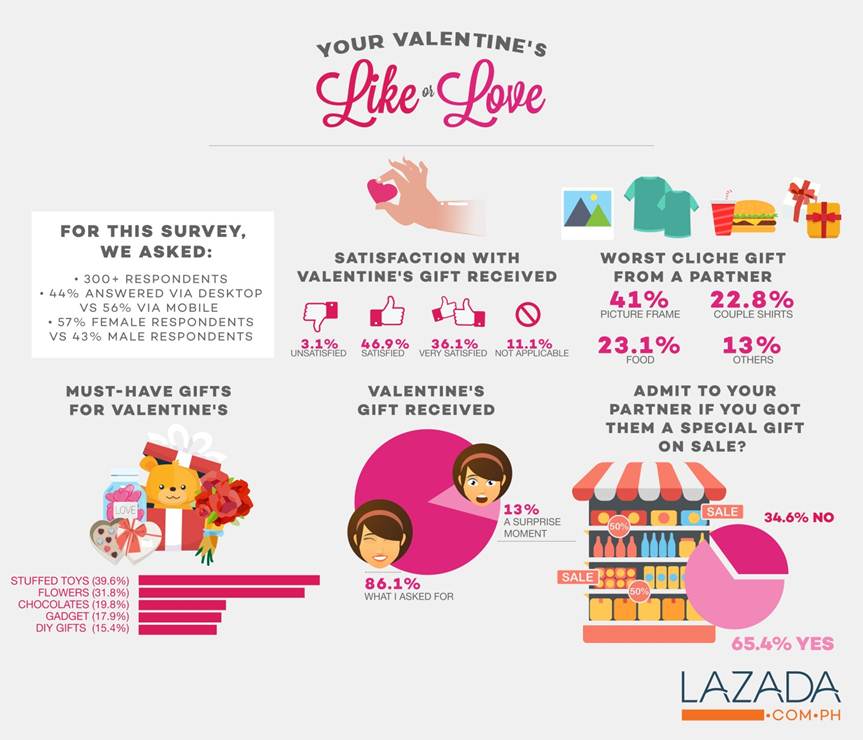
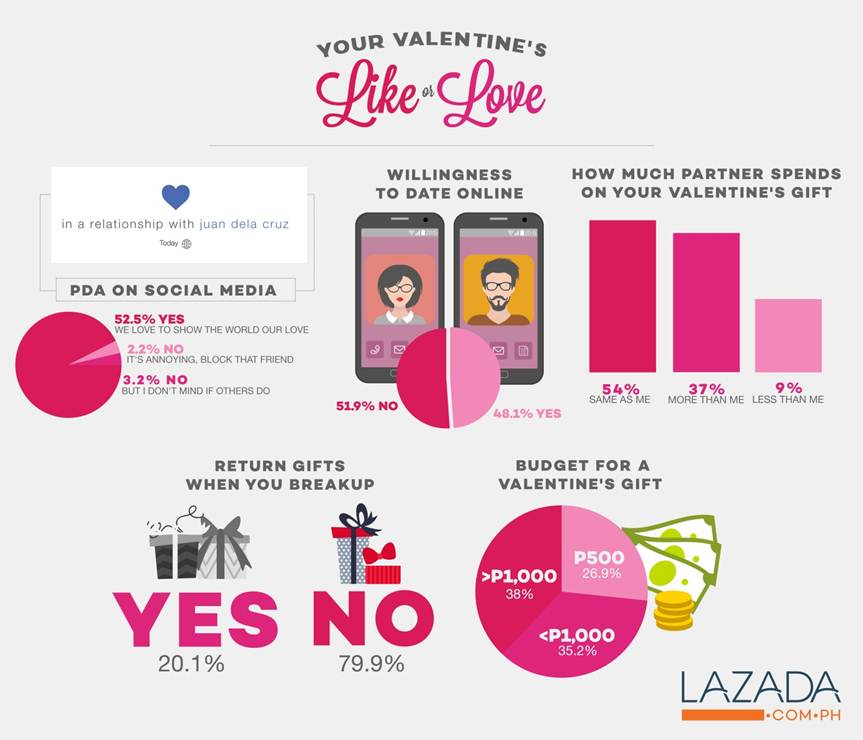
    In an online survey of over 300 respondents, only a third (36%) of Filipinos are really happy with their Valentine’s Day gifts. Less than half (46%) said that they were satisfied while 3% expressed absolute dissatisfaction.

    The survey, conducted by Lazada, explored the processes and reasons for the lack of contentment over Valentine’s Day gifts.

    Avoid Cliché’s but Never Forget the Essentials

    Almost one in four respondents (23%) expressed that chocolates and couple’s shirts are cliché, but the most cliché gifts are picture frames with over 40% of people agreeing they are passé.

    On the other hand, over 30% of respondents agree that flowers are a must have, beating out chocolates (19%), stuffed toys (9.6%). Surprisingly, more and more people (15%) see gadgets as an essential gift for the month of romance.

    image002

    Ask and You Shall Receive

    It seems surprise gifts are falling out of fashion as an overwhelming 86% of respondents prefer to express to their partners what they want. This transparency between couples extends to finding deals. 65% of respondents said they don’t mind sharing that they got their gifts on sale. The implicit learning is that if you get your partner the gift they want, it doesn’t matter if you got it on discount.

    Digital Love
    The survey also explored love in the digital space. Overtly expressing affection over social media or “Online PDA” seems acceptable with 52% of respondents saying they practice social media PDA themselves. 

    However, when it comes to meeting love interests online, half of the respondents had hesitations with online dating. 51% agreed with the statement:  “Online shopping never hurt anyone, people do.” Talk about #hugot.

    image001

    Love to Shop and Shop to Love

    As our Valentine’s Day gifting habits evolve and improve, it is important for Filipinos to discover more convenient and cost effective ways to find the perfect gift. That’s why Lazada’s Valentine’s Day promo makes it the perfect place to get the gifts your partner wants in ways you can easily afford.

  • Benoy’s Portfolio Expands in the Philippines

    Benoy’s Portfolio Expands in the Philippines

    Benoy, the global studio of Architects, Masterplanners, Interior and Graphic Designers, announces its expansion across the Philippines as the firm’s portfolio grows with new and built projects. Benoy is excited to confirm five new appointments as well as welcome the completion of two schemes in the island nation.

    Benoy Director Stephen Chow commented on the firm’s expanding portfolio, “The Philippines is one of the strongest economies in Southeast Asia and it has been an incredibly dynamic market for Benoy. Working in the region for more than ten years, we have seen the opportunities increase as the country grows and competes on an international scale. Our experience within global markets balanced with our local understanding has therefore been an attractive offer.”

    New Appointments

    Benoy’s growing order book is mainly concentrated in the Metro Manila area, the country’s most populous region. Working with leading developers such as Ayala Land and Filinvest, the firm is involved in multiple sectors and across the full complement of its services, from Masterplanning and Architecture to Interiors and Graphic Design.

    In the City of Taguig, Benoy has been appointed as the Podium Architect and Interior Designer on West Super Block, the latest edition of an integrated urban plan known as Bonifacio Global City. The development will consist of a four-storey retail podium, an all-suite residential tower and a Grade A office block where the Philippines Stock Exchange will be located.

    At the heart of Manila’s commercial and financial centre, Benoy is masterplanning and completing the architecture for the future Makati Mixed-use Development. The scheme will include a commercial podium, 15-storey office tower and 39-storey residential tower which will be one of the tallest in the district.

    In Balintawak, a major gateway from the north into Metro Manila, Benoy is delivering an 11ha mixed-use masterplan. Positioned at the intersection of two highways, the Balintawak Masterplan will include Retail, Residential, Commercial Offices, a Hospital and act as a regional transportation hub. Benoy is also the Architect for the regional mall situated on the site.

    The full scope for One Binondo, a new mixed-use development in the heart of Manila’s Chinatown, has also been appointed to Benoy. The four-storey podium will feature, among many offers, ‘Micro Retailing’, a trading form famous within the district. A Grade A office tower and three residential towers with landscaped gardens, club house, pool and recreation facilities will be seamlessly integrated above the retail scheme.

    To conclude Benoy’s new appointments, the firm is delivering a visionary redevelopment plan for Alabang Town Centre, one of the most successful retail destinations in southern Metro Manila. As part of this development, the firm will also complete the Architecture, Interior Design and Landscape Design of a new Lifestyle Centre sitting at the heart of the scheme.

    “We are thrilled to be building such a diverse portfolio in the Philippines. It is very exciting to have the opportunity to help shape the future of the country and we look forward to delivering creative, intelligent and considerate design solutions to these projects,” said Stephen.

    Completed Developments

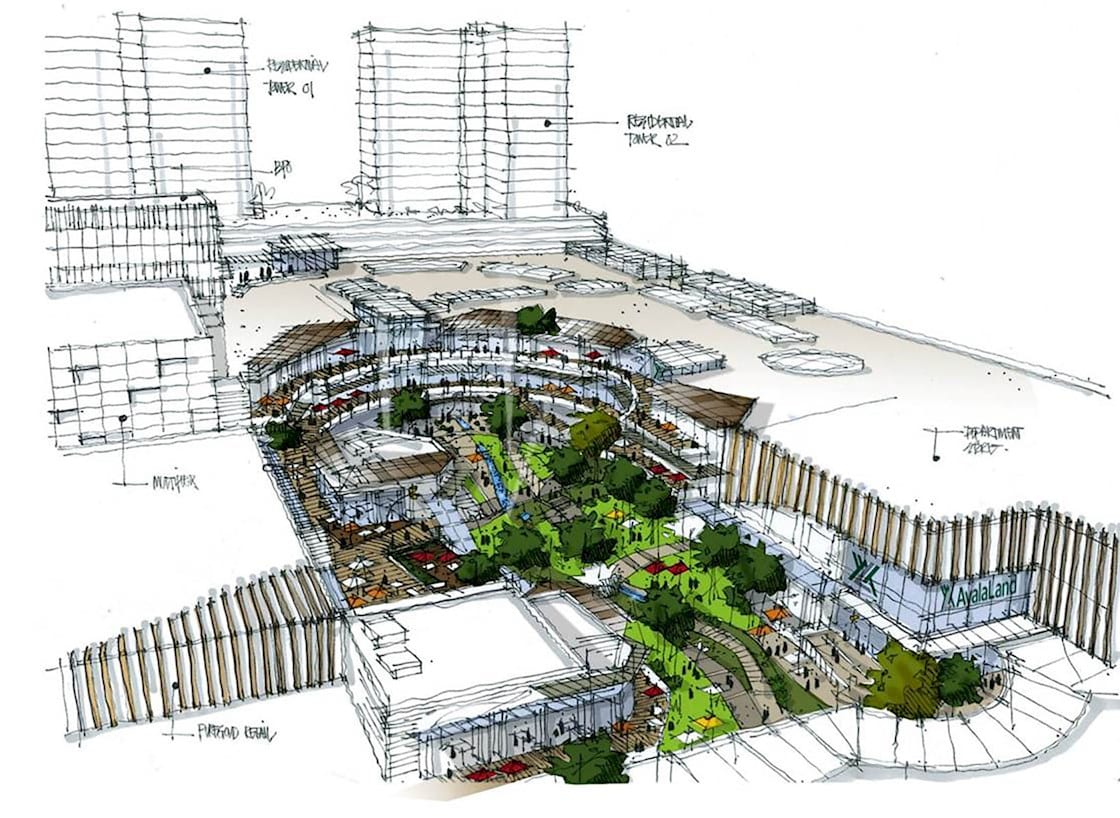
    The firm has also seen the completion of two recent projects in Quezon City, U.P. Town Center and Fairview Terraces, both developed by Ayala Land.

    U.P. Town Center has opened at the University of the Philippines campus. The development is a lively combination of indoor and outdoor retail, dining and commercial uses integrated within a landscaped setting. The scheme covers a GFA of over 88,000m2 and 40% of the site area has been designated as open space. As Masterplanner and Architect, Benoy is overseeing the three phase project. The first two phases have opened and the final phase is due to complete in 2016.

    Situated in the city’s north, Fairview Terraces is a 135,000m2 retail-led, mixed-use development. The mall is spread over five levels and features around 420 retailers and a ‘Boutique Super Market.’ The focal point of the scheme is the generously landscaped central promenade which is surrounded by pocket gardens and al fresco dining. A natural gathering place for residents, shoppers and workers, the design has established this project a thriving community hub. Benoy completed the Architecture and Interior and Graphic Design.

    During the construction phases of both schemes, careful attention was made to protect the existing trees on the sites; preserving the character of the areas. In the case of Fairview Terraces, a long-standing mango tree has now become the very heart of the design, sitting at the centre of the development.

    With the completion of these two schemes, Benoy adds to its growing built portfolio in the Philippines which already includes the extensive renovation of Ayala Alabang Town Centre. With new appointments under construction, the firm looks forward to expanding its offer across the country and creating thriving future hubs for the Philippines community.

  • Philippines’s Formoso new chairman of Asia-Pacific retail organization

    Philippines’s Formoso new chairman of Asia-Pacific retail organization

    The Philippines now takes the leadership role in charting the development direction of the Federation of Asia Pacific Retailers Associations (Fapra) in the next two years with the recent assumption of the Philippine Retailers Association (PRA) President Lorenzo C. Formoso as chairman of the Fapra.

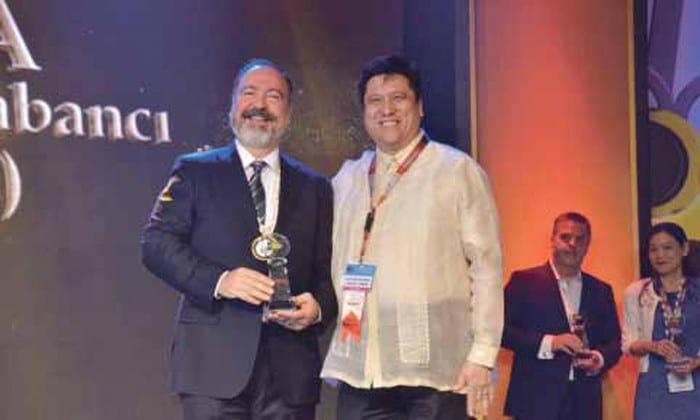
    Formoso, COO of Duty Free Philippines, has assumed the Fapra chairmanship from Mehmet T. Nane, chairman of Turkish Council of Shopping Centers and Retailers, who formally turned over the federation’s leadership to him during ceremonies at the recently concluded Asia Pacific Retailers Convention and Exhibition (APRCE) 2015 that Manila hosted last October. The APRCE is the biggest and longest-running retail industry event in the region.

    The Fapra consists of the recognized national retail trade organizations in 18 member-economies—Australia, China, Chinese Taipei, Fiji, Hong Kong, India, Indonesia, Japan, Korea, Malaysia, Mongolia, Myanmar, New Zealand, the Philippines, Singapore, Thailand, Turkey and Vietnam.

    “As a veteran in the retail industry and being the concurrent president of PRA, we are confident Formoso’s chairmanship of Fapra would be very productive. We are sure he will guide the Fapra in the same way he ably shepherded the PRA,” the PRA Board said.

    Turkey held the Fapra chairmanship for two years—from 2013, the year it hosted the APRCE, to 2015, the year the Philippines hosted it.  The chairmanship of Fapra devolves to the immediate past host of
    the APRCE.

    The Philippines chairs the Fapra until 2017.

    The Fapra was founded in 1989. It has implemented various initiatives and programs designed to develop itself and promote information exchanges and sharing experiences and concerns toward the development of the retail industry and improving the retailers’ status and the welfare of their clients in the region.

    As new Fapra chairman, Formoso now presides over the federation’s policies and programs aimed at helping promote the growth and development of retailing in the Asia- Pacific region.

  • Maitland Smith Philippines Designer Exquisite Vase Pottery, retail$349

    Maitland Smith Philippines Designer Exquisite Vase Pottery, retail$349

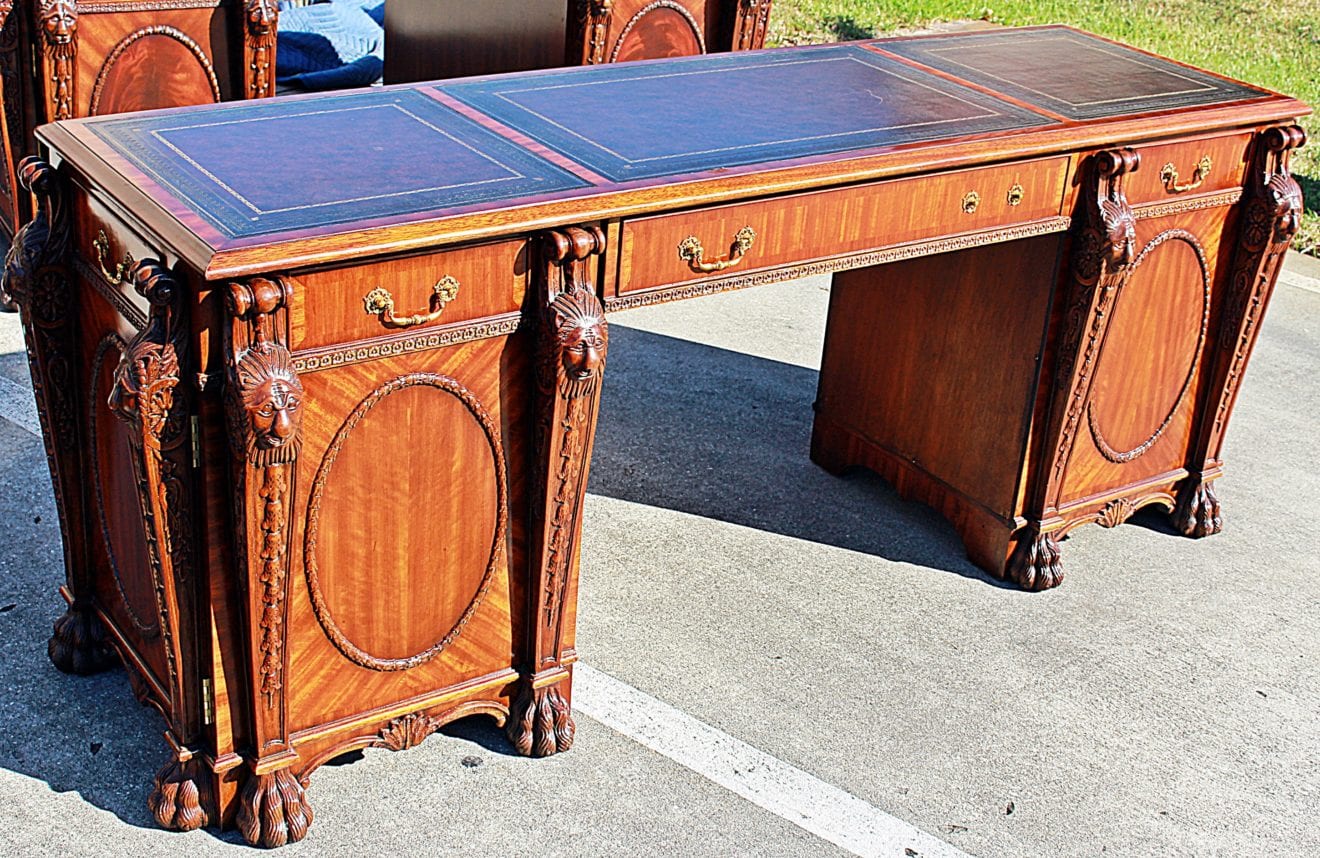
    Beautiful hand made designer artistic vase pottery designed by Maitland Smith Ltd. in Philippines, selling for $150, cash only. Retail price is $349.95 plus tax, reduced to sell quickly, original tags from purchase on bottom of vase

    Maitland-Smith specialises in fine home furnishings and accessories that are made to become treasured family heirlooms. The company is a leader in manufacturing premium and antique-inspired furniture, wall décor accessories, lighting, and many more items for luxury home furnishing. To ensure your home furnishing is indeed unique, Maitland-Smith furniture often comes out with limited editions of its products.

    Paying meticulous attention to intricate details, Maitland-Smith signifies luxury in its one-of-a-kind elegance in terms of designs, exemplary quality, impeccable craftsmanship and extensive choice of materials. The products are handcrafted by expert craftsmen and skilled artisans and showcase beautiful design sense and creative interpretation over a wide variety of traditions and styles.

    Maitland-Smith creates high quality furniture that promises to be unique additions to any home. Their eclectic use of bronze, penshell inlays and lacquer techniques highlights their devotion to quality and styling. Hence, whether you are looking for fine living room furniture, dining room lighting, or pedestal tables; Maitland-Smith furniture promises to be one of the safest bets!

  • The Sapphire Bloc represents the Philippines as ‘Best Condo Development’

    The Sapphire Bloc represents the Philippines as ‘Best Condo Development’

    Robinsons Land Corp. (RLC) ended 2015 by receiving another accolade for its four-tower residential complex called The Sapphire Bloc developed by Robinsons Residences, a trusted residential development brand under RLC.

    The Sapphire Bloc represented the Philippines as “Best Condo Development” in the prestigious South East Asia Property Awards 2015. This real estate award-giving body is known as the largest and most recognized industry awards event in the region.

    RLC joined the roster of top honorees from a pool of about 400 top and emerging names in the South East Asian real estate industry. The awarding ceremonies were held recently at the Shangri-La Hotel Singapore.

    Earlier in the year, The Sapphire Bloc bagged the “Best Condo Development” (Philippines) and “Best MidRange Condo Development” (Metro Manila) awards at the prestigious 2015 Philippine Property Awards which has been rewarding high-caliber work in construction, architecture and interior design of property developments in Asia. Moreover, RLC was named “Outstanding Developer” by FIABCI, a Paris-based real estate federation for its other residential project called The Trion Towers.

    “To be highly commended in the South East Asia Property Awards further drives us to continuously innovate on what comfortable and modern condo living means, as akin to the changing needs and preferences of people over time,” remarked Trina Cipriano, VP for business development at RLC.

    Located at the Ortigas Center in Pasig, The Sapphire Bloc is RLC’s latest foray in modern vertical development that has since become a member of an elite league of other property projects now being recognized throughout the region.

    Lifestyle Feature ( Article MRec ), pagematch: 1, sectionmatch:

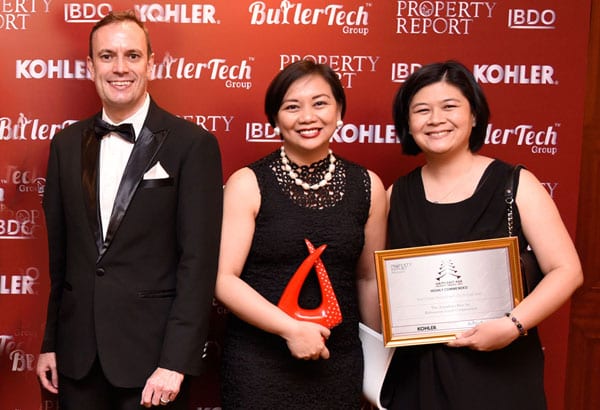
    Robinsons Land Corporation represented by May Precilla, VP for sales and marketing (second from left), and Trina Cipriano, VP for business development, receives the citation from the South East Asia Property Awards 2015. With them is Terry Blackburn, CEO of Ensign Media.

    Its Art Deco architecture amid contemporary buildings gives the Pasig City skyline a unique charm. Its enviable location provides an added measure of value since it is connected to three major cities, and has nearby shopping malls, offices, skyscrapers, building complexes, nightlife bars and restaurants.

    Moreover, the master-planned development offers retail space measuring up to 8,000 square meters that is currently redefining destination dining in the metro. The entire stretch of the ground floor has been dedicated to serving up new and one-of-a-kind retail shops which can satisfy every craving.

    “Again, The Sapphire Bloc has proven our company’s commitment to our ‘City Living Done Right’ mantra, that aims to offer a level of distinction on comfortable and stylish living in the metro,” enthused Trina Cipriano, vice president for business development at RLC. “Representing the country in the South East Asia Property Awards further inspires us to continue embedding the highest industry standards in all our developments.”

    The South East Asia Property Awards is the grand finale of the Asia Property Awards. Started in Thailand in 2005, the Asia Property Awards has since expanded to reward developments, consultants, architects and designers in Singapore, Malaysia, the Philippines, China, Myanmar, Indonesia, Cambodia and Vietnam. With a professionally run and fully transparent judging system, which is audited by BDO — one of the world’s largest accountancy networks — the awards have for a decade helped celebrate the region’s real estate industry on the world stage.

  • Philippine growth short of target at 5.8 percent in 2015

    Philippine growth short of target at 5.8 percent in 2015

    The government initially forecast growth of 7-8 percent for 2015 but later lowered its projection to 6-6.5 percent.

    “Though this is lower than what we targeted for the year, this growth is respectable given the difficult external environment,” Economic Planning Secretary Arsenio Balisacan said Thursday.

    The Philippines has been one of the fastest growing economies in Asia for several years. Despite increased government efforts to raise living standards, the country of more than 100 million still faces considerable challenges including its vulnerability to typhoons and other natural disasters, poverty, corruption and poor infrastructure.

    The economy expanded 6.3 percent in the last quarter of the year, the fastest for 2015. It was up from 6.1 percent the previous quarter but down from 6.6 percent in the same period of 2014.

    Balisacan said growth has averaged 6.2 percent in the past six years, which is the best performance since the late 1970s. The growth has not been due to unsustainable borrowings like in the 1970s and short-lived portfolio capital but fueled by investments that create jobs and increase incomes, he said.

    He said last year’s growth was driven by much stronger domestic demand and government spending that grew 9.4 percent compared to the previous year’s 1.7 percent. Growth in public and private investments more than doubled, primarily led by public construction.

    Service industries were also robust, growing 6.7 percent in 2015 from 5.9 percent in 2014. Industry expanded 6.0 percent while agriculture grew a tepid 0.2 percent.

    Finance Secretary Cesar Purisima said the Philippines was well-positioned to withstand turbulence in financial markets caused by uncertainty about the strength of the global economy.

    He said foreign exchange reserves are more than healthy at $80.6 billion as of the end of last year, enough to cover 10.3 months of imports and equivalent to more than six times the country’s external short-term funding requirements.

  • Philippines leader welcomes Japan’s Emperor as ties blossom

    Philippines leader welcomes Japan’s Emperor as ties blossom

    Philippines President Benigno Aquino III gave a red-carpet welcome to Japan’s Emperor Akihito on Wednesday in a sign of blossoming ties between the two nations, both mired in territorial disputes with China, while further moving past painful memories of Japan’s World War II aggression.

    Mr. Aquino and Emperor Akihito held talks at Manila’s Malacanang presidential palace, where Philippines and Japanese flags were displayed side by side and Filipino troops fired cannons in a traditional salute.

    Mr. Aquino is to host a state banquet later for Emperor Akihito, whose visit marks 60 years of diplomatic relations between the two nations.

    Mr. Aquino and Emperor Akihito briefly discussed robust sales of Japanese-made cars that have contributed to Manila’s heavy traffic and the entry of Japanese retail store Uniqlo, presidential spokesman Herminio Coloma Jr. said.

    Emperor Akihito, a revered symbol of Japanese unity who plays no political role in his country, does not plan to discuss contentious security issues such as the territorial disputes or demands for an apology by Filipino women who accuse Japan’s wartime army of forcing them into sexual slavery, according to the Emperor’s press secretary, Hatsuhisa Takashima.

    During the meeting with Mr. Aquino, “there was no mention of the war,” he told reporters.

    But Mr. Takashima said it was well known to Mr. Aquino that the Emperor had earlier expressed his “profound remorse for the loss of lives of many Filipinos” during the war and that “the Japanese people must remember the agony and difficulty suffered, experienced by Filipino people.

    Asked if an apology could put an ending to the issue of wartime sex slaves, Mr. Takashima said it was not the Emperor’s role to address individual subjects related to the war, but that Emperor Akihito “always mentions the necessity of peace and the stability of the international relations as well as [to] never forget the war and never forget the victims of the war.”

    Relations between Japan and the Philippines have improved dramatically in the seven decades since the war, with Japan becoming a major trading partner and aid donor for the Philippines. Emperor Akihito’s visit is seen as a strong sign of a further deepening of ties as the countries, both close American allies, confront China over long-contested maritime territories.

    Japan’s Self-Defence Forces have staged joint search and rescue exercises with the Philippine Navy near the disputed South China Sea and are providing the Philippines with coast guard patrol boats.

    Still, six elderly Filipino women led a protest outside the presidential palace Wednesday asking the Japanese government to formally apologiSe and compensate them and other sex slaves abused by Japanese forces during the war. They carried placards reading, “No to rising Japanese militarism.”

    “Emperor Akihito’s foreign trips conveying a pacifist message are important because they ease concerns over perceptions that Japanese political leaders are trying to flex the country’s military muscles once again,” said Richard Heydarian, a political science professor at Manila’s De La Salle University.

    “We should forgive but we should not forget the past. That will also help Japan,” Mr. Heydarian said.

    Emperor Akihito is to pay his respects at memorials for both Philippine and Japanese war dead during his visit, which ends Saturday.

  • Indonesia wins three Aseanta 2016 awards

    Indonesia wins three Aseanta 2016 awards

    Indonesia has won awards in three out of the six categories of the ASEAN Tourism Awards (ASEANTA) 2016 at an event held in Manila, the Philippines, a minister said.

    “Wonderful Indonesia” won awards in three of the six categories of the ASEAN Awards, Tourism Minister Arief Yahya said in a press statement on Friday.

    “We have beaten some competing countries, including Malaysia,” Arief Yahya said.

    The three awards were in the categories of the Best ASEAN Tourism Photo, the Best ASEAN Cultural Preservation Effort, and the Best ASEAN Travel Article.

    “Morning in Bromo” by Agung Parameswara grabbed the award in the Best ASEAN Tourism Photo category.

    “Mang Udjo,” the Angklung bamboo musical instrument center in Bandung, Indonesia, was the winner of the Best ASEAN Cultural Preservation Effort category.

    And for the Best ASEAN Travel Article category, the winner was “The Perfect Wave,” published in Garuda Indonesia Color Magazine.

    “Meanwhile, Malaysia won two awards and Singapore only one award,” the minister said.

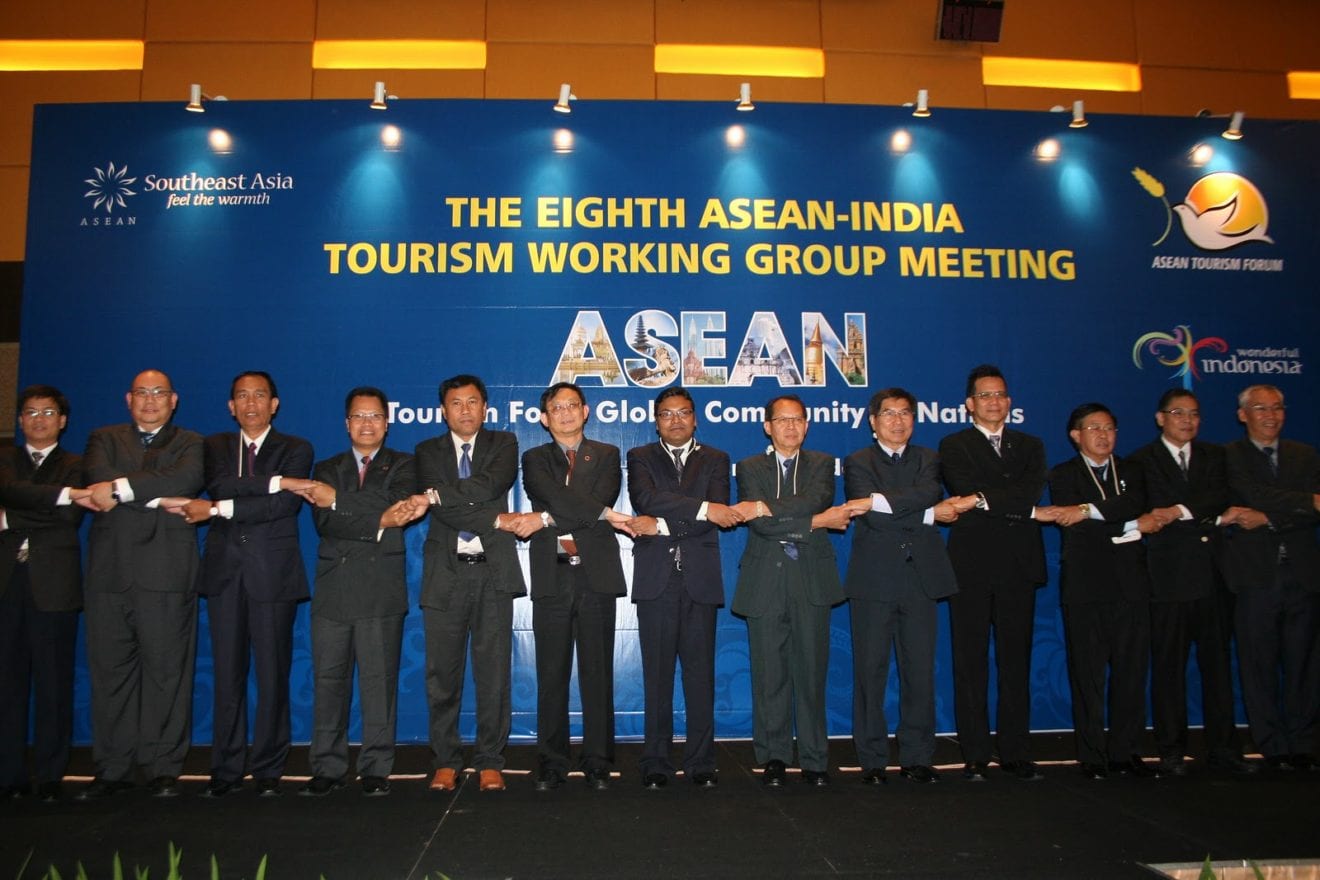
    Minister Arief Yahya was in Manila to attend the 35th ASEAN Tourism Forum (ATF), held from January 18 to 22, 2016.

    The ASEAN Tourism Forum is very strategic to Indonesia because the ASEAN market is the largest contributor to tourist arrivals, he noted.

    In the ATF held in Manila, tourism ministers from all ten member countries of ASEAN – Indonesia, Brunei Darussalam, Malaysia, Cambodia, Singapore, Thailand, the Philippines, Vietnam, Myanmar and Laos participated.

    He believed that the ASEANTA Awards would help promote Indonesian tourist destinations internationally.

    The three other ASEAN Award categories were the Best ASEAN Marketing and Promotion Campaign, the Best ASEAN New Tourism Attraction, and the Best ASEAN Airline Program.

    Filipino President Benigno S. Aquino III spoke before the ASEAN tourism ministers on Wednesday.

    He said that the number of tourist arrivals in ASEAN reached 105.1 million in 2014, a staggering 42.4 percent increase from 73.8 million tourist arrivals in 2010.

    Of those 105.1 million visitors, he said, 49.22 million came from within the ASEAN itself.

    “We belong to a region that holds vast potential in terms of tourism,” President Benigno was quoted as saying by the Philippine Information Agency (PIA).

  • Visa claims more Filipinos using contactless payments

    Visa claims more Filipinos using contactless payments

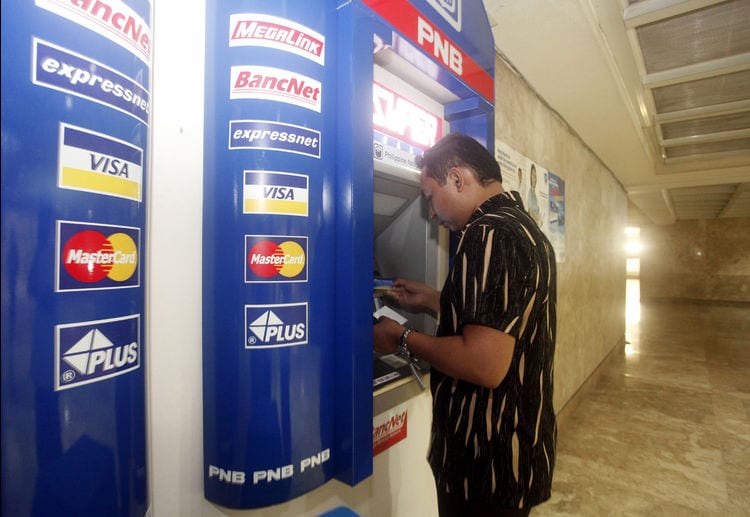
    More consumers in The Philippines are using contactless payments, according to the Visa Consumer Payment Attitudes Study 2015.

    It shows that 29 per cent of Filipinos have used contactless payments for transactions over the past year, up from 21 per cent in 2014. Cardholders cited the convenience of the system, security and ease of use among reasons for using contactless payments.

    Trends in payments behaviour and openness to using contactless payments were identified by the study which surveyed consumers in six Southeast Asian markets. Contactless payments are made by waving a credit or debit card or smartphone over a point-of-sale terminal, eliminating the need for cash, PIN number or signature.

    “As more Filipinos learn about the convenience, security and speed that contactless payments, such as Visa PayWave, bring to their lives, they are more willing to use them regularly,” says Visa country manager for The Philippines and Guam, Stuart Tomlinson.

    Filipinos’ awareness for contactless payments has risen 62 per cent in 2014 to 66 per cent last year. This has led to usage growing from 21 per cent last year to 29 per cent.

    Using contactless payments help save time, report 78 per cent of respondents (up from 58 per cent in 2014). The same percentage said system means they don’t need to carry cash (also up from 58 per cent), and 55 per cent said contactless payments are easier than using cash – a leap from 9 per cent in 2014.

    It was also revealed that Filipinos recognise contactless payments as being less hassle to use (41 per cent) and safer (36 per cent), while freeing them from queueing (34 per cent) and giving them a more enjoyable shopping experience (22 per cent).

    In The Philippines, contactless payments are mainly used for groceries plus food and beverage – 57 per cent for groceries, 37 per cent for F&B, 28 per cent for fashion and accessories, 27 per cent for beauty and cosmetics, 25 per cent for health and wellness services, 23 per cent for movie tickets, and 22 per cent for household electronics. Another revelation was that women are buying across all categories, however men use these payments more than women for transportation (8 per cent of total purchases). Other expenditures include books, CDs and DVDs (18 per cent), personal electronics (18 per cent), financial services (17 per cent), and events and concerts (10 per cent).

    Most respondents (80 per cent) said they prefer to buy products and services from retailers who offer contactless payments, and 84 per cent are interested in making payments with contactless wearables, such as smartwatches. Women would like to make such payments for groceries (67 per cent) while men prefer them for buying food and drinks (62 per cent).

    Users said security is also important, which is addressed by contactless cards having multiple layers of security including EMV chip technology and dynamic encryption. As they have a short read range, they are claimed to be virtually impossible to compromise. Financial institutions and credit card companies also monitor transactions to identify suspicious and unusual transactions.

    “Given growing awareness, use and openness to contactless payments among Filipinos over the past year, there is an immense opportunity for businesses to grow their market share by adopting the technology,” says Tomlinson.

  • Philippines Plans to Restrict Access to Cash-Mopping Tools

    Philippines Plans to Restrict Access to Cash-Mopping Tools

    The Philippines plans to close a loophole in regulation of trust funds, by restricting those overseen by banks from parking short-term cash at the central bank.

    Bangko Sentral ng Pilipinas is considering limiting lenders’ trust units from placing funds in its short-term deposit facility, monetary board member Felipe Medalla said Tuesday. Policy makers are reviewing access to its liquidity-mopping tools “under the overall framework” of its interest-rate corridor, Governor Amando Tetangco said Wednesday.

    Banks’ trust units have undue advantage over non-bank trust groups that aren’t allowed to put money in the central bank’s special deposit account or SDA facility, and also over lenders themselves that must comply with the reserve requirement, Medalla said in an interview.

    Placements in the so-called SDA facility, which the central bank uses to control liquidity, totaled about $16.8 billion as of December 29. The central bank is preparing to shift to an interest-rate corridor by the second quarter, a move intended to strengthen its policy tools.

    Limiting fund managers’ access to SDAs will make it a purely cash-mopping tool, said Eugenia Victorino, an economist at Australia & New Zealand Banking Group Ltd. in Singapore. In line with plans to shift to an interest-rate corridor system, “the central bank may be thinking of making SDAs a liquidity-management tool that should not be thought of as an investment vehicle.”

    At present, the central bank pays 2.5 percent for funds placed at SDAs, compared with its benchmark rate of 4 percent. The 91-day Treasury bill fetched 1.684 percent at the most recent auction.

    BSP has tools to ensure liquidity growth is healthy and is seeking comments on the proposal, Medalla said.

  • Ford Philippines delivers record sales in 2015

    Ford Philippines delivers record sales in 2015

    Ford Philippines sales last year jumped a record 25 percent to 25,372 units, firmly establishing Ford as the number three-selling automotive brand in the country.

    EcoSport, Everest and Ranger each deliver record full-year sales in the Philippines.

    Record December sales soar 48 percent to 2,824 units, capping record quarterly performance with jumping 50 percent to 8,691 units.

    The record sales year and continuing momentum helped Ford jump one spot to become the number three-selling automotive brand in the Philippines in 2015.

    “It’s been a breakthrough year for Ford in the Philippines. We launched more global Ford vehicles that showcased the very best of Ford, and expanded our retail presence across the country to make the Ford brand closer to our customers through a strong dealer network,” said Lance Mosley, managing director, Ford Philippines. “We’re truly proud of how the Ford brand is being embraced by our Filipino customers.”

    The EcoSport compact urban SUV’s continuing impressive run made it Ford’s best-selling nameplate in the Philippines in 2015. December retail sales of EcoSport rose 49 percent to 799 units, helping drive full-year sales up 67 percent to 8,702 units – the highest full-year total for a single Ford nameplate.

    The highly capable and versatile Ranger finished 2015 as the second best-selling pickup truck in the Philippines with total retail sales that increased six percent year-over-year to 8,445 units.

    “We launched the new Ranger here in August, and it really helped to build on an already strong reputation as the most capable, powerful and smartest pickup in the market,” explained Mosley.

  • Countries must improve ICT sectors

    Countries must improve ICT sectors

    Countries must continue to invest and pursue reforms in information and communication technology (ICT) to serve the nearly 60 percent of the world’s population who remain excluded from the digital economy, a new World Bank report said.

    In its “World Development Report 2016: Digital Dividends” report, the Washington-based lender noted that the internet, mobile phones and other digital technologies were spreading rapidly.

    “Digital technologies are transforming the worlds of business, work, and government,” said Jim Yong Kim, president of the World Bank Group.

    The anticipated digital dividends of higher growth, more jobs, and better public services, however, have fallen short of expectations, the World Bank said.

    To deliver fully on the development promise, it said countries must pursue “analog complements” to digital investments.

    This means regulations must be strengthened to ensure competition among business, adapting workers’ skills to the demands of the new economy, and fostering accountable institutions.

    Digital development strategies need to be much broader than ICT strategies, it added.
    To reap the greatest benefits, countries must create the right environment for technology, with regulations that facilitate competition and market entry, skills that enable workers to leverage the digital economy and institutions that are accountable to people.

    It noted that in the Philippines, business process outsourcing has few entry barriers and that firms use digital technology intensively, which is not the case for the retail sector.

    “The Philippine retail sector has substantial restrictions to domestic and foreign entry and is dominated by a few incumbent firms, while few firms use ICTs,” the World Bank said.

    Foreign retailers that aim to establish a commercial presence need to pass prequalification procedures, meet minimum capital requirements, deal with limitations to foreign equity participation, and have the majority of their boards comprised by Filipinos, it stressed.
    “Only about 20 percent of retail firms (with at least five employees) sell online in the Philippines,” it added.

    In contrast, the Philippine outsourcing sector is characterized by high entry rates and few regulatory barriers to competition.

    “It is intensive in ICT-related services such as software development, animation, contact centers and transcription. These ICT-specific services experienced high productivity growth in recent years and provided about 1.2 million jobs in 2015,” it said.

    Investing in basic infrastructure, reducing the cost of doing business, lower trade barriers, facilitating the entry of start-ups, strengthening competition authorities and facilitating competition across digital platforms were some of the measures suggested in the World Development Report.

    Digital technologies can transform economies, societies and public institutions, but changes are neither assured nor automatic, the report stressed.

    “Countries that are investing in both digital technology and its analog complements will reap significant dividends, while others are likely to fall behind. Technology without a strong foundation risks creating divergent economic fortunes, higher inequality and an intrusive state,” the World Bank said.

  • Top Japan bank buys 20% of Security Bank

    Top Japan bank buys 20% of Security Bank

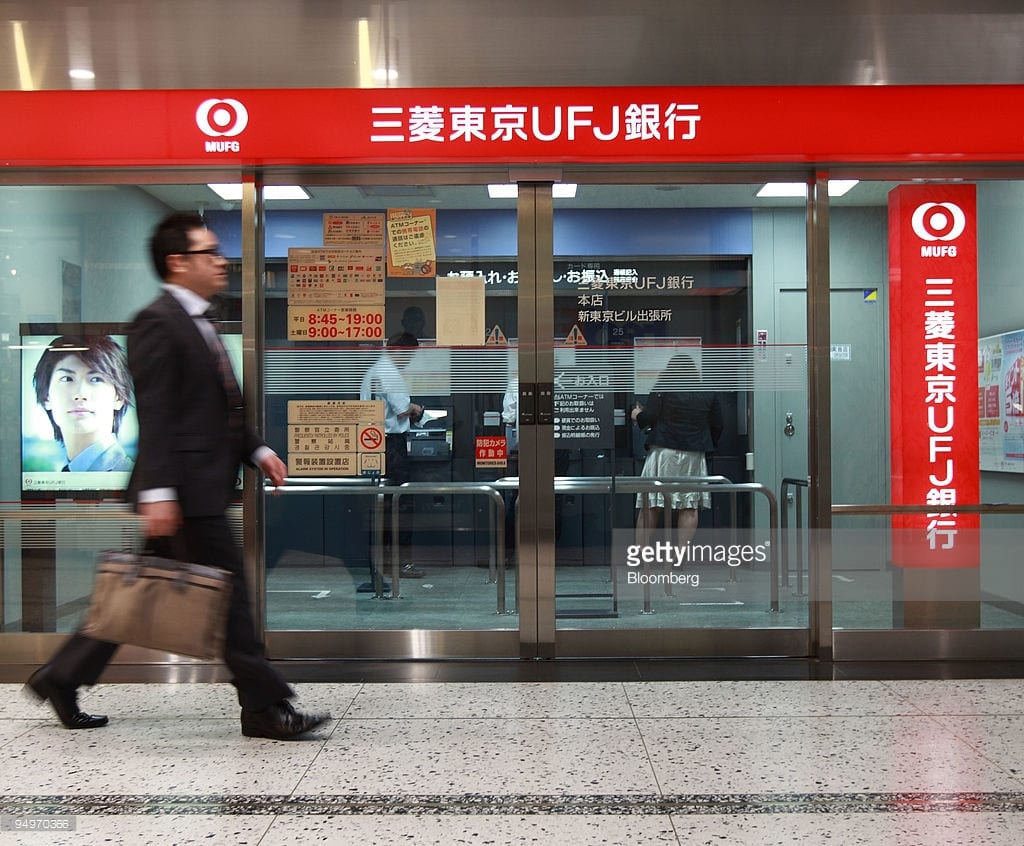
    Bank of Tokyo-Mitsubishi UFJ Ltd., Japan’s biggest bank, is buying a 20 percent stake in the Philippines’ Security Bank Corp. in a deal expected to expand both institutions’ market reach.

    Security Bank Corp. said the deal would infuse an additional P36.9 billion in capital with BTMU investing in newly issued common and preferred shares. The sale remains subject to regulatory approvals and other conditions.

    Described as the largest equity investment in a Philippine financial institution by a foreign investor, the stake sale will increase Security Bank’s shareholder capital from P52.4 billion as of September 2015 to P89.3 billion on a pro-forma post-transaction basis.

    “The additional capital will help us accelerate our strategy over the next three to five years of building our retail banking business as a third business pillar alongside wholesale banking and financial markets,” said Alfonso Salcedo Jr., Security Bank president and chief executive officer.

    Salcedo said the bank would be able to scale up its branch network much faster, from the current 262 to more than 500 branches by 2020.

    “We will be able to conveniently serve our customers with a larger network, offer them a comprehensive range of financial services, as well as make inroads into the Japanese business sector, tapping on BTMU’s expertise,” he added.

    The strategic partnership will result in BTMU, the commercial banking entity of Mitsubishi UFJ Financial Group, becoming the second largest shareholder of Security Bank.

    BTMU will be appointing two directors to Security Bank’s board, while Security Bank will become an equity affiliate of BTMU.

    The Dy Group will remain as the biggest shareholder of Security Bank with majority voting control.

    Through the partnership, BTMU aims to establish a comprehensive financial service platform, including retail banking, to meet clients’ needs in the Philippines. It has adopted similar equity alliance deals in Asia including Vietnam.

    Seeking to take advantage of the fast-growing Philippine market and the economy’s attractive fundamentals, BTMU expects to expand its business platform indirectly through the investment in Security Bank, which is known for its retail and small and medium business capabilities that will be new business areas for BTMU in the country.

    “BTMU has been focusing on Asia as one of its core markets for growth. It is a strategic intent for the bank to identify the right partner in the higher growth markets like the Philippines to deepen our presence, including through inorganic means,” said Go Watanabe, chief executive officer of BTMU for the Asia and Oceania region,
    “This strategic partnership with Security Bank reinforces our Asia strategy and enables both parties to offer more comprehensive financial services to a wider range of customers in the Philippines. We believe in Security Bank’s growth strategy and are keen to play a role and be part of its transformational journey, “he added.

    For Security Bank, the partnership with Japan’s largest banking group is expected to enhance shareholder value by accelerating the bank’s growth strategy, including the
    expansion of its branch network and increasing its retail market penetration.

    It also expects to tap BTMU’s extensive relationship with Japanese corporates, its global network, and diverse range of functions and expertise within MUFG.

    “We are elated to have BTMU as a strategic shareholder and business partner. The transaction will position Security Bank as a large independent bank supporting the growth of the Philippines’ economy, with the strength and capabilities to compete with other larger financial institutions,” said Alberto Villarosa, Security Bank chairman.

  • SM Cinema adds more cinema screens nationwide

    SM Cinema adds more cinema screens nationwide

    Beyond technology, SM Cinema extends its world-class experience to persons with disability (PWD) by providing dedicated areas for their convenience. SM Cinema also holds separate screenings of sensory friendly movies for those with special needs such as the blind and deaf, as well as children with autism and down syndrome.

    “We are very pleased to bring state-of-the-art cinema technology and a whole new movie experience out into the suburbs and provincial areas. We remain focused in providing the complete entertainment experience to every corner in the country,” SM Lifestyle Entertainment President Edgar Tejerero said.

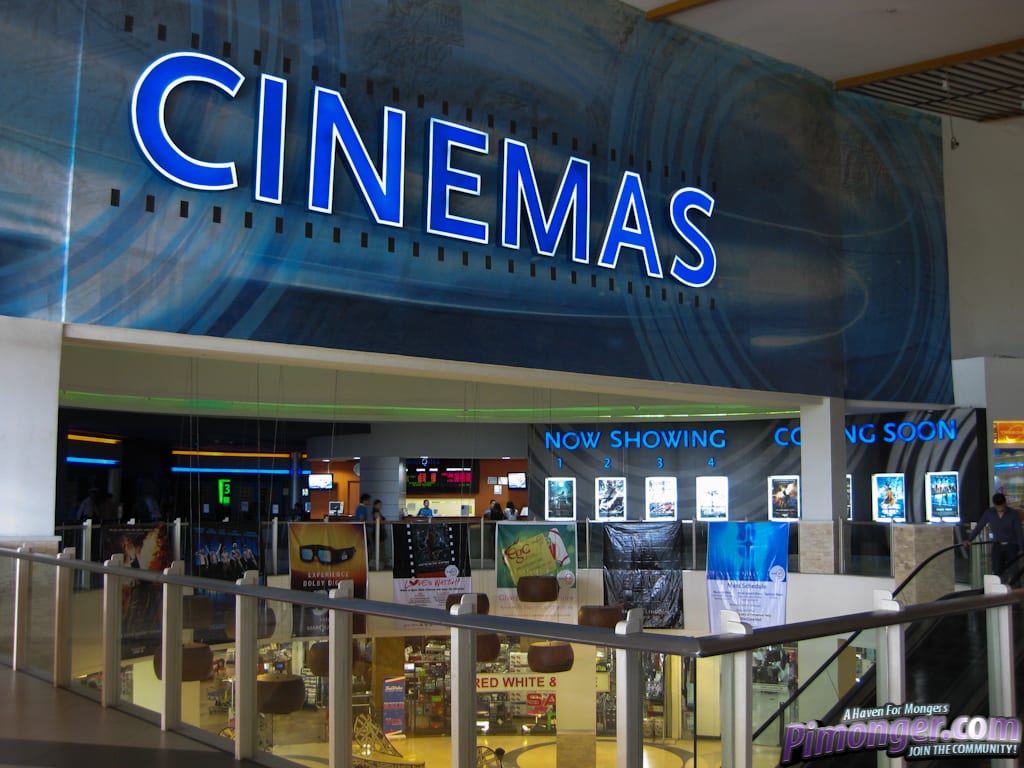
    For 2015, SM Cinema added four fully digitized cinemas in SM Center Angono in Rizal, its 55th branch. With digital surround-sound technology, the cinemas in Angono promise to deliver an optimum movie-watching experience. Each theatre will cater to 200 patrons in a stadium-like seating, making certain that all patrons will enjoy the view from any seat they choose.

    In Cebu, SM Cinema recently added the first laser projection system in Southeast Asia in its large screen cinema at the recently opened SM Seaside City, Cebu. This format uses the Christie® 6P laser projection system and features a super-sized screen almost 30% larger than the regular cinema screen size. The Christie® 6P laser produces the brightest images with 80% illumination and offers the best 3D platform that accurately reproduces the colors of the actual movie set, developing the most immersive cinema experience. The SM Large Screen Cinema also proudly uses the DOLBY ATMOS Sound System and the top-of-the-line Christie Vive Speakers, its audience fully immersed in surround-sound technology. SM Large Screen Cinema will house 351 guests in stadium-like seats.

    Earlier this year, SM Cinema also opened in Cabanatuan City through SM Megacenter and SM Cabanatuan; in Rizal Province through SM San Mateo and SM Angono; and in Caloocan through SM Sangandaan. SM Cinema also partnered with housing arm SM Development Corp to open its cinemas at Light Mall, the first theater available in an SM residential complex.

    Tejerero added that he is optimistic that ticket sales will be robust by the end of 2015 given blockbuster movies such as Heneral Luna, Star Wars: The Force Awakens, A Second Chance, Felix Manalo and movies shown during the Metro Manila Film Festival in December.