Retail News CRM

Tag: cars

  • Hyundai Motor net profit plummets 67%

    Hyundai Motor net profit plummets 67%

    Hyundai Motor’s operating profit plummeted 76 percent on-year in the third quarter as a recall in the U.S. and sluggish growth in major markets hurt the automaker’s bottom line. Korea’s No. 1 carmaker by sales announced Thursday that it posted 289 billion won in operating profit in the July-Sept. period.

    Its net profit was 306 billion won, down 67.4 percent on-year.

    “To fortify quality control, Hyundai Motor rolled out a recall related to airbags and engines which resulted in a 500 billion won one-time cost realized in the Q3 report,” said a Hyundai Motor official.

    Operating costs totaled 3.4 trillion won in the third quarter, according to the carmaker, which is 8.6 percent more than during the same period last year.

    Despite good sales in Europe and emerging markets like Brazil and Russia, low demand in the U.S. and China dragged down overall sales. It sold 1.12 million units globally in the third quarter, 0.5 percent less than during the same period last year.

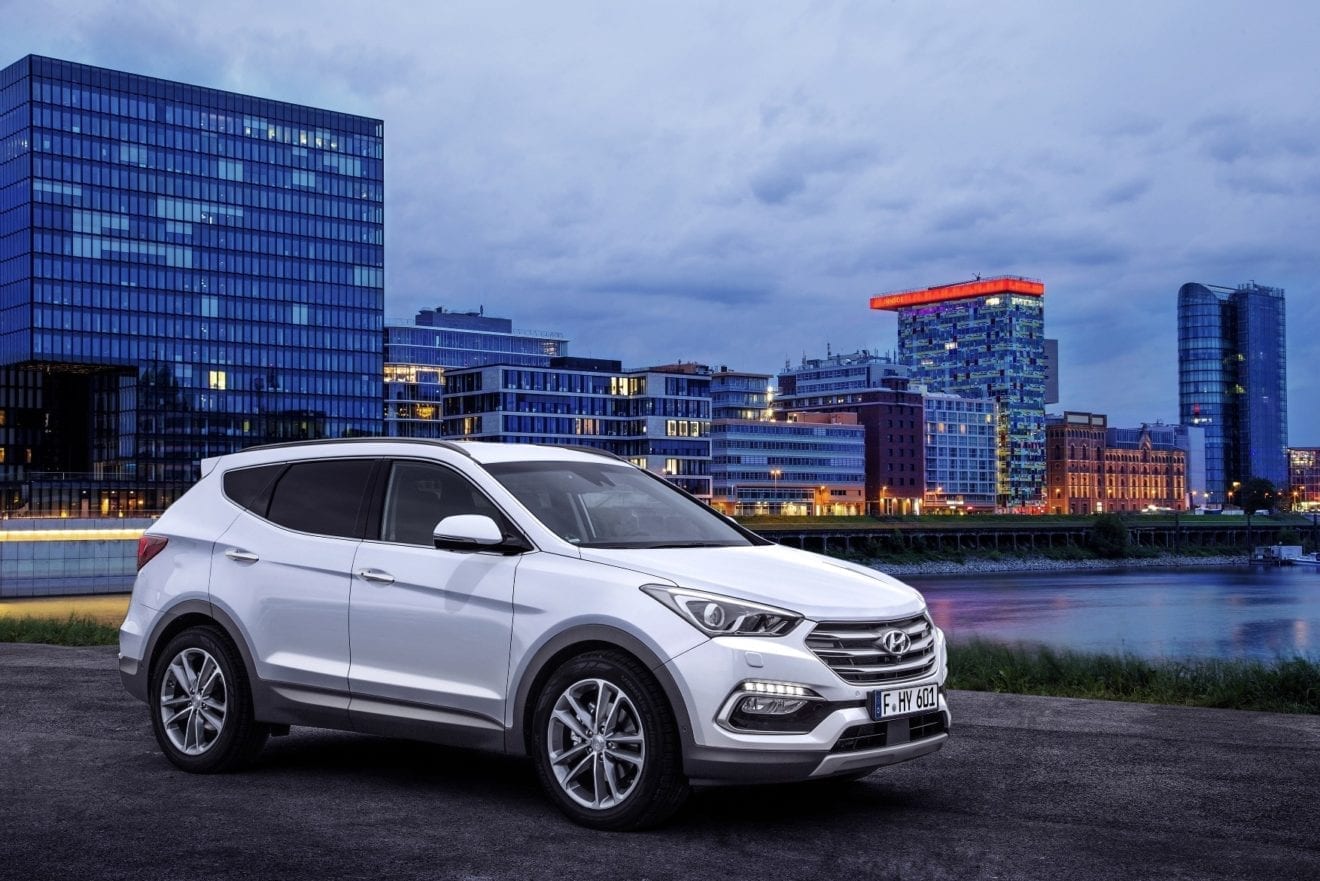
    The domestic market got a bost from the new Santa Fe SUV, but a decreased number of operating days at dealerships resulted in Hyundai Motor selling just 171,443 units, a 1.4 percent drop compared to last year. Chinese sales dropped by 3.7 percent on-year, selling 181,000 units. Sales in the U.S. dropped by 4.1 percent on-year to 302,000 units.

    Hyundai Motor expects profitability to improve in the fourth quarter and going into next year with the launch of new SUV models and a reduction in costs.

    “In the fourth quarter, the new Santa Fe SUV and an upgraded Tucson SUV will launch in the U.S.,” said a Hyundai Motor official.

    “The implementation of a new platform starting next year will help reduce costs and raise efficiency as well.”

    Hyundai Motor shares fell by 5.98 percent to 110,000 won on Thursday as of press time.

  • Hyundai brings wearable robotics to factories

    Hyundai brings wearable robotics to factories

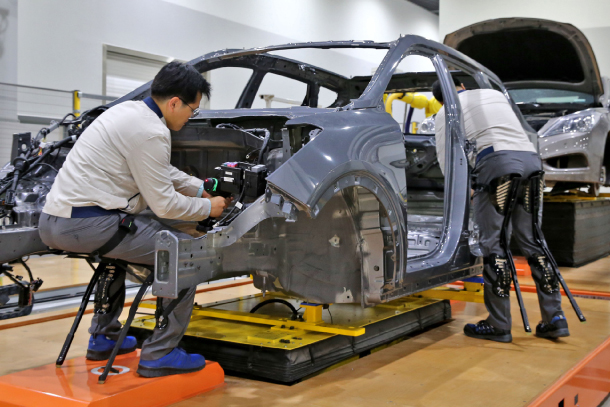
    The Hyundai Motor Group will expand the use of wearable robots at its facilities as it works to make robotics a major source of revenue, the company said Monday. Since September, Korea’s largest automaker has been testing the Hyundai Chairless Exoskeleton (H-CEX) at its North American factory. The H-CEX is an assistive robot for workers who have to stay in a seated position throughout the day. By the end of this year, the carmaker will introduce the Hyundai Vest Exoskeleton (H-VEX) at the same facility.

    The H-CEX, the first wearable developed by Hyundai for use at production sites, reduces the use of waist and lower body muscles by 80 percent, reducing the fatigue that results from being in the same seated position for a long period of time, Hyundai said in statement. The soon-to-be introduced H-VEX exoskeleton is for workers in jobs that require a lot of arm lifting. The machine vest will support the upper body and protect neck and shoulder muscles.

    “By expanding test applications, we hope to prove the technological effectiveness of our wearable robots,” Hyundai said in statement.

    The two exoskeletons were developed by Hyundai’s robotics team, established in May after the company named robotics as one of its five pillars for the future.

    The team is preparing to launch other robots focusing on three main areas: wearables, service robots and mobility robots.

    Hyundai is gearing up to test a hotel robot capable of providing room service and guiding guests. It will be introduced at the Haevichi Hotel & Resort on Jeju Island and at the Rolling Hills Hotel in Hwaseong, Gyeonggi, from the end of this year.

    A car-selling robot with natural language conversation capabilities and artificial intelligence will be prototyped by early next year. By 2020, the automaker plans to introduce a robot that can autonomously charge electric vehicles at charging stations.

    “We believe that robotics could be a solution not only for mobility but also for production in areas suffering from population decline,” a spokesperson for Hyundai said. “We plan to make notable achievements in robotics using technological data we have accumulated while developing autonomous cars.”

    Hyundai is not the only automobile maker bringing exoskeletons to assembly lines. U.S. automaker Ford has tested EksoVest, an upper-body assisting wearable jointly developed with Ekso Bionics. It was introduced at two U.S. factories in November last year. Ford announced in August a plan to bring the robot to 15 plants globally.

    German automakers BMW and Audi are also developing wearable aids for factory workers.

    According to market tracker BIS, the world’s wearable robot market is due to grow by 50 times from $96 million in 2016 to $4.65 billion by 2026.

  • Nissan Leaf approved for vehicle-to-grid use in Germany

    Nissan Leaf approved for vehicle-to-grid use in Germany

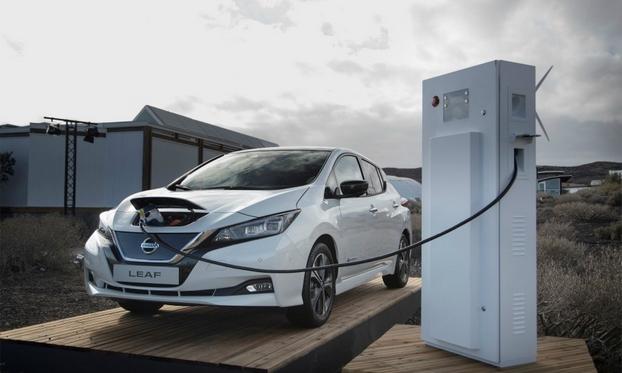
    Nissan’s Leaf is the first electric vehicle to secure regulatory approval as an energy backstop for Germany’s electricity grid. So-called vehicle-to-grid (V2G) technology is a connection between the EV and the grid through which power can flow from the grid to the vehicle and vice-versa, potentially enabling car owners to sell energy to the network. This would allow utilities to use EVs as a backstop if demand rises.

    Nissan said it would initially target corporate clients with fleets of more than 60 electric vehicles, adding that services based on V2G technology would be offered in Germany starting next year.

    “We strongly believe in an emission-free future,” said Guillaume Pelletreau, Vice President and Managing Director, Nissan Center Europe. “Leaf batteries could make an important contribution to energy transition in Germany and a sustainable future.”

    The initiative was also supported by Daimler-backed The Mobility House, local utility Enervie and German transmission system operator Amprion, which is co-owned by RWE and infrastructure investors including Munich Re, Swiss Life and Talanx.

    Nissan is relying on the CHAdeMO charging standard, which has been jointly developed by several Japanese companies as a competitor to Tesla’s supercharger system and the European-backed Combined Charging System (CCS).

    That puts Nissan at odds with European automakers, including BMW and Volkswagen, who are pushing to have the CCS, which is also capable of V2G services, established.

    “Nissan is ahead for now but other technologies, including Tesla’s supercharger can theoretically do the same thing,” said Thomas Raffeiner, chief executive and founder of The Mobility House.

    Nissan has so far sold about 370,000 electric vehicles and, along with top shareholder Renault, has been very active in exploring how car batteries can be integrated into the wider power system.

    While a mass uptake of EVs is expected to put a major strain on the power grid and require billions of euros in infrastructure investments, car batteries have already proven that they can become part of the network.

  • BYD chief expects all vehicles to be electric in China by 2030

    BYD chief expects all vehicles to be electric in China by 2030

    The head of Chinese automaker expects all vehicles in the country to be electric or hybrid by 2030, a more aggressive timeframe than even Europe, as Beijing pushes ahead on a longer-term plan to shift away from petrol-engine cars.

    Earlier this month, a senior Chinese official said the world’s largest auto market had begun studying when to ban the production and sale of cars using traditional fuels, without giving a timeframe from the shift.

    The United Kingdom and France have said they will ban new petrol and diesel cars from 2040.

    “We are very confident about all the timetables (to eliminate fossil fuel cars) and we think it will happen earlier than expected,” said Wang Chuanfu, chairman and president at Shenzhen-based carmaker BYD, which has invested heavily in battery electric and plug-in hybrid vehicles.

    “Various governments have announced timetables to end the sale of fossil fuel cars and this is putting pressure on everyone else,” Wang told reporters in Shenzhen on Thursday.

    China has set goals for electric and plug-in hybrid cars to make up at least a fifth of its auto sales by 2025 in a bid to combat air pollution and close a competitive gap between its newer domestic automakers and their global rivals.

    However, China is also phasing out subsidies for the electric-vehicle market that have supported makers of new-energy vehicles like BYD. BYD, which is backed by U.S. investor Warren Buffett, has seen its profits fall sharply this year.

    Wang added that 20 cities in China would begin building BYD sky rail transport systems next year, amid a push by the firm to diversify away from cars alone.

    BYD’s first sky rail project was launched in China’s northwestern city of Yinchuan at the beginning of this month.


  • Germany draws up rules of the road for driverless cars

    Germany draws up rules of the road for driverless cars

    Protecting people rather than property or animals will be the priority under pioneering new German legal guidelines for the operation of driverless cars, the transport ministry said on Wednesday.

    Germany is home to some of the world’s largest car companies, including Volkswagen, Daimler and BMW, all of which are investing heavily in self-driving technology.

    German regulators have been working on rules for how such vehicles should be programmed to deal with a dilemma, such as choosing between hitting a cyclist or accelerating beyond legal speeds to avoid an accident.

    Under new ethical guidelines – drawn up by a government-appointed committee comprising experts in ethics, law and technology – the software that controls such cars must be programmed to avoid injury or death of people at all cost.

    That means that when an accident is unavoidable, the software must choose whichever action will hurt people the least, even if that means destroying property or hitting animals in the road, a transport ministry statement showed.

    The software may not decide on its course of action based on the age, sex or physical condition of any people involved.

    “The interactions of humans and machines is throwing up new ethical questions in the age of digitalization and self-learning systems,” German Transport Minister Alexander Dobrindt said in a statement.

    “The ministry’s ethics commission has pioneered the cause and drawn up the world’s first set of guidelines for automated driving,” he added.

    Germany earlier this year passed legislation under which a driver must be sitting behind the wheel at all times ready to take back control if prompted to do so by the autonomous vehicle, clearing the way for the development and testing of self-driving cars.

  • Honda to focus on self-driving cars, robotics, EVs through 2030

    Honda to focus on self-driving cars, robotics, EVs through 2030

    Japanese carmaker Honda Motor on Thursday spelled out for the first time its plans to develop autonomous cars which can drive on city streets by 2025, building on its strategy to take on rivals in the auto market of the future.

    Unveiling its mid-term Vision 2030 strategy plan, Honda said it would boost coordination between R&D, procurement and manufacturing to tame development costs as it acknowledged it must look beyond conventional vehicles to survive in an industry which is moving rapidly into electric and self-driving cars.

    Honda has already spelled out plans to market a vehicle which can drive itself on highways by 2020, and the new target for city-capable self-driving cars puts its progress slightly behind rivals like BMW.

    “We’re going to place utmost priority on electrification and advanced safety technologies going forward,” Honda CEO Takahiro Hachigo said.

    Developing new driving technologies, robotics- and artificial intelligence-driven services and new energy solutions also would be key priorities for Honda in the years ahead, the company said.

    LEVELING UP

    Honda established a division late last year to develop electric vehicles (EVs) as part of its long-held goal for lower-emission gasoline hybrids, plug-in hybrids, EVs and hydrogen fuel cell vehicles (FCVs) to account for two-thirds of its line-up by 2030, from about 5 percent now.

    By 2025, Honda plans to come up with cars with “level 4” standard automated driving functions, meaning they can drive themselves on highways and city roads under most situations.

    Achieving such capabilities will require artificial intelligence to detect traffic movements, along with a battery of cameras and sensors to help avoid accidents.

    BMW has said it would launch a fully autonomous car by 2021, while Ford Motor has said it will introduce a vehicle with similar capabilities for ride-sharing purposes in the same year. Nissan Motor is planning to launch a car which can drive automatically on city streets by 2020.

    Honda has been ramping up R&D spending, earmarking a record 750 billion yen ($6.84 billion) for the year to March.

  • BMW to raise production capacity to 3 million cars by 2020

    BMW to raise production capacity to 3 million cars by 2020

    German luxury carmaker BMW Group will raise its annual production capacity to 3 million cars by 2020 and plans to build its X5 offroader in China, citing company sources familiar with the plans.

    BMW Group, which includes the Mini and Rolls-Royce brands, and built 2.37 million cars last year, plans to double its production capacity in China to 600,000 cars.

    In North America and Mexico, production capacity will be increased to 750,000 vehicles from 410,000, the paper said, adding that BMW brand wants to overtake rival Mercedes-Benz, which is owned by Daimler, to reclaim the volume sales crown for premium carmakers.

  • Australia new vehicle sales edge higher in March

    Australia new vehicle sales edge higher in March

    Australian new vehicle sales bounced modestly in March as the timing of the Easter holidays resulted in more selling days compared to the same month last year.

    The Australian Federal Chamber of Automotive Industries’ VFACTS report out on Thursday showed 105,410 new vehicles were sold in March, up 0.9 percent on the same month last year.

    March this year had two more selling day than in 2016.

    For three months to March, sales were running 0.8 percent behind the same period last year.

    Sales of SUVs continued their domination with a rise of 7.9 percent on March last year, giving them 39.4 percent of the entire market. Sales of passenger vehicles dropped 10.7 percent, extending their long decline.

    Sales of light commercial vehicles jumped 11.3 percent, while sales in the heavy vehicle market rose 11.0 percent.

    Toyota Motor Corp retained first place on the sales ladder with 18.6 percent of the market. Mazda Motor Corp had another strong month taking 9.9 percent.

    Hyundai Motor took third spot with 8.3 percent, ahead of Mitsubishi on 7.3 percent. The Holden unit of General Motors took 6.8 percent and Ford held 6.5 percent.

  • Vietnamese crazy about cars, manufacturers rush to sell

    Vietnamese crazy about cars, manufacturers rush to sell

    Car trading in 2016 saw the number of projects in the sector increasing sharply. About 505 projects in the field were licensed, ranking second in terms of foreign direct investment (FDI), just after real estate, according to the Ministry of Planning and Investment (MPI).

    The representative of a foreign-invested automobile manufacturer said previously, FDI capital flowed into production and assembling, but now, it pours into retail and post-sale services.

    He said foreign investors all can see great potential in Vietnam, where the demand has been increasing rapidly. There is a big wave of foreign investors coming to Vietnam to work as distribution agents for manufacturers.

    Sources said some auto manufacturers have finalized the list of distributors for the years from now to 2023, i.e that from 2017, they will only consider appointing distributors for the years from 2024.

    From January 1, 2018, the tariff on the imports form ASEAN will be cut down to zero percent. Under free trade agreements, the tariffs on CBU (complete built unit) imports will also be decreasing step by step. By 2026, nearly all the tariffs will be lowered to zero percent before Vietnam fully opens its market by 2029.

    About 30 leading brands are present in Vietnam. However, most of them still don’t have large distribution networks. The biggest brand has 40 sales agents throughout the country. The Central Highlands and the western part of the southern region –  potential market areas – still have not been exploited.

    Automobile manufacturers understand that expanding distribution networks is the best solution to improve revenue. Therefore, they applaud the FIEs joining the distribution market.

    Mercedes Benz, Audi, BMW, Toyota, Honda, Mazda, Ford, Hyundai, Kia and Mitsubishi  have opened a series of authorized distribution agents recently.

    It is expected that by 2029, Vietnam market scale would be about 1 million brand-new cars a year with revenue of $12 billion.

    Vietnam is among the fastest growing markets in the region. Over 300,000 cars were sold in 2016, an increase of 24 percent over 2015. Experts have predicted the growth rate would be 20 percent in 2017 thanks to the tax cut and lower car prices.

    An analyst said there were clear opportunities to make money from selling cars as import tariff cuts would make cars cheaper and more affordable to Vietnamese.

  • Daimler to supply self-driving cars for Uber

    Daimler to supply self-driving cars for Uber

    German auto giant Daimler on Tuesday (Jan 31) said it had struck a partnership with Uber to supply self-driving cars for the US ride-hailing company.

    The tie-up comes as both carmakers and ridesharing firms are jockeying to establish themselves as leading players in the burgeoning world of autonomous driving, seen as the future of the auto industry.

    “Under the terms of the cooperation, Daimler plans to introduce self-driving vehicles … on Uber’s global ride-sharing network in the coming years,” the companies said in a joint statement.

    The agreement will see Daimler build and operate self-driving Mercedes-Benz cars for use by Uber, but the statement revealed no financial details.

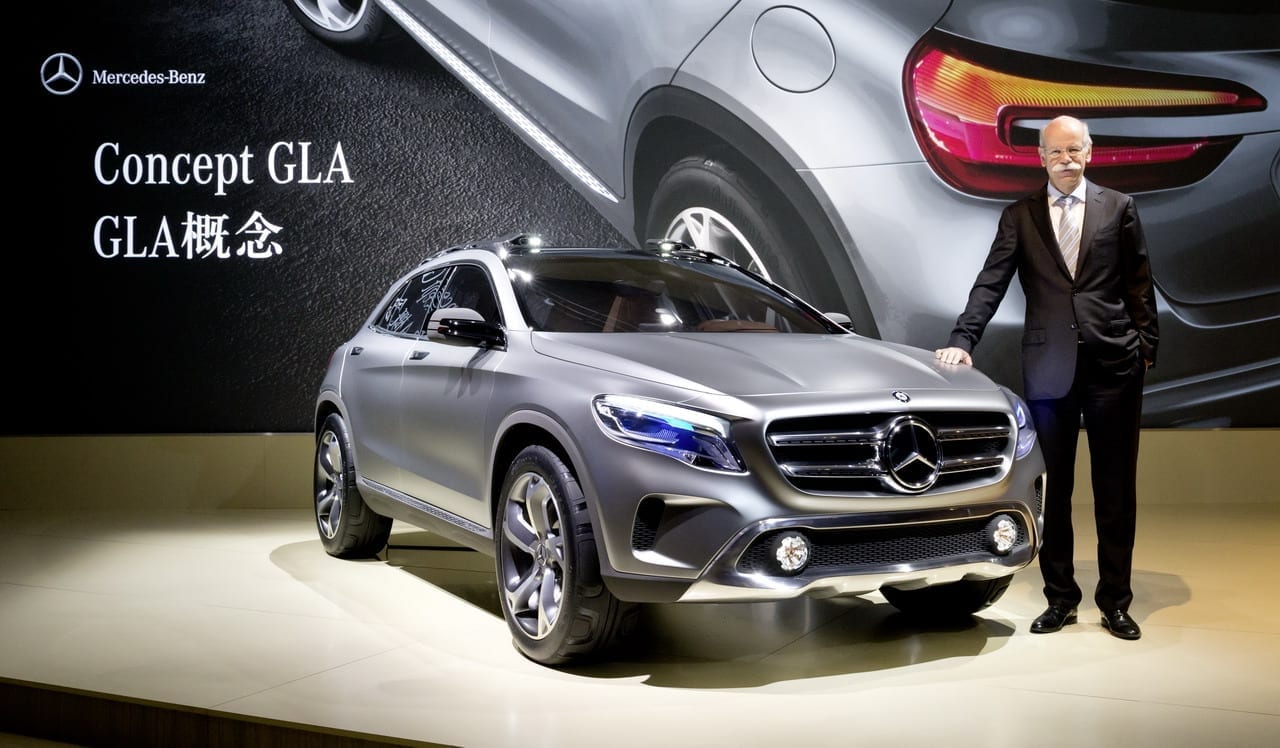
    “As the inventor of the automobile, Daimler aims to be a leader in autonomous driving – one of the most fascinating aspects of reinventing mobility,” Daimler CEO Dieter Zetsche said in the statement.

    San Francisco-based Uber has invested heavily in self-driving car technology in recent years and is currently piloting the use of autonomous vehicles in the US city of Pittsburgh.

    But it has no car-building experience, prompting it to seek partnerships.

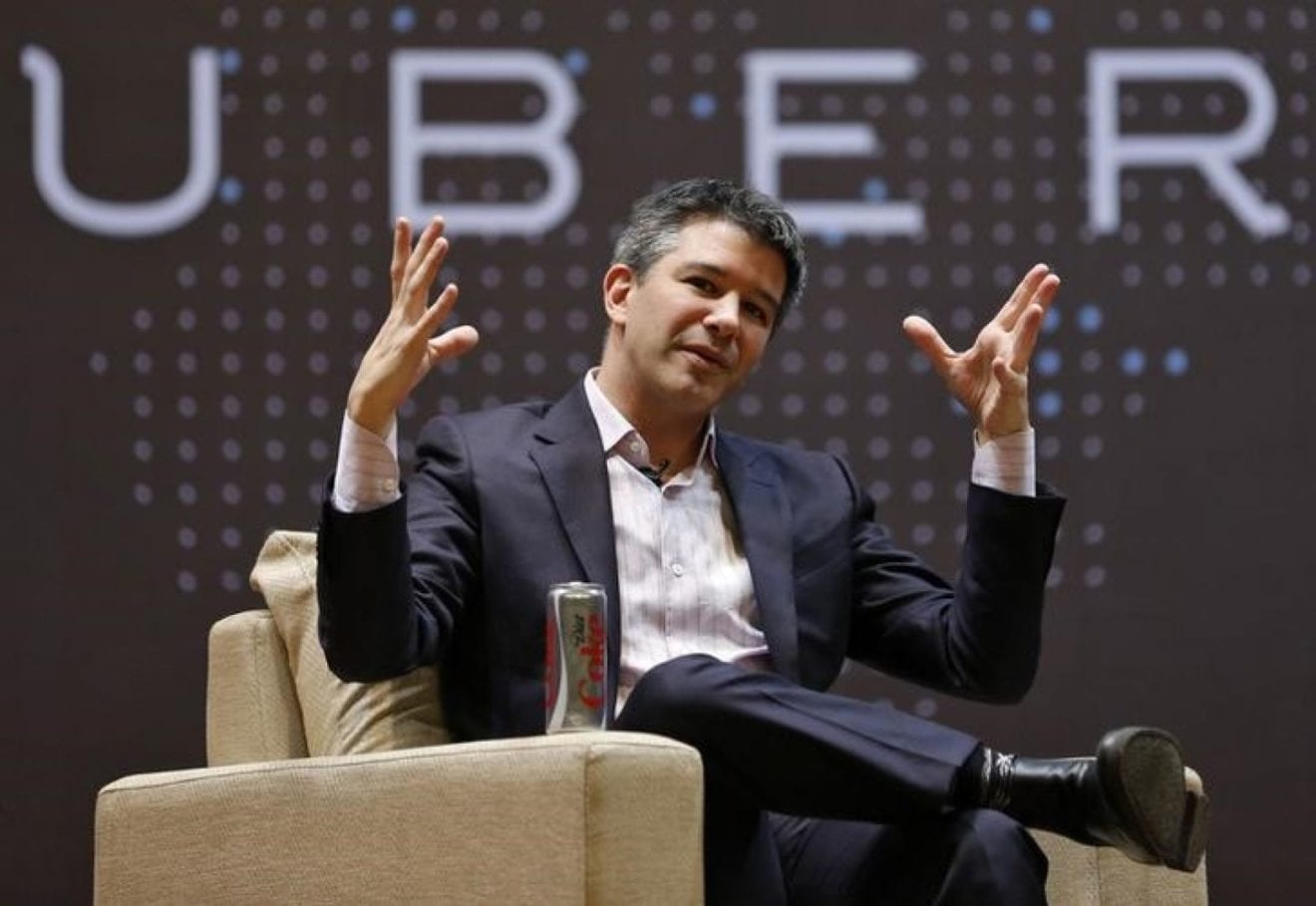
    “Self-driving technology holds the promise of creating cities that are safer, cleaner and more accessible,” Uber CEO and co-founder Travis Kalanick said.

    “But we can’t get to that future alone. That’s why we’re opening up the Uber platform to auto manufacturers like Daimler.”

    Uber is already working with Sweden-based Volvo Cars to develop self-driving cars for sale by 2021.

    And in a world first, a self-driving truck built by Uber’s Otto unit successfully delivered a beer shipment in October.

    Cars with some autonomous functions, such as the ability to adjust the speed, are already on our roads.

    But nearly all the major global automakers – including BMW, Volkswagen and Ford – are racing to get fully self-driving cars on the market in the next few years, often in cooperation with tech firms.

    US automaker General Motors last year announced a US$500 million (€460 million) investment in Uber’s rival Lyft, while Google parent company Alphabet has partnered with Fiat Chrysler to develop self-driving cars.

    The BMW group, which has partnered with US computer chip giant Intel, said earlier this month it plans to start testing self-driving vehicles on roads in the US and Europe by the end of the year.

    Auto industry expert Ferdinand Dudenhoeffer of Germany’s CAR institute predicted that the tie-up between Uber and Daimler wouldn’t be the last in the sector.

    “It’s almost to be expected. And Uber is sure to work with more car manufacturers in the future,” he told AFP. “It only makes the world of tomorrow even more exciting.”

  • China’s Future Mobility plans $1.7 bln electric car plant in Nanjing

    China’s Future Mobility plans $1.7 bln electric car plant in Nanjing

    Chinese electric car venture Future Mobility plans to build an 11.64 billion yuan ($1.7 billion) factory in Nanjing, aiming to capitalise on rising demand for electric cars in the world’s second-largest economy and elsewhere.

    The investment announced on Thursday comes despite a delay to planned funding from technology giant Tencent Holdings and Taiwan manufacturing heavyweight Foxconn , with Hong Kong-registered Future Mobility citing stricter implementation of China’s capital flow controls.

    China has ratcheted up controls on money leaving the mainland since last year in an effort to bolster a weakening yuan and prevent capital flight as the pace of economic growth slows.

    Future Mobility said it is in “close communication” with relevant parties, while a source with direct knowledge of the matter told Reuters that the company has been able to find ample funding from other investors.

    Tencent and Foxconn did not respond to requests for comment outside of business hours.

    The Tencent and Foxconn money currently sits in a China-based fund established before the tightening of capital controls and Future Mobility is working with lawyers to devise mulitiple options to “find a smart way” to complete the investment, the source said.

    The source added that Foxconn and Tencent remain as backers despite the hiccup.

    “We didn’t (initially) find a way to get the funds to come from China to the company outside of China,” the source said. “The money is there.”

    The new factory will eventually have capacity to produce 300,000 cars a year. The company did not give an indication of when it expects to reach that output but said that the first phase of the plant’s construction will be completed by 2019.

    After that initial phase, the factory should be able to produce 150,000 vehicles a year, it said.

    China, struggling with high pollution levels in major cities, is aggressively pushing plug-in vehicles. Its carrot-and-stick approach combines heavy investment and research funding with subsidies, as well as regulations designed to discourage the driving of fossil-fueled cars in big cities.

    Future Mobility said the first product it plans to produce is expected to be a pure-electric medium-sized smart SUV and that vehicles produced at Nanjing will be sold globally.

    A company spokeswoman said that the first car is likely to have a price tag of about 300,000 yuan ($43,700) and is expected to hit the Chinese market in 2019.

  • Volkswagen won’t make Audi cars with SAIC in China before 2018

    Volkswagen won’t make Audi cars with SAIC in China before 2018

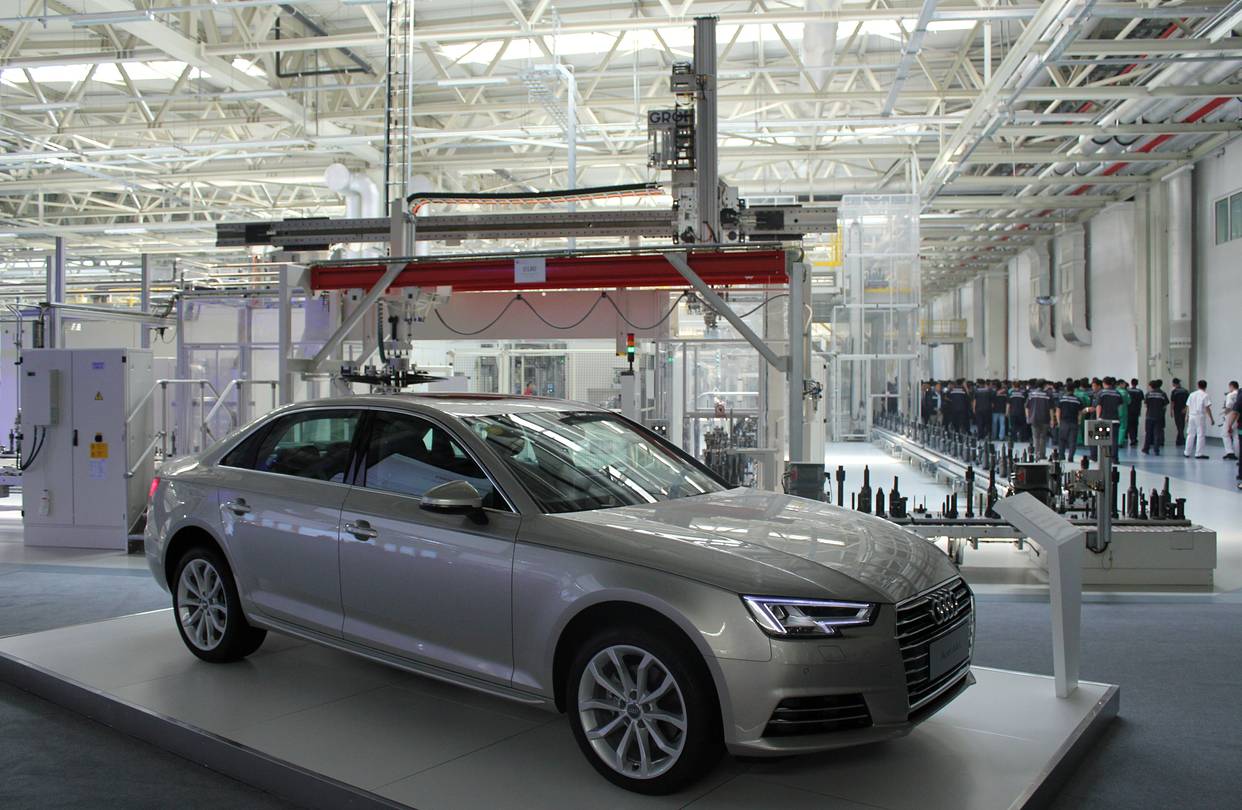
    German carmaker Volkswagen said on Wednesday it would not produce or sell any Audi cars with SAIC Motor until at least 2018, seeking first to strengthen ties with existing Audi partner China FAW Motor Corp .

    VW announced in November a non-binding agreement with SAIC to discuss a partnership regarding Audi AG, which is the best selling premium brand in China.

    Tying up with SAIC, China’s largest automaker, could boost slowing sales for the premium Audi brand as Daimler’s Mercedes and newer entrants such as General Motor’s Cadillac eat into its market share.

    “No sales, no production, nothing this year (2017),” state-owned China Daily on Wednesday quoted VW China chief Jochem Heizmann as saying.

    A VW spokesman confirmed Heizmann’s remarks, saying talks with SAIC were ongoing but that nothing “operational” would happen before 2018.

    “An agreement (with SAIC) could be reached in 2017 and there will be preparation with all the points for sales and production and so on,” an Audi spokeswoman told Reuters.

    “As soon as there is an agreement, there will be measures to fulfil this agreement, but right now we are just in talks and we have no agreement.”

    She added that while larger talks were ongoing, discussions about sales with SAIC were on hold until an agreement is reached resolving concerns of existing FAW dealers.

    Volkswagen gets a larger proportion of the proceeds from the 50-50 tie-up with SAIC than from its 40 percent stake in the venture with FAW.

    Joint ventures with VW and Audi have given FAW a lifeline as it struggles to create successful brands of its own.

    Existing dealers of Audi cars in a letter to the German firm last year said creating a new sales network would further damage an already tenuous situation as existing dealers suffer from slowing sales and generally operate at a loss.

    The Volkswagen spokesman said the priorities were first to strengthen ties with FAW, including with a recently agreed 10-year joint plan, second to resolve concerns of existing Audi dealers, and last, to move forward with a cooperation with SAIC.

    Audi said on Tuesday that its joint venture with FAW would introduce five more plug-in electric cars in China in the next five years, following on FAW and VW agreeing to a 10-year roadmap for the venture.

  • Mercedes-Benz to overtake BMW as largest premium carmaker

    Mercedes-Benz to overtake BMW as largest premium carmaker

    Mercedes-Benz is expected to reach its goal of becoming the largest premium carmaker four years early – a feat achieved, ironically, only after it stopped chasing market share and focused on making stylish high-tech cars loved by consumers.

    Introducing an elegant, sporty design and establishing itself as a pioneer in new technologies like autonomous driving has helped revive the Mercedes brand which analysts say will help keep the Stuttgart-based carmaker ahead of the pack.

    The achievement is a coup for Daimler Chief Executive Dieter Zetsche, who struggled to revive the company following a messy divorce from mass market brand Chrysler in 2007. Less than four years ago Zetsche faced restive shareholders, worried that the automaker was lagging behind rivals BMW and Volkswagen AG’s Audi brand.

    “We had some deficits, cost and quality problems. Design was not top-notch. And with Chrysler we were no longer a pure premium carmaker,” Zetsche told Reuters in an interview held late in 2016 in his office at Daimler’s headquarters in Stuttgart, Germany.

    On Sunday, Daimler said it had sold 2.08 million Mercedes-Benz branded passenger cars in 2016, a lead that BMW, which has held the premium sales crown since 2005 and is due to release annual sales figures on Monday, is not expected to beat.

    Including sales of the Smart brand, Daimler sold 2.23 million passenger cars last year, the company said.

    Zetsche has presided over a renaissance in the design and technology of Mercedes vehicles, refocused the company on technological superiority instead of short-term sales goals, and adapted the entrepreneurial mindset of Silicon Valley to the traditionally risk averse culture of Stuttgart.

    Daimler is also preparing for a new era when the auto industry’s business model moves beyond manufacturing and selling cars, to lure customers interested in pay-per-minute transport solutions provided by autonomous cars.

    Zetsche set the goal of making Mercedes the best-selling luxury carmaker by 2020 at the company’s 125th anniversary in 2011, a year when even Audi sales overtook those of Mercedes, pushing it into third place.

    “Since then we worked hard and today we are leading or among the leaders when it comes to innovation, quality, design and security,” Zetsche said.

    Daimler traditionalists were shocked by the volume target, fearing that selling too many vehicles may dilute the exclusivity of their cars and reduce the appeal of the Mercedes brand in the long run.

    But consumer electronics companies like Apple had already proven that the pull of their brand did not suffer with increased volume sales so long as they offered the best customer experience.

    Audi was gaining traction with customers thanks to cool designs, so Zetsche appointed a young designer, Gorden Wagener to head up Mercedes design. He introduced an elegant and sporty style to spruce up Stuttgart’s Teutonic limousines. Mercedes cars were also equipped with state-of-the-art digital display technology, luring smartphone savvy customers.

    It was a change for Mercedes where engineers always believed they were producing the best cars in the world, but measured quality mainly using technical or engineering criteria, a strategy which often led to powerful cars with expensive and complex technical innovations.

    Today, Mercedes-Benz follows its motto “the best or nothing” by thinking about whether customers would notice or benefit from a new technological innovation, and by benchmarking the brand against competitors, Zetsche said.

    The company’s renaissance began in earnest in May 2013 with the launch of a new flagship S-class. To burnish its credentials as a technology leader, Mercedes developed a prototype version which drove around 100 kilometres (62 miles) autonomously the same year.

    Rather than designing a limousine which appealed mainly to rear seat passengers, the new S-Class featured large digital display screens on the dashboard, a deliberate attempt to appeal to a younger, driver-focused audience.

    The same youthful design approach was used for the new C-Class and E-class designs, which are now the company’s volume sellers.

    Mercedes also revived the Maybach brand, a marque targeting the ultra-luxury sector which the company had stopped making after the prior bespoke design failed to gain traction, leading the car to sell only 200 times in its final year of production.

    Since Maybach’s latest revival in February 2015, Daimler has sold 15,000 cars.

    “The rewards we are reaping today are the logical consequence of careful preparation,” Zetsche said.

  • Nissan’s premium brand Infiniti sells 230,000 vehicles in 2016

    Nissan’s premium brand Infiniti sells 230,000 vehicles in 2016

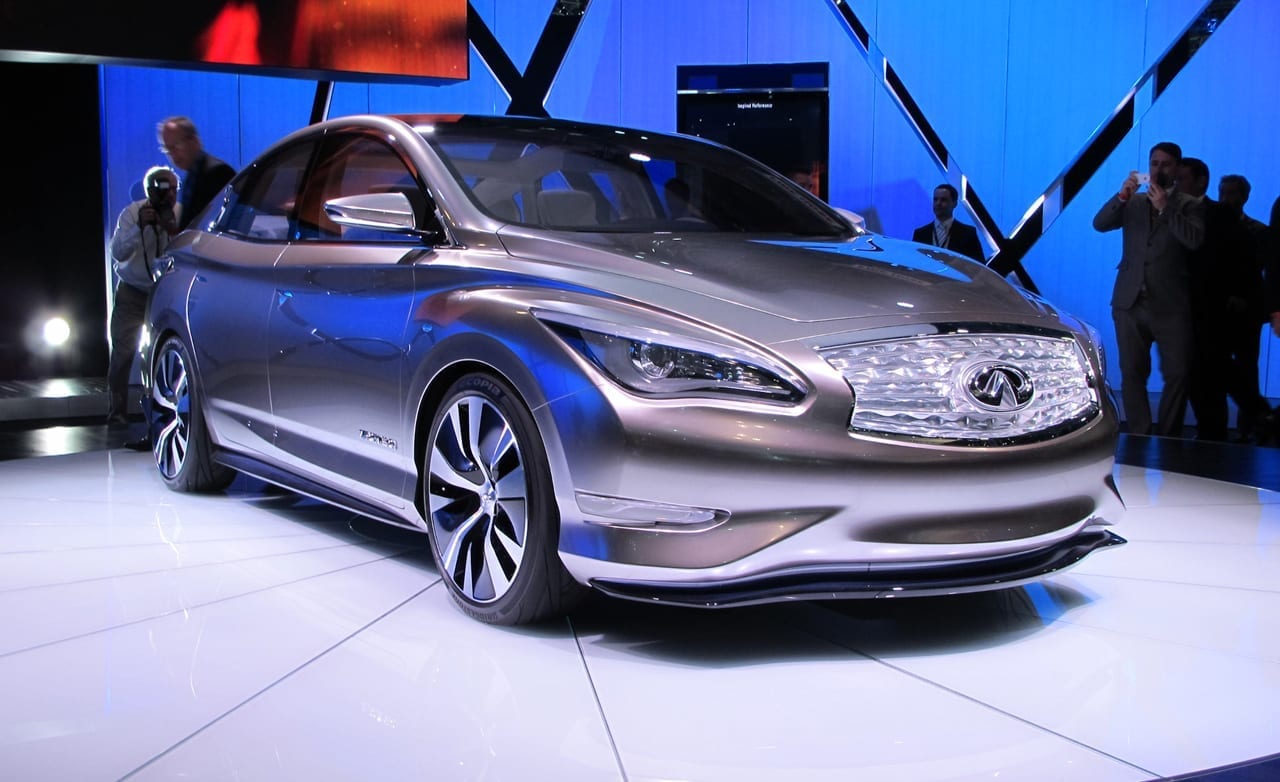
    Nissan Motor’s premium brand Infiniti sold more than 230,000 vehicles globally in 2016, a 7 percent annual rise, Infiniti said on Wednesday, a record year for a marque that trails rivals in the increasingly crowded premium market.

    The brand distantly lags German luxury competitors like BMW, which can sell almost as many vehicles in a single month, and second-tier luxury leaders like Toyota’s Lexus, which sells at least twice as many cars each year.

    Infiniti annual sales grew 4 percent year-on-year in the United States, its largest market, to more than 138,300, while China sales rose 3 percent to 41,590.

    In December, Infiniti sold 27,200 vehicles globally.

  • Nissan halts joint development of luxury cars with Daimler

    Nissan halts joint development of luxury cars with Daimler

    Nissan is halting joint development of luxury cars with Daimler’s Mercedes-Benz, sources close to the companies told Reuters, suspending a key project in their seven-year partnership and potentially hitting profitability at a new shared factory in Mexico.

    Nissan (7201.T) decided in October its premium Infiniti brand would not use “MFA2”, an upgraded Daimler (DAIGn.DE) car platform that the companies have jointly funded, in part because Infiniti was not performing well enough to absorb Mercedes technology costs, the sources said.

    “It wasn’t possible to close a deal on the basis of MFA2,” said one of the people. “The targets set by Infiniti were too difficult to achieve.”

    The move could reduce efficiency at a $1 billion shared factory opening this year in Aguascalientes, Mexico, where the companies had planned to use the same compact car architecture to cut complexity and production costs, two of the sources said.

    It could also ultimately force Nissan to write down part of a 250 million pound ($306 million) investment at its UK plant that included Mercedes-based tooling, they added.

    Daimler and Nissan pursue joint programs only when “beneficial for both sides”, the companies said in separate statements to Reuters, without directly addressing emailed questions about their plans for MFA2 vehicles.

    Projects are constantly reviewed against targets to account for “developments beyond the control of management”, they added, and discussions about joint development of future premium compact cars are ongoing.

    Nissan’s decision deals a blow to the broad cooperation deal struck between Renault-Nissan boss Carlos Ghosn and his Daimler counterpart Dieter Zetsche in 2010.

    It also underscores the mixed results of Nissan’s battle over almost three decades to transform Infiniti into a significant global player in the lucrative luxury car market.

    The decision predates Donald Trump’s election as the next U.S. president, the sources said, and was unrelated to campaign vows to penalize Mexican imports that have rattled the auto industry. Ford (F.N) on Tuesday scrapped a planned compact car plant in the country.

    Nissan and Daimler are pushing ahead with Aguascalientes, where they will build Infiniti and Mercedes models for the U.S. and other markets from a single assembly line opening in 2017.

    The project nonetheless faces weakening U.S. demand for smaller cars that contributed to Ford’s cancellation and has further raised profitability hurdles for new Infiniti compacts.

    Persistently low oil prices accelerated the market shift to larger vehicles in 2016, Ford sales chief Mark LaNeve said on Wednesday. “All the growth was SUVs and trucks.”

    PREMIUM STRUGGLE

    Infiniti has struggled outside the United States, last year selling 16,000 vehicles in Western Europe and 230,000 globally – less than 5 percent of Nissan’s overall tally and barely one-tenth of Mercedes’s expected 2 million deliveries.

    The first Infiniti appeared in 1989, the same year as the launch model for Toyota’s (7203.T) upscale Lexus brand – which has since grown three times bigger by sales.

    Modern carmakers pursue economies of scale by increasing the number of models built on each underlying platform – an adaptable chassis accommodating different body sizes, engines and alternative component sets for every part of the vehicle.

    The retreat on luxury compacts leaves intact the sharing of engines between Infiniti and Mercedes, and small cars between Renault and Daimler’s Smart. The three groups also collaborate on vans and pickups.

    But joint premium car development for Mexican production was “one of the largest projects between the Renault-Nissan alliance and Daimler”, Ghosn said when unveiling the program in 2014.

    A year later, after upgrading its plant in Sunderland, England, Nissan began building the Infiniti Q30 hatchback on the current MFA architecture developed for the Mercedes A-Class and derivatives. The plant added the QX30 SUV in 2016, extending Infiniti’s push into smaller vehicles.

    Nissan has now ditched plans to use the updated Mercedes platform for successors to those models planned for Aguascalientes, the sources said – or for any future Infinitis. Other cancellations include a compact Mercedes-based Infiniti Q40 sedan earmarked for the plant in 2018.

    Instead the single, less efficient assembly line will build Mercedes cars including an A-Class sedan and subsequent mini-SUV alongside Infiniti vehicles based on Renault-Nissan architecture, starting with a new QX50 SUV this year.

    PRICING POWER

    Nissan was forced to conclude that the Infiniti brand would not command the higher prices required to turn a profit on vehicles stuffed with Mercedes technology, one source explained.

    “One of the lessons learned is that if you have the costs of a luxury vehicle but not the pricing, it’s hard to be profitable,” he said.

    Nissan may end up writing down some Sunderland investment in Mercedes-based tooling that had been intended to outlast the current Q30 and QX30, people with knowledge of the matter said.

    The company is still paying its share of MFA2 development costs running to hundreds of millions of euros for a platform it no longer plans to use, they said, but will leave Daimler with a higher share of some production costs in Aguascalientes.

    The setback may also show the limits of Ghosn’s consensual approach to economies of scale as head of both Renault (RENA.PA) and Nissan, whose 18-year-old alliance is underpinned by significant cross-shareholdings.

    The slow pace of integration has contributed to upheaval at the recently created alliance powertrain division, charged with converging Renault and Nissan engineering.

    Plans to build Infinitis on Mercedes technology had encountered resistance at Nissan from the start, one source said. “Once again, Ghosn has been unable to break through the wall of engineers to force commonality.”