Retail News CRM

Tag: ecommerce

  • aCommerce recruits new CXOs for Indonesia operations

    aCommerce recruits new CXOs for Indonesia operations

    Norwegian international management executive Snorre Larstad​ will take the lead as aCommerce Indonesia CEO. Larstad previously worked as a chief strategy office for the Morris Group in China.

    Meanwhile, the company has also hired H​adi Kuncoro to lead its Indonesian operations for IT and supply chain management. This follows stints by Kuncoro in co-founding an Islamic fashion e-commerce company​ and a successful founding role at Rocket Internet’s Zalora Indonesia.

    Commenting on the leadership appointments, Paul Srivorakul, group CEO of aCommerce, said,“We’ve seen unparallelled growth in Indonesia and it is on track to become our most important strategic market.”

    Srivorakul added, “With Snorre’s experience scaling and managing huge and complex international retail businesses and Hadi’s success rate in building massive ecommerce operations in Indonesia we are confident that this pairing will streamline our incredible growth and gear us up for the next phase of our commercial development in Indonesia.”

    Indonesia recently became aCommerce’s biggest regional operation, with August seeing it reach a manpower count of 360 staff, surpassing the growth of its operations in Thailand and the Philippines. July 2015 also saw aCommerce Indonesia double its warehouse capacity to 9332 square metre. A new Pondok Ungu fulfilment center of more than 5232 square metres was added to supplement the current 4100 square-metre Halim facility.

    aCommerce Indonesia currently powers ecommerce for major brands and retailers such as Matahari Mall, HP and L’Oreal. According to official statements, the demand for aCommerce’s services in Indonesia exceeded forecasts due to the rapidity and growth of heady new entrants to the Indonesian e-commerce space and the growth in major clients signed.

    This internal round was targeted at funding the development of further competencies in marketing, technology platforms, expanding warehouse space and recruitment. The addition of Snorre and Kuncoro to the team brings significant knowledge capital to aCommerce as its scales up operations in Indonesia and the region.

    In a media release, Snorre stated: “This is an exciting time to be in the ecommerce industry in Indonesia. With ecommerce still accounting for much less than one per cent of retail in Indonesia, I will be continuing the work of positioning aCommerce as the key driver of ecommerce industry development across the archipelago.”

    Snorre succeeds previous CEO Hadi Wenas, who has taken up the role of CEO as M​atahariMall.com.​ Previous co-CEO Adrian Suherman has shifted to an executive role within the Lippo Group.

    Snorre speaks fluent Chinese and his twenty years in international management have predominantly taken place in Asia, with a career involving roles across the retail, manufacturing, supply chain, shipping, strategy and financial advisory sectors. Snorre had also previously worked for AT Kearney as a strategy consultant, advising CXOs on M&A, supply chain and growth strategies across multiple industries on a global scale.

    A member of i​dEA​ and deputy chief of the Indonesia L​ogistics Association, new COO​ Kuncoro previously served as the COO of First Logistics and as VP and operations director at Zalora Indonesia. Kuncoro brings deep domain experience in r​etail management, supply chain and domestic and cross-border logistics across consumer goods and retail industries.​

    Indonesia is slated to become the biggest ecommerce market in Southeast Asia, with a recent AT Kearney report estimating the market to grow to reach $30 billion in value over the next few years, up from the $1.3 billion in 2013.

    “In Indonesia, we envision that the industry is about to enter into a rapid growth phase. aCommerce will be at the forefront of providing the solutions for any obstacle in the growth path of the ecommerce industry,” said Snorre.

    According to aCommerce, the latest CXO recruitments are in preparation for a Series B round and further scaling of its operations in Indonesia and the region. Earlier this year, it raised a $5 million internal bridging round in preparation for a Series B round of funding.
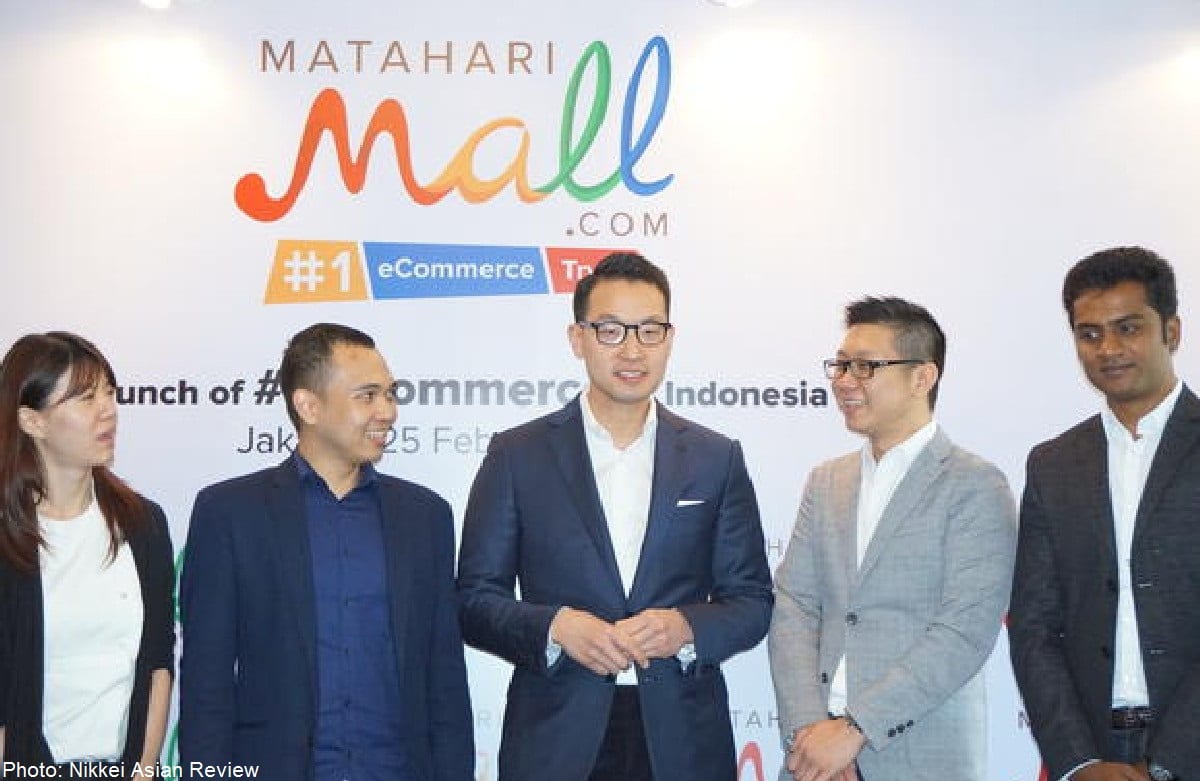
  • MatahariMall aims for 20% of Indonesian e-commerce market by 2020

    MatahariMall aims for 20% of Indonesian e-commerce market by 2020

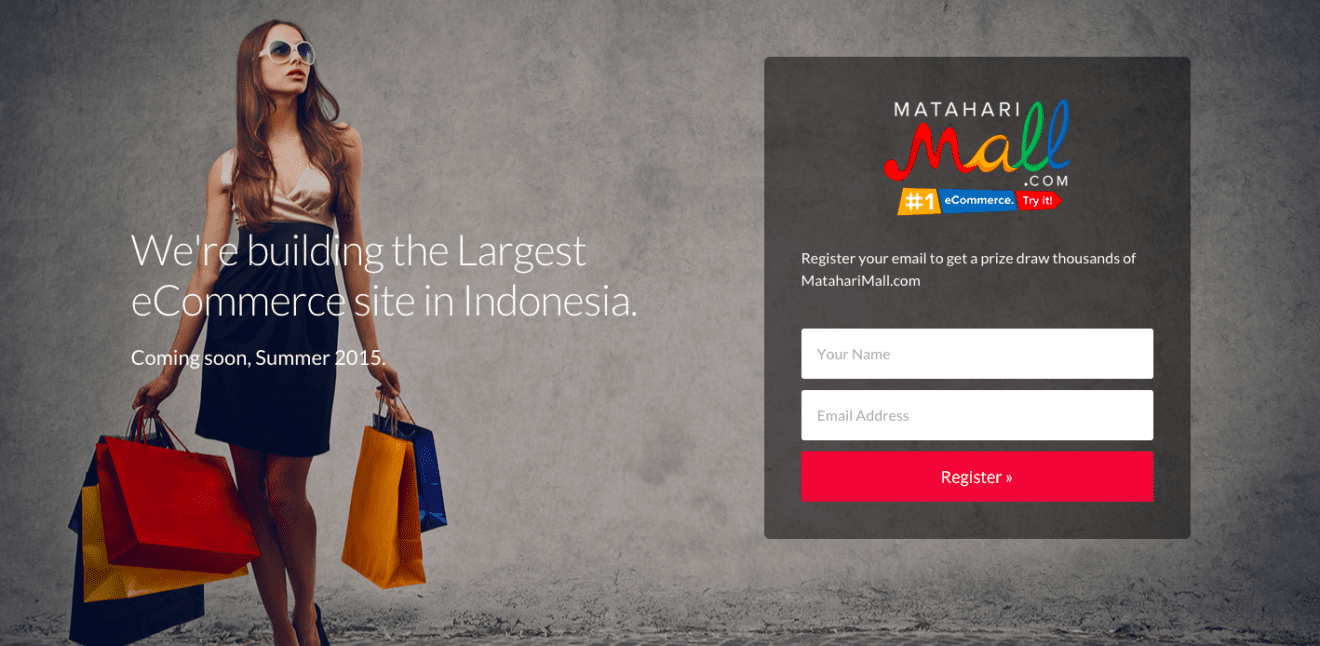
    MatahariMall, which is planned to be launched next September, is eyeing 20 per cent of the e-commerce market in Indonesia by 2020. That year, the total market volume is projected to reach US$20-30 billion, compared to US$1.3 billion currently.

    It was told by MatahariMall’s Chairman Emirsyah Satar to Berita Satu. He stated that the team uses Alibaba as their role model. As we know, MatahariMall is the first marketplace to use O2O (Online to Offline) concept since the very beginning.

    Satar said, “Currently, the e-commerce market in Indonesia is worth around $1.3 billion. It’s so low, not even one percent of the total national retail sales. In other countries, e-commerce could cover 5-8 per cent of total retail sales. So, we estimate that out market volume would reach around US$20-30 billion by 2020.”

    “Our network footprint is quite strong and well-distributed all over Indonesia. We also have the experience of doing offline retail. Users may inspect their desired products before purchasing them, thanks to the support by Matahari and Hypermart. So, they may touch, feel, and even return the product should they feel that the it doesn’t meet their expectation,” he continued.

    MatahariMall has been accessible at the moment, although it’s still in form of a teaser page. Satar claimed that the number of buyers is already quite significant.

    Challenges of the e-commerce industry

    Satar pointed out two main challenges of the e-commerce industry in Indonesia, which are infrastructure and regulation. Infrastructure refers to the poor distribution of the Internet network, while regulation refers to the government’s law.

    “For instance, the regulation that requires merchants to fill out their TIN or ID number before posting at marketplace. I don’t think it’s urgent, as the industry is still infant. It should be enforced once the right time comes,” he said.

    The government, led by the Minister of Communication and Information Rudiantara, is currently formulating the roadmap for e-commerce in Indonesia, as President Joko Widodo stated in the opening of Indonesia Convention Exhibition (ICE) last Tuesday.

  • Online Retailer MatahariMall Sets 20% Market Share Target

    Online Retailer MatahariMall Sets 20% Market Share Target

    Lippo Group’s new e-commerce unit MatahariMall is embarking on an ambitious expansion plan, aiming for a 20 percent market share of Indonesia’s web-based retail sector by 2020, its chairman said on Wednesday.

    MatahariMall.com chairman Emirsyah Satar said the potential of the e-retailer, which is slated for an official launching in September, is similar to Chinese e-commerce giant Alibaba’s in light of Indonesia’s huge untapped e-commerce market.

    Indonesia’s  e-commerce market is currently worth around $1.3 billion, constituting only 1 percent of the national retail market.

    “The e-commerce markets of other countries can reach between 5 and 8 percent of total retail sales, so we are confident the market volume can expand to between $20 billion and $30 billion by 2020,” Emirsyah said at the MatahariMall office in Jakarta.

    Unlike other online retailers, MatahariMall will offer the O2O, or Online to Offline, system that would allow customers to order products online and see the products first-hand at a nearby Matahari or Hypermart store, both of which are affiliated with the Jakarta Globe through Lippo Group.

    “We have a very solid footprint network in Indonesia and we have the experience in offline retailing through Matahari and Hypermart,” said the former president director of Garuda Indonesia.

    MatahariMall, Emirsyah added, is also partnering with various top brands in the lifestyle, fashion, automotive and electronics sector to enrich the array of products available to customers.

    “We believe MatahariMall.com will be the [region’s] best and biggest online retail store,” he added.

    Emirsyah is also urging the government to support the online retail industry through Internet infrastructure and regulations that support a growing local industry.

    MatahariMall has appointed Credit Suisse and Bank of America Merrill Lynch to lead its first round of financing for an amount expected to be between $200 and $250 million. This financing would make MatahariMall the most valuable e-commerce company in the country.

    The online retailer has also built a main warehouse of 10,000 square meters in Halim, East Jakarta, that can accommodate thousands of products.

    Lippo Group, one of Indonesia’s largest business conglomerates, has committed to invest $500 million for the next three years in its e-commerce arm.

  • Now, you can shop on Twitter

    Now, you can shop on Twitter

    Twitter has announced that the company is launching a product and place pages that allows users to discover and purchase items within the service.

    According to the Verge, the new pages will organise related tweets about products and brands on dedicated pages.

    A product page will let people see others’ tweets about that product, prices, and, sometimes, a buy button.

    The company is also rolling out what it’s calling Collections, a way for brands and celebrities to curate products and recommend them to followers.

    This is the second new feature Twitter has unveiled this week after announcing Project Lightning, a news platform that would allow users to follow events instead of people.

  • Online shopping made safe at 11street

    Online shopping made safe at 11street

    Worrying statistics call for stringent safety measures to ensure Malaysians can make their online purchases risk-free. 11street, one of the biggest online marketplaces in Malaysia, has taken numerous steps to ensure safety of its customers with an ESCROW system being the most significant one. 

    “11street constantly strives to address e-shoppers’ concerns by implementing safety-boosting solutions. ESCROW system is a financial instrument of placing a buyer’s money on hold in control and releasing it to the seller only when the delivery of the purchased item is fulfilled, thus protecting buyers from frauds. 11street also takes extra effort and responsibility to penalise any sellers for non-delivery cases,” 11street’s Chief Executive Officer, Hoseok Kim said. 

     “Furthermore, we are Payment Card Industry Data Security Standard (PCI DSS) compliant and with our in-house security system, our website is strengthened with comprehensive capabilities to monitor all products and transactions between buyers and sellers, that allows us to focus on detecting suspicious activities such as counterfeit product listing to minimise online risks while facilitating secured online transactions.” Kim added.

    In light of recent increasing incidents of cybercrimes, 11street developed basic guidelines for consumers to follow in order to stay safe online:

    1.Choose only trustworthy online shopping sites

    Reliable sites offer full information on sellers and customer service support reachable via email and phone. A credible site will also include features such as a return policy in case the buyer is unsatisfied with their purchase, along with a ‘help’ section for shoppers to lodge any complaints. 

    2.Use a secure connection when you place your order

    Look for a lock symbol on the page and check if the web address starts with “https://”, rather than “https://”. This guarantees that encryption is being used and your sensitive information is protected.

    3.Be cautious when making payment  

    Upfront payment is common for online transaction. Yet, legitimate sellers usually offer multiple secured payment methods via bank or credible payment gateway, including credit card payment and online bank transfer to company account rather than personal account. 

    A good practice to ensure that you are buying from legitimate sellers would be to look for their bank partners or multiple secured payment channels that are available when making a purchase. This further enhances the site’s credibility, as they would need to be qualified by banks or the authorities through stringent checks.

    If a site has an ESCROW system in place to assure buyers with delivery, that is another plus point which indicates the credibility of the site.  

    4.Read reviews shared by other customers

    Make an informed purchase and read comments from real customers. You can be sure you’ll find out a lot on their overall shopping experience and the quality of products. Have a closer look at negative reviews and the way they were handled by sellers, as this will give you some insights into their customer service.

    5.Never click on links from spam emails to make purchases

    It is never a good idea to click on a link in an email from someone you don’t know, let alone purchasing from a random website that sent you spam email. Remember to verify the seller before any purchase and never follow links from dubious sources.

    6.Use strong passwords

    If your password can be found on the list of 25 most popular passwords it requires an immediate change. Set passwords that are at least 10 characters long and consist of a combination of letters and numbers. 

    7.Don’t use public computers for online shopping

    Even if you erase your browsing history and log out, your sensitive information may still be accessible to industrious thieves. It is not uncommon for them to install sophisticated software that records keystrokes and then emails that data to the thief on public computers 

    Kim ends, “We believe security is the key to success in the online sphere. All sellers on 11street have been thoroughly vetted and we also flag up suspicious credit cards to banking authorities to ensure that our sellers don’t get tricked as well. In the same manner, customers make payments to bank accounts that have been registered with us. Yet, we advise all online shoppers to take these precautions to make sure their online shopping experience is enjoyable and safe”.

  • PayPal completes eBay split

    PayPal completes eBay split

    Having finalised its split from eBay, PayPal is now an independent public company trading on the Nasdaq  as PYPL.

    Dan Schulman, president and CEO of PayPal, said the business would be focussing on enabling digital payments on a “technology agnostic platform that creates value for our consumers and merchants online, in apps, and increasingly in stores.”

    “As the world’s open, digital payments platform and most trusted and popular digital wallet, we are excited to celebrate our listing day and embark on our next chapter,” said Schulman.

    “Mobile technology is transforming payments, making it easier, safer and more affordable for people to move and manage their money than ever before. As an independent company, we see a tremendous opportunity for PayPal to expand our role as a champion for consumers and partner to merchants, and to help shape the industry as money becomes digital at an increasingly rapid pace.”

    PayPal previously was listed on the Nasdaq under the same ticker symbol, PYPL, before it was acquired by eBay in 2002 for $1.5 billion. “We’d like to thank our friends at eBay for their tremendous support and partnership over the past 12-plus years,” said Schulman.

    In 2014, PayPal processed $235 billion in total payment volume and generated more than $8 billion in revenues. Also last year, PayPal processed $46 billion in mobile payment volume. The company serves more than 169 million active customer accounts in 203 markets around the world.

  • Uber Takes The eCommerce Route In Indonesia

    Uber Takes The eCommerce Route In Indonesia

    After being recently shut down in multiple countries over its controversial “tech company” status, Uber seems to have found a workaround at least in Indonesia.

    The company has announced plans to register itself as an eCommerce business so as to avoid taxes, and taxi-medallion regulations, which has brought troubles to its door in almost all of its major business markets.

    With the registration, the company plans to establish itself as a foreign-owned entity registered as an Internet portal, said Uber Indonesia’s Country Head Alan Jiang.

    “Indonesia is a super-key market for us,” he said.

    The ride-hailing company has been cutting corners in its everlasting struggles against local and national laws in all of its market, but in Indonesia the plans come after the local police in Jakarta arrested five Uber drivers as part of a wider investigation in a case filed by other taxi companies accusing Uber for challenging market rates with its predatory pricing scheme.

    For expanding its business in the country, Uber has not only been offering its service for 30 percent less than the main local taxicab companies, but has also not been charging commission on rides, Jiang said.

    “In the future we will take a service fee and when we do we will pay all the applicable taxes on that,” he said. “I don’t have a specific timeline for when.”

    As it struggles to keep its business open in several markets, the company has repeatedly justified its business model. “Uber is a technology company,” the company said. “We do not own, operate vehicles or employ drivers.”

  • E-commerce to drive Asean retail growth

    E-commerce to drive Asean retail growth

    In its 2015 report to leaders, Asean BAC said business-to-customers Internet sales in Asean account for only one per cent of total sales as opposed to eight per cent in developed economies.

    According to global management consulting firm AT Kearney, Singapore is the only Asean country to be placed in the top 30 in a ranking led by the US, China and United Kingdom.

    In the firm’s 2015 Global Retail E-Commerce Index, Singapore ranked 14th with a 41.5 score in terms of online market attractiveness.

    The study said the city state has infrastructure that makes the retail environment conducive for online shopping.

    In terms of consumer behaviour, Singapore was rated at 89.4, a score higher than the US, which indicated a favourable consumer base for online transactions.

    Asean BAC said e-commerce technology is essential for the integration of Asean’s retail sector as it makes shopping easier for consumers. It also helps grow businesses without having to contend with too many pre-existing impediments.

    But in order to develop e-commerce, the council said Asean needs to work on its logistics, develop an online payment system and promote access to finance.

    Asean should also consider the establishment of a region-wide e-payment regulation system that will help companies identify their clients.

    To speed up the payment process, an e-payment escrow solution could also be explored, the council said in its report.

    Asean should also encourage partnerships between e-retailers and logistics players to improve trade efficiency.

    The integration of logistics systems in Asean must be accelerated. The council added in its report that the Asean Single Window system should be fully-implemented.

    Asean BAC said access to finance and use of regional e-commerce platforms will help Asean e-commerce players keep up with their international competitors.

  • China’s on-line cross-border buying growth

    China’s on-line cross-border buying growth

    Guangzhou has taken the lead in a pilot cross-border purchasing eCommerce scheme, offering each challenges and large alternatives for Hong Kong companies.

    Cross-border on-line purchasing is more and more in style on the Chinese language mainland. Generally known as haitao, the apply permits shoppers to order merchandise by way of abroad on-line buying platforms, and have their purchases dispatched by worldwide couriers or collected and shipped to China by forwarding brokers. Its reputation has been spurred by the comparatively restricted vary of abroad items out there throughout the mainland and the premium costs of such gadgets when obtainable.

    A number of mainland cities have been authorised to hitch the pilot program for cross-border e-commerce. However solely six cities – Shanghai, Chongqing, Hangzhou, Ningbo, Zhengzhou and Guangzhou – have been assigned the proper to undertake complete import-export actions. This has given these cities the prospect to determine typical retailers designed to facilitate abroad on-line purchasing. Guangzhou has been on the forefront of maximising this chance.

    Three cross-border eCommerce companies – MeijoyBest (Guangzhou MeijoyBest E-commerce Co Ltd), zero20 (Guangzhou Lingerling Cross-Border E-Commerce Co) and Ieasy (Guangzhou Yangxitai E-Commerce Co Ltd) – lately commenced operation within the metropolis. A fourth, Nansha Cross-Border Direct Purchasing Expertise Centre, will open shortly. On its first day of buying and selling, almost 100,000 individuals visited MeijoyBest’s 230 sqm retailer, a transparent indication of the large demand in Guangdong for imported items.

    1. Decrease costs

    General, costs are typically some 30 to 60 per cent cheaper than comparable items obtainable elsewhere. In line with the procedures for basic commerce, imported items are required to pay three taxes – a customs tariff, VAT and a consumption tax.

    The tax charges differ in line with the class of the products. The tax price for cosmetics, for instance, might be as excessive as 50 per cent. Moreover, each logistics step within the distribution of a product, from the importing agent to wholesalers and retailers, provides to the general value.

    As abroad on-line bodily shops place orders on-line and gather items offline, the one tax payable is on baggage and private postal articles, thus significantly decreasing the general tax burden. Moreover, these shops are entitled to supply tax exemptions for single purchases valued beneath Rmb50. This, along with the shortage of a day by day ceiling (although every buy might not exceed Rmb1000 in worth and the unit worth of indivisible commodities might not exceed Rmb1000), drastically boosts shopper’s inclination to spend.

    The tax on baggage and private postal articles is a type of import tax levied by the Chinese language customs on baggage and articles carried by incoming travellers, in addition to on private postal articles. This tax has 4 tax bands – 10 per cent (meals, toys, and books and periodicals), 20 per cent (textiles, residence electrical home equipment and audio-visual gear), 30 per cent (high-end watches and golf golf equipment), and 50 per cent (tobacco, wine and spirits, and cosmetics).

    2. Peace of thoughts and authenticity

    There have been some situations of eCommerce websites promoting counterfeit items in recent times. There have additionally been many instances the place individuals didn’t obtain items that they had paid for. These incidents have prompted shoppers to return to bodily retail channels, that are perceived as decrease danger. Sometimes, shoppers have larger religion in items they will contact and look at and that they will pay for on the spot.

    Gross sales at abroad on-line bodily shops are monitored in real-time by the related authorities departments. The sources and high quality of products and the monitoring procedures are extra clear than is the case with online-only buying, thus they’re extra dependable. Guangdong shoppers appear to have welcomed these abroad on-line buying bodily shops as a most popular and extra reliable buy route.

    three. On-site assortment

    In accordance with Tao Zili, chairman of Meijoybest E-Commerce Co, on-site pick-up is simply attainable on the firm’s bodily retailer within the Guangzhou Bonded Space. Its Guangzhou Pearl River New Metropolis retailer nonetheless has to dispatch on-line orders to shoppers. Upon customs approval, the acquisition is dispatched from the bonded space and delivered by the suitable logistics corporations. This course of takes as much as 48 hours, quicker than the prevailing supply association for items bought at abroad on-line buying web sites. The corporate is constructing a 50,000sqm abroad on-line purchasing bodily retailer within the Guangzhou Bonded Space, which is because of open subsequent month. This new retailer will permit on-site pick-up and supply buyers with an expertise similar to that of typical purchasing. The power is predicted to offer a further increase to the uptake of abroad on-line purchasing within the metropolis.

    The bodily retailer at Pearl River New Metropolis is, actually, primarily a promotional outlet for its abroad on-line shopping center within the bonded zone. To draw clients, the Pearl River New Metropolis retailer has a “obligation paid part”. All items bought right here have the three taxes pre-paid and can be found for instant on-site assortment. The disadvantage is that costs are similar to typical market costs elsewhere within the metropolis.

    four Eradicating language and transaction obstacles

    Most abroad eCommerce websites, sometimes that includes an English interface, will not be obtainable in Mandarin. If shoppers encounter issues with their purchases, they need to make long-distance calls and talk with the seller who typically doesn’t converse Chinese language. As well as, most of the bank cards issued by mainland banks are usually not accepted by abroad purchasing web sites. Establishing abroad on-line buying bodily shops on the mainland addresses each of those issues.

    When it comes to Hong Kong companies, the emergence of those shops has two clear implications:

    1. Fewer cross-border purchasing journeys by Guangdong residents

    Whereas costs for many items at these shops are greater than these for comparable items in Hong Kong (after taking the tax on baggage and private postal articles under consideration), if journey time and prices are factored in, it’s nonetheless cheaper than buying immediately in Hong Kong. This can inevitably have an effect on Hong Kong’s retail enterprise and scale back commerce between the 2 cities. It might, nevertheless, assist to alleviate Hong Kong’s gray market items drawback.

    2. Larger entry to home gross sales channels

    Provided that there are not any restrictions on the sorts of products bought in these shops, there’s appreciable scope for Hong Kong-sourced gadgets.  Tao, for example, welcomes the chance for elevated cooperation with Hong Kong suppliers. As MeijoyBest will maintain points referring to taxation, promotion, advertising and logistics, this provides Hong Kong companies that haven’t any advertising community in Guangdong a streamlined route into the huge mainland market.

    When it comes to the operation of those shops, Tao believes there are three key parts required for fulfillment – a vendor system (administration of provide and suppliers); a gross sales system (eCommerce platform and cost system); and a logistics system (administration of dispatch and transportation of products). These all require customs approval and should adjust to the related customs monitoring techniques.

    Whereas Tao was reluctant to reveal the precise quantity of funding required to ship this, he did point out that an eight-figure sum went into creating these three techniques over the previous two years.

  • MetaPack expands into Asia with Hong Kong workplace

    MetaPack expands into Asia with Hong Kong workplace

    The MetaPack Group, the main supplier of e-commerce know-how for supply providers, as we speak introduced its enlargement into Asia with the opening of operations in Hong Kong. With workplaces in the UK, France, Germany, Poland and the USA at present, the institution of a Hong Kong workplace is additional proof of MetaPack’s dedication to worldwide progress.

    Asia varieties a serious a part of MetaPack’s evolving international technique to turn out to be the e-commerce supply buyer expertise know-how platform of selection globally. Buying German delivery fulfilment specialist XLogics and US delivery platform suppliers Abol in 2013 and 2014 respectively, MetaPack has seen speedy progress because the launch of its distinctive SaaS platform in 2008. This development is about to proceed because it expands outdoors Europe and the USA.

    The division will probably be headed up by Peter Winslow, who just lately joined MetaPack as VP of Higher China. Previous to becoming a member of MetaPack, Winslow was the managing director at InXpress, an authorised DHL Categorical reseller concentrating on SMEs in Hong Kong. He constructed up his wealthy information of the area’s supply business and tendencies by way of holding a collection of high-level roles at each DHL and UPS in Asia and Australia. MetaPack is planning to capitalise on Peter’s 35 years of expertise in cross-border provide chain freight and categorical enterprise in Asia to focus on sellers who’re delivery their merchandise everywhere in the world.

    Patrick Wall, CEO of MetaPack, stated: “Not solely are we happy to announce the opening of our Far East Asia HQ, however we will really feel assured that the brand new workplace shall be in protected palms with Peter approaching board with us. He has the management expertise, enterprise relationships and business information that may assist us develop quickly within the Far East.”

    Winslow stated: “The Far East is an space the place e-commerce is rising at an outstanding fee, and that’s the reason this can be very thrilling to be getting into the market and facilitating cross border on-line commerce. There’s an awesome alternative to attach European retail manufacturers with Asian shoppers in addition to assist native Asian retailers and carriers rework the web shopper expertise and supply a more sensible choice of extra aggressive supply providers.”

  • Globe Telecom partners with Lazada for mWallet service

    Globe Telecom partners with Lazada for mWallet service

    Globe Telecom recently partnered with online retailer and marketplace Lazada to bring its GCASH mobile wallet to the e-commerce space in Southeast Asia.

    Under the agreement signed by Globe Telecom President and CEO Ernest Cu and Lazada Founder and CEO Maximilian Bittner in Seoul, Korea, GCASH will be used as a mode of payment in Lazada’s eCommerce website through an open integrated mWallet platform.

    “By increasing transactions through mWallet, we will expand the online ecosystem of Globe and provide our customers with a full digital lifestyle experience,” said Cu. GCASH is a product of Globe Telecom’s wholly-owned subsidiary G-Xchange, Inc. (GXI) and is among the pioneers of telco-led mWallet.

    GXI’s partners today include government agencies, utility companies, cooperatives, insurance companies, remittance companies, universities, banks, and commercial establishments which accept GCASH as a means of payment for products and services via mobile phone or the Internet.

    Through mWallet, Globe customers no longer need to own a credit card or even have a bank account to shop online. Instead, they can turn their mobile phone into a virtual wallet to shop at the speed of a text message.

    Lazada has over 15,000 merchants in Southeast Asia, and 1.4 million active customers. In the Philippines, mobile traffic constitutes more than 50 percent of its daily traffic. According to Inanc Balci, CEO of Lazada Philippines, the Lazada Mobile App downloads have grown 18 percent month-on-month since its launch in early 2014.

  • Cyber risk in retail: protecting the retail business to secure tomorrow’s growth

    Cyber risk in retail: protecting the retail business to secure tomorrow’s growth

    Years 2013 and 2014 saw an unprecedented level of cyber assault on retailers. Several major breaches hit the headlines and retailers reported tens of millions of customer data and credit card records exposed. Despite widespread attention to payment card industry (PCI) compliance, cyber criminals have clearly taken retailers by surprise.

    Due to the frequency and impact of recent cyber attacks targeting retailers, Deloitte undertook efforts to gather information and facilitate practical dialogue on the issue of cyber risk. The report, Cyber risk in retail: protecting the retail business to secure tomorrow’s growth, summarizes key issues facing retailers:

    • Compliance does not always equal risk management
    • Breach response readiness is top of mind as companies scramble to shore up detection
    • External intelligence will play a crucial role in the war against cyber threats
    • Cyber risk is a business issue

    It also outlines actions that retail organizations can take near term to mitigate cybersecurity risk, and concludes with a set of issues that call for future research, dialogue, and collaboration.

    To download the report, click here.

  • Lazada sees healthy online retail growth

    Lazada sees healthy online retail growth

    Thailand’s online retail market is expected to grow by up to eight times in the coming years, the same pace as China’s.

    The proliferation of inexpensive mobile devices and the growing number of internet users will be the main contributors.

    Riccardo Basile, chief executive of online shopping mall Lazada Thailand, said the local online retail market excluding food and travel would account for 1 percent to 1.5 percent of the country’s retail market this year.

  • Flipkart to create 2 million jobs in 2015

    Flipkart to create 2 million jobs in 2015

    Indian leading e-commerce company Flipkart on Wednesday said it would directly and indirectly create about two million jobs in 2015 through its marketplace and ancillary services.

    Among other segments, logistics and warehousing would be key employment generators, the company said. In 2014, the e-commerce industry created about half a million jobs, according to Flipkart.

    The Bengaluru-based company employs about 33,000 people. Earlier this week, Flipkart said it planned to double the size of its technology team in 2015 to 2,000.

  • New stores, eCommerce drive Gome growth

    New stores, eCommerce drive Gome growth

    China’s Gome Electrical Appliances boosted online sales by 84 per cent last year helping fuel a 43.5 per cent boost in annual profit.

    The full year surplus was 1.28 billion yuan, (US$206.2 million).

    The booming online operation is clearly still growing with a quarter on quarter sales boost of 117 per cent in the three months to December 31.

    At the same time, Gome says it continued to refurbish its bricks and mortar store network and revamp its supply chain, procurement and distribution operations.

    In annual figures released Monday, Gome said it continues to pursue its goal of becoming an ‘Open Omni-channel Retailer’ by optimising its open supply chain platform, driving further improvements in the areas of procurement, logistics, information system and financial services, and building an open omni-channel platform encompassing ‘online + offline + mobile terminal + other socialised channels’.

    “The group has managed to provide cross-regional and cross-channel full services to consumers as a whole. The launch of this strategic transformation, supported by the low-cost highly-efficient open supply chain, has enabled the group to achieve year-on-year growth in key financial indicators for eight consecutive quarters and increase its operating efficiency,” the company said in a statement.

    As well as renovating 100 existing stores, Gome continued its push into tier 2 markets, strengthened partnerships with supermarkets and department stores and promoted its eCommerce development. Last year it opened 145 new stores, 78 of them in tier 2 cities. A further 154 concessions were opened.