Retail News CRM

Tag: future

  • Indonesia’s Go-Jek rejected in the Philippines

    Indonesia’s Go-Jek rejected in the Philippines

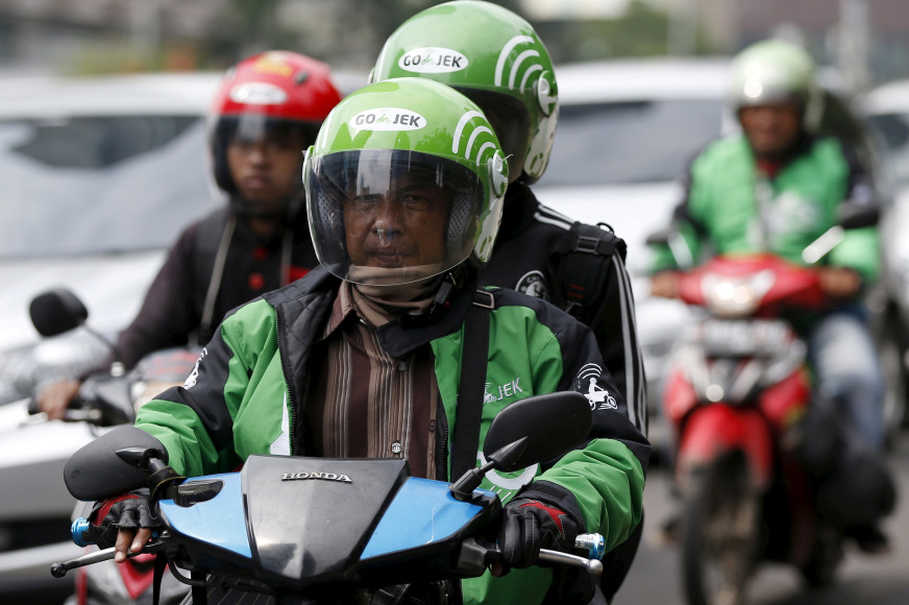
    Indonesia’s Go-Jek suffered a setback to its expansion plans on Wednesday after the transportation regulator in the Philippines rejected its application to launch a ride-hailing service, saying its domestic unit did not meet local ownership criteria. However, the setback may only be temporary as the firm, whose backers include Google, could appeal the decision or team up with Philippine investors.

    “Go-Jek can get a local partner that will own at least 60 percent of the ride-hailing entity to comply with the law,” said January Sabale, head of communications at the Land Transportation Franchising and Regulatory Board (LTFRB).

    The decision comes as Go-Jek seeks to expand in Southeast Asia, having evolved from a ride-hailing service founded in 2011 to provide a one-stop app through which users can order food and services such as massages and make payments online.

    The firm has raised billions of dollars from investors such as Tencent Holdings, JD.com and Temasek Holdings to challenge market leader Grab.

    Several Philippine ride-hailing firms have been operating in the capital Manila and in major provinces since March 2017, but have had limited success in wresting domestic market share away from Singapore-based Grab, which stands at over 90 percent.

    “Homegrown firms are not making a dent on early player Grab, because the cars they can enroll now have to go through the LTFRB’s filtering hurdles,” said Rene Santiago, a transportation expert and president of Bellwether Advisory in Manila.

    Go-Jek applied for a license to operate in Manila in August through wholly owned subsidiary Velox Technology Philippines. Later the same month, ride-hailing was added to a list of industries where foreign ownership is limited to 40 percent.

    Velox “did not meet the citizenship requirement and the application was not verified in accordance with our rules,” regulator chairman Martin Delgra said

    A spokesman for Go-Jek said: “We continue to engage positively with the LTFRB and other government agencies, as we seek to provide a much-needed transportation solution for the people of the Philippines.”

    There are around 37,000 registered ride-hailing vehicles across eight accredited firms, Delgra said. The Department of Transportation has capped the total at 65,000.

  • LG to utilize Azure for autonomous systems

    LG to utilize Azure for autonomous systems

    LG Electronics will be utilizing a Microsoft product in the development of autonomous vehicle systems, LG said Wednesday. Under the agreement between the two companies, LG has gained access to Microsoft’s Azure cloud-computing platform for its self-driving car systems. Apart from storing vast amounts of data, the Azure platform also offers immense computing power for data-based applications and services.

    The two companies met Monday to sign a memorandum of understanding at the Consumer Electronics Show (CES) in Las Vegas. LG will connect with Azure in developing driver-support systems, cameras and a virtual assistant that can answer vocal commands.

    “Developing software for self-driving car components – whether it’s for navigation or infotainment – requires an enormous amount of data processing,” explained an LG spokesperson.

    “The agreement with Microsoft Azure is basically aimed at helping our software save and utilize as much data as possible in the shortest amount of time.”

    LG plans to use Azure’s high-performance computing and graphics processing units. According to the company, these tools can slash the time required to learn roads and traffic patterns from more than a full day to a few minutes. Higher processing speeds will also help the software learn patterns gathered from cameras regarding the driver, pedestrians and other objects on the streets.

    Another tool offered on the Azure platform is a voice assistant. LG plans to incorporate this into its infotainment system so that the car’s software can answer questions and receive commands.

    It could, for example, check traffic conditions, search for a restaurant nearby or call up favorite songs.

    The large amounts of data LG collects from self-driving cars will be saved in the Azure system, including photos of roads, obstacles and road signs collected from all over the world. LG will be able to utilize the data collected for further development. In the past, before cloud services existed, international data had to be shipped to Korea in hard drives.

    LG Electronics has been supplying components to self-driving carmakers since late 2016. The field is considered a future growth engine for the company.

    “In the upcoming age of autonomous vehicles, LG Electronics will shift the definition of cars from a means of transportation to a mobile space, which can turn into a conference room, a theater or a shopping mall,” said the company’s chief technology officer, Park Il-pyung, during a pre-show keynote speech on Monday.

  • Online Marketplaces India: Delivering fashion to the discerning masses

    Online Marketplaces India: Delivering fashion to the discerning masses

    The online fashion space in India is positively buzzing with private labels or brand partnerships. Recently, heritage American denim brand, Wrangler collaborated with Indian e-commerce giant, Flipkart to launch an exclusive sub-brand called Wrangler 20X. Myntra also launched its in-house plus size apparel brand, Sztori as well as House of Pataudi, an ethnic wear brand co-owned by Myntra, Exceed Entertainment and Bollywood actor Saif Ali Khan.

    Addressing Consumer Demand

    Wrangler 20X is targeted at the digitally-savvy youth who increasingly shop for fashion online and are seeking the perfect mix of trend and value. Gen Z are increasingly brand-aware and aspire to own brands with flaunt appeal. The denim brand aims to give them a brand that they would be proud to wear at prices they can afford.

    Known for democratising fashion across segments, the launch of both Sztori and House of Pataudi enables Myntra to go a step further and include profiles into the ambit of ‘fashion for all’. It champions inclusivity in fashion, evaluating and emphasising greater attention to styles, trends, designs, fit and fabric for plus sized apparel and fashion conscious consumers, in order to bring out the personality of the person wearing it.

    Sztori has been especially designed to suit a larger range of body shapes and sizes. It is essentially a designer wear in the plus size category, offering consumers the perfect fit and multiple style options. The apparel is made to suit plus size body types rather than prove to be a mere extension in size on existing profiles, thus breaking the existing age-old norm in the Indian market.

    Manohar Kamath, CXO and Head, Myntra Fashion Brands, says, “We are extremely delighted to announce the addition of Sztori to our portfolio of private brands. Plus size clothing is in great demand and it was time we offered something substantial in the category, opening up more avenues and possibilities for our customers.”

    The brand offers a range of products for men and women, including, tees, denims, tops, dresses and more in L to XXXXL (Large to 4 times Large) sizes. Shoppers can choose from over 225 styles and designs at prices ranging from Rs 799-Rs 1,999.

    Myntra identified a space opportunity in this segment and set out to design and develop merchandise under a new brand to cater to the category and make wearers look fashionable with multiple style options at affordable prices and opening new avenues in the industry.

    ‘House of Pataudi’ is a lifestyle brand for men and women that delivers fine taste and refinement to the discerning and the fashion conscious. Each piece not only exudes style but also narrates the rich story and history of the Pataudi heritage. The collection comprises traditional Indian wear, conceptualised inthe form of Rozana, every day wear with a contemporary ethnic touch; Jashn, festive finery with a regal charm; Riwayat, bespoke splendour for the classic Indian wedding; and a Special Edition, comprising collections inspired by the Pataudi trousseau.

    The range includes kurtas, sherwanis and Nehru jackets for men and kurta sets, lehengas and dresses for women. Products from House of Pataudi will be available exclusively on Myntra and Jabong, across a price range of Rs 1,500-Rs 15,000 for men and Rs ,000-Rs 20,000 for women. The brand’s design team has worked closely with Saif Ali Khan; inspired by his own personal style statement and has designed and perfected the line, modelling it on the Pataudi lineage and contemporary fashion preferences, to make it relatable for the modern fashion shopper. House of Pataudi is focused on changing the perception about ethnic dressing being limited only to festivals and occasions and bringing it back to everyday wear.

    Tapping the Market

    “Research estimates that the plus size segment will account for US$ 5 to 6 billion in the US$40 billion Indian online fashion apparel market, by 2020, which is approximately 10 to 12 percent of the overall market, making it an important proposition,” shares Manohar Kamath.

    Flipkart’s has aggressive plans to grow the fashion business and this maps well with Wrangler’s vision of meeting the needs of the young, online shopper. “We are delighted to partner with

    Flipkart on the launch of Wrangler 20X. The brand will be available exclusively on Flipkart and is designed for young, trend-aware digital citizens who aspire to buy Wrangler but are also looking for a more affordable value proposition. We look forward to working with Flipkart to make this a successful sub-brand of Wrangler,” comments Krishna Dorai, General Manager, Wrangler.

    Rishi Vasudev, Vice President, Flipkart Fashion says, “Men’s fashion is one of our fastest growing categories, where we have witnessed a 75 percent Y-o-Y growth, within which denims is one of the most successful categories. Crafted basis an understanding of what fashion shoppers are looking for, we are excited to launch Wrangler 20X, a denim-wear brand, from the house of Wrangler, exclusively on Flipkart Fashion. The range is specifically designed to off er the latest in fashion to the style conscious young men looking for the best in the value branded segment and we are sure, this range will be a massive hit, while it strengthens our men’s portfolio.”

    The Wrangler 20X collection features attractive style elements such as PU detailing on the pockets and belt loops, the shirts embrace printed designs with yarn-dyed fabrics and the tees receive a fresh colourful graphic spin. The sub-brand is currently available only for men.

    Ananth Narayanan, Ex-CEO, Myntra- Jabong, said, “We are clearly focused on a strong customer proposition and currently there is a huge gap in brand offerings in the ethnic wear space, especially for men. House of Pataudi is an ideal fit, being rich on tradition, heritage, design, and offers customers a slice of the world that we believe is lost, at price points that are highly affordable.”
  • Hyundai Mobis shows off futuristic concept self-driving car

    Hyundai Mobis shows off futuristic concept self-driving car

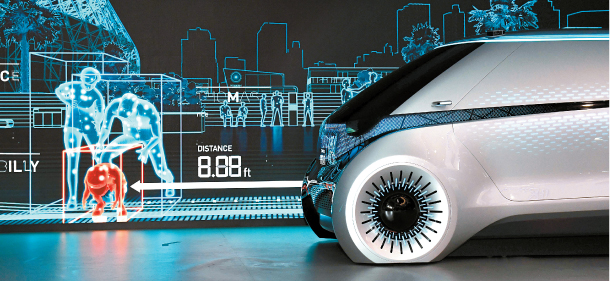
    Hyundai Mobis introduced its concept autonomous car equipped with 26 sensors and a special lighting system that enables cars to communicate with pedestrians at the Consumer Electronics Show (CES) in Las Vegas on Tuesday.

    The auto parts maker said it is the first time it has unveiled a concept car with at least Level 4 self-driving capability, which means cars can drive themselves without being actively monitored by the driver.

    The car comes with a modular self-driving kit comprised of various sensors – which function as eyes for the car – on the roof as well as lamps that can send messages to nearby pedestrians or cars. Mobis calls all of the technologies and parts used on the autonomous vehicle M.Vision.

    The kit on the roof – comprised of four lidar sensors, or laser-based radar, and five multifunctional camera sensors – are key strengths of M.Vision, according to Mobis.

    The modular kit can simply be mounted on the roof, so it can easily be used on different vehicles. The Korean company said it is best to put sensors on the car’s roof, considering that sensors can better detect the surrounding environment when they are placed higher above the car. To complement the kit on the roof, Mobis also installed five radar sensors and 12 ultrasonic sensors on the car’s lower body.

    The Korean company is on its way to make all sensors used in the kit with its own technology by 2020.

    The so-called communication lighting technology is a new innovation that Mobis thinks will greatly reduce fatal accidents involving autonomous cars and pedestrians.

    The company said it will use lighting to indicate to pedestrians and other drivers when the car is driving in self-drive mode. Autonomous cars will be able to detect a pedestrian from more than 450 feet away. Once someone is detected, car headlamps will project a red warning symbol to warn people it’s not safe to move around the vehicle.

    “Light has been used as a conduit for communication among vehicles and pedestrians for almost as long as the automobile has existed, so we are excited to lead the evolution of this technology to save lives and offer peace of mind to all that use the road,” said Mirco Goetz, director of lamp engineering at Hyundai Mobis.

    “Our primary focus on the safe progression to future mobility will enable our industry to continue the advancement of autonomous vehicle technology while helping to keep pedestrians and drivers out of harm’s way.”

  • Hyundai puts holograms on road to help with navigation

    Hyundai Motor Group unveiled a holographic AR navigation system, the first of its kind, in collaboration with start-up WayRay at the Consumer Electronics Show (CES) in Las Vegas on Tuesday. Hyundai partnered with the Switzerland-based start-up that specializes in AR technology and demonstrated the navigation system on the group’s luxury sedan, the Genesis G80.

    While conventional head-up displays (HUD) project a reflected image through a liquid-crystal display screen installed on the dashboard, the new holographic AR system displays what appear to be 3-D images on the road through the windshield and automatically adjusts the displayed information to the driver’s viewing angle.

    The AR navigation system, demonstrated at WayRay’s CES booth, also takes up considerably more real estate compared to existing HUDs, typically relegated to a small corner of the windshield, and displays a variety of driving information that includes navigational features and safety warnings.

    Information such as lane guidance, destination points and the current speed is shown along with advanced driver-assistance system features including lane departure warnings and forward collision warnings.

    Hyundai said an image size of 3.15 meters (10.33 feet) by 1.31 meters will be visible from the driver’s perspective, despite the actual projected image being just 310 millimeters (12.2 inches) by 130 millimeters. The company’s existing HUD was changed to incorporate WayRay’s system.

    Hyundai promised that the technology will bring changes to the conventional concept of a windshield.

    “Future mobility windshields will be more than just a piece of glass,” said Hwang Yun-seong, director of Hyundai Motor Group’s Open Innovation Business Group. “AR holographic powered glass will serve as a platform to provide new services and open up new in-vehicle experiences”

    Hyundai said that the two companies will continue to cooperate to expand the technology to display information that identifies objects on the road such as buses and crosswalks.

    The two companies also plan to incorporate real-time data such as traffic signals, surrounding vehicle information and road or weather conditions into the technology.

    Hyundai has worked on holographic technology since 2017 and invested in WayRay last September.

  • Samsung plans to release robots this year

    Samsung plans to release robots this year

    Samsung robots are coming this year. Kim Hyun-suk, president and head of Samsung Electronics’ consumer electronics division, said the company has been conducting research on the robotics market and is now preparing to launch several robots this year during a press conference with reporters on Monday, a day prior to the opening of the Consumer Electronics Show (CES) in Las Vegas.

    Until now, Samsung Electronics has stayed mum on whether it is making robots. “To develop robots, it’s important to have an artificial intelligence [AI] platform ready [to mount on the robots],” Kim said. “That AI platform is almost ready.”

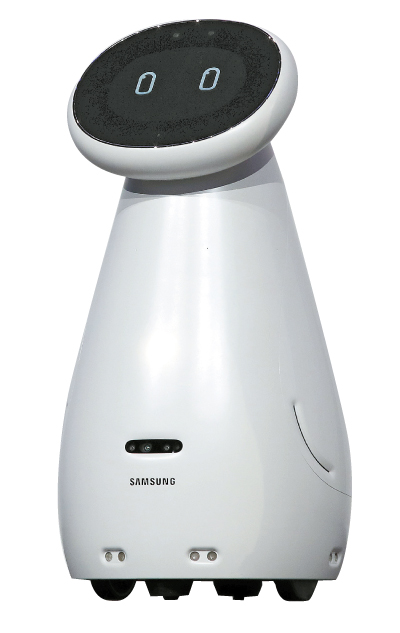
    Samsung unveiled three variations of its AI-based robot, dubbed Samsung Bot, at the briefing, revealing its robotics technology for the first time.

    The three Samsung Bots, labeled Care, Air and Retail, are designed to aid people’s health, and improve air quality and retail shop management. Samsung Bot Care, for instance, monitors users’ vitals like blood pressure and heartbeat and helps people take medicine at the right time. The robot can also call 119 and contact family members when it senses an emergency such as a heart attack.

    The electronics giant also introduced its wearable robot, dubbed GEMS. It assists people with difficulty walking due to weak muscles or injuries and reduces physical pain in the knees and ankles.

    “I can’t say for sure when the products introduced today will be commercialized,” Kim said. “There are possibilities that robot products not introduced yet could be commercialized first.”

    Kim added that demand for robots is expected to increase, especially due to societal aging, pointing out that robots like Samsung Bot Care will be useful for the elderly.

    “By exploiting Samsung’s know-how in AI, Internet of Things and developing multiple devices, we are considering our options for various types of robots,” Kim said.

    On concerns of whether Samsung’s own AI engine Bixby is losing ground due to the company’s AI partnerships with tech giants like Google and Amazon, Kim said that is a “misunderstanding.”

    Though Amazon’s Alexa AI assistant and Google Assistant may be a step ahead of Bixby in terms of technology and presence in the global market, Kim said partnerships make Bixby stronger, not weaker.
    The important thing, according to Kim, is that when people ask Bixby a question, the AI will be able to give out answers based on its own knowledge or by utilizing data from Google or Amazon.

    “No company has strengths in every aspect of business,” Kim said. “Though Bixby is a latecomer [to the AI assistant market], Samsung has relative strength in making devices compared to other tech companies, and Google and Amazon will focus on what they are good at.”

    Kim also commented on LG Electronics’ rollable TV that made headlines globally. LG’s rollable TV prototype can roll itself into a storage box that becomes a table with speakers.

    According to the Samsung president, there needs to be considerations on whether the product can be “economical.” He added that without the economic feasibility to commercialize the product, the prototype is a lot less meaningful.

    Brian Kwon, head of LG’s home entertainment division, said in a separate press briefing Tuesday in Las Vegas that the company will make rollable TVs its future growth engine.

    On concerns about the product’s cost, Kwon said while the price may be a barrier in widely expanding sales of the product right after launch, the company will strive to quickly improve the TV’s cost competitiveness.

  • Hyundai Cars to go online – and have legs

    Hyundai Cars to go online – and have legs

    By 2022, all cars made by Hyundai Motor will be connected to the internet, the automaker announced during a press briefing held Monday in Las Vegas ahead of the 2019 Consumer Electronics Show (CES). “We aim to have 10 million active users of our connected-car services globally and apply connected-car technology to all vehicle segments in the global market by early 2022,” said Suh Jung-sik, senior vice president of Hyundai Motor Group’s ICT division.

    At the CES, the company also introduced a vehicle in which the wheels are attached to robotic legs with a wide range of motion. Hyundai’s concept of a truly connected car is a car smarter than a computer that can share information not only with other vehicles on the road but also with homes, surrounding infrastructure and cities.

    Using connectivity, the cars can offer real-time traffic and parking lot information to drivers and also alert drivers remotely of theft. Remote adjustments of in-car settings, such as temperature, will also be possible.

    While Hyundai is already offering early versions of its connected cars in Korea, the United States, China, Canada and Europe, the automaker said it will establish additional big-data centers to offer similar services in countries like India, Brazil and Russia.

    To offer better connectivity worldwide, the carmaker is currently developing an operating system, a cloud platform and network technology for connected cars. The company also announced a plan to introduce an open platform on which third parties can develop new technologies using big data shared by Hyundai.

    Hyundai is not the only carmaker that came to CES with grand ambitions to take leadership in the connected car business.

    BMW will introduce the BMW Intelligent Personal Assistant, which can interact with drivers and allow for video meetings, shopping and other digital services inside cars. Audi is introducing a virtual-reality entertainment service for passengers in back seats. VR games or travel content will match the actual movements of the car. In the long run, the carmaker said the videos will reflect real-time traffic conditions so that if a car stops due to red light, the video will show an obstacle.

    Other participants, including Mercedes-Benz, Nissan, Bosch and Continental, all shared their focus on connectivity.

    “In the future, cars will be categorized as cars with hyper-connectivity and those without,” Suh of Hyundai Motor Group added.

    Apart from connectivity, Hyundai said it will develop personalized electric vehicles for everyone by giving customers the freedom to select software and hardware for their vehicles.

    To bolster open innovation, the carmaker has been setting up global open innovation centers to collaborate with foreign start-ups. Already there are three centers, established in Korea, the United States and Israel. Two more centers are set to be established, in Berlin, Germany and Beijing, China this year.

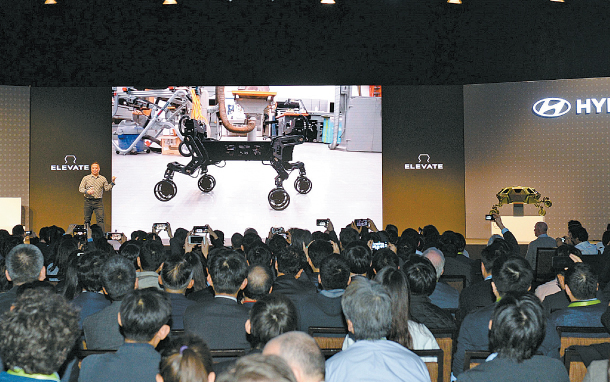
    Hyundai Motor and its innovation center in Silicon Valley, the Hyundai Cradle, introduced the “Elevate” concept vehicle at this year’s CES. It has four robotic legs specifically designed for rescue in challenging environments.

    U.S. design-consulting firm Sundberg-Ferar was involved in the development of Elevate, which Hyundai calls the ultimate mobility vehicle. It can swiftly move around places inaccessible to existing rescue transport.

    Hyundai said the Elevate’s body can be switched depending on the mission and that the robotic-leg architecture has five degrees of freedom. The company added that the vehicles can also aid people with physical impairments.

  • LG unveils TV that rolls up for storage

    LG unveils TV that rolls up for storage

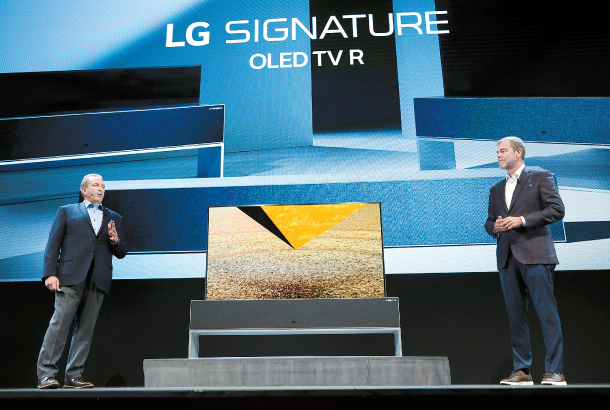
    LG Electronics unveiled the world’s first “rollable” television at the Consumer Electronics Show (CES) 2019 that launched in Las Vegas, United States, on Tuesday. Last year, its affiliate LG Display unveiled a prototype of a 65-inch rollable OLED display panel at the same event. Dubbed the LG Signature OLED TV R9, it uses the same technology, only it comes with an aluminium case at the screen’s bottom that looks like a long tissue box.

    A rolling OLED display was possible because unlike TV panels of the past, OLED screens don’t need backlight to show color, but have molecules that let out light on their own.

    The panel can roll itself up and down from the case so that the television set looks more like a long, rectangular table once the screen is completely inserted. LG boasts that the screen can maintain its color definition even as it rolls itself. R9 won the CES 2019 Innovation Awards in the video display sector.

    LG plans to launch global sales of R9 this year, starting from Korea. Its price was not disclosed, but it will be among LG’s premium television lineups. The advantage of the rollable TV set is that it can be placed in locations like the window side or in the middle of a room. For conventional TV screens, the popular choice was beside or on the walls as they take up space and block the view if installed elsewhere.

    The television set also comes with high-quality speakers and an artificial intelligence software that enhances the set’s performance to adjust definition and sound according to the film or video played. It also recognizes simple vocal commands.

    When the screens are rolled inside the case, R9 can work similarly to an audio set as it can play music via connection to smartphones or other portable devices. It also comes with various modes to use the screen apart from watching movies and TV shows.

    It can function like a huge electronic canvas that shows photos saved in your smartphone. For those who want to create a cozy atmosphere, it has a “Mood” mode that plays a video of a fireplace or displays mood-specific light on the screen.

    LG Display Vice Chairman Han Sang-beom expressed confidence in the panel in front of local reporters on Tuesday at the CES. According to Han, the rollable panel was rolled and unrolled more than 100,000 times during its development process.

    “We’re talking with other clients as well [apart from LG Electronics] for the rollable TV panels,” he said. “My plan is to target the premium market instead of aiming for sales volumes.”

  • Samsung to release feature-rich phone to take on Huawei

    Samsung to release feature-rich phone to take on Huawei

    Samsung is releasing a phone with robust functions specifically designed to meet the challenge posed by Huawei. It has fast internet speeds — utilizing 5G wireless — is foldable and has an innovative screen design. Last year’s smartphone market can be summarized in one sentence: Apple’s defense, Huawei’s catch-up and the fall of Samsung Electronics.

    According Counterpoint Research, Apple’s share in the super high-end smartphone market, those priced over $900 (880,000 won), was 79 percent in the third quarter of 2018. In the $600-$900 market (660,000 to 880,000 won), Apple (61%) surpassed Samsung Electronics (21%) by a large margin, and in the $400-$600 range (440,000 to 660,000 won), Huawei (17%) was right behind Samsung (25%).

    At this critical moment, Samsung Electronics celebrates the 10th anniversary of the release of its “Galaxy” smartphone. The Galaxy Black came to market in April 2009. A new Galaxy S10, a commemorative issued for the anniversary, will be unveiled at the Mobile World Congress (MWC) 2019 in Barcelona, Spain this February. The name of the new S10 is “Beyond.”

    Samsung’s says it wants to outdo itself with the latest release.

    In the new S10, Samsung’s Infinity-O Display will be embedded. The display has a small hole in the screen for the selfie lens, so almost the entire face of the device is screen. The proportion that is screen is more than in Apple products, which utilize more real estate for the lens.

    The fingerprint-identifying sensor does not require separate hardware, but is found within the screen. The sensor itself utilizes Qualcomm ultrasonic-wave technology, which can identify prints that are less readable due to water or soil on the screen. Instead of scanning the user’s iris, the new model will utilize facial recognition, as is done with iPhones.

    It is expected that Samsung will maintain the 3.5mm-earphone jack, which has been scrapped on iPhones. It will also be 5G capable, allowing for a 1.5-gigabyte movie to be downloaded in less than a second. Samsung announced last month it will supply the world’s first 5G phones to Verizon and AT&T.

    Huawei is expected to release its own 5G phone in the first half of the year.

    Early versions of the new Galaxy S10, to be released in February, will not be 5G capable. It is possible that the S10 with a 5G communications chip will be released separately, as was done with the Galaxy S5 broadband LTE-A model, which was separately released in 2014.

    It was expected that LG Electronics will release its 5G smartphone this April or May, but it changed its goal for release to late March. Apple might not equip new iPhones, which will be released this year, with a 5G-communications chip.

    A telecommunications industry source said, “Apple originally did not really care about the speed of telecommunications that much. Apple might embed 5G in the iPhone in fall.”

    Smartphone competitors are seen pushing foldable phones in 2019. According to market research firm Strategic Analysis (SA), shipments of foldable smartphones globally will increase gradually from 3 million in 2019 to 14 million in 2020, and ultimately to 30 million in 2022.

    Chinese phone market Royole released a foldable first, in October last year, ahead of Samsung Electronics and Huawei. Royole will release its 7.8-inch Flex Pie foldable phone at the 2019 Consumer Electronics Show (CES), to be held in Las Vegas from Jan. 8-Jan. 11. Royole led the market but has received criticism about the quality of its device.

    The Galaxy foldable phone will be released in February. It will have a 7.3-inch screen as well as a 4.58-inch screen. The initial run will be about 1 million units.

  • Carousell Expands Executive Team to Strengthen Operations and Leadership

    Carousell Expands Executive Team to Strengthen Operations and Leadership

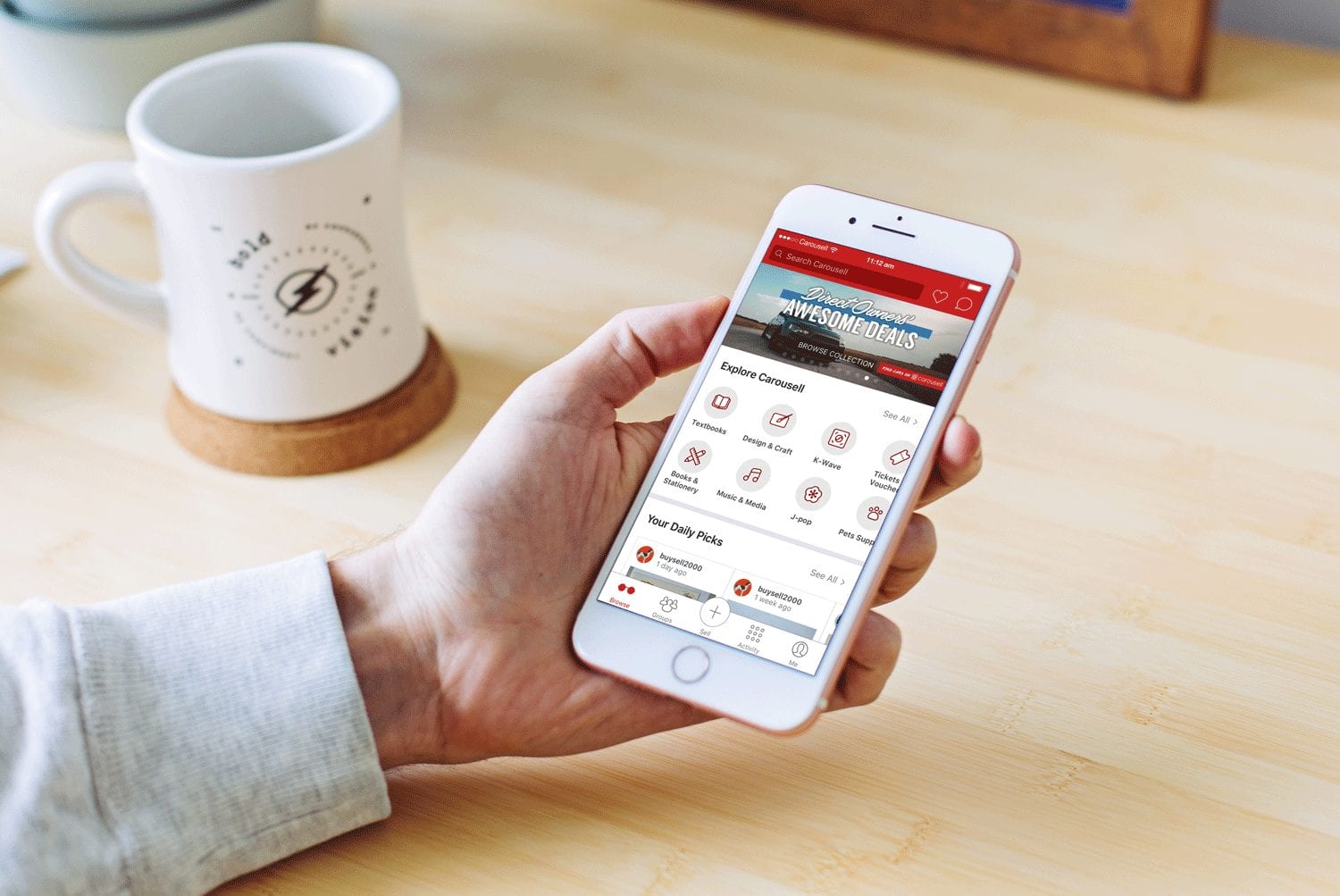
    Carousell, one of the world’s largest and fastest growing classifieds, announced the appointment of industry veteran Su Lin Tan as Vice President of Operations, while Colin Bryar has taken on an advisory role. The new additions reflect the company’s steadfast commitment to solidify its market-leading position in the classifieds industry and to continuously improve user experience of our marketplace in the region.

    “We are always on the lookout for world-class talent who shares our values and passion for solving meaningful problems with technology, and we are tremendously fortunate to have found that in Su Lin and Colin,” said Siu Rui Quek, Carousell Co-founder and CEO. “Their collective experience and proven track record in transforming organisations amidst complex digital environments will be invaluable as we power through our next chapter of growth. It is an absolute privilege and I look forward to learning from them as we continue to innovate classifieds in an AI-first world.”

    Su Lin, previously Deputy Chief Marketing Officer and Senior Vice President of Sales Strategy and Operations at Singapore Press Holdings (SPH), brings over two decades of leadership experience in digital strategy, marketing and the classified space to Carousell. Having overseen sizable advertising sales and digital organisations and working across complex organisational eco-systems, she was most recently associated with the launch of Singapore’s first and only digital publisher alliance, the Singapore Media Exchange, Su Lin serves as the Vice President of Operations to lead the teams in scaling up operations in Singapore and across the region. In her new role at Carousell, she reports to Co-founder and CEO, Siu Rui Quek.

    “I am deeply honoured and humbled at the chance to work alongside Carousell’s visionary founding team. I knew they were destined to achieve great things from the first time we met back when they had first started the company,” said Su Lin. “Despite their incredible success in a short span of six years, the leadership team’s deep commitment and mission-driven values to make an impactful change in the world have never wavered. Their humility and willingness to learn and grow, not only themselves but also their people, moved me. I am excited for the opportunity to help make the founders’ dream come true so that we might show the world what Singapore born and bred
    companies are capable of.”

    In his new advisory role to Carousell’s executive leadership team, Colin will focus on identifying opportunities for faster growth and providing a world-class customer experience for users across the region. Colin has successfully led digital platform businesses in all stages of evolution for over 25 years in various senior leadership roles at Amazon, IMDb and Alibaba-owned RedMart. He also served two years as Technical Advisor to Jeff Bezos. This unique blend of experience makes Colin a great fit for the next phase of Carousell’s growth.

    Colin shares his excitement for tackling new challenges at Carousell, “In my many years of working with major tech companies, the potential I saw in Carousell and the impact it can bring to many more millions of users around the world is something really special. I have profound admiration and respect for the founders and their vision for the company. It’s an exciting time to be part of a team that is aggressively expanding its capabilities to bring simpler and more trusted solutions to help people discover new possibilities when buying, selling and connecting with one another.”

  • Mobile Payments in China is expected to witness three-fold growth by 2023

    Mobile Payments in China is expected to witness three-fold growth by 2023

    Low credit card usage, and increasing popularity of eCommerce coupled with a growing middle class in China have accelerated the growth of mobile payments in the country. China has also seen an increase in cross-border payment transactions, primarily due to growth in sectors such as eCommerce, travel and overseas education. Frost & Sullivan recently reportedthat nearly 65% of Chinese tourists have used mobile payments abroad, approximately six times higher than the average non-Chinese traveler.

    “In China, eCommerce is a powerful incentive for users to purchase smartphones that enable mobile payment features. The social aspect that mobile payments brings can serve as an integral step in building trust and learning about digital services, especially in rural communities,” said Ms  Mei Lee Quah, Industry Principal Analyst, Information & Communication Technologies (ICT) Practice, Digital Transformation at Frost & Sullivan.

    The market of mobile payments services in China is expected to grow at a compound annual growth rate (CAGR) of 21.8% from 2017 to 2023, growing three-fold from US$29.93 trillion to US$96.73 trillion. The total number of active mobile payment customers is expected to reach 956 million by 2023 from 562 million in 2017 which will attract additional investments from mobile payments market participants.

    Frost & Sullivan’s recently published report, Chinese Mobile Payments Services Market, Forecast to 2023, highlights the growth opportunities presented in the market, namely:

    •    Rural region penetration
    •    Addressing the elderly market

    The report also offers detailed analysis of the mobile payment market in China with a focus on key market players such as AliPay and WeChat Pay, and their business and revenue models. The Chinese market for mobile payment offers not only market opportunities for solution providers intending to operate within the domestic market but also learning points for global mobile payment solution providers.

    Frost & Sullivan predicts that China will continue to be a major player in the global mobile payment services market and service providers in the country will continue to focus on improving and enhancing security on mobile payment platforms.

  • JD driverless delivery vehicles up for test

    JD driverless delivery vehicles up for test

    JD driverless delivery vehicles have been deployed in live testing in two Mainland China cities. The technology-cum-e-commerce company has opened two smart-delivery stations in the cities of Changsha and Hohhot, strengthening its autonomous logistics capabilities. The stations are carrying out research and development testing and personnel training to solve issues related to last mile delivery.

    The JD driverless delivery vehicles can be loaded with up to 30 parcels before autonomously delivering them within a 5km radius. The vehicles can plan routes, avoid obstacles and recognise traffic lights.

    The vehicles have locked boxes so each customer’s purchases are kept separate. Once the robots reach their destination, facial recognition technology enables customers to easily and securely collect their parcels from the correct locker.

    When running at full capacity, the two delivery stations, operating with a half-half split between robots and human couriers, can deliver up to 2000 packages a day.

    The JD driverless delivery vehicles are part of the company’s Boundaryless Retail vision, in which consumers can buy whatever they want, wherever and whenever they want it.

    “As China’s largest retailer, JD is in the unique position of being able to research and develop, and commercially deploy, innovative new technology that is shaping the future of shopping worldwide,” said Chen Zhang, JD’s chief technology officer.

    “As JD opens its technology up to other companies and industries, the features that we’ve already rolled out in China from automated warehouses to virtual shopping are going to be enjoyed by consumers everywhere,” he said, referring to the company’s Retail as a Service strategy.

    CES debut

    The opening of the smart delivery stations comes days before JD attends its first Consumer Electronics Show in Las Vegas, Nevada – the world’s largest event for the latest technology, innovation and creative thinking.

    The company will showcase cutting-edge technology which is changing the way consumers shop in China, and which it says will revolutionise global commerce. Visitors will be able to see how JD uses its drones to deliver consumer goods and medical supplies to remote areas in China, and catch a glimpse of the world’s first fully-automated fulfillment centre. They will also see how underground urban logistics will make shopping more convenient than ever, and fundamentally alter how cities work.

    This year, CES attendees will be able to see JD’s futuristic technology up close and even try some of it for themselves at the company’s interactive booth.

    Aside from drones and delivery robots, visitors will be able to experience drone flights in virtual reality, as well as JD’s augmented-reality fitting and styling software. They will also see how JD is developing Internet of Things technology that enables consumers to remotely control the smart devices in their homes, even from their cars.

    JD will also give people the chance to try a special exoskeleton worn by staff in JD warehouses that makes lifting heavy objects easier.

  • Vietnam wants urban residents to pay bills without cash

    Vietnam wants urban residents to pay bills without cash

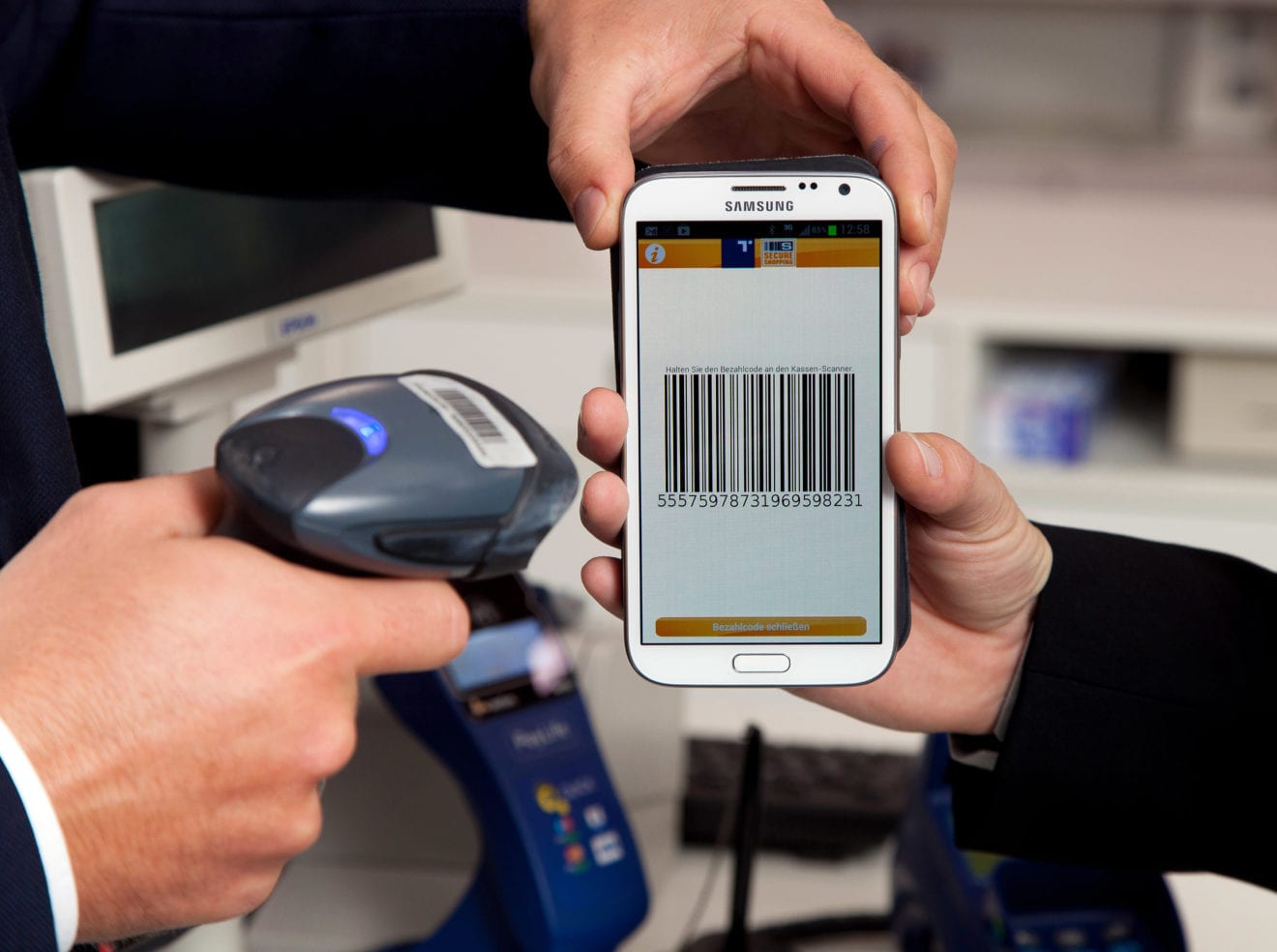
    The Vietnamese government wants cashless transactions made viable for all household bill payments by the end of this year. A recent government resolution on changing the business environment to improve competitiveness and labor productivity contains a push to accelerate use of cashless transactions. Provincial and municipal leaders have accordingly been tasked with instructing all schools and hospitals, as well as electricity, water, sanitation, telecommunications and postal companies in urban areas to coordinate with banks and intermediary payment service providers in collecting bills and fees via cashless transactions.

    The government has recommended that establishments prioritize mobile payments and payment via card readers, and requested that the task be completed before December this year.

    Vietnam Electricity, the national utility, has been asked to ensure power companies work with banks and intermediary payment service providers to collect electricity bills via cashless methods and promote the use of electronic and mobile payments. The target for the year is to double the number of customers using e-payments to pay their electricity bills.

    The State Bank of Vietnam has been asked to come up with solutions that would promote the use of electronic wallets, wherein users can deposit cash into their e-wallets without the need for a bank account. The central bank has also been asked to find ways to remove imitations on e-transactions before the third quarter of this year.

    The State Bank must also require commercial banks and intermediary payment service providers to implement the QR code standard, and work with the Ministry of Finance to come up with a list of types of transactions that have to be done through banks, as well as make amendments to existing regulations to promote cashless payments for real estate transactions.

    According to the World Bank’s statistics released last July, Vietnam was the country with the lowest percentage of cashless transactions in the region with only 4.9 percent, while this value for China and Thailand were 26.1 percent and 59.7 percent respectively.

    While Vietnam rolled out an e-payment system for taxes in 2014 with 95 percent of companies registered, currently only 70 percent of tax money is collected via this method and many businesses still prefer paying their tax directly with cash.

    Similarly, while Vietnam has had policies to encourage consumers to pay electricity bills through banks and intermediary payment service providers, currently only 4.5 million people, or 20 percent of electricity consumers, pay their bills through these channels.

    The government’s resolution does not include rural and remote areas as the majority of Vietnamese living in such areas still lack access to modern payment methods.

  • Seoul launches zero-fee digital payment system

    Seoul launches zero-fee digital payment system

    The city of Seoul has moved to ease the transaction-fee burden on small and medium-sized businesses (SMBs) by launching the “Zero Pay” zero-fee digital payment system. The system has been set up in partnership with banks and fintech firms in response to shop owners paying excessive proportions of their monthly sales into credit-card transaction fees.

    Twenty banks and digital payment firms – with the notable exclusion of KakaoPay, South Korea’s most popular mobile payment service – are participating in the zero-fee digital payment system, which is digital-wallet activated via QR codes through which money is transferred directly between bank accounts.

    Businesses with annual sales less than KRW800 million (US$708,820) will not be charged transaction fees, while those with higher takings will be charged fees well below the credit card industry standard of 2.2 per cent.

    “If consumers and citizens use Zero Pay whenever possible, it will be a great help for self-employed businessmen,” said Seoul city mayor Park Won-soon.

    Around 16,750 stores have signed on to the Zero Pay program so far.

  • Indian shop fit industry poised for sustainable growth in 2019

    Indian shop fit industry poised for sustainable growth in 2019

    The Indian retail sector is growing faster than ever before and is one of the fastest growing in the world. According to a Deloitte Report, the Indian retail industry is expected to grow to US $1.1 trillion by 2020, registering a CAGR of 8.79 percent between 2000 and 2020. This growth can be attributed to the growing young population of the country, rise in disposable income, change in lifestyle and most importantly, digitization and connectivity.

    Though brands are investing heavily in online retail, traditional retail continues to be their core focus and hence, demand for shop fit designers and manufacturers only continues to grow.

    Changing retail landscape and role of retail shop fitting

    2018 was a redefining period for Indian retail industry. From huge investments by international players to M&A, downsizing of physical stores from traditional players to investing in physical stores by ecommerce players, the retail industry witnessed significant changes.

    As the debate around relevance and profitability of brick-and-mortar stores continues, retailers continue to invest in physical stores and thrive to provide the best shopping experience for customers. The traditional, one-size-fits-all store formats are slowly decreasing and brands are now continuously working towards exploring creative concepts to rejuvenate the look and feel of the store to stay relevant and attract their respective consumer targets.

    Every brand has a different approach in designing retail outlets and so are their shop fit requirements. For example, a sportswear brand store will have a spacious interiors, relaxed furniture for seating, minimum product placement on shelves to create clutter free picking up of products and eye-catching digital display of celebrated sports personalities on the walls to influence customer’s shopping. Whereas, a clothing brand store for infants and children has shop fittings and fixtures of lower height making it easy for kids to select what they want and have popular animated characters all over the store. This is where the expertise of shop fitters come into the picture. Shop fitters play a very important role in building successful retail brands by planning, designing and manufacturing shop fit and fixtures that reflect a brand’s ethos. They closely work with the brands to execute their designs and ideas for Visual Merchandising.

    Growth opportunities for shop fit industry

    A study by JLL suggests that the country is expected to see the highest mall supply in the next three years (2018 – 2020) touching 19.4 million square feet. Due to the radical shifts in the consumption pattern of new-age consumers, brands see tremendous untapped potential in small towns and cities (Tier II and III) they will expand their footprints in these geographies and continue to invest in physical stores.

    Brands continue to focus on integrating online and off-line shopping and the concept of ‘Experiential shopping centers’ will gain importance. Physical stores will double as fulfillment centers to help process online orders. Like in other markets, the concept of BOPIS, i.e. “Buy Online, Pickup In-Store”, which gives customer the flexibility to shop (order) online and visit the nearest store to try the product and collect it may become popular among people. As customer shopping experience, engagement and purpose of the physical store becomes more crucial, brands will regularly invest in store design, interiors, shop fits and new concepts in order to differentiate themselves from competitors. A good fit-out raises a brand’s profile, efficacy and creates a positive perception about the brand. Hence, there is a growth opportunity for shop fitting industry.

    Adding to this, the trend of solo entrepreneurs entering the market and small scale traditional retailers who wish to revamp their business rely on professional shop fitters for retail store design, floor planning, shop fits, etc. which will also give a boost to the shop fit industry.

    Conclusion:

    As organized retail industry continues to grow in the country, it possesses a great opportunity for the shop fit industry. Decisions by brands to downsize the store formats may hurt the shop fit industry’s business and profitability, but there will definitely be significant growth as more brands are now looking to establish their offline presence and also increase their physical presence across markets. In addition to this, with the new rules regarding single brand retail ownership, many new foreign brands will look to enter the Indian market.

    Being an allied industry of the retail sector, the shop fit industry grows hand-in-hand with the retail industry. As brands continue to invest in visual merchandising and store design, they rely on experienced and quality focused shop-fit manufacturers to partner with them. The role of shop fitters cannot be understated in helping the retail brands build their identity, differentiate them from competitors and attract footfall in the store by their innovative designs and store concepts. Shop fitting is an important investment for retail brands and when done right can translate to improved business and performance. Overall, the outlook for the shop fit industry is positive.