Tag: Singtel

  • Singtel Dash partners Zip for buy now, pay later options

    Singtel Dash partners Zip for buy now, pay later options

    Singtel and Zip, a leading global buy now, pay later (BNPL) player, announced an exclusive partnership to launch Zip’s pay later service in Singapore on the Dash app. This new service provides an alternate payment option for Dash customers, giving them the flexibility to choose between paying for their purchases immediately with Dash or paying later with Zip.Larry Diamond

    Dash customers can use Zip’s pay later service for in-store or online purchases from merchants such as Klook, Omnidesk, OSIM and Singtel. Zip’s current payment scheme offers four interest-free installments across six weeks. Over the next six months, Zip will be rolling out more payment schemes and bringing onboard more than 2,000 merchants through partner agreements with AsiaPay, Razer Merchant Services and HitPay.

    Gilbert Chuah, head of financial and lifestyle services at consumer Singapore, Singtel said, “Many of our customers want greater choice and control over managing their finances and our partnership with Zip provides just that with an alternative payment method that is transparent and flexible. This collaboration adds to Dash’s rapidly growing financial services business and we are working on expanding our suite of financial products and services to meet our customers’ diverse needs.”

    According to FIS’ 2021 Global Payment Report, BNPL is projected to be the fastest-growing payment method for Singapore, with transaction volume expected to increase from US$210 million in 2020 to US$1.3 billion by 2024. A study commissioned by Zip also showed that 56% of e-commerce users in Singapore have used or will consider using a BNPL service.

    Larry Diamond, CEO and co-founder of Zip said, “We are thrilled to be launching in Singapore through an exclusive partnership with Singtel Dash, one of the country’s most widely-used mobile apps for everyday financial and lifestyle needs. This partnership is consistent with Zip’s strategy to build a truly global BNPL business that supports regional and global partners operating in multiple markets. Our move into Singapore is an opportunity for us to tap into the country’s growing BNPL market and expand our presence in the Southeast Asian region following our strategic investment in BNPL provider TendoPay in the Philippines.”
  • Singtel partners with Microsoft their first public MEC solution in Asia

    Singtel partners with Microsoft their first public MEC solution in Asia

    Singtel will launch the first Microsoft Azure Edge Zones integrated with Singtel’s 5G network, delivering multi-access edge compute (MEC) for enterprises in Asia. The solution combines the speed, hyperconnectivity, and high bandwidth of Singtel’s 5G network with Microsoft Azure services, enabling developers to deploy and manage mission-critical applications that require high throughput and low latency. It will boost business capabilities in areas such as metaverse-based real-time simulations, and live video analytics in a multi-tenant environment. Customers will be able to use their existing Azure subscriptions.

    Bill Chang, chief executive officer, group enterprise at Singtel said, “This collaboration is a key milestone for edge computing in Asia. We’re always looking for ways to support enterprises in leveraging the potential of 5G for digital transformation to drive innovation for the benefit of consumers, business users and entire industries. This solution enables enterprises to streamline the integration of 5G and MEC into business operations, facilitate the development of new solutions, and scale and transform their business.”

    In addition to running low-latency applications at the edge using Singtel’s 5G network, the solution has the potential to transform operations in sectors such as public safety, urban planning, healthcare, banking, civil service, transportation and logistics. It also offers public sector customers high security and better performance for end-users, enabling new intelligent edge scenarios.

    Customers can leverage these capabilities, only paying for the amount of compute and storage they use for the duration which they use it, replicating the cloud consumption model at the network edge and saving on additional operational overhead.

    Dr. Yousef Khalidi, corporate vice president Azure for operators, Microsoft said, “With Azure for operators, Singtel empowers its customers to unlock business value at the network edge. The integration of Azure compute services with Singtel’s 5G network will enable enterprises and developers to provide low-latency applications across industries such as public sector and healthcare.”

    The solution will be publicly available in the second half of 2022 for Azure customers in Singapore through the Azure portal to rapidly develop, test and deploy 5G applications such as autonomous guided vehicles, drones, robotics and virtual, augmented or mixed reality, at the edge of Singtel’s 5G network. Government agencies and enterprises of all sizes that have built their business applications and operations on Microsoft Azure’s plug-and-play cloud computing service can conveniently leverage the benefits of 5G and MEC as well.

  • Singtel and Hyundai Motor to develop Singapore’s smart manufacturing and mobility technologies

    Singtel and Hyundai Motor to develop Singapore’s smart manufacturing and mobility technologies

    Hyundai Motor Company and Singtel today signed a Memorandum of Understanding (MOU) to collaborate on a range of ventures to support smart manufacturing, connectivity for electric vehicle battery subscription service. The MOU follows Hyundai Motor Group’s announcement in October 2020 that it is setting up a new state-of-the-art Hyundai Motor Group Innovation Centre Singapore (HMGICS) to conduct studies on future mobility and explore innovative solutions, services and disruptive technologies to revolutionize commuters’ transport experience.

    Hyundai Motor will combine its expertise in developing innovative automotive and manufacturing solutions with Singtel’s capabilities in 5G, Internet of Things (IoT), and next-generation info-communications technologies and solutions to develop Industry 4.0 advanced digital solutions to   transform the way vehicles are currently manufactured. The parties will develop and pilot a 5G-enabled smart factory use case for HMGICS’ intelligent manufacturing platform, and potentially scaling it up for deployment across Hyundai’s manufacturing plants globally.

    “Hyundai is delighted to work with Singtel, implementing next-generation communication solutions that will enhance mobility experiences for our customers,” said Hong Bum Jung, Senior Vice President of HMGICS at Hyundai Motor Company. “We also hope to explore future innovative solutions and business opportunities with Singtel to help realise Singapore’s Smart Nation vision.”

    Hyundai and Singtel will also work together on an IoT communications solution for the batteries powering Hyundai’s electric vehicles (EVs) in Singapore. The IoT system enables Hyundai to monitor the telemetry, or automatic data transmission, of the batteries’ real-time status and performance.

    The data-driven insights can enhance the EVs’ reliability, advancing Singapore’s EV ecosystem and Smart Nation vision of connected and sustainable mobility solutions.

    Andrew Lim, Managing Director, Government and Large Enterprise, Group Enterprise at Singtel said, “Our collaboration with Hyundai Motor is timely given the Singapore Government’s decision to phase out internal combustion engine vehicles by 2040 and the recent Budget announcement on new policies to encourage more Singaporeans to switch to driving electric vehicles. By pushing the boundaries of what is possible with 5G, IoT and other advanced technologies, we also want to build up Singapore’s smart manufacturing and Industry 4.0 capabilities and strengthen its innovation ecosystem.”

  • Singtel to Expand Mobile Financial Services Offerings

    Singtel to Expand Mobile Financial Services Offerings

    The robo-adviser, in partnership with UOB Asset Management, is expected to launch by the first half of 2021.

    Singtel and UOB Asset Management have signed an agreement to launch a robo-advisor to make digital investments more accessible to users of Singtel’s Dash mobile wallet, according to a joint announcement on Monday.

    The partnership paves the way for Dash to make its foray into wealth management and furthers its goals of digital and financial inclusion by expanding the app’s range of mobile financial services offerings, the announcement said. Dash customers will be able to invest in a portfolio of Exchange Traded Funds (ETFs), managed funds and/or other asset classes within the Dash app.

    The two sides will also explore opportunities to offer robo-advisory and other investment solutions through Singtel’s associates in the region, given the extensive presence of both companies in Asia including Indonesia and Thailand.

    We aim to democratize access to digital investments for our customers who value simplicity, affordability and convenience when managing their finances on a digital platform, Arthur Lang, Singtel International Group CEO, who noted the growing interest in online investing among its users.

    With over 1 million registered users, Dash is among the largest non-bank mobile wallets in Singapore. Since its launch in 2014, the app has expanded beyond payments and mobile remittance to include lifestyle services like restaurant bookings and insurance.

    Singtel, as part of a consortium with Grab, is one of two recipients of a full digital bank license from the Monetary Authority of Singapore. The consortium aims to formally launch the digital bank in early 2022.

  • Singtel launches Singapore’s first 5G standalone trial network for enterprises

    Singtel launches Singapore’s first 5G standalone trial network for enterprises

    Singtel has deployed the nation’s first 5G standalone (SA) trial network at its 5G Garage testing facility. The network, which utilizes 3.5GHz spectrum and Ericsson’s advanced Massive MIMO (Multiple-input multiple-output) technology to deliver ultra-fast speeds and low-latency or response times, provides enterprises with early access to 5G to develop and trial 5G solutions.

    Mr Bill Chang, Chief Executive Officer of Group Enterprise at Singtel said, “COVID-19 has brought a new urgency to digital transformation for many sectors. Having unveiled our first 5G use case with our 24/7 unmanned pop-up retail store in September, our 5G SA trial network offers enterprises from across industries the opportunity to develop and test applications to accelerate automation and digitalization. With 5G’s low latency and scalability, enterprises can not only drive efficiencies and make better and more cost-effective decisions but also deliver richer customer experiences. The launch of this 5G SA trial network is also an important step as we get ready for commercial 5G SA. We welcome enterprises to harness the power of 5G to future-proof their businesses and catalyze their digital transformation at 5G Garage.”

    Global cloud gaming provider, Ubitus, is the first enterprise to use Singtel’s 5G SA network for a 5G cloud gaming trial. The trial demonstrated a 5G cloud gaming experience that consistently delivered 85% lower latency of between 8 to 11 milliseconds compared to cloud gaming on 4G. It was conducted on Singtel’s multi-access edge computing (MEC) platform which integrates 5G’s ultra-low latency and high bandwidth capabilities with powerful cloud computing performance. This allows rich graphics to be processed on dedicated servers and transferred directly to devices, significantly cutting lag times, which is critical to the gaming experience.

    “We are very excited about the potential of Singtel’s 5G SA and MEC to push the envelope on cloud gaming. The trials will inform our designs for exciting games which will test gamers’ reflexes and instincts. We will leverage the ultra-low latency of 5G and MEC to offer immersive, hyper-realistic gaming experience,” said Mr Wesley Kuo, Ubitus’ Chief Executive Officer.

    5G and MEC’s ability to integrate with technologies such as Internet of Things, analytics, robotics, artificial intelligence and augmented, virtual or mixed reality enables enterprises across industries to leverage the low latency in applications requiring little or no lag times. These include remote surgery, smart manufacturing, autonomous driving, remote robotic repair and maintenance and virtual reality-enabled live concerts. By removing the need for data to be sent all the way to public clouds to be processed and sent back, MEC is not only able to better serve mission-critical data connectivity, it also enables enterprises to optimize their total cost of ownership for hosting, dedicated link provisioning and data transfer.

    Since the launch of 5G Garage with Ericsson and Singapore Polytechnic in January 2019, Singtel has successfully developed ten 5G use cases together with more than 20 start-ups and enterprises in areas such as robotics, virtual reality, artificial intelligence and drones. Singtel has also collaborated with PSA to trial maritime 5G use cases to optimize port operations at the future Tuas Port. In addition, Singtel is working with the Agency for Science, Technology and Research’s Advanced Remanufacturing and Technology Centre, and JTC to enable enterprises to develop and test advanced 5G-powered manufacturing solutions.

    Singtel’s 5G SA cloud gaming trial follows the recent unveiling of UNBOXED, its 5G-powered unmanned pop-up retail store, and the launch of Singtel’s 5G NSA network trial that offers consumer and enterprise customers an early taste of ultra-fast 5G mobile speeds.

  • Singtel and Great Eastern partner to offer general insurance products with telco-centric benefits

    Singtel and Great Eastern partner to offer general insurance products with telco-centric benefits

    Singtel and Great Eastern today announced their partnership to launch a range of general insurance products spanning home, motor and travel, jointly developed by both companies. These innovative insurance offerings, underwritten by Great Eastern, seek to address customer needs arising from their increasingly digital lifestyles, featuring telco-centric benefits that are industry firsts. This collaboration expands Singtel’s foray into insurance, tapping its wide customer base to reach more than 60% of all households in Singapore, and valuable customer insights that help tailor insurance products to customers’ lifestyle needs.

    To start, Singtel and Great Eastern will be introducing Singtel Home Protect, a home insurance first that provides coverage for both telco bills and home contents. The plan reimburses Singtel broadband expenses besides covering renovation, furniture, appliances, valuables and personal effects, which most home owners do not insure today. Insurance that bundles both home contents and broadband is synergistic, as home owners typically sign up for or re-contract their broadband services when they shift or renovate their homes.

    Mr Yuen Kuan Moon, CEO of Consumer Singapore at Singtel said, “With the shift to work from home since the onset of COVID-19, many people have made home improvements to create a more conducive environment. This makes protecting their homes with Singtel Home Protect more important than ever. On top of better coverage for home belongings, we want to give our customers additional peace of mind by providing extra protection for their telco bills. We’ve worked closely with Great Eastern to enhance traditional insurance with the kind of telco benefits that speak to our reliance on technology and this will also be extended to motor and travel insurance.”

    In the coming weeks, Singtel and Great Eastern will also be offering car owners motor insurance. For travellers keen to tour the world once more travel restrictions lift, Singtel will be introducing travel insurance with mobile-related benefits. This is another first in Singapore as it includes unique benefits such as reimbursement of Singtel mobile bill during hospitalization due to an accident, and of additional Singtel mobile data expenses incurred due to delays in travel, as well as repair or replacement of mobile phone in case of loss.

    Mr Ryan Cheong, Managing Director of Digital for Business, Great Eastern, said, “The partnership with a trusted telco like Singtel is yet another milestone in our digital affinity strategy and expansion into new customer segments as a leading regional insurer. To provide value-added protection to augment Singtel’s existing customer offer, we leveraged data insights to develop affordable, relevant general insurance solutions with unique benefits to help protect their everyday needs. Through continuous engagement and a seamless consumer purchase journey, we are making customized protection solutions easily accessible to Singtel customers to LifeProof their assets through home, and later motor and travel insurance.”

    Singtel Home Protect is offered to Singtel broadband customers at launch and will be made available to all Singtel customers later. For as low as S$6.50 a month, they can sign up for the plan on the Singtel website or through My Singtel app. The plan covers reimbursement of Singtel bills of S$280 per month for up to three months, and up to S$80,000 for home contents and renovation in the event of a disruption to services due to a fire or other types of damage to the home. Available for S$84 for 12 months of coverage, or S$156 for 24 months of coverage, customers can enjoy 10% off Home Protect from now until 18 September 2020. For more details, visit singtel.com/homeprotect.

    The launch of these general insurance products adds to Singtel’s expanding range of insurance offerings for its customers. Singtel first made its foray into the local insurance market last July, when it launched free personal insurance cover for its prepaid customers as part of mobile data plans. Earlier in the year, Singtel extended free 30-day COVID-19 insurance coverage to prepaid and Dash customers. Singtel also introduced an insurance savings plan for Dash customers who wish to start saving regularly for the future.

  • Singtel Adds Insurance Savings to E-Wallet

    Singtel Adds Insurance Savings to E-Wallet

    Singtel is adding financial services to its mobile wallet Dash, in the form of offer an insurance savings solution underwritten by Etiqa.

    The Dash EasyEarn savings insurance is designed for investors who want to start saving regularly for their future but who may be concerned about cash flow, Singtel said in a statement on Monday announcing its launch.

    The insurance plan has a minimum initial premium of S$2,000, up to a maximum of S$20,000. Policyholders are automatically covered with a 105 percent death benefit of the account value.

    Other benefits include up to 2-percent per annum returns for the first policy year, no lock-in period and unlimited withdrawals with zero penalties. Customers can purchase, top-up and make withdrawals on their EasyEarn plan via the Singtel Dash app on their mobile phone.

    The offering represents the next steps for Dash as it grows to become a more inclusive everyday app that will play a bigger part in enabling our customers’ digital lifestyles, Gilbert Chuah, head of mobile financial services, International Group, Singtel, said.

    Dash is among the largest non-bank mobile wallets in Singapore. Since its launch in 2014, the app has expanded beyond payments and mobile remittance to include lifestyle services like restaurant bookings and travel insurance. The app now has over 1 million registered users.

  • Singtel ushers in 5G era with 5G licence

    Singtel ushers in 5G era with 5G licence

    Singtel today was officially awarded the 3.5GHz and the millimeter wave spectrum as part of the 5G license issued by the Infocomm Media Development Authority. This paves the way for Singtel’s nationwide 5G rollout that will not only massively boost the quality of connectivity of its services but set the stage for extensive digital innovation that will prove transformative for industries, businesses, and how people work and live.

    “We are excited to get this greenlight to lead and shape 5G in Singapore by building a world-class, secure, and resilient 5G network that will serve as the backbone of Singapore’s digital economy. More than a business investment, we see this as a significant investment in Singapore’s digital future as 5G spurs innovation among enterprises and industries, creating new businesses, jobs, and economic value in the process,” said Singtel Group CEO Ms Chua Sock Koong. “This license is also very timely in light of Covid-19 and the ensuing reliance on robust infrastructure and connectivity. Our existing network capabilities have allowed us to pivot quickly to the needs of the public and businesses at this critical time and 5G will help extend and accelerate the digital adoption we’ve witnessed as we navigate our way out of Covid-19 towards recovery.”

    Singtel will build on the momentum created from ongoing 5G trials in the fields of port operations, manufacturing, and cloud gaming to offer the most transformative services and solutions to support Singapore’s digital economy.

    “As a company, we intend to move beyond access and connectivity to create new enterprise use cases and innovative platforms, applications, and services to reposition ourselves for growth in the converging eco-systems of tech and telecoms,” Ms Chua added. “As our subsidiary Optus in Australia and our regional associates forge ahead with their 5G strategies, the Group will leverage this experience and scale to build a robust 5G ecosystem with the right partners across our footprint.”

    After a rigorous tender process, Singtel has selected Ericsson to commence a period of negotiation to provide the 5G SA Core, RAN and mmWave network, with a view to finalising the contractual terms as soon as practicable.

    Singtel has been test-bedding new consumer and enterprise 5G solutions through various trials with key technology vendors and public service agencies. This includes working with the PSA on developing port-related 5G use cases such as drones and crane automation at the Pasir Panjang Terminal, exploring how 5G can enable Industry 4.0 manufacturing technologies at the Agency for Science, Technology and Research’s Advanced Remanufacturing and Technology Centre, and testing network readiness for 5G cloud gaming with IMDA and Razer. Singtel is also driving 5G innovation at the 5G Garage together with Ericsson and Singapore Polytechnic, a live facility where enterprises can develop and test 5G solutions. In the same vein, Singtel’s Centre of Digital Excellence helps enterprise customers realise the value and speed up the adoption of 5G in their digital transformation journeys.

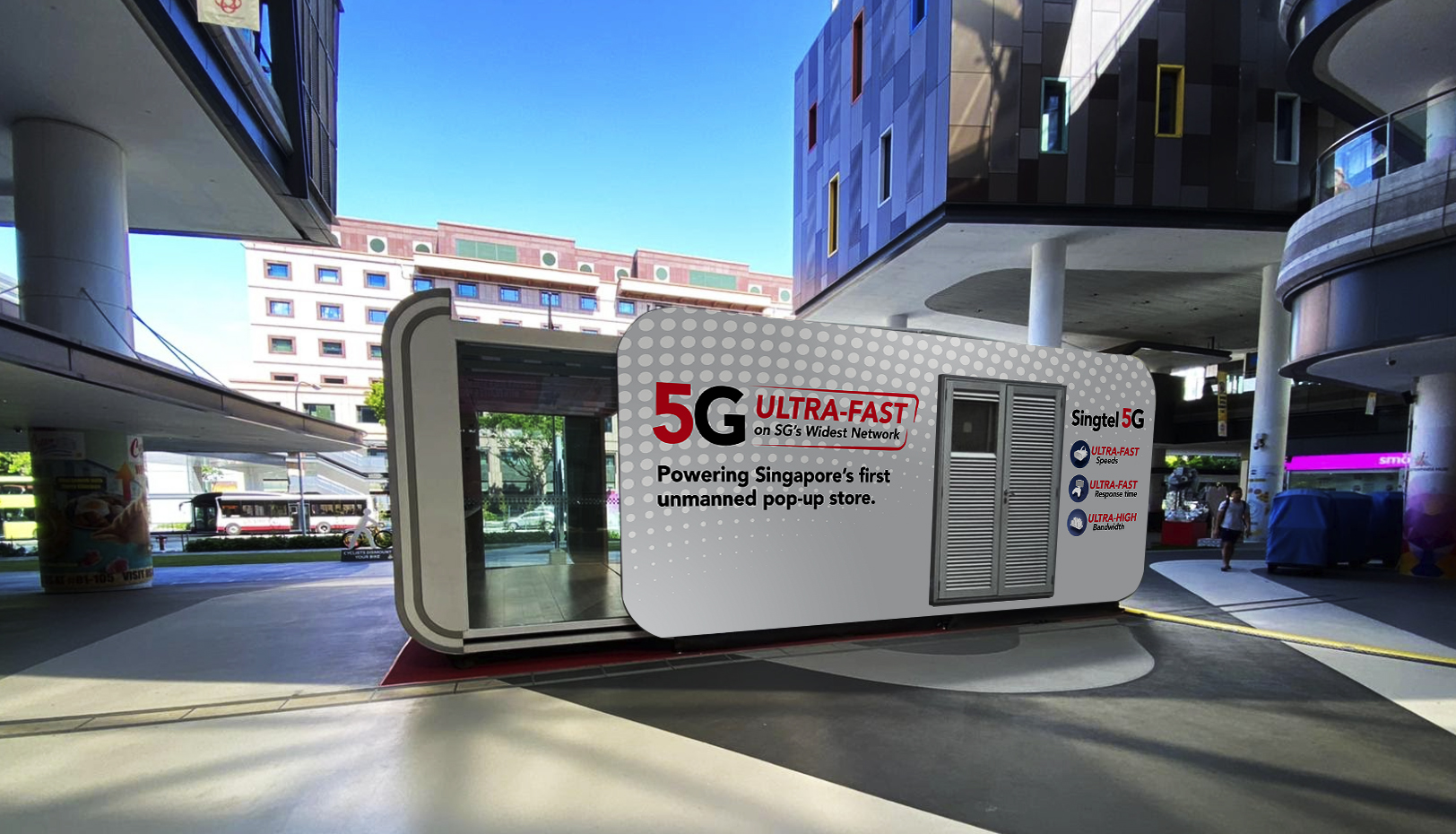
    In a first for Singapore, Singtel is bringing 5G to life for consumers at its unmanned 24/7 pop-up retail store, UNBOXED, which has been outfitted with live 5G connectivity. With 5G powering all self-serve Singapore Telecommunications Limited Company registration number: 199201624D

    kiosks and sentinel surveillance systems within the store, UNBOXED can now be relocated anywhere without laying fibre cables and serve customers with faster transactions. From late July, customers can get a taste of a 5G future while trying out applications such as cloud gaming, 360⁰ immersive entertainment, augmented reality education, as well as checking out the latest 5G mobile devices. Consumers will be able to visit UNBOXED at its current location at Tampines Hub or find out more about 5G at www.singtel.com/5g.

  • Singtel’s NFC Partners Nets for Central Bank Payments

    Singtel’s NFC Partners Nets for Central Bank Payments

    The partnership leverages NCS’ capabilities in building government applications and infrastructure, and Nets’ experience as Singapore’s national payments provider and facilitating cross-border payments.

    NCS and the Network for Electronic Transfers (Nets) group will jointly develop a new real-time electronic payment and securities settlement platform for central banks in Asia Pacific, according to a memorandum of understanding (MOU) signed on Monday.

    The ceremony took place via video conferencing in light of enhanced safe distancing measures against the Covid-19 outbreak.

    The platform will be secure, resilient and robust by design to allow interoperability with current and future payment systems and facilitate high-value inter-bank fund transfers, a statement said. According to the partners, this will enhance the way central banks deliver monetary policies and critical market infrastructure to support financial stability.

    NCS and Nets will also develop a «next-generation suite of central banking products» that can be customized to the regulatory needs of different financial markets.

    This will allow the firms to expand their footprints in markets in Southeast Asia, as well as Hong Kong and China, the announcement said.

    NCS is an information, communications and technology (ICT) service provider that works with governments and firms in the Asia Pacific region on digital infrastructure projects, and global and regional banks to support their front and back-end operations.

    While we continue to strengthen our core services, we are also investing in our digital capabilities to develop local-IP fintech products and platforms to fuel our growth in the financial services sector, said Ng Kuo Pin, CEO, NCS, about the partnership.

  • Ex-Citi Singapore Banker To Join Grab-Singtel

    Ex-Citi Singapore Banker To Join Grab-Singtel

    Citibank Singapore’s head of retail banking Charles Wong is set to join the Grab-Singtel entity that is bidding for a digital full bank in Singapore.

    With strong credentials for bringing about a strong turnaround of Citi Singapore’s business, Charles Wong is likely to play a key role in the digital full bank if the Grab-Singtel consortium secures the license, according to a report.

    Wong had resigned from the U.S. bank in February after more than 20 years at Citibank, where he spent nearly five years in his last role as head of retail banking at Citibank Singapore. Under his leadership, the unit delivered consistent double-digit growth.

    Grab Holdings and Singtel have jointly applied for a digital full bank license, with Grab holding a 60 percent stake in the proposed consortium, and Singtel holding the rest.

    Both partners see financial services as a natural extension of their core businesses.

  • Singtel Dashes Ahead of Grab In Survey On Deposits

    Singtel Dashes Ahead of Grab In Survey On Deposits

    A greater percentage of respondents expressed willingness to park money with Singtel compared to Grab, a survey conducted by CGS-CIMB finds. In a recent survey conducted by local brokerage CGS-CIMB, participants were given a scenario whereby they were offered a slight premium (another 30 basis points) to market rates at new digital banks. In this case, 45 percent of the respondents were willing to place fixed deposits with Singtel compared to just 33 percent for Grab. Only two choices were provided to survey respondents.

    We noted a clear difference in the trust levels accorded to Singtel and Grab, based on their willingness to use these entities as a depository institution given an identical set of circumstances, said CGS-CIMB analyst Andrea Choong in the report.

    Singtel and Grab, which operate digital wallets Singtel Dash and Grab Pay respectively, have expressed interests in applying for Singapore’s digital banking licenses. This prompted the local broker to do a survey of preferences.  The brokerage surveyed 139 respondents from various industries, with a larger proportion of them from the finance industry. Those aged between 30 and 50 years made up three-quarters of the sample pool.

    Testing for depositors’ sensitivities to interest rates with an additional 50 basis premium over the rates offered by the digital banks above, 55 percent of those who were previously unwilling to place fixed deposits with Singtel would now in this case, compared to just 40 percent for Grab, the brokerage said.

    CGS-CIMB estimates that 4 to 11 percent of deposits from the domestic banking unit is at risk of being taken by the upcoming new digital banks in Singapore. However, the brokerage acknowledged that this simulation does not take into account «retaliatory measures» by incumbent banks and the effects of further Fed rate cuts.

    The brokerage surveyed 139 respondents from various industries, with a larger proportion of them from the finance industry. Those aged between 30 and 50 years made up 75 percent of the sample pool.

    The fight for deposits is essential for digital banks, as they need cheap retail deposits to move towards profitability. The Monetary Authority of Singapore, in setting out the guidelines for digital banks here, had made it clear that digital bank applicants cannot engage in predatory pricing behavior, and must show a path towards profitability in their five-year financial projections.

    Currently, DBS, OCBC and UOB’s Singdollar deposits account for 24 percent, 17 percent and 20 percent of total deposits in the domestic banking unit – the unit that mainly accounts for Singdollar deposits.

  • Singapore Telcom Debuts Mobile Payment in Japan

    Singapore Telcom Debuts Mobile Payment in Japan

    Singtel launches its cross-border mobile payment capabilities in Japan, joining a handful of sectors outside of finance making a run at market share in the payments business.

    Singtel’s VIA, cross-border mobile payment alliance in Asia, debuts first in Tokyo’s Haneda Airport before expanding to the rest of the city and beyond in popular tourist locations such as Osaka, Kyoto, and Hokkaido. NETTERS is the participating network enabling payments.

    The VIA network enables tourists from Singapore (mobile wallet: Dash) and Thailand (mobile wallet: AIS Global Pay) to make payments in Japan using QR code in the local currency at a «competitive rate», the release said.

    In Southeast Asia, digital payments are gaining widespread acceptance and fast replacing cash as the preferred transaction mode,» said Arthur Lang, CEO of Singtel’s International Group, adding that announcements of more wallets joining would be made in the coming months.

    This is a big step in further bridging the digital economies of Japan and Southeast Asia, facilitating travel for our customers and connecting Japanese merchants to more consumers, he added.

  • Singtel Makes Foray Into Insurance Market

    Singtel Makes Foray Into Insurance Market

    Singtel announced its first foray into the insurance market on Thursday, introducing Singapore’s first prepaid data plan and Dash mobile remittance service that comes with personal insurance cover.

    Singapore’s dominant telco provider will be offering customers of its prepaid data plan and users of Dash mobile remittance service insurance cover that is provided by NTUC Income (Income), with premiums paid for by Singtel.

    As many of our prepaid and Dash mobile remittance customers are the sole breadwinners in their families, income stability and protection from financial loss are among their topmost concerns. By working with Income to remove price barriers and simplify the sign-up process, we want to make insurance accessible for all, enabling our customers to protect their loved ones, by simply topping up their data or remitting money back home, said Yuen Kuan Moon, CEO of Consumer Singapore at Singtel in a media statement.

    Prepaid customers who purchase a 30-day 50MB Protect data plan worth S$2 or do a S$20 prepaid top-up will be entitled to an insurance policy that provides coverage for 30 days. The coverage provides a range of benefits, including lump-sum payouts in the event of loss of employment due to hospitalization, as well as permanent disability and accidental death.

    The plan also offers daily cash benefits for each day of hospitalization and a one-off get-well benefit, together with mobile data to ensure that the beneficiary can stay connected with his or her loved ones, according to Singtel’s web page. Dash customers who remit at least S$100 will qualify for Free 30-Day Dash Protect, an insurance policy that offers lump-sum payouts in the event of permanent disability and accidental death – a first in the remittance market.

    Currently, the Singapore telco company provides mobile connectivity to more than 60 percent of foreign workers in Singapore, including S Pass workers (mid-level skilled staff), foreign domestic workers and migrant workers which number about 1.171 million in Singapore. Dash mobile remittance volumes have been growing steadily, doubling in the quarter ended June 2019 from a year ago.

  • Unmanned pop-up store Unboxed by Singtel

    Unmanned pop-up store Unboxed by Singtel

    In the 45sqm store, customers can consult with a live bot, which is powered by facial recognition technology, to receive personalised recommendations, try out phones, sign up for mobile plans at video-assisted self-serve kiosks and buy and collect phones and devices via an in-store POPStation.

    Customers can browse and buy accessories including headphones, phone cases, power banks and contract-free handsets.

    They can also make bill payments, top up prepaid cards and Dash wallets, and get SIM card replacements.

    “The future of retail is here and now. Our digital transformation integrates online and offline customer touchpoints to deliver fresh and fuss-free buying experiences to consumers,” said Yuen Kuan Moon, CEO of consumer at Singtel.

    “Unboxed fulfils the needs of today’s consumer and provides a peek into the next-generation of retail – fast, instant, convenient and experiential.

    Co-created by Singtel, NCS and SingPost, Unboxedbuilds on the success of the digital transformation of Singtel’s flagship Comcentre store, which offers integrated online and in-store shopping carts, and instant purchases via an automated checkout.

    The store will move to a new location every few months to serve customers at high-traffic areas such as transport hubs and school campuses.

  • Singtel full-year profit falls 44%

    Singtel full-year profit falls 44%

    Singtel Group has reported a 44% slump in net profit for the financial year ending in March, partly as a result of lower contributions from the group’s regional mobile associates.

    Net profit declined to S$3.10 billion ($2.26 billion), despite revenue remaining stable at S$17.37 billion, and growing 4% in constant currency terms.

    But the bottom line was impacted by an exceptional gain last year arising from the divestment of a 75% stake in NetLink Trust – the company established by Singtel to deploy Singapore’s national broadband network.

    Losses at Indian mobile associate Airtel, a lower contribution from Indonesia’s Telkomsel, and the erosion of revenue from carriage services also contributed to the decline.

    During the fourth quarter, Singtel’s wholly-owned Australian subsidiary Optus reported a 10% increase in revenue, while Singtel’s domestic Singapore business reported 1% higher revenue and 5% higher ebitda.

    “We have executed well to our strategy amid tougher industry, business and economic conditions. The fundamentals of our core business remained strong,” Singtel Group CEO Chua Sock Koong said.

    “We gained market share in mobile across both Singapore and Australia led by our product innovations, content and services that were well-received by customers. Our digital businesses Amobee and Trustwave continued to deepen their capabilities and to scale. Looking ahead, we will accelerate our digitalization efforts to drive better customer experience and improve productivity and cost structure by transforming our processes.”