Retail News CRM

Tag: stock

  • Asian stocks ‘unstable’, yuan struggles

    Asian stocks ‘unstable’, yuan struggles

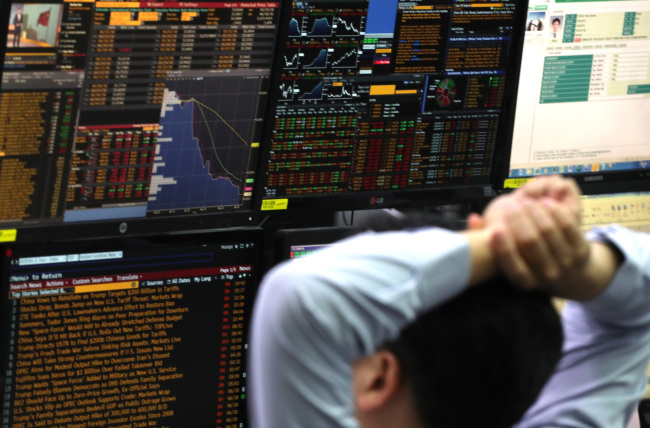
    Asian markets were mixed today with early gains pared by continuing concerns about the brewing China-US trade war, while the yuan struggled to maintain momentum after the Chinese central bank moved to support the unit.

    Traders started the day on an upbeat note, tracking their New York and European counterparts following recent painful losses.

    The gains came as data on Friday showed that while the US economy saw a slowdown in jobs creation in July, the pace of hiring remained strong over the past three months.

    The report also showed wage growth remained tepid, helping ease worries about an overheating economy.

    The result provided some much-needed cheer to markets, which brushed off a warning from Beijing that it would impose new tariffs on US$60 billion (RM244.7 billion) worth of US goods if Washington pushes ahead with levies on US$200 billion of Chinese imports.

    However, while reports said unofficial talks have been held between Beijing and Washington, trade tensions continue to rise, with a top White House adviser calling China a bad bet and saying its economy – the world’s second biggest – was struggling.

    By the end of trade today Tokyo was 0.1% lower, reversing a morning rally, while Shanghai tumbled 1.3%. Seoul dipped 0.1%.

    Hong Kong closed up 0.5% but well off the gains of more than 1% seen soon after the open.

    Sydney added 0.6%, Singapore gained 0.8% and Taipei was 0.1% higher. Manila and Bangkok were flat while Jakarta jumped more than 1% despite an earthquake that rattled the island of Lombok and killed dozens of people.

    “Caution about further escalation in US-China trade frictions is still strong,” Yoshihiro Ito, chief strategist at Okasan Online Securities, said in a commentary.

    The yuan’s early gains petered out, having made small gains Friday after the People’s Bank of China (PBoC) unveiled measures making it harder to bet against the currency, which has suffered steep losses in the past two months.

    The unit, which is wallowing around lows not seen for more than a year, bounced back soon after the announcement. It extended the gains this morning before going into reverse.

    The bank’s measure was similar to a move when the currency went into freefall following a devaluation three years ago that rattled global markets.

    However, analysts were lukewarm on the move. Some said it indicated Chinese leaders were growing increasingly worried about the unit’s depreciation.

    “The yuan kept falling when China did this last time in 2015, so I don’t think the PBoC’s move will significantly change the market tone,” Hao Hong, chief strategist at Bocom International Holdings said.

    “No matter what happened over the weekend, the weakness in Chinese stocks may continue. The trade war is nowhere near its end and China’s economy is slowing down, so why would the trend reverse?”

    In other forex trading, the pound was fighting to recover from Friday’s sell-off after Bank of England boss Mark Carney warned that the chance of leaving the EU without a proper deal was “uncomfortably high” and “highly undesirable”.

    While he said such a situation was still unlikely compared with other outcomes, the comments come as leaders on both sides are struggling to reach a compromise with just months to go before Britain is due to formally exit.

    The remarks sent sterling tumbling, with an interest rate rise last week unable to provide any support.
  • Big players hit hard by unstable stock market in Vietnam

    Big players hit hard by unstable stock market in Vietnam

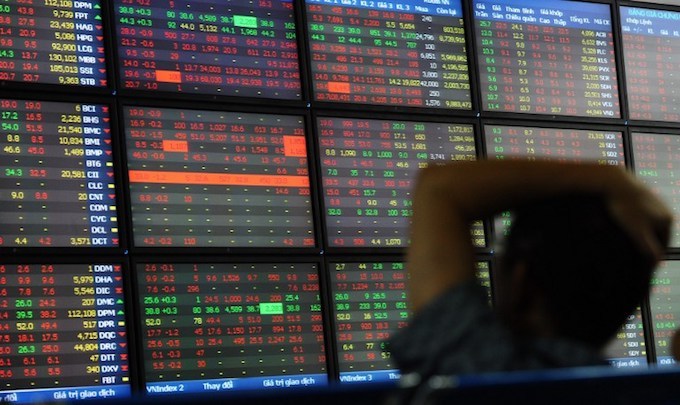
    In the first half of 2018, at least 13 major funds and investors on Vietnam’s stock market suffered negative growth rate in their net asset value (NAV), which is value per share of a fund on a specific date or time.

    Leading this was Hanoi-based Hestia Joint Stock Company registered on the Unlisted Public Company Market (UPCoM) on the Hanoi Stock Exchange (HNX), which saw its NAV falling by 19.4 percent.

    Thien Viet Securities Joint Stock Company came second with its Thien Viet Growth Fund 2 (TVAM TVGF2) on the Ho Chi Minh stock exchange (VN-Index) dropping 11.6 percent.

    Other funds and investors in the negative growth list include U.S.-based VanEck Vectors Vietnam ETF (VNM ETF), Passion Investment, Pyn Elite Fund, the TCEF fund of Techcom Capital Co. Ltd, SSI Sustainable Competitive Advantage Fund (SSI SCA), VCBF Leading Investment Fund (VCBF-BCF), Vietfund Management Company (VMFVF4) and Vietnam Enterprise Investment Limited (VEIL), managed by Dragon Capital Group.

    Why this happened to these major investors is not so difficult to understand, market observers say.

    It is common that big investors tend to pour investments into blue chip stocks, and from the second half of 2017 to the first few months of 2018, it was those blue chips that pushed the Vietnam stock market up high, and the investors profited, duly.

    The country’s stock market hit a 10-year high and reached 984.24 points in the last trading session of 2017. It had not broken the 800-point barrier since 2008.

    Continuing its good run, the VN-Index, the benchmark stock index of Vietnam, grew 19.33 percent in the first three months of this year, becoming the best-performing market in the world.

    It passed the 1,200-point level on April 9 and has stayed at 900 something before things started to turn bad in the second quarter when the market plunged 18.19 percent, making it the worst-performing market in the world.

    In such a reversal, it was the blue chips investors that suffered the most, and now, have to face the consequences.

    A typical example is Passion Investment.

    This fund spent almost 95 percent of its total VND220 billion ($9.5 million) acquiring 3.24 million shares of the Vietnam Prosperity Joint Stock Commercial Bank (VPBank), as shown it its Q1 report.

    The price of VPBank’s shares kept rising from the year’s beginning to early April when it reached the peak of nearly VND70,000 ($3) per share.

    Then it dropped to VND50,000 and fell nonstop to around VND25,000 recently.

    “When all investors are pinning their hopes too high and the stock market is pushed for a long time, a small impact can worry investors and make them scatter,” an expert said as he explained the plunge.

    Nguyen The Minh, director of analysis at Yaunta Securities Vietnam Company, said that many investors had started selling their stocks back in the first quarter.

    Other experts said the global situation, from the tensions in Syria when the U.S.-led air strikes targeted Syrian military sites to the U.S.-China trade war and worries about global capital movements as the U.S.’s Federal Reserve System raised interest rates, might have affected the stock exchange in the second quarter.

  • Malaysian stocks, ringgit to remain under selling pressure

    Malaysian stocks, ringgit to remain under selling pressure

    The Malaysian stock market and the ringgit, which have seen constant pressure since the surprise outcome of the 14th general election, are unlikely to change course anytime soon as the US action to slap tariffs on imports from China is expected to increase risk aversion in the short term, say economists.

    Last Friday, the US imposed tariffs on US$34 billion (RM137 billion) worth of goods from China. Beijing was quick to retaliate, announcing levies on the same value of US imports. Bursa Malaysia’s benchmark index, the FBM KLCI, fell 1.6% or 26.79 points to close at its intraday low of 1,663.86 points in reaction to the news, while most emerging market currencies, including the ringgit, yuan, Indian rupee, baht, won and Singapore dollar traded lower. The Malaysian unit closed at 4.0465 to the US dollar on Friday.

    MIDF Amanah Investment Bank chief economist Dr Kamaruddin Mohd Nor said that the local currency as well as the emerging economies’ currencies are expected to remain under pressure this week amid heighten trade tensions between the two economic powerhouses.

    He said trade tensions would hamper investor sentiments towards emerging economies, which in turn would influence the flow of funds as investors assess the possible risks and adverse outcomes associated with the dispute.

    “Thus, selling pressure due to this factor as well as other external factors (faster than expected interest rate increases in the US and stronger dollar) will weigh on the ringgit and regional currencies in the near term,” he added.

    Meanwhile, FXTM global head of currency strategy and market research Jameel Ahmad said there is some risk aversion in the atmosphere following the announcement by US President Donald Trump, where emerging market currencies and stock markets appear to be struggling as a result of a cautious trading environment.

    “If Asian stock markets continue to trade cautiously in wake of the US trade tariffs on China coming into play, there is a likelihood that this could also negatively impact the European stock markets,” Jameel said.

    Socio-Economic Research Centre executive director Lee Heng Guie noted that emerging markets’ assets, including currencies, have been under pressure in recent weeks due to the trade tensions, damaging market volatility due to capital reversals on expectations of higher US interest rates ahead and US dollar strength.

    Additionally, Lee said the ringgit is expected to remain at the current trading range given the multifacet external headwinds amid domestic political and policy transition.

    He noted that among the potential long-term effects from the tariffs’ implementation are slowing trade and investment as trade activity lessens, which would weigh on firms’ profitability and investments’ returns.

    Lee added that domestic demand would also dampen as households’ income becomes affected by the weak performance of export-oriented companies and industries.

    “In addition, global financial market volatility will have negative spillover on domestic equity market,” he said.

    Therefore, Lee said the government needs to widen its trade relationships with countries that are committed to adopting fair and open trade practices while companies work on products and markets complexities to minimise the disruption amid the global network of supply and value chains.

    Kamaruddin said while the research firm which does not expect local companies to face devastating near-term disruptions, they will have to be prepared if the list of products involved are part of their value chain.

    Overall, economists said the continued trade spat between the US and China, the return of market volatility, and the reality of higher US interest rates pressuring emerging financial markets and currencies, are expected to weigh on Malaysia’s growth momentum this year.

    “The estimated impact on GDP growth is around 0.1-0.3 percentage point,” Lee said.

    However, Kamaruddin said MIDF is keeping its full-year 2018 GDP growth forecast at 5.5%.

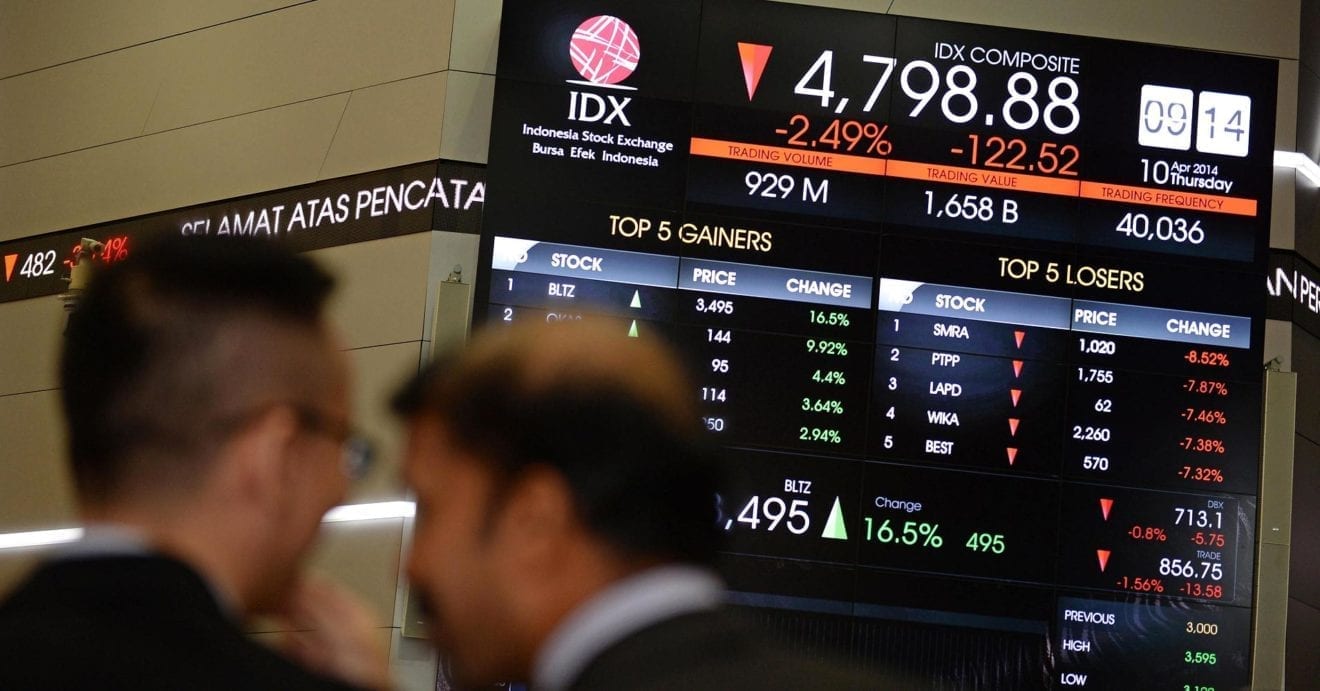
  • Indonesian Stocks Slump 2.5% as Trade Resumes After Idul Fitri

    Indonesian Stocks Slump 2.5% as Trade Resumes After Idul Fitri

    Indonesian shares slumped 2.5 percent on Wednesday (20/06), their sharpest intraday fall in nearly two months, after trade resumed following a long holiday for Idul Fitri celebrations.

    Global equity markets saw a selloff during the Idul Fitri holiday and Indonesia is expected to play catch-up, driven by stocks with high foreign ownership such as Bank Central Asia and Bank Mandiri, according to a Trimegah Securities note. Indonesian financial markets were closed from June 11 to 19.

    Financials were the biggest losers with Bank Central Asia declining 3.8 percent and Bank Mandiri shedding 6.5 percent.

    An index of the country’s 45 most liquid stocks slid 3.6 percent to its lowest in nearly one month.

    Among other Southeast Asian stock markets, the Philippines was down for a fifth straight session while Thailand rose after five consecutive sessions of declines ahead of central bank policy meetings.

    The Bank of Thailand is expected is expected to leave its policy interest rate near a record low, while a slim majority of economist expect the Bangko Sentral ng Pilipinas to raise rates.

    Energy and financial stocks were among the biggest boost in Thailand with PTT climbing 0.5 percent and Bangkok Dusit Medical Services rising 3.3 percent.

    Malaysian shares were higher after seven straight sessions of falls with Axiata Group gaining 1 percent and Genting adding 1.8 percent. The consumer price index rose 1.8 percent last month from a year earlier, meeting market expectations, on stronger fuel and transport prices and rising demand for food, government data showed.

  • Toyota Pumps $1b in Grab in Auto Industry’s Biggest Ride-Hailing Bet

    Toyota Pumps $1b in Grab in Auto Industry’s Biggest Ride-Hailing Bet

    Toyota Motor has agreed to buy a $1 billion stake in Grab in the biggest investment by a carmaker into a ride-hailing firm, at a time when traditional automakers are racing to team up with disruptive tech companies.

    The value of six-year-old Grab will be just over $10 billion after the investment, said a person familiar with the matter.

    The deal comes as the auto industry faces a spike in the need for technological prowess with the advent of features such as autonomous driving, while app makers offer passengers the option to forgo car purchases by connecting them with drivers.

    Some automakers have responded by partnering with makers of ride-hailing apps, which dominate the fast-growing field of mobility services, in anticipation of a future of reduced car ownership.

    General Motors has invested in US ride services firm Lyft, whose rival Uber Technologies is also backed by Toyota. Meanwhile Japan’s SoftBank Group – also an investor in Grab and Uber – last month said it would invest $2.25 billion in GM’s autonomous vehicle unit Cruise.

    Toyota’s trading arm invested an undisclosed sum in Grab last year. This time, the automaker is lead investor in a financing round launched after Grab acquired Uber’s operations in Southeast Asia, a region of 640 million people.

    Grab called it the largest-ever investment globally by an automotive manufacturer in the ride-hailing sector.

    The Singapore-headquartered firm did not disclose how much fresh capital it aims to raise. It raised $2.5 billion in its last round in July, resulting in a reported value of $6 billion.

    Grab said it logs six million rides a day via apps downloaded onto over 100 million mobile devices. The firm also offers online to offline services, such as food delivery and digital payments, which it aims to expand deeper into the region using funds from its latest financing round.

    “We will work with partners like Toyota to continue to transform transportation in Southeast Asia,” Grab said in an email. “We want to be the one-stop mobility platform for users.”

    It also said Toyota will appoint an executive to Grab’s board of directors while a dedicated Toyota team member will be seconded to Grab as an executive officer.

    Toyota said it aimed to offer financing, insurance and maintenance services to drivers based on data collected through recorder devices already installed in some Grab vehicles.

    “Going forward, together with Grab, we will develop services that are more attractive, safe and secure for our customers in Southeast Asia,” Toyota executive Shigeki Tomoyama said in a statement.

    The data could also help Toyota develop its own next-generation mobility services, including a self-driving electric vehicle aimed at companies for use in tasks such as ride hailing, package delivery and mobile shops.

    Other Grab investors include Japan’s Honda Motor, South Korea’s Hyundai Motor and Chinese ride-hailing firm Didi Chuxing. Uber acquired 27.5 percent of Grab in exchange for the US firm’s Southeast Asian business earlier this year.

    Grab’s main rival is now Indonesia’s Go-Jek, which last month said it would invest $500 million to begin expanding abroad.

  • Fook Tai Holdings seeking to go on the stock exchange

    Fook Tai Holdings seeking to go on the stock exchange

    Jewellery retailer Hong Kong Fook Tai Holdings is seeking an IPO on the growth enterprises market board with the aim of opening more retail stores and improving brand recognition.

    Fook Tai runs seven retail shops under the Fook Tai Jewellery brand in Hong Kong, while also selling products to VIP customers at its office. The company is a wholesaler of products mainly to a few jewellery retailers with stores outside Hong Kong and is a trader of recycled gold products. The company’s products come under three major categories – gold jewelry, platinum, karat gold and silver jewellery, as well as gem-set jewellery for mid- to high-end customers. Those categories accounted for 32.4, 4 and 24.3 per cent of total revenue respectively last year.

    Recycled gold products bought from the public and sold to recycled gold products collector/dealers, who resell them to goldsmiths, generated 39.3 per cent of total revenue.

    All the retail shops of Fook Tai are in residential areas of non-prime districts in Hong Kong, including Tsuen Wan, Jordan, Sham Shui Po, Tseung Kwan O, Sheung Shui and Kwun Tong. Fook Tai believes these locations will help grow a loyal customer base.

    The company intends to grow sales in major shopping and residential areas after going public. It plans to open two street-level shops in North Point and Sheung Shui in June and October respectively this year.

    Fook Tai directors believe the company should broaden its customer base and try to attract mainland customers. The new Sheung Shui store is near the border and is expected to benefit from mainland tourists. Also, North Point’s population includes high-income immigrants from the mainland.

    Fook Tai also plans to refurbish its retail stores after going public, and aims to attract younger buyers.

    Meanwhile, in its IPO prospectus, Fook Tai says its business may be adversely affected by the fluctuation of gold prices, while turnover from retail stores is subject to the risk of decline in the coming years.

  • China, Hong Kong stocks fall tracking Wall Street

    China, Hong Kong stocks fall tracking Wall Street

    Stocks in China and Hong Kong fell early on Tuesday, tracking losses on Wall Street, where concerns over increased regulation of large technology companies led to shares of Facebook plunging overnight.

    ** Facebook shares tumbled 6.8 percent as Chief Executive Mark Zuckerberg faced calls from both U.S. and European lawmakers to explain how a consultancy that worked on U.S. President Donald Trump’s election campaign gained access to data on 50 million Facebook users.

    ** Investors also worried about the potential for a trade war after Trump imposed tariffs on steel and aluminium.

    ** At 04:06 GMT, the Shanghai Composite index was down 0.26 percent at 3,270.82, and the blue-chip CSI300 index was 0.48 percent lower at 4,054.64. ** Chinese H-shares listed in Hong Kong fell 0.93 percent at 12,542.44, while the Hang Seng Index was down 0.54 percent at 31,344.20. ** The smaller Shenzhen index was down 0.55 percent, while the start-up board ChiNext Composite index was weaker by 0.06 percent.

    ** The Trump administration is expected to unveil up to $60 billion in new tariffs on Chinese imports by Friday, targeting technology, telecommunications and intellectual property, two officials briefed on the matter said Monday.

    ** U.S. businesses have been alarmed, with several large U.S. retail companies, including Walmart Inc and Target Corp , on Monday urging Trump not to impose massive tariffs on goods imported from China. ** Around the region, MSCI’s Asia ex-Japan stock index was weaker by 0.31 percent, while Japan’s Nikkei index was down 0.73 percent. ** The yuan was quoted at 6.3264 per U.S. dollar, 0.07 percent firmer than the previous close of 6.3308. ** The largest percentage gainers on the main Shanghai Composite index were Guodian Nanjing Automation Co Ltd up 10.1 percent, followed by Guizhou Yibai Pharmaceutical Co Ltd gaining 10.03 percent and Beijing AriTime Intelligent Control Co Ltd up by 10.02 percent. ** The largest percentage losers on the Shanghai index were Heilongjiang Interchina Water Treatment Co Ltd down 6.41 percent, followed by Cultural Investment Holdings Co Ltd losing 6.36 percent and Zhonglu Co Ltd falling by 5.46 percent. ** The top gainers among H-shares were CSPC Pharmaceutical Group Ltd up 10.4 percent, followed by China Gas Holdings Ltd gaining 4.74 percent and Huaneng Power International Inc up by 1.37 percent. ** The three biggest H-shares percentage decliners were Byd Co Ltd which has fallen 2.70 percent, China Vanke Co Ltd which lost 2.7 percent and New China Life Insurance Co Ltd down by 2.2 percent. ** About 8.25 billion shares have traded so far on the Shanghai exchange, roughly 45.9 percent of the market’s 30-day moving average of 17.96 billion shares a day. The volume traded was 13.80 billion as of the last full trading day. ** As of 04:06 GMT, China’s A-shares were trading at a premium of 25.94 percent over the Hong Kong-listed H-shares. ** The Shanghai stock index is below its 50-day moving average and its 200-day moving average. ** The price-to-earnings ratio of the Shanghai index was 14.91 as of the last full trading day, while the dividend yield was 2 percent. ** So far this week, the market capitalisation of the Shanghai stock index has risen by 0.24 percent to 29.29 trillion yuan. ** In Hong Kong, the sub-index of the Hang Seng index tracking energy shares rose 0.3 percent, while the IT sector fell 0.3 percent. The top gainer on Hang Seng was Sunny Optical Technology Group Co Ltd up 3.94 percent, while the biggest loser was Hong Kong Exchanges and Clearing Ltd which was down 1.81 percent.

  • Stock mostly higher but Facebook sinks again; Oracle plunges

    Stock mostly higher but Facebook sinks again; Oracle plunges

    Stock indexes finished mostly higher after a day of bouncing around Tuesday as retailers, energy companies and banks recovered some of their losses from the day before, but technology companies struggled as Facebook dropped again.

    Amazon led a rally among retailers, and it passed Alphabet, Google’s parent, as the second most-valuable U.S.-listed company, while energy companies rose with oil prices. Banks rose along with interest rates as the leaders of the Federal Reserve met. They are expected to raise interest rates on Wednesday.

    Facebook sank following reports that the Federal Trade Commission will investigate its handling of user data while authorities in the U.S. and U.K. demanded answers from the company. That came after reports that Cambridge Analytica, a data mining firm working for President Donald Trump’s campaign, improperly obtained data on 50 million Facebook users without their permission.

    While Facebook stock regained a portion of its losses at the end of the day, it has fallen more than 9 percent this week. Social media companies Twitter and Snap also fell as investors considered the possibility that the government will pass new laws affecting their businesses.

    “We don’t know what’s in store for an industry that isn’t really regulated,” said Samantha Azzarello, global market strategist at JPMorgan Exchange Traded Funds.

    The gainers Tuesday were mostly larger companies, which suffered the biggest losses Monday. Smaller companies struggled and more stocks fell than rose on the New York Stock Exchange.

    After a drop of 1.4 percent Monday, the S&P 500 index rose 4.02 points, or 0.1 percent, to 2,716.94. The Dow Jones industrial average gained 116.36 points, or 0.5 percent, to 24,727.27. The Nasdaq composite rose 20.06 points, or 0.3 percent, to 7,364.30. The Russell 2000 index of smaller-company stocks dipped 0.16 points to 1,570.41.

    Amazon jumped $41.58, or 2.7 percent, to $1,586.51 and Best Buy picked up $1.51, or 2.2 percent, to $70.04. Industrial companies including Caterpillar recovered much of their losses as well. Some major technology companies including Apple, Microsoft and Nvidia moved higher after significant drops a day ago.

    Facebook lost $4.41, or 2.6 percent, to $168.15. The drop in the last two days is the worst for Facebook in two years, and it knocked Facebook from its perch as the fifth most valuable publicly traded company in the U.S. Warren Buffett’s Berkshire Hathaway conglomerate, which owns insurance companies and railroads among many others, moved ahead of Facebook.

    Other social media companies also sank: after sharp losses Monday, Twitter plunged $3.63, or 10.4 percent, to $31.35 and Snap lost 42 cents, or 2.6 percent, to $16. Alphabet, which fell 3 percent Monday, lost another $427 to $1,095.80.

    Investors were disappointed with Oracle’s third-quarter report. While the company announced a bigger profit than analysts expected, they were less impressed once items like lower tax rates and stock repurchases were excluded, and its sales were lower than Wall Street had forecast. The company’s forecast for the fourth quarter also came up short of estimates. The stock dropped $4.90, or 9.4 percent, to $47.05.

    The Federal Reserve’s leaders began a two-day policy meeting that is expected to result in another interest rate increase on Wednesday. The Fed has said it expects to raise interest rates a total of three times this year, and one of the key debates on Wall Street is whether it will wind up increasing rates three times or four. The current meeting is the Fed’s first since Jerome Powell became chairman, and investors will be watching his comments at a press conference Wednesday afternoon.

    “Markets right now are hypersensitive to the Fed,” said Azzarello of JPMorgan. She said the Fed is trying to communicate clearly with investors and it won’t rush to raise interest rates.

    Bond prices fell. The yield on the 10-year Treasury note rose to 2.89 percent from 2.85 percent. When yields rise, it allows banks to charge higher interest rates on loans including mortgages.

    Banks and other financial companies rose, while companies that pay large dividends, including phone and utility companies, moved lower. Those stocks tend to fall out of favor with income-seeking investors when bond yields rise.

    Benchmark U.S. crude rose $1.34, or 2.2 percent, to $63.40 a barrel in New York. Brent crude, used to price international oils, gained $1.37, or 2.1 percent, to $67.42 per barrel in London.

    Wholesale gasoline gained 4 cents to $1.97 a gallon. Heating oil added 4 cents to $1.95 a gallon. Natural gas picked up 2 cents to $2.68 per 1,000 cubic feet.

    Gold fell $5.90 to $1,311.90 an ounce. Silver fell 14 cents to $16.19 an ounce. Copper lost 4 cents to $3.04 a pound.

    The dollar rose to 106.46 yen from 105.97 yen. The euro fell to $1.2253 from $1.2357.

    Germany’s DAX added 0.7 percent and the CAC 40 in France gained 0.6 percent. Britain’s FTSE 100 closed 0.3 percent higher. Japan’s benchmark Nikkei 225 lost 0.5 percent while South Korea’s Kospi edged up 0.4 percent. Hong Kong’s Hang Seng inched up 0.1 percent.

  • Vietnamese equities lead Asia-Pacific price gains in November

    Vietnamese equities lead Asia-Pacific price gains in November

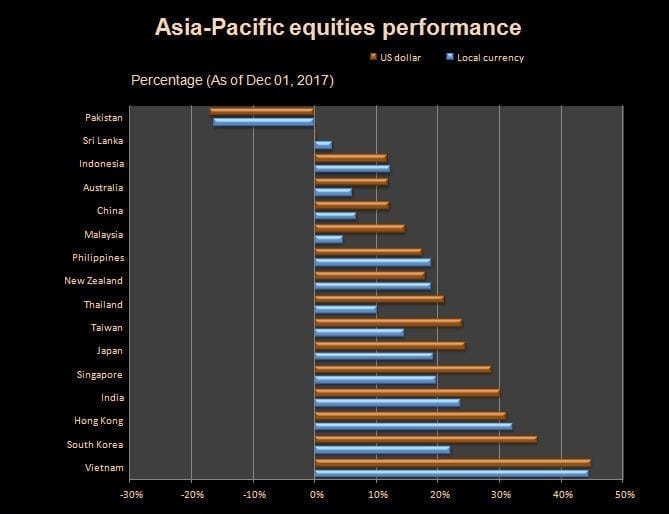
    Vietnamese shares reached decade-highs and topped Asia-Pacific with the highest price gains in November, bolstered by rising foreign interest during the month.

    Foreigners were net buyers of about $500 million of shares in the country’s stock market in November, the highest monthly purchases in at least seven years.


    Vietnam will also kick off the sale of a majority stake in Sabeco, the country’s biggest brewer, in December.Singapore-listed Jardine Cycle & Carriage Ltd’s purchases of about $900 million in Vinamilk’s shares was seen as a positive for Vietnamese markets, with government aiming to trim its stakes in more state-owned firms.

    The Vietnam index rose more than 13 percent in November.

    Hong Kong and Japanese shares rose more than 3 percent each in November.

    Sri Lankan stocks led the losers with a fall of 3.11 percent, followed by China and Taiwan shares with declines of more than 2 percent.

    South Korean, Malaysian, Thai, Philippine and Indian equities fell between 1 to 2 percent.

  • HSBC debuts mobile stock app

    HSBC debuts mobile stock app

    HSBC has introduced a new stock trading mobile app for both Android and iOS to help Hong Kong customers more easily trade Hong Kong, China A and US stocks.

    The HSBC HK Easy Invest standalone stock trading app includes new features including a one-screen quick buy function, interactive charts, a sector heat map and tailored news.

    Customers can access the app using their existing HSBC Personal Internet Banking Details or Touch ID fingerprint authentication for Apple users. The app also employs several industry-standard security measures for further protection.

    To promote the new app, HSBC is offering new users a HK$100 brokerage fee rebate on customers’ first trade using the system until November 30.

    “With changing customer behaviour and increasing demand for faster and more convenient banking services, we are expanding our digital capabilities to better meet customers’ needs,” HSBC head of retail banking and wealth management for Hong Kong Greg Hingston said.

    “HSBC HK Easy Invest is a smart and powerful tool that is easy to use, fast and secure, helping us support our customers as they manage their wealth.”

  • Vietnam’s benchmark index hits ten-year high on back of blue chip gains

    Investors have been spending big on the stock market so far this year.

    Ho Chi Minh City’s VN-Index broke the 800-point barrier on Friday for the first time since February 2008.

    The index finished up 4.48 percent at 801.5 points.

    Growth was driven by blue chips, including brewery giant Sabeco, Masan Group, insurance firm Baoviet and Vietcombank.

    The benchmark index hit an all-time high of 1,170.67 in March 2007, before a sharp sell-off in the wake of the global financial crisis.

    The average transaction value reached about VND3 trillion ($132 million) per session last year, but it has been hitting up to VND7.5 trillion at some points this year.

  • MIDF: Foreign funds flow back to Bursa

    MIDF: Foreign funds flow back to Bursa

    Foreign tide has finally returned to Bursa Malaysia after three successive weeks of attrition, albeit only marginally.

    Foreigners turned net buyers last week despite the short trading week, according to MIDF Research in its weekly fund flow report today.

    Bursa was closed on Thursday, Friday and yesterday for the National Day, Aidul Adha festival and public holiday due to outstanding achievements by national athletes at the 2017 SEA Games.

    Last week, foreign funds acquired RM36.2 million net based on transactions in the open market, excluding off market deals. This is the lowest weekly foreign acquisition for the year.

    “We note that the six-day selling streak has snapped as global funds acquired RM7.1 million net on that day. Foreign buying momentum increased the next day by seven times to RM52.2 million net.

    “However last Wednesday, international fund managers cleared their positions ahead of the long weekend, disposing RM23.1 million net,” it explained.

    August turns out to be the first month of net outflows this year which amounted to RM241.9 million net. Nonetheless, cumulative year-to-date net infl ow still stands above the RM10 billion mark.

    Foreign participation rate was resilient for the week as foreign average daily trade value (ADTV) remains above RM800 million for the fifth week in a row.

    Retail participation, meanwhile, edged higher for the week. The retail ADTV increased by 25 per cent to RM865 million after three straight weeks being below RM700 million.

  • Leading US-based index to include Chinese stocks for 1st time

    Leading US-based index to include Chinese stocks for 1st time

    MSCI’s decision has been closely watched as a sign of China’s growing importance on international financial markets. China on Wednesday hailed the acceptance of its stocks in a leading U.S.-based index of emerging market shares as a signal of confidence in the Asian power’s economy after three previous rejections.

    The Shanghai and Shenzhen stock markets opened higher after New York’s MSCI agreed to include 222 large capitalization Chinese stocks in its MSCI Emerging Markets Index, representing 0.73 percent of the index.

    MSCI’s decision has been closely watched as a sign of China’s growing importance on international financial markets.

    “We applaud and appreciate MSCI for making such a decision,” said Zhang Xiaojun, spokesman for the China Securities Regulatory Commission.

    “It showed international investors’ confidence in a stable Chinese economy with better prospects and in the steadiness of China’s financial market,” Zhang said.

    The benchmark Shanghai Composite Index jumped 0.29 percent while the Shenzhen Composite Index, which tracks stocks on China’s second exchange, gained 0.24 percent in early trading.

    MSCI said the move has “broad support” from international institutional investors and was the result of loosening of restrictions enacted by China on foreign ownership of “A” shares — stock in mainland China-based companies — ownership of which had once been limited to mainland citizens.

    “International investors have embraced the positive changes in the accessibility of the China A shares market over the last few years and now all conditions are set for MSCI to proceed with the first step of the inclusion,” said Remy Briand, MSCI managing director.

    “MSCI is very hopeful that the momentum of positive change witnessed in China over the past years will continue to accelerate.”

    ‘Token inclusion’

    MSCI says its emerging markets index is tracked by more than $1.5 trillion in assets. The company said the Chinese representation in the index could be increased in time if China enacts additional reforms.

    MSCI has in the past cited obstacles such as China’s restrictions on market access and on moving capital in and out of the country. Prior to Tuesday’s decision, it had excluded Chinese shares for three years in a row.

    “We reflected the comments from the institutional investor community. They (Chinese officials) took them very seriously and acted upon some of them,” MSCI chief executive Henry Fernandez told CNBC.

    Institutional investors praised a decrease in the number of stock suspensions in China, but said the current level is still an “outlier” compared with other markets, MSCI said.

    Chinese shares will go into a number of provisional indices before they are included in the flagship index starting in June 2018.

    China’s addition would help around $8 billion flow into its stock markets, Capital Economics said, describing it as “a token inclusion” given that the weighting would be the equivalent of 0.1 percent of the domestic market’s capitalization.

    Opens the door

    Analysts nevertheless said China’s admission to the index would be a good start.

    “A low number of shares and weighting is not important at the beginning,” said Li Daxiao, chief economist at Yingda Securities.

    “It is like opening a door. Even if it is just a crack, it is a huge improvement compared to being completely shut.”

    Citic Securities analyst Zhang Qun said inclusion would have “more of an emotional effect than a practical one”.

    “It is the change from zero to one. If in the next few years the degree of opening up increases… then it could go from one to 10 or even 100,” Zhang said.

  • IDX Closes on Regional Election Day

    IDX Closes on Regional Election Day

    The Indonesia Stock Exchange (IDX) will close on the simultaneous regional election day, February 15, 2017, the IDX website page stated. Earlier, Vice President Jusuf Kalla had asked Indonesians to use their voting rights and vote for credible candidates to improve their respective regions.
    JK said that election is a peaceful, responsible, and clean democratic process that ensure individual right to vote. He expects to see a smooth democratic process during the simultaneous regional elections. “Let’s go to the polling station with a smile, happiness, and peacefully vote for leaders who can lead us to a better life,” he said.
  • Nice start to the year. Pity about the rest of it

    Nice start to the year. Pity about the rest of it

    There are too many uncertainties ahead to know whether it will continue or crumble, economists say. The world economy has begun the year in fine form. America is cruising along, China is growing faster than expected, Britain is muffling the Brexit downdraft. Even the usually lagging euro zone is perky.

    Pity about what lies ahead.

    Almost every major economy’s data releases these days seem to follow a similar pattern.

    First, they are generally positive – either better than previously or only a little weaker. Then, policymakers and economists come out and say there are too many uncertainties ahead to know whether it will continue or crumble.

    “Geopolitical risks are mounting and increasingly catching market attention in such fashion as to risk overshadowing most other developments,” Canada’s Scotiabank told its clients.

    The risks are primarily political. How will U.S. President Donald Trump’s “America First” protectionist talk translate into policy? Will Brexit finally come back to bite Britain by cutting off commercial growth and breeding inflation?

    For the euro zone, meanwhile, the risks are existential. Elections in France, Italy, Germany and the Netherlands could result in anti-euro political parties gaining significant ground or even taking office. And Greece’s hold on its place in the currency union remains flimsy.

    In the past week the extra money investors demand to buy French bonds rather than German ones jumped – much of it because of a comment by an official of the far-right National Front that it would put leaving the euro at the heart of its economic platform.

    Polls suggest National Front candidate Marine Le Pen will not win the presidency – but after the Trump and Brexit surprises last year nothing can be ruled out.

    Other risks are more Keynesian, revolving around whether years of stimulus from central banks in the form of asset-buying and negligible interest rates are finally producing inflation, which in turn will stop consumers from buying, slowing economic growth.

    Economics can be very much a game of whack-a-mole.

    Up next

    The coming week may well be dominated by China, which returns from a holiday with a large slate of data, including the services purchasing managers index – which implied steady if slightly slower growth – foreign reserves data and possibly trade figures.

    China grew a faster-than-expected 6.8 percent in the fourth quarter, boosted by higher government spending and record bank lending.

    But the economy still faces headwinds from a cooling housing market and possible protectionist measures from the U.S.

    The foreign exchange reserves, meanwhile, are on the verge of falling below $3 trillion, although the pace of declines could be slowed by capital controls and the dollar’s retreat.

    China is being cautious. It raised a number of policy rates on Friday against what Deutsche Bank described as a dilemma.

    “Policy needs to be tightened for financial stability considerations, but (the central bank) wants to control the pace and magnitude so that … the tightening does not trigger disruptive adjustments (bubble burst), and … does not jeopardize the stabilizing growth outlook,” it said.

    In the euro zone, there will be German, French, Spanish and Italian industrial production data. All are expected to show growth.

    Germany’s volatile factory orders may be under particular scrutiny. They fell 2.5 percent month-on-month in November, a plunge from a 5 percent rise the month before.