Retail News CRM

Tag: tech

  • Gentle Monster, Huawei team up over smart eyewear

    Gentle Monster, Huawei team up over smart eyewear

    South Korean eyewear label Gentle Monster has partnered with Chinese tech giant Huawei to produced connected eyewear.

    The networked eyeglass frames allow wearers to answer calls without picking up their phone, and feature antennae, noise-reduction microphones and speakers tucked behind the ear.

    “Smart eyewear is different than the smart phone or the smart watch,” said Gentle Monster co founder and CEO Hankook Kim. “The smart eyewear is on our face … It is normal but actually it is slightly different. We believe the small difference changes everything.”

    The label, known for its trendy and futuristic individualised store designs, has 18 locations selling both futuristic and more conservative eyewear.

    “If you want to see how it looks on normal people, you can look at me,” said Kim.

    “I really appreciate Huawei because they realise that eyewear comes first and smart comes later,” he added.

  • The tech advancements transforming the Hong Kong retail environment

    The tech advancements transforming the Hong Kong retail environment

    Ever-changing market dynamics and audience preferences are pushing retailers into a digital-driven world to respond promptly to consumer needs. Though e-payment machines are an increasingly common in-store sight, there are other retail tech trends that will have a longer lasting impact and help businesses stay one step ahead.

    Despite the rise of eCommerce, physical stores are not going anywhere. Customers will always want the option of visiting a physical store to try on jeans and dresses rather than buying three different sizes online. Sue Temple, vice president of global consumer insights at Nielsen, sees the trend of shoppers doing smaller, but more shopping trips in general, including online and physical stores. Connecting online and physical store experiences remains a major focus this year.

    Shops without shopkeepers

    When Amazon launched its Amazon Go to the public last year, the cashier-free store concept was seen as a revolutionary model for the future of retail, enticing the rest of the industry worldwide to play catch up. This year we are likely to witness more movements on smart, automated and cashier-less checkout schemes. Unmanned stores will eventually become ubiquitous in retail.

    Hong Kong shoppers had a taste of this kind of smart retail experience during the Chinese New Year. Tencent’s WeChat Pay HK and JOOX collaborated with Sun Hung Kai Properties to open an unmanned shop at the apm mall in January. The 1,000 square foot unmanned shop featured five themed zones offering trendy gaming, Chinese New Year merchandise, limited edition souvenirs, a self-service karaoke station and an AI mechanical arm interactive experience zone.

    The highlight of the unmanned store was a digitised consumer journey with more than 1,000 assorted goods in the store embedded with RFID chips. Customers could pick out items they wanted to purchase and then scan the QR code. The RFID system would automatically detect their chosen goods at the store exit, at which point, customers could use the Wechat Pay HK system to settle their transactions and leave.

    Tencent’s International Business Group (Tencent IBG) tells Marketing: “The unmanned store has been well-received by shoppers. It is a real-life demonstration for consumers to experience smart retail through a seamless and secure mobile payment solution. We aim to enhance the overall consumer journey, and empower consumers through greater flexibility and convenience as they go about their daily lives.”

    In the unmanned store, Tencent’s technologies not only enhanced the consumer experience, but also reduced operation costs for the retailer. It also provided analysable data to allow businesses and marketers to better understand consumer traffic, preferences and behaviour.

    Tencent IBG has noticed a number of challenges that traditional retailers are currently face: rising offline operating costs, declining revenue as shoppers move online, and increased consumer demand. At the same time, there are visible opportunities for retailers to drive business efficiency by disrupting old channels, gaining a better understanding of consumers, and exploring new technological possibilities such as facial recognition and voice recognition.

    Unmanned stores are all about removing friction and increasing productivity. While the minimisation of time in store has proven particularly effective for some retail categories (such as convenience and groceries) they are not suitable for other categories. Luxury, for instance, relies on the experience and time spent in-store, along with a high-touch service, as part of its value proposition.

    Reality bytes

    Great customer experiences will come from blending technology with a personal touch. Retailers are continuing to strive towards more personalised experiences with the use of AR and VR tech in their marketing campaigns and consumer journeys.

    Recently, L’Oréal Group brand Lancôme partnered with Alibaba Cloud to introduce an AR game to Hong Kong customers. The launch of a seasonal mobile app coincided with the opening of a Lancôme pop-up store in Harbour City. The partnership leveraged Alibaba Cloud’s data, image search and AR technologies with Lancôme’s beauty product lines to create a holistic online-to-offline experience.

    Customers could activate and play the AR game on their smartphones from anywhere in the city. Moving their cameras around, they were able to find and capture AR images of Lancôme’s signature beauty products.

    “The retail store is no longer simply a place for making a purchase, it is also an entertainment destination.”

    Larry Luk, CMO at L’Oréal Group, says, “As a beauty-tech company, L’Oréal combines beauty-tech with integrated marketing plans to drive the ‘retailtainment’ trend. This adds an entertainment element into the traditional retail approach, providing consumers with better interactive experiences.”

    Alibaba aims to demonstrate that cloud technology can also be used in offline retail shops, by not only offering innovative ways of engaging consumers, but also showing how Lancôme will better understand customers’ needs by using data analytic tools.

    “Lancôme began the Year of the Pig by breaking its daily sales record and achieving double-digit growth in Hong Kong by leveraging AR, Alibaba Cloud’s image search technology and cloud services,” Luk says. “Employing Lancôme as the pilot brand, the Chinese New Year campaign succeeded in creating unique and fun experiences and establishing personalised relationships with consumers.”

    The ultimate goal of all these types of innovative and interactive campaigns is to stimulate customers’ interest in the products and drive business growth. Nevertheless, in 2019, retailers may go a step further from AR and VR to the  world of IR (immersive reality).

    The potential of IR could be immense. While AR overlays digital content onto an existing physical space and VR transports users into a synthesised 3D world through sight and sound input, IR is a dramatic advancement. It provides an immersion of all five senses (sight, sound, touch, smell and taste) and far more interactivity. Which could, of course, result in far more data.

    Consumer soothsayers

    While marketers believe collecting big data is enough to understand current consumer behaviour for planning campaigns or business strategies, building accurate predictions of future consumer behaviour may be the game changer.

    “A lot of big data looks backwards. It is what happened five minutes ago, an hour ago or last week. Now we are trying to predict what happens next,” Nielsen’s Temple explains.

    Shopper behaviour is changing rapidly; a tool that enables retailers to keep up with the speed of change, or even stay ahead of it, will be the key to winning. Temple says: “If we can get quicker at research, we can model more things, more quickly, and we can look forwards not backwards, then the retailers have a real chance to win, to differentiate themselves from competitors, to deliver something the shopper wants.”

    After rolling out in 12 markets in 2018, in February 2019, Nielsen’s Smartstore launched in Hong Kong. Smartstore is a digital solution that captures shopper insights in a 3D virtual immersive environment. Respondents will be tested in multiple live scenarios in a variety of custom store formats to gather predictive information. Their shopper experience will provide tracked head, eye and feet movements, alongside 3D heat maps for analysis. The turnaround for results can be as fast as one week.

    This solution combines store planning, merchandising and marketing research. Retailers can measure, evaluate and optimise a range of retail concepts on sales and profit, based on how target shoppers react at the moment of truth. The solution allows retailers to measure the effectiveness of point of sale merchandise based on what shoppers “see, think and do”.

    Technological advancements help businesses to create better marketing strategies with a better understanding of consumer behaviour, and ultimately, achieve greater business uplift with higher conversion. However, Temple thinks Hong Kong is lagging behind adopting retail tech.

    “Digital is not an option anymore, it is not about being a digital marketeer, it is about being a marketeer that embraces all of that, the traditional and the digital, and getting the right mix for your brand, your category and your store.”


  • AirAsia opens technology centre in India’s Silicon Valley

    AirAsia opens technology centre in India’s Silicon Valley

    AirAsia has unveiled a new technology centre in Bengaluru, India’s Silicon Valley, housing 35 software engineering and technology experts each tasked to design and create custom-built solutions for AirAsia’s airline and digital businesses.

    The new centre affirms its mission to transform into a travel technology company, AirAsia said in a statement. The team will work to streamline the airline’s digital assets such as airasia.com and the AirAsia mobile app, alongside the creation and implementation of new products and enhancements such as the new AI-powered chatbot, AVA, to provide frictionless journeys for the airline’s guests.

    The opening of the new technology centre is one of many global initiatives AirAsia is exploring to drive its digital transformation. In recent times, AirAsia has implemented a number of new digital features including flight search mapping and voice assistance which provides guests with a more seamless, user-friendly experience on its mobile app. Last October, it also collaborated with Google Cloud to integrate machine learning and artificial intelligence into every aspect of the airline’s business and culture.

    Aireen Omar, AirAsia deputy group CEO (technology and digital) said: ““India is a source for innovation and cutting-edge technology, and offers us tremendous growth potential when it comes to our mission to develop an all-encompassing travel technology ecosystem. This is why we are so excited to expand our footprint in India with the opening of a new technology centre.”

    AirAsia India MD and CEO Sunil Bhaskaran added that India’s skilled manpower can address the requirements of the global market, at the same time adding value to the Indian ICT industry and helping to strengthen the industry ecosystem.

  • Tech products to drive reboot of Asia’s growth engine

    Tech products to drive reboot of Asia’s growth engine

    The technology boom powering Asia’s economies is about to get a reboot. Explosive growth in new-era gadgets such as wearable devices and internet-linked home appliances is tipped to offset cooling sales of smartphones, which has already dinged Asia’s tech manufacturers.

    “Where demand may be softening in some areas it will be strengthening in others,” Koshy Mathai, a senior official in the International Monetary Fund’s Asia Pacific Department, said in an interview. He pointed to upcoming demand from “a vast middle class in China, India and other frontier markets.”

    That’s good news for the world economy. Asia Pacific accounts for 60 percent of global growth, much of it from a technology-supply chain that’s vulnerable to smartphone cycles.

    The IMF isn’t alone in tipping the rise of a new tech cycle. The world is in the early stages of a shift from the late-stage mobile Internet era to a new, data-centered computing era, Morgan Stanley analysts wrote in a report last month.

    Crucially, it will be the first such era in which multiple technologies emerge at once, including the internet of things, artificial intelligence and virtual and augmented reality, and it will require IT investment unparalleled since the launch of the web in 1990, Morgan Stanley analysts said.

    Samsung Tops Profit Estimates, Warns of Weaker Phone Demand

    Take wearable devices. Global sales of body-worn cameras are forecast to reach 5.6 million units in 2021, more than triple the 1.6 million this year, according to forecasts by Gartner Inc. Smartwatch sales are expected to hit 81 million from 48 million over the same period, while those of head-mounted displays will more than double to 67 million.

    Spending on robotics and drones solutions will reach US$103.1 billion in 2018, up 22 per cent from last year, and more than double to US$218.4 billion by 2021, according to International Data Corporation.

    China, Japan, South Korea and Taiwan would be among the economies expected to benefit most — as they did from smartphones — with the new products stoking fresh demand for components such as semiconductors and displays.

    That is expected to benefit manufacturers such as South Korea’s LG Display Co., which makes displays used in products including smartwatches and Bluetooth devices, and Samsung Electronics Co., which makes memory capacity. Japan’s Sony Corp. is developing 3D sensors that can be used in drones, self-driving automobiles, gaming consoles, industrial equipment and more.

    “Manufacturers have always been able to shift their production line to cater to the newest trend in the market,” said Kenneth Liew, Singapore-based senior research manager at IDC. “We are now seeing products like wearables, smart home devices as some of the key products for future growth.”

    The upbeat view comes as a more-than-year-long rebound in Asia’s exports has hit a speed bump, with softening industrial and manufacturing activity. Smartphones contributed around one sixth of the estimated growth in trade in 2017, according to the IMF. Sales totaled close to 1.5 billion units last year — enough for one of every five people on the planet.

    But with more and more people already owning a smartphone, demand has peaked. That’s being felt at chip foundries and assembly plants across Asia.

    Taiwan’s Pegatron Corp., which assembles Apple Inc.’s iPhone 8, ramped up capacity in anticipation of a surge in business last year. A subsequent shortfall in demand led to lower utilization rates across its factories and operating margins almost halved. Both Pegatron and Hon Hai Precision Industry Co. — Apple’s principal assemblers — reported declines in net income in 2017 even as their biggest customer racked up record profits.

    To be sure, the smartphone sector is tapering off, not cratering, as evidenced by Apple’s results. And it will be some time before the emerging tech cycle reaches a point of matching demand generated through phone production, said Frederic Neumann, co-head of Asian economics research at HSBC Holdings Plc in Hong Kong.

    “While demand for consumer electronics like wearable devices and virtual reality headsets is growing rapidly, production runs still pale in comparison to smartphones,” Neumann said.

    Apple Earnings Show Growing Immunity to Smartphone Malaise

    Of course, all bets are off if an all-out trade war erupts between China and the U.S. Barring that, the next evolution in tech is poised to support global economic growth, even as smartphones reach saturation.

    “It is fair to say that economists often don’t understand technology well enough to understand what it can do in terms of growth,” the IMF’s Mr Mathai said.

  • Touché announces appointment of new Chief Legal Officer

    Touché announces appointment of new Chief Legal Officer

    Singapore based technology company Touché has announced the appointment of Mr Arvind Vij to the position of Chief Legal Officer with effect from 01 May 2018. Arvind is joining Touché’s experienced executive leadership team.

    Arvind brings with him 20+ years of international legal experience across different sectors, both as an in-house lawyer and in private practice. He founded and served as the Chief Executive Officer of Illuminati Humanista Solutions, providing specialised and customised services in the areas of Legal, Compliance and Corporate Secretarial support to a diversified range of clients in the areas of Corporate, Commercial Banking and Finance, Information Technology and Intellectual Property.  Arvind will continue to be involved with Illuminati.

    Prior to that, Arvind spent more than 14 years at JPMorgan in Singapore, Mumbai & New York and was most recently Managing Director & Associate General Counsel, Global Head Legal Entity Management and General Counsel and Head of Compliance for Offshoring and Outsourcing. Prior to JPMorgan, Arvind was with Drew & Napier in Singapore, Milbank, Tweed, Hadley & McCloy in Singapore & New York and Pillsbury Winthrop in Singapore & New York.

    Arvind will report directly to Sahba Saint-Claire, Chief Executive Officer and co-founder of Touché.

    “Arvind’s unique blend of multinational legal expertise and business acumen makes him a great addition to the team as we realise our plans to redefine payment transactions into value-added interactions, in the region and globally. He joins us at an exciting time with multiple partnerships being discussed with leading banks and merchants across APAC and the Middle-East,” said Saint-Claire.

    “Touché is a dynamic company that is uniquely positioned to reshape the payments industry and provide personalised customer experiences through its comprehensive biometric based system. I look forward to joining the team and helping Touché develop and implement new strategies on legal matters,” said Arvind.


  • Singapore company AIQ brings Keat Hong Community Club online with Visual Recognition Technology

    Singapore company AIQ brings Keat Hong Community Club online with Visual Recognition Technology

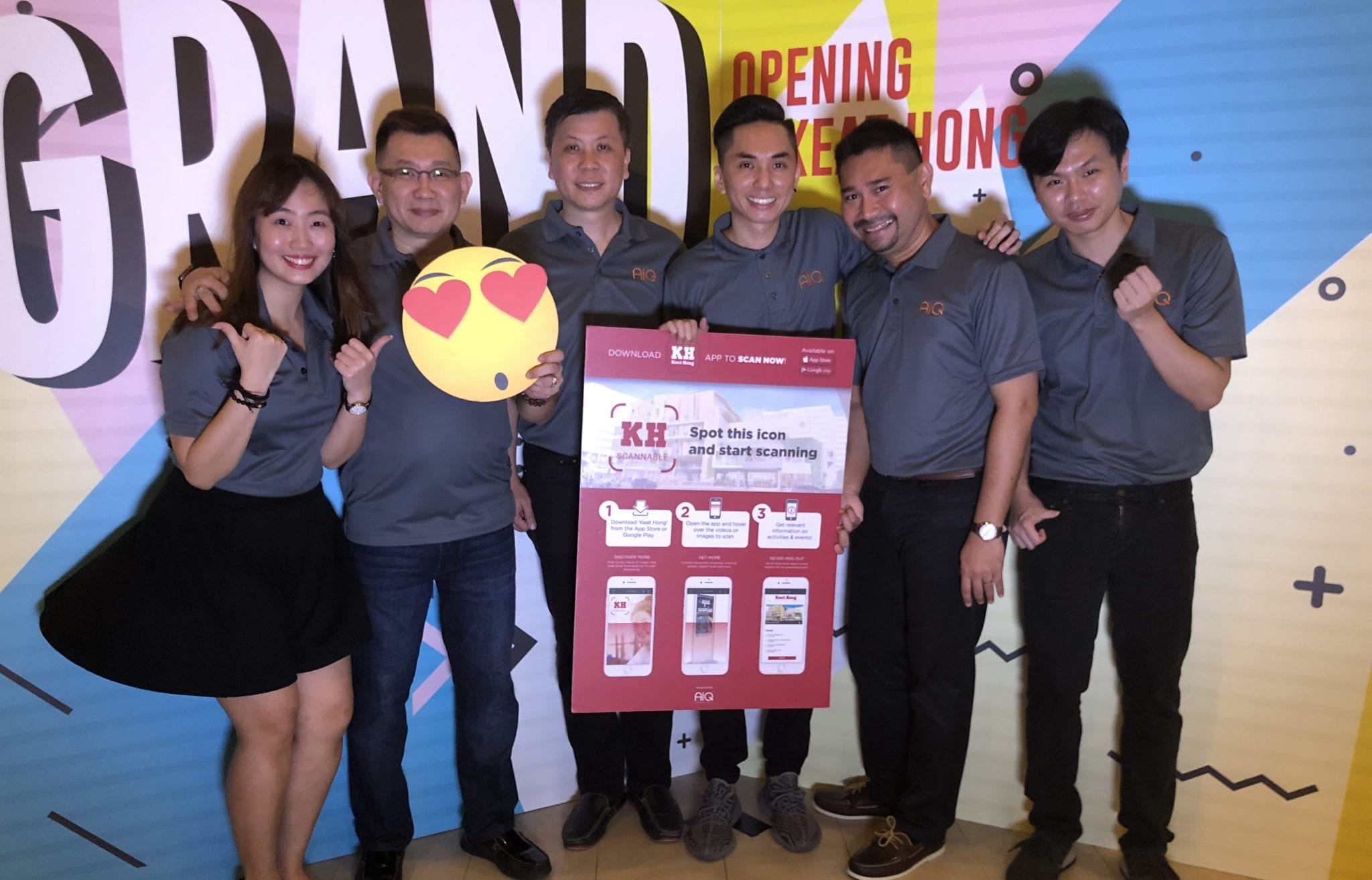
    AIQ, a Singapore company that offers AI Visual Recognition Technology (VRT), today announced that their VRT is powering the Keat Hong mobile app to provide an interactive, smart and visual layer to resident’s interactions at Keat Hong Community Club (CC). The Community Club held its grand opening last Saturday on 5 May.

    AIQ’s technology will allow visitors to Keat Hong Community Club to access online features through their mobile phones. By using their mobile phone camera and the mobile app, residents can view photos and read about the heritage of the community club when they scan the physical heritage wall, as well as register for courses and events by scanning posters and digital kiosks. Utilising AIQ’s video recognition technology, visitors can even scan live video on outdoor digital panels which will lead them to discover additional video content on Keat Hong’s YouTube Channel.

    Mr Marcus Tan, CEO of AIQ, said: “We see our visual technology as a potential replacement for the QR code, and helping to connect the offline to the online. Even in a mobile first, online world, offline interactions still play a very important part of our daily lives, particularly at community clubs which are designed to be physical spaces for the community to get together. The ability to use images and visuals is also very important to build brand equity and recognition. What our app does is connect visitors at Keat Hong CC to the wealth of information and convenience available online.”

    AIQ’s Visual Recognition Technology can process live images and video with processing speeds of up to 300 milliseconds, with just 30 per cent of the image or video captured, by utilising a proprietary image matching and video recognition technology. Specifically, for visitors to Keat Hong CC, this means that they can almost instantaneously access online information through the app even if the area is crowded.

    The same AIQ technology was previously used by travel company Insight Vacations at the NATAS Travel 2018 and Travel Revolution fair in March. AIQ helped Insight Vacations increase engagement and interactions, by providing fair visitors with the ability to connect with information on Insight Vacation’s website and winning instant prizes just by scanning a static, physical poster at the fair. AIQ’s Visual Data Analytics technology also gave insight into fair visitor’s favourite holiday destination by tracking scans and interactions, providing immediate and useful data points for the company to customise their campaigns.The Keat Hong app is now available for download on Google Play and the App Store.

  • SAP expands innovation footprint in APJ with the launch of SAP Leonardo Center Singapore

    SAP expands innovation footprint in APJ with the launch of SAP Leonardo Center Singapore

    SAP  today announced the launch of the SAP Leonardo Center Singapore, established to help customers, partners and the broader ecosystem of universities and start-ups across the Asia Pacific Japan (APJ) region to deliver faster innovation with less risk. This launch expands SAP’s innovation footprint in the region, adding to the three Innovation Centers and four SAP Labs in APJ. Globally, SAP spent €3,352 M on Research and Development in 2017.

    According to World Economic Forum, Singapore is the most competitive economy in Asia Pacific and third globally. The SAP Leonardo Center Singapore is the fifth in the global network of SAP Leonardo Centers. It is designed to serve as the “front-end” for APJ customers and partners to accelerate their digital innovation journeys using the capabilities of SAP Leonardo and Design Thinking. SAP Leonardo brings together Internet of Things (IoT), Machine Learning, Blockchain, Big Data, Analytics and Data Intelligence on SAP Cloud Platform. It also applies SAP’s leading technology capabilities and deep knowledge of 25 industries, in a live technology-delivery environment to deliver the Intelligent Enterprise for every customer.

    “The SAP Leonardo Center in Singapore will showcase the art of the possible in digital innovation and help our customers scale quickly, easily and effectively,” said Scott Russell, President, SAP APJ. “Together with our customers and partners, we aim to leverage the SAP Leonardo Center Singapore as a think tank to drive purpose-led innovation that will ultimately improve the lives of one billion people and deliver the Intelligent Enterprise for over 70,000 customers in APJ by 2022. The SAP Leonardo Center in Singapore will play a key role in realizing our growth strategy and drive customer success in the new Intelligence era.”

    Collaborative business environment

    The SAP Leonardo Center Singapore aims to foster a collaborative environment for businesses, start-ups, small and medium-sized enterprises to experiment and innovate. One of SAP APJ’s first SAP Leonardo customers in Korea is Hanon Systems. Headquartered in South Korea, Hanon Systems is a global leader in automotive thermal and energy management solutions, and an early-adopter of SAP Leonardo in APJ. With insight into the benefits of digital manufacturing, the company identified manufacturing performance and equipment health as areas of measurement to pilot the Leonardo platform at one of its plants in Europe. Robert Oh, Chief Information Officer and Business Transformation Executive at Hanon Systems, believes a supplier’s ability to compete in today’s automotive market is no longer measured by just its product offering. “At Hanon Systems, we believe our digital transformation can change the way we manufacture in a positive way to improve our productivity, increase our overall efficiency and further strengthen our customer relationships.”

    Hub for Ecosystem

    The SAP Leonardo Center Singapore also serves as a hub for SAP’s broader digital technology ecosystem including universities, startups, tech communities and accelerators. SAP APJ prepares the next-generation innovators with knowledge and skills for the digital future through the SAP University Alliances program, which exposes 1.7M students in educational institutions in APJ to innovative technologies. SAP APJ has established 13 Next-Gen labs in APJ with plans to open more in the future. SAP India designed a modular offering called i360 forAjeenkya DY Patil University, which includes SAP Leonardo IoT, SAP Leonardo Machine Learning and SAP Open SAP Learning. India has seen an increase in the uptake of modular offerings that focus on Industry 4.0 and Smart Cities. Demand for talent in India with skills in IoT, Machine Learning, Artificial Intelligence, Blockchain and Big Data and Analytics is high. Educational institutions have found merit in collaborating with technology firms to close this gap.

  • Warnings of ‘online catastrophe’ in domain name industry

    Warnings of ‘online catastrophe’ in domain name industry

    A long-simmering dispute between the .au Domain Administration (auDA), the industry self-regulatory body tasked with managing the country’s top-level domain, and its members has erupted this week, with some members calling for the resignation of the organisation’s CEO, Cameron Boardman, and three directors.

    Jim Stewart, chief executive of digital marketing firm StewART Media and a signatory to the letter calling for Boardman’s resignation, said the situation has become untenable and demanded a special general meeting to discuss Boardman’s position.

    The auDA in recent months has held public hearings and received submissions on the development of an implementation process to add a direct registration option to Australia’s domain space. This would allow website owners to register a domain ending in .au, rather than .com.au, .net.au, .org.au and so on.

    However, some auDA members say the panel has failed to make a business case for direct registration, nor has it fully complied with its obligation to include a peak industry body representative on the review panel, despite repeated calls to do so.

    “Business has not been consulted on this at all,” Stewart told.

    “The auDA were meant to have a peak industry body rep on a panel going over the .au proposals, but they only appointed someone last month, after submissions closed.

    “And the person they appointed works for Canstar…you wouldn’t call Canstar a peak industry body,” he said.

    Weighing up the costs and benefits

    According to Stewart, the implementation of direct registration could result in businesses disappearing from Google searches, cybersquatters claiming desirable .au domains and holding them ransom, widespread confusion among consumers and internet users and potential security issues.

    “Most people don’t fully understand the implications. For instance, a competitor may secure your domain name without the dot com. When the changes come into effect, any company can register say commbank.au or bhpcom.au causing confusion and cybersecurity issues. If a company was able to register their name.au and just switched it on that would be a disaster, you would lose all your Google search traffic,” he said.

    “By switching your current domain name (for example ‘.com.au’ to ‘.au’) you’re effectively creating a new website.

    “This means you run the risk of disappearing from Google searches. Imagine if you were an Australian retailer, what would that do to your business?”

    Stewart said the benefits – shorter, more appealing and memorable domain names, according to the auDA – pale in comparison to the risks. He also questioned the need for the change, noting that more than 100 million .com domains have been registered, compared to only around three million .com.au domains.

    Panel member resigns

    A spokesperson for the auDA told Inside Retail the reform is intended to preserve the value of the .au domain and pointed out that countries like Canada, the UK and New Zealand all offer direct registration.

    “Currently, Australia is among only a minority of G20 nations that do not offer a direct registration option. There is a risk that […] .au could diminish in value and usefulness,” an auDA spokesperson said.

    The auDA also said the review panel has consulted with a range of industry representatives and that the views and interests of business are always a leading consideration.

    However, a member of the review panel, Luke Summers, owner of The Lucky Country, recently resigned his position, citing a lack of confidence in the panel’s ability to act in the best interest of the Australian internet community.

    “The size and composition of the panel is entirely inappropriate for a policy review of this scale and significance,” he wrote in a letter of resignation to the panel chair, John Swinson, on 7 April.

    “I am greatly concerned that the panel lacks objectivity, and that stakeholder feedback is being overwhelmingly overlooked in favour of personal views held by some panel members.

    “Many of the policy reforms being pushed for by the panel are in direct opposition to the majority of views expressed by stakeholders; and should these reforms be implemented, then a large number of stakeholders’ concerns will ultimately be realised.”

    Acting in whose interest?

    There are two types of auDA members: domain name holders, which include internet users the general public, and domain name industry participants, which include registry operators, registrars and resellers.

    According to Stewart, the push for direct registration is being driven by the industry participants to the detriment of the other members.

    A law firm acting on behalf of the auDA responded on Tuesday to the letter signed by Stewart, saying the auDA is currently considering the request for a special general meeting.

    The panel is due to present its findings to the auDA board by the end of this year.

  • Nike buys custom fit start-up from Israel

    Nike buys custom fit start-up from Israel

    The Israeli based computer vision firm was bought for an undisclosed sum and is Nike’s second acquisition in recent months following its purchase of consumer data business Zodiac in March.

    Invertex found David Bleicher has previously the technology as a “mass customisation” tool that enables customers to fit products to customers online through mobile applications that scan shoppers bodies.

    The business has also launched a smart mat product that uses maching learning to scan feet in-store and achieve what the business calls “unprecedented” levels of sizing reccomendations.

    Nike said the deal would deepen its digital capabilities at a time when it is rushing to capitalise on growing demand for online experiences.

    “The acquisition of Invertex will deepen our bench of digital talent and further our capabilities in computer vision and artificial intelligence as we create the most compelling Nike consumer experience at every touch point,” said Nike Chief Digital Officer, Adam Sussman.

    Nike said Bleicher and his team will focus on “ground breaking innovations” under the Nike umbrella.

    “Nike’s connection to and understanding of their consumer is unsurpassed and we look forward to joining their team to help drive the Consumer Direct Offense,” Bleicher said of the deal.

  • Visual search on Zalora Group apps

    Visual search on Zalora Group apps

    Online fashion destination Zalora Group has launched a visual search feature on its Android and iOS mobile apps.

    By clicking the search button, users can take a photo of their favourite clothing item or accessory and instantly see similar products available on the online fashion destination. It is a result of a partnership with artificial-intelligence company ViSenze, which specialises in visual commerce.

    ZALORA App Visual Search


    “We understand the pain of not being able to describe the perfect dress or shoe in a text search, and wanted to give our customers the simple joy of shopping for what they like by simply taking pictures of fashion items,” says Zalora Group chief technology officer Karthik Subramanian.

    ViSenze CEO Oliver Tan says Zalora is one of its earliest partners in the region.

    More than 20 million customers across Asia have downloaded the Zalora app, and to date more than half of the company’s orders come from mobile devices. Founded in 2012, the company has a presence in Hong Kong, Indonesia, Malaysia, Singapore, Taiwan and the Philippines. Zalora is part of Global Fashion Group.

    ViSenze delivers intelligent image-recognition software for retailers, its clients including Asos and Rakuten. The company has offices in China, India and Singapore as well as the UK and US.

  • Toyota seeks more investments in Israeli auto tech, robotics

    Toyota seeks more investments in Israeli auto tech, robotics

    Japan’s Toyota Motor is seeking more investments in Israeli robotics and vehicle technologies after its venture arm led a $14 million investment in Intuition Robotics in July.

    The startup, which makes robots for the elderly, was the first Israeli investment for Toyota AI Ventures, a new $100 million fund investing in artificial intelligence, robotics, autonomous mobility and data and cloud computing.

    “We will see more involvement of Toyota in the Israeli market in the future,” said Jim Adler, managing director of California-based Toyota AI Ventures, which is part of the $1 billion Toyota Research Institute.

    “There’s more in the pipeline,” he told Reuters during a visit to Israel, adding that technologies dealing with perception and prediction and planning were of particular interest to Toyota.

    Perception technology enables a self-driving vehicle to understand the world around it while prediction and planning can help a car interpret situations such as whether a child at an intersection might try to cross at a red light.

    “There’s a tremendous amount of innovation happening in Israel as cars become more produced by data,” said Adler, who is in the country meeting companies whose technologies interest Toyota.

    Israel is a growing center for automotive technology. Earlier this year Intel Corp bought autonomous vehicle firm Mobileye – one of Israel’s biggest tech companies – for $15.3 billion.

    On Friday Germany’s Continental AG said it was buying Israel’s Argus Cyber Security, whose technology guards connected cars against hacking.

    Toyota AI Ventures has made five investments and expects to invest in at least 20 companies worldwide.

    Regarding its investment in Intuition Robotics – which plans to begin trials of its robots with older adults in their homes early next year – Adler said there were many common features between robotics and autonomous vehicles, which he referred to as “big robots with wheels”.

    Japan’s population is aging, with 40 percent expected to be over 65 in 20 years, he said, and there will be demand for technologies that help the elderly stay in their homes, rather than have to move to assisted-living facilities.

    “We think Toyota will have a role there,” he said.

  • New RedMart executive aims to boost tech talent pool

    New RedMart executive aims to boost tech talent pool

    Back home in Singapore to work for online supermarket RedMart, Silicon Valley veteran Patrick Teo says he has another job on his hands: attracting other talent back to boost the island city/state’s expanding tech hub.

    After gaining a PhD in Computer Science at Stanford University and holding senior positions at Amazon, Facebook and Shutterfly, he has been appointed chief product officer and executive VP for engineering at Lazada-owned RedMart.

    “As a Singaporean, I see the exciting developments taking place at home and want to contribute to building the tech ecosystem here,” he says. He is keen to work with the industry and government “to further cultivate the talented engineers coming out of Singapore’s universities and attract many living abroad to come back”.

    Teo started his Silicon Valley career at online retailer and manufacturer Shutterfly, where he led its engineering teams from start-up to its IPO.

    He then went on to build Amazon’s digital music technology as head of technology and site leader of the company’s San Francisco office. Most recently, he led multiple engineering teams at Facebook.

    Now he reports to RedMart president Vikram Rupani, who says Teo’s presence is “a stamp of validation for Singapore’s maturing tech ecosystem”.

    Teo says that with top e-commerce companies such as Alibaba and Lazada investing in Singapore, the nation “is on the path to become a truly world-class tech hub”.

  • The inaugural Asian Food Tech Expo opens in Shanghai 2018

    The inaugural Asian Food Tech Expo opens in Shanghai 2018

    The first Asia Food Tech will be held from May 16-18 May 2018, in Shanghai New International Expo Center. The exhibition is organized by the Messe München. It focuses on fresh food production, food  processing and packaging. Through the latest processing and manufacturing equipment & technology from meat, dairy products, fruits and vegetables, seafood, wine and other eight sectors, the show aims to push China’s food industry towards a better standard – “safety, seamless, intellectualised, modularised and flexibilized, tailor-made”.

    Asia Food Tech will be collocated with 3 other shows including “2018 Fresh Food Asia”, the 5th “Fresh Logistics Asia”. The event covers over 50,000 sqm exhibition area, with more than 800 exhibitorsand 35,000 professional visitors.  Be the first to lock down business opportunities!

  • Tech giants all-out to secure more data for AI leadership

    Tech giants all-out to secure more data for AI leadership

    Big data is all the rage as the key building block to prop up the emerging artificial intelligence (AI) industry. For this reason, tech giants here and abroad have gone all-out to become more data-rich to embrace the next AI era.

    This is true for almost all the tech industries including smartphones, internet and e-commerce as shown in the latest steps taken by leaders of these tech platforms.

    Apple and Samsung, for example, are turning their eyes to the autonomous vehicles market as their next growth area, which requires massive datasets for full-fledged services. Google and its Korean counterpart, Naver, are intensifying their rivalry for language translation service. This is also cited as a war of data, as those with enough datasets can offer more accurate and natural translation outcomes.

    One thing they have in common is that they have their own voice recognition platforms combined with big data. The smartphone leaders are equipping their flagship devices with voice assistant services, while Naver and Google are seeking leadership in the AI speaker industry.

    The AI home speaker is particularly drawing keen attention from the global tech sector, with industry-leading IT giants such as Google, Amazon and even Alibaba tapping into the data-driven hardware market.

    Observers point out that the AI speaker is not serving as a key revenue generator for those leading tech titans, but plays an important role in collecting datasets.

    Amazon and Google are two leading players in the industry, with the former launching its wireless speaker, Echo, in 2015. The latter followed suit with Google Home in 2016.

    Amazon’s Chinese e-commerce counterpart, Alibaba, is also set to unveil its own AI speaker this week.

    In Korea, Naver is cited as the most influential AI player, backed by its unmatched amount of datasets from its internet search portal that has more than a 70 percent market share here.

    The internet giant is boosting its AI presence in Asia where Google and Amazon have yet to achieve notable success.

    Naver plans to launch its AI speaker called Wave this year. Its AI voice assistant app, Clova, will operate the device.

    “Wave is targeting Japan at the initial stage, as no AI speaker competes in the market seriously as of now,” a Naver spokesman said. “After securing a sizable market there, we are going to expand the business into other Asian countries.”

    The company said it is seeking to take advantage of its AI expertise and massive language-related datasets.

    “The language-learning process may come as a hurdle for overseas AI firms like Amazon and Google in tapping into Asian markets,” he said. “But we have strong footholds in both brand value and language datasets in major Asian markets.”

    The company, teaming up with its Tokyo-based subsidiary LINE, is also planning to launch its Champ portable AI speaker in Japan and other Asian nations. It vies to take advantage of its presence as a dominant messaging app player especially in Southeast Asia.

  • China’s Tech Entrepreneurs Need to Watch Their Backs

    China’s Tech Entrepreneurs Need to Watch Their Backs

    In China, that’s already happening. Alibaba Group Holding Ltd. and Tencent Holdings Ltd. are online-offline conglomerates each with hundreds of millions of users. The pair–directly or through companies they invest in–provides services and products across a range of businesses from retail, media and entertainment to health care, payment, banking, logistics and transportation.

    Their market capitalizations, Alibaba at $358 billion and Tencent at $350 billion, are much higher than those of the state-owned enterprises that dominate the Chinese economy. The country’s biggest bank, Industrial and Commercial Bank of China, is valued at $261 billion; the telecom titan China Mobile is valued at $218 billion. The tech giants, with their wide reach into many facets of daily life, touch ordinary Chinese in ways state companies don’t.

    As their size and influence grow, Alibaba and Tencent are entering uncharted territory: Never in nearly seven decades of Communist Party rule have private-sector companies held such sway over the economy and society. How well they handle relationships with competitors, old-line companies and, ultimately, an authoritarian government that isn’t used to sharing power will be a top challenge in coming years.

    “The most important counterbalancing force against Alibaba and Tencent will probably not come from their direct competitors but the government and the traditional industries they disrupt,” says Yin Sheng, an independent technology consultant who owns shares in both companies. As the two tech companies push further into other sectors, Mr. Yin believes established businesses will lobby the government to enforce tax, antimonopoly and other rules.

    A Tencent spokeswoman said the company “views our peers in the internet sector and traditional industries as partners” and “the healthy growth of the internet industry will benefit users, industry players” and the economy. Alibaba didn’t respond to requests for comment.

    Alibaba and Tencent need to tread carefully. Some of China’s wealthiest businessmen ended up in jail, often when they appeared to fall out of favor with the government. Earlier this month, the government said it was investigating the borrowings of some highflying private conglomerates to rein in runaway debt.

    Bitterness from the old guard is already spilling into view. On a popular business program on national TV late last year, beverage tycoon–and once China’s richest man– Zong Qinghou dismissed as “nonsense” Alibaba Chairman Jack Ma’s idea that a new world is being created as data and growing computing power transform industries from retail to manufacturing.

    “He’s not in the physical economy. What does he make?” Mr. Zong said. The other two panelists, heads of two biggest electronic appliance makers, concurred. An Alibaba executive was quoted in Chinese media at the time as saying that Mr. Zong’s comments were illogical.

    Mr. Zong is one of the more outspoken among a cadre of traditional entrepreneurs raising questions about whether the internet businesses should continue to benefit from preferential policies. Online shops operated by individuals and small businesses, for example, pay extremely low to no taxes under a policy that was aimed at nurturing a fledgling e-commerce sector. But that sector is now huge.

    Members of this business lobby raised the e-commerce taxation issue during spring meetings of the legislature and a top government advisory body. They noted that current tax rules put traditional retailers at a disadvantage and urged the government to heed their complaints because they employ more people than the online firms.

    Big tech firms have also been called bullies and monopolists because of their treatment of competitors. When Uber Technologies Inc.’s China operation was battling Didi Chuxing Technology Co. more than a year ago, for example, Tencent, a Didi investor, blocked some of Uber China’s service accounts on WeChat, its popular messaging app. Some online commentators excoriated Tencent for abusing its power. Uber sold its China operation to Didi last year.

    Above all, there’s their delicate relationships with the government. As I wrote earlier, once disrupters, China’s internet companies are now part of the system. But still, they’re private enterprises founded by ambitious men.

    “The question is whether these companies will demand more say in things as they grow bigger,” says Jingzhou Tao, managing partner of China practice at law firm Dechert LLP.

    Mr. Tao points out that private ownership is increasingly at odds with the current political environment. The Communist Party is strengthening its command of state-owned businesses and building up its presence in private and multinational companies. “Will it come to a point that the party committee will take charge of private enterprises too?” he says.

    For now, neither side is testing the line in the sand. The government knows these companies are important and globally known. The companies are being supportive of Beijing’s goals. Alibaba’s Mr. Ma recently traveled to America to talk up the benefits of China-U. S. trade, and Tencent’s Pony Ma organized a forum on improving the competitiveness of Hong Kong, a former British colony, and the surrounding area.

    Both sides are fumbling for “the best way to coexist,” says an executive who has worked on government relations for decades.