Retail News CRM

Tag: energy

  • Time to get serious about saving energy

    Time to get serious about saving energy

    A tax will never be welcome, but it can be timely. The carbon tax that Singapore will levy on large polluters from next year is one such example.

    The tax – details of which were announced yesterday by Finance Minister Heng Swee Keat – comes against a backdrop of rising temperatures and increasingly erratic weather.

    Last year was Singapore’s warmest year on record – excluding years influenced by El Nino, a weather phenomenon associated with hot and dry weather in this part of the world. The Republic is also experiencing more bouts of intense rainfall – such as the one on Jan 8 that led to flash floods in its eastern parts.

    That these effects can already be felt here highlights the urgent need for action. And a carbon tax is one direct way to tackle climate change – by trying to get large polluters to reduce the emission of greenhouse gases.

    Singapore’s introduction of a carbon tax is also in line with carbon pricing strategies adopted by other countries to reduce greenhouse gases.

    As Singapore marks its Year of Climate Action this year, its move to get ready for the roll-out of the carbon tax next year shows how serious it is in tackling the global threat of climate change.

    About 67 countries and jurisdictions, including China, the European Union and Japan, have implemented or announced plans to implement carbon pricing schemes, which incentivise emitters to reduce their greenhouse gas emissions and improve energy efficiency.

    In Singapore, the carbon tax will initially be set at $5 per tonne of greenhouse gas emissions until 2023, although the plan is to increase this to between $10 and $15 per tonne of emissions by 2030.

    This will be levied on the 30 to 40 companies responsible for the lion’s share of emissions here, but households will experience a knock-on effect – a 1 percentage point increase in total electricity and gas expenses on average, Mr Heng said.

    As the implementation of the carbon tax next year follows the full liberalisation of the retail electricity market in the second half of this year, households will be able to choose which retailer they wish to buy electricity from.

    Professor Euston Quah, head of the economics department at the Nanyang Technological University, said competition will put pressure on energy retailers to keep their prices competitive by not passing on the full cost of the carbon tax to consumers.

    The impact of the carbon tax will also be cushioned by the additional utilities rebates that eligible HDB households will get from next year to 2021.

    This gives consumers some time to form energy-saving habits, which could include turning off power at the socket when appliances are not in use, or using more energy-efficient appliances.

    The introduction of the carbon tax is a timely move which reminds both companies and individuals that it is time to get serious about saving energy.

  • Further steps needed to thwart EU’s move to ban palm oil in biofuels

    Further steps needed to thwart EU’s move to ban palm oil in biofuels

    More engagements, consultations and follow-up actions are needed to remove the European Union’s (EU) threat to ban palm oil use in biofuels, said industry veteran Tan Sri Dr Yusof Basiron.

    The former Malaysian Palm Oil Council CEO said Malaysia’s stance was still not being heeded by the EU Parliament, despite various talks and engagements being undertaken and conducted at the government-to-government level.

    “There have been clear statements by the governments of major palm oil-producing countries to oppose the ban and even those hinting at possible trade actions or retaliation, including consulting the World Trade Organisation, to deter the EU from implementing the discriminatory ban on palm oil for biofuels,” he said.

    Yusof said the MPOC and the Malaysian Palm Oil Board representative offices in the EU recognised the need to counter the ban when the threat first emerged.

    As a result, many initiatives had been taken, including continuous talks with the EU countries, to oppose the proposed ban by the trading bloc.

    The EU Parliament voted on Jan 17, 2018, to ban palm oil-based biofuels by 2021, while other vegetable oil-based biofuels such as those from soya oil and rapeseed oil can continue to be used until 2030.

    Spain was the latest EU country to speak out against the resolution after France, Sweden, the United Kingdom (Conservative MPs who are part of the governing party of Prime Minister Theresa May), Germany and the Netherlands.

    Yusof said palm oil-producing countries had reacted to this singling out of palm biofuels for the ban as a trade discrimination that would affect the imports into the EU, because locally-produced soya and rapeseed oils were not similarly subjected to the ban.

    “There are also Members of the European Parliament (MEPs) who are sympathetic to maintaining good trade relations with palm oil-producing countries.

    “This is reflected in an amendment submitted by 57 MEPs to drop the ban on palm biofuels. Nevertheless, 492 MEPs voted in favour of the ban, although the number was far less than the 640 who had voted for it in April 2017,” he said.

    However, he said, it was common for the EU Parliament to vote based on popularity trends, knowing that the next round of scrutiny for approving the Renewable Energy Directive (RED) Bill would be done at the tripartite meeting or trilogue, where the council would discuss and recommend the final version of the RED Bill.

    The trilogue to be held soon will consist of government representatives of EU member countries, the Commission and Parliament.

    “It is already envisaged that the Council and Commission, being technically competent with the legal, economic and scientific ramifications of the proposed discriminatory ban on palm oil, are not supportive of the ban.

    “We are hopeful that any future ban on the use of biofuels to be approved in the RED Bill will not be discriminatory towards palm oil,” Yusof said.

  • Vietnam seeing a boom in renewable energy projects

    Vietnam seeing a boom in renewable energy projects

    Vietnam has seen a boom in renewable energy projects, in a bid to meet the nation’s future demands for power, after the Government scrapped plans to build a nuclear power plant in Ninh Thuận Province.

    Experts have noted that this is a golden opportunity for the country, which is confronted by environmental issues, to develop renewable energy, given the huge potential of wind and solar power.

    In 2015, the Prime Minister approved a renewable energy development strategy by 2030 with a vision to 2050, which targeted an increase in the ratio of power generated from renewable energy to 32 per cent by 2030 and 43 per cent by 2050.

    The national project for power development in 2011-20 also identified developing renewable energy as a breakthrough to ensure the security of the nation’s energy supplies, and reduce the negative impact of generating power on the environment.

    This could be regarded as a launching pad to promote investment in developing renewable energy in Việt Nam, according to Võ Tân Thành, deputy chairman of the Việt Nam Chamber of Commerce and Industry.

    There were some 50 wind power, and more than 100 solar power projects, along with a number of biomass projects being developed in the country.

    Hundreds of solar projects have been registered, as of July 2017, allowing them to seek investors, with a total capacity of up to 17,000 MW, according to an estimate by the Energy Programme’s officer under the US Agency for International Development.

    Also, many investors recently announced very large investments in renewable energy projects in Việt Nam.

    Thiên Tân Group announced it would invest US$2 billion in building five solar power projects in Ninh Thuận Province by 2020. The group also seeks to develop some 20 large-scale solar power plants in the northern provinces by 2020.

    In late January, BIM Group began construction of the BIM 1 solar power project in Ninh Thuận Province, with a planned annual electricity output of 50 million kWh, in cooperation with AC Energy, a subsidiary of Philippines’ Ayala Group.

    The group planned to develop the largest clean energy farm in Việt Nam in Ninh Thuận Province, with a total capacity of 300 MW, by the first quarter of 2019, with a target of producing 1,000 MW of clean energy by 2025.

    Besides Ninh Thuận, investors were also keen on developing solar power projects in other provinces, with a potential for generating solar power in Phú Yên, Bình Phước and Khánh Hòa.

    Recently, Asia infornet INC, a member of Japan’s AIN Group, began working with Bình Phước Province on the feasibility of developing a solar power project in Becamex Industrial – Urban Zone.

    The Phú Yên People’s Committee said that it allowed 17 investors to carry out field surveys and study the possible development of solar power projects, with a total capacity of 1,310 MW, in the province.

    Besides solar power, wind energy projects are also being developed, such as a 98 MW wind power plant by Super Wind Energy Công Lý Sóc Trăng in Sóc Trăng Province, the 373 million kWh Bạc Liêu wind power plant phase three, and phase two of the Đầm Nại wind power project in Ninh Thuận Province.

    Read more at https://vietnamnews.vn/economy/422909/vn-seeing-a-boom-in-renewable-energy-projects.html#72dOEXroH8LmVOYq.99

  • Coal buyers spooked by Indonesia’s new shipping rules

    Coal buyers spooked by Indonesia’s new shipping rules

    Buyers of Indonesian coal are holding back orders of the fuel after the government issued new shipping rules for coal and crude palm oil that would restrict exports to Indonesian vessels, an industry association said today.

    Jakarta issued rules in October requiring coal and palm oil exporters to use Indonesian-flagged vessels and Indonesian insurance companies, to boost the role of the archipelago’s shipping industry in its export market.

    However, guidelines on implementing the rules and possible exemptions have not been released, raising concerns among shippers in Indonesia, the world’s top thermal coal exporter and palm oil producer.

    The regulation will take effect at the end of April.

    “There was some information, several potential buyers from abroad put on hold making any new contracts,” Hendra Sinadia, executive director of the Indonesia Coal Mining Association said.

    Describing the new rules as “dangerous”, Sinadia said they could affect export volumes and state revenues if shipping contracts had to be renegotiated to shift to so-called cost,
    insurance and freight (CIF) contracts from free-on-board (FOB) contracts.

    Under CIF contracts, the seller is responsible for the shipping arrangements and must buy insurance to protect the cargo against losses during the voyage. Under FOB contracts, the buyer procures the vessel and is responsible for all shipping costs.

    The industry is worried that time is running out to make adjustments before the rules come into effect, Sinadia said, noting that it would be difficult to do so without the
    guidelines.

    Indonesia Palm Oil Association secretary-general Togar Sitanggang said in an interview on Jan 24 that there were several problems with the new rules, noting there were not enough Indonesian-flagged food-grade tankers, and that Indonesian insurers may lack capacity.

    “If we’re selling CPO (crude palm oil), free-on-board at Belawan port, does this mean our buyer has to use Indonesian vessel? That is ridiculous.”

    The palm oil industry is awaiting guidance on when foreign vessels can be used if local vessels are unavailable, he said. “There should be no obstacles, but if we must do this and that, it could hold up exports.”

    The new rules could add to freight costs, Sitanggang said, if shipping companies were unable to find cargo for their return trips to Asia. “If their ships are empty, of course they’ll ask for a higher price from us.”

    According to Oke Nurwan, director-general of foreign trade at the Ministry of Trade, while most domestic shipping uses Indonesian-flagged vessels very little is exported on Indonesian ships.

    “It can’t be like that any more,” Nurwan said on Jan 25, adding that the government wanted the domestic shipping sector to compete more with multinationals.

    “If (the government) didn’t intervene there would be no trigger, so we made it mandatory,” he added.

  • TAS Offshore posts RM1.56 million net loss in Q2

    TAS Offshore posts RM1.56 million net loss in Q2

    Shipbuilding firm TAS Offshore Bhd swung to the red registering a net loss of RM1.56 million for the second quarter ended November 30, 2017 against a net profit of RM489,000 in the previous corresponding period, due to unrealised forex losses as a result of the strengthening ringgit.

    Revenue however, jumped three times from RM2.92 million to RM11.71 million on progressive revenue recognition on shipbuilding contracts.

    TAS Offshore told Bursa Malaysia that despite signs of demand and supply finally finding a balance, the group will be cautious in its operation since the market is still uncertain due to the US shale oil industry.

    “However, in the long term, we envisage the oil price outlook to be positive due to the increase in demand for energy when industrial and development activities increase in tandem with the population growth and the demand for offshore support vessels will return.”

    For the first half of the year, TAS Offshore, however, reported a net profit of RM673,000 versus a net loss of RM642,000 in the same period a year ago, while revenue leaped over three fold from RM5.17 million to RM22.14 million.

    The stock closed unchanged 33.5 sen with some 147,000 shares changing hands.

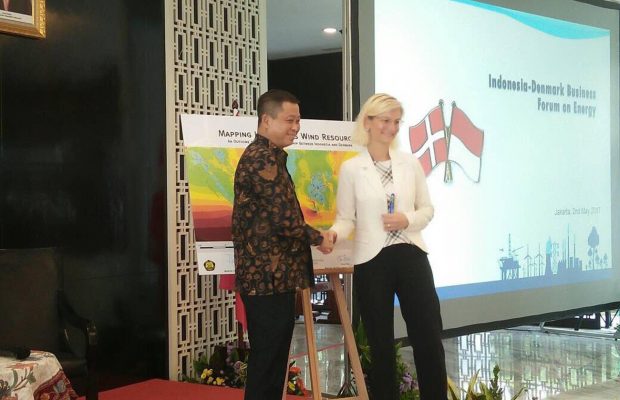
  • Indonesia-Denmark launch wind power map

    Indonesia-Denmark launch wind power map

    The Energy and Mineral Resources Ministry and Denmark’s Development Cooperation Ministry launched on Tuesday a map pinpointing the wind power potential for electrification in Indonesia.

    Denmark Development Cooperation Minister Ulla Tørnæs said this was part of a six-month cooperative engagement between the two governments, during which they exchanged their experiences in developing renewable energy sources for electrification.

    “Today, we are launching a new wind map that shows the vast potential for utilizing wind in Indonesia,” Tørnæs said in her opening speech at the Energy and Mineral Resources Ministry in Central Jakarta on Tuesday.

    “A number of visits to Denmark by Indonesian officials over the past six months has deepened the discussion and insight into waste-to-energy solutions, the use of biomass and how to accommodate fluctuating markets.”

    The map displays the hot spots for wind power potential in Indonesia. It is expected to help the government and investors decide the best locations to develop wind turbines.

    The map was also launched alongside a book titled Integration of Wind Energy in Power Systems, which will serve as a guide for policymaking and the integration of electricity into state-owned electricity firm PLN’s existing system. The book was written based on Denmark’s experiences in wind power development.

  • France launches energy group in Indonesia

    France launches energy group in Indonesia

    France launched the French Renewable Energy Group (FREG) here on Tuesday, as a forum for French companies interested to be a part of the renewable energy sector (EBT) in Indonesia.

    During the launching ceremony, a memorandum of cooperation was also signed between Indonesia Renewable Energy Community (METI) and FREG.

    METI has become FREGs local partner to assist the French companies in identifying and developing renewable energy projects in Indonesia.

    In his speech, Energy and Mineral Resources Minister Ignatius Jonan said Indonesia was committed to have 23 percent of renewable energy in the national energy mix of electricity as soon as possible, or at least by 2025.

    Meanwhile, French Minister of Foreign Affairs and International Development Jean-Marc Ayrault stated that FREG was aimed at gathering French energy companies, which are in Indonesia at present and those interested to enter the country, to cooperate with the Indonesian partners.

    He explained that the mobilization of all stakeholders, both public and private, is needed for achieving 23 percent renewable energy in the energy mix of electricity.

    It requires a regulatory framework and proper finance, and companies should develop innovative solutions which are tailored to the realities in each country, Ayrault added.

    FREG will be an extension of the French Syndicate of Renewable Energy, which is the largest organization in France.

    FREG is expected to improve the relationship between Indonesia and French business companies in renewable energy sector and encourage the participation of French companies in renewable energy projects in Indonesia.

  • Red Bull apologises to Indonesia over offensive ad

    Red Bull apologises to Indonesia over offensive ad

    Red Bull has publicly apologised for shooting a commercial in which an athlete performed acrobatic stunts across one of Indonesia’s ancient holy temples, an official said Thursday.

    Red Bull has issued an apology in Indonesia’s national newspapers admitting it shot an advert at the 9th-century Borobudur temple “without permission from the appropriate authorities”

    The energy drink manufacturer issued an apology in national newspapers admitting it shot the video at the 9th-century Borobudur temple “without permission from the appropriate authorities”.

    The video — in which a famous “free running” athlete is shown jumping between the temple’s stone stupas — triggered outrage in Indonesia, where Borobudur is a revered Buddhist site and national icon.

    In one scene, the athlete is seen walking past a sign clearly stating “No Climbing” in both English and Indonesian before performing acrobatics throughout the UNESCO-listed heritage site.

    The video was shot secretly despite the crew having been issued a warning by temple guards, Borobudur Conservation Agency head Marsis Sutopo told AFP.

    “They must have shot again while our guards were not looking,” he said.

    The video, uploaded online on March 18, sparked outrage within Indonesia and prompted the government to threaten a legal suit against Red Bull.

    Authorities later issued a warning to the drink company after determining no physical damage had been incurred.

    Red Bull met with government officials in early June and agreed to place formal apologies in national newspapers.

    “We want to set an example because we painstakingly try to conserve this historical site,” education ministry official Hilmar Farid told AFP.

    “It was obvious as there was a “No Climbing” sign there too.”

    Red Bull have also been asked to shoot a new video explaining the importance of protecting holy sites, Farid added.