Retail News CRM

Tag: financial

  • UBS Clients Face Most Difficult Environment in a Decade

    UBS Clients Face Most Difficult Environment in a Decade

    Despite one of the most challenging investment environments in a decade, Switzerland’s largest bank managed to match its first-quarter profit performance in the second.

    UBS reported a net profit of $2.1 billion in the second quarter despite facing numerous challenges and despite an 11 percent drop in pre-tax profit in the global wealth management (GWM) unit, the bank reported Tuesday.

    The GWM unit posted a pre-tax profit of $1.2 billion in the second quarter compared to the same three-month period last year. Invested assets for the unit stood at $2.8 trillion. Although net new fee-generating assets grew by a modest 400 million in the second quarter, they increased by $19.8 billion through the first half of the year, underscoring the challenges faced during the second quarter.

    Switzerland and the Asia Pacific region reported net new money inflows during the second quarter of $1.1 and $3.3 billion respectively during the second quarter. The Americas region saw net outflows of $3.5 billion, while EMEA reported a $500 million outflow.

    In the asset management (AM) division, UBS booked a pre-tax profit of $1.0 billion. The unit saw net new money outflows of $12 billion in the second quarter, although for the January to June period, flows were a positive 2 billion. Invested assets for the unit were $1.0 trillion, according to UBS.

    The second quarter was one of the most difficult periods for investors in the last decade. Inflation remained high, the war in Ukraine continued, and parts of Asia continued to pursue a strict corona policy. In these uncertain times, our customers rely on our strong ecosystem to help them to meet market conditions and invest for the long term, said UBS CEO Ralph Hamers.

    Today’s financial results translate into diluted earnings per share of $0.61.

    The report said that high and increasing inflation and tight labor markets in many countries have led central banks to raise interest rates at an accelerated pace. The implications of Russia’s ongoing war in Ukraine, including higher energy and commodity prices, as well as the continuing effects of the pandemic and related restrictions, particularly in Asia Pacific, have increased uncertainty about the global economic outlook. As a result, equity and fixed income valuations declined steeply in the second quarter and high volatility persisted.

    Against this backdrop, client sentiment and activity among our private clients remained muted in the second quarter of 2022, while institutional trading activity remained strong. We expect these uncertainties to continue to affect client sentiment, which, combined with normal seasonality, may also affect client activity levels in the third quarter of 2022. While lower asset valuations will hurt our recurring net fee income and weak client sentiment may affect net new assets in our asset-gathering businesses, we expect higher interest rates will positively affect our net interest income.
  • VN-Index plunges with rising trade

    VN-Index plunges with rising trade

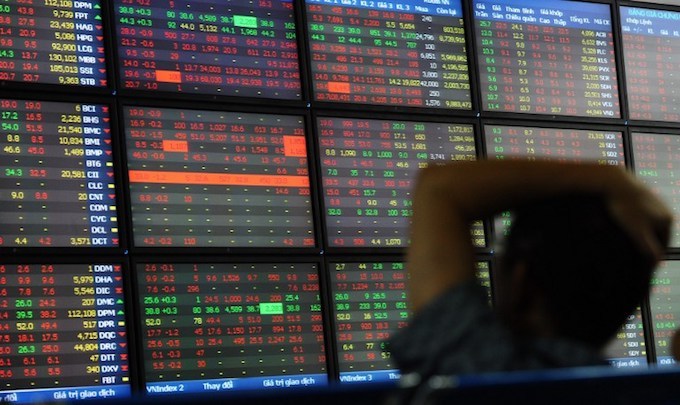
    Vietnam’s benchmark VN-Index dropped 1.56 percent to 1217.30 points Friday with trading value rising double-digit.

    The index closed 19 points lower after gaining nearly 23 points on Thursday. It has lost 67 points this week as global markets plunged due to concerns of inflation and disrupted supply chains.

    Trading on the Ho Chi Minh Stock Exchange (HoSE) increased by 17.5 percent to VND17.33 trillion, highest in four sessions. The VN-30 basket, comprising the 30 largest capped stocks, saw 22 tickers dropped.

    SSI dropped 7 percent to the lowest since March last year in its seventh losing session in a row.

    It was followed by eight banking stocks, losing between 6.4 percent and 3.6 percent, including MBB of lender MB, TPB of private TPBank and CTG of state-owned lender VietinBank.

    Five blue chips rose, with MSN of conglomerate Masan Group rising 5.7 percent and GAS of state-owned Petrovietnam Gas gaining 4.7 percent.

    Foreign investors were net buyers to the tune of VND309.68 billion, mainly picking up HPG of steelmaker Hoa Phat Group and VND of brokerage VNDirect.

    The HNX-Index at the Hanoi Stock Exchange, where mid and small caps list, was down 2.68 percent while the UPCoM-Index at the Unlisted Public Companies Market was down by 2.41 percent.

  • Game Your Way to a Job at Julius Baer

    Game Your Way to a Job at Julius Baer

    The Swiss bank is launching its own video game to attract future tech talent. In an effort to attract future tech talent, Swiss bank Julius Baer is offering its own game on the video game platform Roblox where candidates can take the Be Baer Challenge in the metaverse, the bank announced Monday.

    How many times must children have heard their parents admonish get off of the computer and go play outside, or do your homework and stop playing games?

    Now they can play and look for a job.

    The Julius Baer Challenge was launched on April 11 and requires the users to employ logical and analytical thinking, creativity, and speed in a gaming environment. Players can create their own avatar which can roam around the bank’s virtual headquarters in Zurich in 3D. The challenge has four different levels where prizes can be won, and a showroom that informs players about jobs and benefits at the bank.

    We are thrilled to have been able to implement this unconventional approach to attract tech talent. We wanted to bring a ‘Super Mario’ aspect to the banking world. Gaming requires curiosity, agility, and a drive to advance to the next level. These skills are highly sought after in a banking environment said Guido Ruoss, global head of human resources at the bank.

    The Be Baer Challenge was designed in partnership with E-Sports and gaming experts aimed at creating an inspiring location in the Roblox metaverse. Founded in 2004, Roblox is a global gaming platform with 55 million daily active users with video games are available on PCs, Xbox, and cell phones. There are currently 9.6 million developers on the platform.

    Maybe now, kids will be hearing from their parents «what are you doing outside? Come in and get on the computer and look for a job!»

  • Former Wirecard Bosses Indicted

    Former Wirecard Bosses Indicted

    Three ex-Wirecard bosses could face ten years in prison after prosecutors issue indictments, while one former executive is still on the run.

    In June 2020, German fintech Wirecard was forced to admit that there was a 1.9 billion euros ($2.2 billion) hole in its balance sheet, leading to bankruptcy proceedings. Now, three former heads of the firm have been indicted, according to a story in Germany’s Handelsblatt.

    Prosecutors in Munich accuse former Wirecard CEO Markus Braun of professional fraud, misappropriation of company assets, balance sheet falsification, and manipulation of the company’s stock price, according to the 480-page indictment obtained by the German newspaper.

    Oliver Bellenhaus, who managed Wirecard’s Dubai office, and Stephan von Erffa, responsible for accounting, were charged along with Braun, and could face up to ten years in prison. Bellenhaus, alleged to have embezzled millions, has confessed and is the key witness for the prosecution. Testimony he provided so far has led to the imprisonment of Braun and von Erffa.

    Left out of the indictment is Jan Marsalek, the former Wirecard COO, who is a wanted fugitive, and could currently be in Russia, the paper said.

    Investigators say that Braun and his co-defendants were cooking Wirecard’s books as early as 2015, with fake bookings and revenues with partner companies. As a result, it is very likely the former managers will have to stand trial, Handelsblatt said. They are presumed innocent.

    Wirecards auditors, EY, have been dragged into the proceedings, with insolvency administrator Michael Jaffé exploring claims for damages against the auditor. If it can be established that EY made intentional errors when auditing Wirecard’s books, they would be subject to unlimited liability.

    A report last year from Germany’s Institute of Public Auditors known as the «Wambach Report,» didn’t paint a very flattering picture of EY’s auditing of Wirecards books,  another Handelsblatt report said.

  • Russia’s large holdings of foreign exchange could pose a problem for financial markets.

    Russia’s large holdings of foreign exchange could pose a problem for financial markets.

    Russia holds vast foreign exchange reserves, a large chunk of which are held offshore, having the potential to upend money markets.

    The country had international reserves totaling $630 billion at the end of January, consisting of $467 billion in foreign exchange and $132 billion in gold. The rest consists of special drawing rights (SDRs) and IMF reserves, Bank of Russia data showed.

    With the country’s invasion of Ukraine Thursday, a critical question is how much of these reserves are outside of Russia.

    Credit Suisse strategist Zoltan Pozar, crunched the numbers to determine just that. The resulting figure using Bank of Russia data with that from financial markets was that $300 billion is being held offshore, according to the report.

    Pozar estimates around  $200 billion is held in swap agreements with an additional $100 billion in overseas bank deposits, a sum more than enough to cause a shift in funding markets.

    If things escalate, it’s hard not to see a direct impact on FX swaps and U.S. dollar Libor fixings given Russia’s vast financial surpluses and where those surpluses are deployed, he said.

    On Thursday, the Bank of Russia announced emergency measures to maintain financial market stability, including intervening in the foreign exchange markets.

    Markets are likely hoping the mountain of cash doesn’t turn out to be an erupting volcano.

  • UBS Asset Management Names Sustainability Head

    UBS Asset Management Names Sustainability Head

    Swiss bank UBS is hiring a sustainable expert for its asset management arm. The experienced banker used to manage the investments of an Australian state.

    UBS asset management is appointing Lucy Thomas as head of sustainable investing, the bank said in an emailed statement.

    Thomas will lead sustainability and impact strategy and report to Barry Gill, head of investments for UBS asset management.

    In her previous role, Thomas was head of investment stewardship at TCorp, the financial markets’ partner of the New South Wales government in Australia. Thomas will move from Sydney to Zurich for the position.

    Thomas brings extensive experience working with clients and leading the integration of sustainability factors into the investment process globally, Gill said in the statement.

  • Julius Baer Profits Rise on Asset Growth and Improved Costs

    Julius Baer Profits Rise on Asset Growth and Improved Costs

    Profitability in the first ten months of 2021 at Julius Baer «rose significantly», according to the Swiss bank, on the back of client asset growth and improved cost efficiency.

    Julius Baer’s profitability rose significantly in the first ten months of 2021 on the back of strong growth in client assets and substantial improvements in cost efficiency, complemented by a near absence of credit losses, according to a statement from the Swiss lender.

    Assets under management climbed 12 percent year-on-year to 484 billion Swiss francs with net new money inflows growing 4.4 percent.  Gross margin during the first ten months of the year was around 82 basis points, down from 88 basis points from the full year of 2020.

    According to the bank, this is due to «softening in client activity from the exceptionally high levels witnessed last year». It also noted that initial results this month indicate a potential recovery for the final months of the year.

    Meanwhile, Julius Baer’s 200 million Swiss francs gross cost reduction program announced in 2020 is underway with cost-income ratio inching lower to 63 percent during the period, compared to 66 percent for the full year of 2020.

  • Binance Shuts Futures Accounts in Hong Kong

    Binance Shuts Futures Accounts in Hong Kong

    The world’s largest crypto exchange Binance said it would no longer allow new users to open futures accounts in Hong Kong, following warnings issued by the city’s regulators.

    Existing users will have a 90-day period to close their positions, Binance said, and no new positions thereafter can be opened.

    As the market leader, Binance constantly evaluates its product and service offerings,» the firm said in an announcement, adding that it was the first major firm to proactively restrict access to crypto-linked derivatives. We will be restricting Hong Kong users in respect of derivatives products (including all futures, options, margin products and leveraged tokens) in line with our commitment to compliance.

    The latest move follows a warning issued by the Securities and Futures Commission in July stating that the cryptocurrency exchange was not licensed or registered to offer securities.

  • Ant Group in Talks to Form Credit Scoring JV with Beijing

    Ant Group in Talks to Form Credit Scoring JV with Beijing

    Ant Group is reportedly in discussions with state-owned enterprises to create a credit scoring firm that houses data collected from its massive user base.

    The formation of the new entity could see Ant Group cede control over financial data of more than a billion users, according to a report citing unnamed users.

    Ant Group’s data sharing process with Beijing has been ongoing with reports earlier this year that the People’s Bank of China was unhappy with the progress.

    According to the report, considerations are being made to form a joint venture co-owned by Ant and state-owned enterprises (SOEs) – including an unnamed Shanghai-based financial conglomerate.

    The talks also covered the types of data collected, alignment between the credit scoring system and broader state plans as well as whether the joint venture should be controlled by Ant or SOEs.

    The entry could be established as soon as the third quarter this year though discussions are ongoing and no final decisions have been made.

  • UBS Fined for Rigging European Bond Trading

    UBS Fined for Rigging European Bond Trading

    The European Commission censured seven investment banks for maintaining a cartel on European government bond-trading. The Swiss bank was hit with the largest fine, despite cooperating.

    Brussels extracted a total of 371 million euros ($453 million) on UBS, UniCredit, and Nomura for a seven-bank ring which colluded between 2007 and 2011 on prices and volumes of European government bonds, the commission said in a statement on Thursday.

    The other banks censured in the cartel were not fined: Natwest had blown the whistle on it, while Bank of America and Natixis escaped because their wrong-doing fell outside of a time period for which fines could be levied. Lastly, WestLB, now Portigon, generated zero revenue from the scheme in the last business year, capping its potential fine at nil.

    UBS, which racked up the biggest fine (174.2 million euros), told domestic agency AWP that it is considering an appeal. The fine will take roughly $100 million out of UBS’ second-quarter results, it said.

    The Swiss bank’s fine would have been 45 percent higher had it not cooperated with the commission, overseen by Brussels’ anti-trust chief Margrethe Vestager. The commission fined Nomura 130 million euros and Italy’s Unicredit, now run by UBS’ former top investment banker Andrea Orcel, 69 million euros.

  • HSBC AM Names Asia Head of Credit Research

    HSBC AM Names Asia Head of Credit Research

    HSBC’s asset management arm appoints a new head of credit research in Asia amid an ongoing expansion across its product range and distribution capabilities in the region.

    HSBC Asset Management appoints Seok Poh Yeoh as head of credit research for Asia, according to a statement, effective immediately.

    In her Hong Kong-based role, Yeoh reports locally to head of Asian fixed income Elizabeth Allen as well as Paris-based global head of credit research Tina Radovic.

    Yeoh has 16 years of industry experience and was most recently a financial and corporate credit research analyst at Credit Suisse. She rejoins HSBC Asset Management after first joining in 2012 as a financial analyst.

    The latest hire follows announced ambitions by HSBC Asset Management to enhance its platform in mainland China, India, and Southeast Asia, most notably for the high net worth product range across alternatives, sustainability, and thematic equities.

    According to the bank, HSBC Asset Management has Asian fixed income assets under management totaling nearly $73 billion as of March 31 this year.

  • DBS Doubles Quarterly Earnings

    DBS Doubles Quarterly Earnings

    The board is recommending an interim dividend of 18 cents per share, to which the scrip dividend scheme will be applied. Net profit at DBS grew to S$2.01 billion ($1.52 billion) for the January-March period, up from S$1.01 in the previous quarter and 72 percent higher year-on-year, according to first-quarter earnings posted on Friday.

    It cited strong business momentum and stabilizing asset quality as behind the record quarter – loans grew 3 percent and deposits increased 2 percent from the previous quarter, while fee income rose 28 percent on-quarter to a record S$953 million and Treasury Markets income reached a new high. Bad loans were also at pre-pandemic levels.

    Wealth management fees also grew 24 percent to a record S$519 million on the back of strong investor demand across a wide range of investment products in a low-interest rate environment, DBS said.

    This has been an extraordinary quarter for our business as we fired on all cylinders, Piyush Gupta, DBS chief executive, said in a statement.

    During the quarter, DBS grew its franchise in the Greater Bay Area with a stake in Shenzhen Rural Commercial Bank, and announced the development of Partior – an open industry platform with Temasek and J.P. Morgan that aims to reimagine and accelerate value movements for payments, trade, and foreign exchange settlement.

    The global economic rebound is strengthening and we are bullish about prospects for the coming year, Gupta added.

  • DBS Deepens Roots in China

    DBS Deepens Roots in China

    The bank will accelerate its expansion in the rapidly growing Greater Bay Area with a stake in Shenzhen Rural Commercial Bank.

    DBS has entered into an agreement to acquire a 13 percent stake in Shenzhen Rural Commercial Bank in a deal valued at RMB 5.286 billion ($813.2 million), as part of its strategy of investing in its core markets, the bank announced on Tuesday evening.

    The deal for 1.35 billion new shares at RMB 3.91 ($0.60) per share, representing 1.01 times the book value per share as of 31 December 2020, will make DBS the largest shareholder of SZRCB. DBS will use internal cash resources to fund the investment, which is expected to complete when the deal is approved by regulatory authorities in China.

    Established in 2005, SZRCB currently operates one of the largest bank branch network in Shenzhen, with 210 branches and over 3,600 employees servicing over 5 million active retail customers and over 170,000 active corporate customers.

    Approximately 40 percent of its loans are in the retail segment and the remaining 60 percent are in corporate segment, largely to Shenzhen-based small-and-medium-enterprises. The bank has RMB 519 billion in assets and RMB 404 billion in deposits, and generated RMB 4.8 billion in net profit as of 31 December 2020.

    We see this as a highly complementary strategic partnership that will allow us to double down on the GBA and leverage on SZRCB’s local network and know-how to deepen DBS’ GBA strategy. At the same time, we would be able to support the continued growth and digital transformation of SZRCB through our regional presence and digital capabilities, Piyush Gupta, DBS CEO, said in the announcement.

  • HDBank profit up 87 pct

    HDBank profit up 87 pct

    HDBank reported a 67 percent increase year-on-year in consolidated profit in the first quarter to over VND2 trillion ($86.9 million).

    Its outstanding loans at the end of the quarter were VND198 trillion, up 5 percent from the end of last year. The parent bank’s profit was VND1.8 trillion, up 87.7 percent. The lender also owns consumer finance company HD SAISON.

    It targets full-year profits of VND7.28 trillion, an increase of 25 percent from 2020, and credit growth of 26 percent. It plans to pay a 25 percent dividend for 2020 in the form of stocks.

    HDBank is among the few banks that have not signed an exclusive bancassurance contract.

    The bank recorded VND5.8 trillion in consolidated profit last year, a year-on-year increase of 15.9 percent.

  • Singapore-Based Compliance Specialist Partners HPE

    Singapore-Based Compliance Specialist Partners HPE

    Tookitaki is partnering with Hewlett Packard Enterprise to provide the financial sector with enhanced anti-money laundering capabilities using artificial intelligence and machine learning.

    The offering, delivered via HPE GreenLake for Big Data, enables financial institutions to create a central big data platform capable of rolling out anti-money laundering solutions centered around data analytics, the Singapore-based regtech said in a statement.

    The announcement follows a pilot with UOB that covered transaction monitoring and name screening, in which the models achieved 96% prediction accuracy in the high priority category, the announcement said.

    Abhishek Chatterjee, Co-Founder and CEO, Tookitaki, said that banks need high module accuracy systems to ensure they are staying compliant at a time when organizational growth and business continuity are crucial to success and highlighted the benefits of an enhanced AML solution delivered with the flexibility of an as-a-service model.

    Founded in 2014, Tookitaki’s revenue growth has surpassed 300 percent over the last two years. It raised $19.2 million in Series A funding in 2019, which the startup said would be used to grow its presence across the U.S. and Asia-Pacific.