Tag: Korea

  • Retailers grapple with dull domestic consumption

    Retailers grapple with dull domestic consumption

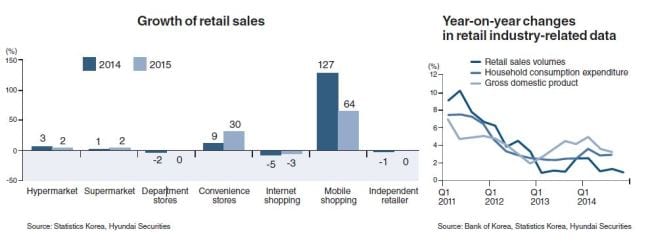
    South Korea’s retail stocks suffered a series of challenges last year, including the broader economy’s downturn to a nationwide outbreak of a deadly virus. Experts see no turnaround in sight for them this year, as economic worries continue to weigh down on consumer sentiment while competition from online and mobile rivals intensify.

    “It’s hard to expect a dramatic turnaround for the retail industry, except from the base effect from the year-earlier period when the MERS outbreak kept people holed up in their homes,” said Kim Ji-hyo, an analyst at Eugene Investment & Securities,

    The combined operating profit of 10 major retail companies, including


    department stores, home shopping firms and convenience stores, declined 11 percent in 2015 from a year earlier, according to Hyundai Securities.

    The government had pushed retailers to hold coordinated sales events last year starting in October, which helped increase private consumption by an annual 3.2 percent in the final quarter of 2015 — the strongest figure in five years.

    But the spike in spending seemed short-lived after the bargain ended.

    January’s consumer sentiment index slipped to a level on par with July last year when consumption fell into the doldrums in the aftermath of the Middle East respiratory syndrome outbreak.

    “For the time being, I do not expect to see meaningful growth in domestic consumption,” Kim said.

    Last December, hypermarkets reported a 5.1 percent year-over-year drop in sales as they failed to recover from the human traffic loss to department stores during the massive sale events initiated by the government, according to Mirae Asset Securities.

    Department stores were also affected by an unseasonably warm winter that held back the sales of winter goods, which suffered a 5.7 percent year-on-year decline.

    Shares of retail giant Shinsegae fell by nearly 20 percent, from 262,500 won ($212.63) in November to 211,000 won in Monday’s trading.

    Some say the malaise of the retail sector owes much to a shift in consumer spending patterns.

    Major retailers are failing to adapt to the growth of online and mobile shopping, they say.

    “The sharp drop in retail firms’ earnings is bound up with the mobile shopping market’s growth. It won’t be an easy battle to fight against online rivals,” Kim Keun-Jong, analyst at Hyundai Securities said.

    For traditional retailers, opening of physical retail outlets used to provide significant advantages in expanding the geographical reach of business, but with the huge spike in mobile shopping, they have lost the competitive advantage, he added.

    In contrast to large retailers, Korea’s mobile retail market is large and growing. Its value increased to 13 trillion won in 2015 from just 60 billion won in 2008.

    Convenience stores remain a bright spot for the retail industry. Sales at convenience stores jumped 29.6 percent on-year to 16.52 trillion won last year, due to the popularity of convenient meals prepared away from home and increased margins in cigarette prices.

    “Although the positive impact of the cigarette price hike on the convenience stores’ revenues will fade away this year, they are expected to improve profitability by expanding a range of private brand products, such as prepackaged meals and coffee,” Lim Dong-geun, an analyst at Mirae Asset said.


  • Kingsdown Debuts First Bedmatch System In South Korea

    Kingsdown Debuts First Bedmatch System In South Korea

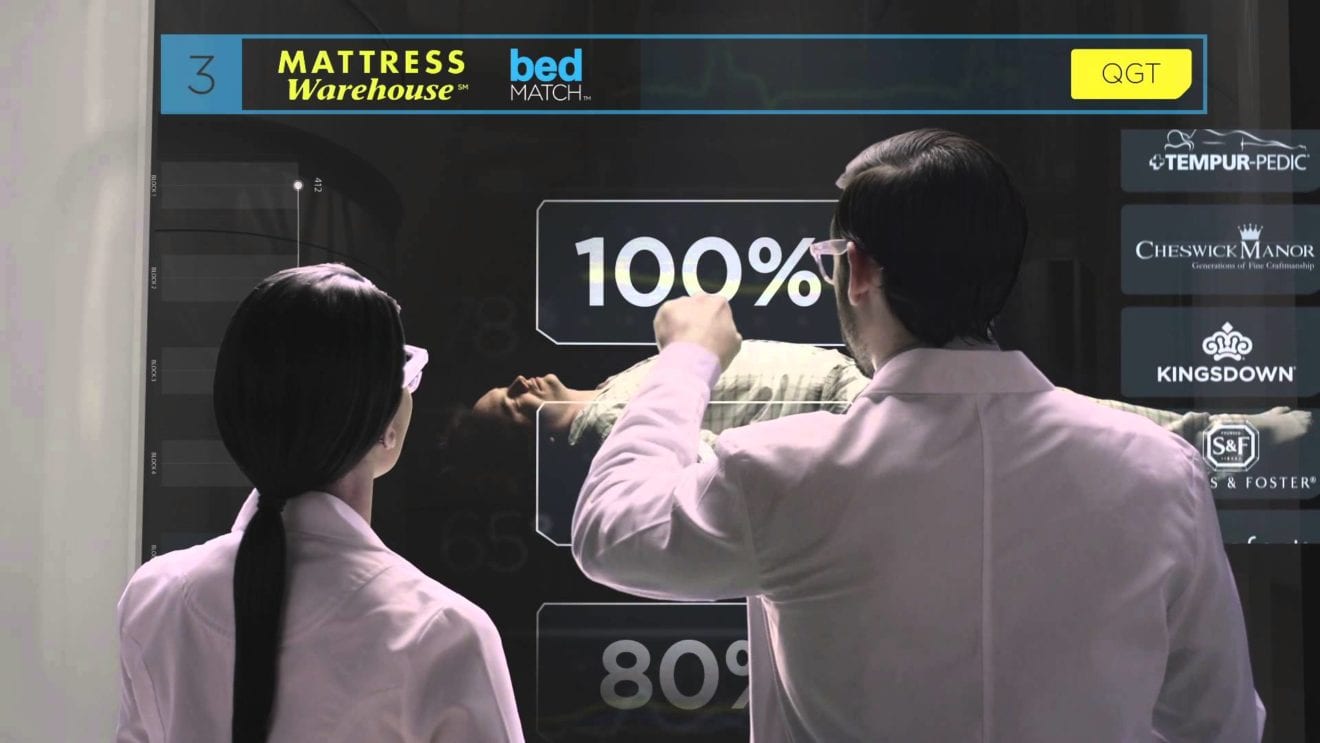
    Kingsdown, an employee-owned mattress manufacturer, announced recently that it has debuted its first bedMATCH system in Songdo, South Korea. Kingsdown is one of the largest U.S. manufacturers selling product in Asia, and plans to use this program as a launching starting point for further distribution of bedMATCH systems, Kingsdown and Sleep to Live bedding products throughout the region.

    Partnering with Kingsdown licensee, Navijam, Inc, the South Korea store is the first in the country to feature the patented bedMATCH diagnostic system to enhance the way consumers shop for mattresses. The majority of the Sleep to Live mattresses on the store’s showroom floor are made in South Korea with additional products being imported from the United States.

    “Looking to grow our brand in Asia, we are confident that South Korea is the right location due to their focus on advancements in technology, product quality and styling,” said Kingsdown President and CEO Frank Hood. “As Kingsdown continues to expand we have seen great success and growth abroad through our innovations in sleep technology. We have also found a partner that not only believes in our product but also shares our company’s vision of providing retailers and their consumers with high quality products from an internationally respected brand.”

    bedMATCH uses 18 statistical measurements along with thousands of calculations to assist the customer in determining the best mattress option for their specific body type. In addition to this South Korean location, Kingsdown is also set to open 60 additional bedMATCH/My Side locations throughout Asia in 2016.

  • Rip Curl accused of “slave labour” in North Korea

    Rip Curl accused of “slave labour” in North Korea

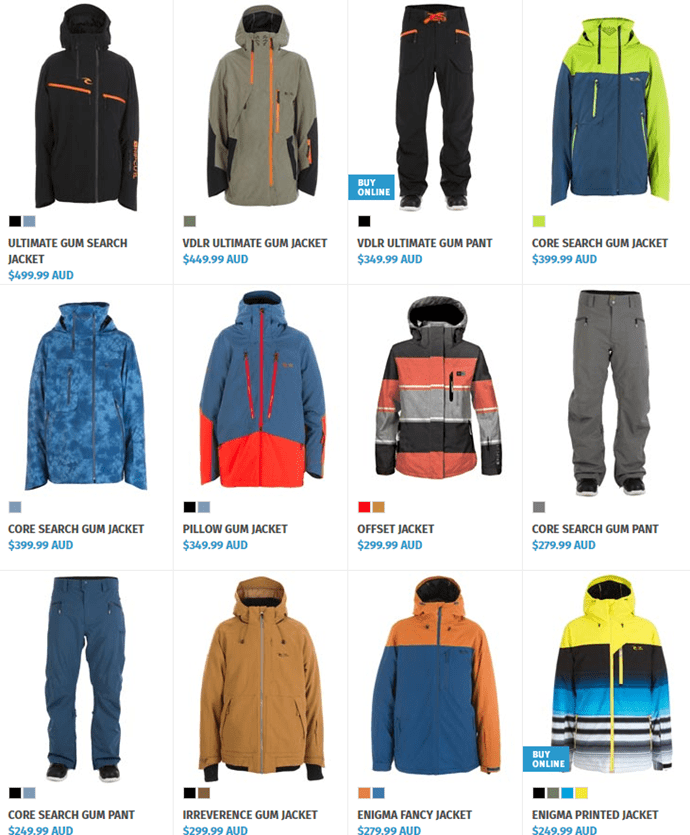
    An explosive Fairfax Media investigation has revealed that Aussie surfwear giant, Rip Curl, has been manufacturing garments out of North Korean factories where the workers are forced to withstand slave-like conditions.

    The range of winter garments were shipped to retail stores with a “Made in China” tag on them, which according to non-governmental agencies raises the likelihood that other large Australian clothing brands are doing this too.

    Rip Curl has blamed one of their subcontractors for the use of the Taedonggang Clothing Factory near the North Korean capital Pyongyang, with Chief Financial Officer, Tony Roberts stating:

    “We were aware of this issue, which related to our Winter 2015 Mountain-wear range, but only became aware of it after the production was complete and had been shipped to our retail customers.

    “This was a case of a supplier diverting part of their production order to an unauthorised subcontractor, with the production done from an unauthorised factory, in an unauthorised country, without our knowledge or consent, in clear breach of our supplier terms and policies.

    “We do not approve or authorise any production of Rip Curl products out of North Korea.”

    Rip Curl Mountainwear rangeRip Curl Mountainwear range

    Rip Curl Mountainwear range

    Factory conditions in North Korea are notoriously horrific, with North Korean defectors telling human rights activists that they are forced to work long hours with little to no pay. If they disobey they can be imprisoned in work camps.

    Being unaware is a paltry excuse, says Oxfam’s CEO, Dr Helen Szoke.

    “Australians would be shocked to hear that an iconic Australian brand with roots on the surf coast of Victoria can’t confidently track clothing produced within its own supply chain.

    “Rip Curl has no excuse for being unaware of what is happening. Companies are responsible for human rights abuses within their businesses – not only morally but also within international human rights frameworks,” Dr Szoke said.

  • JAJU continues quiet battle with Muji

    JAJU continues quiet battle with Muji

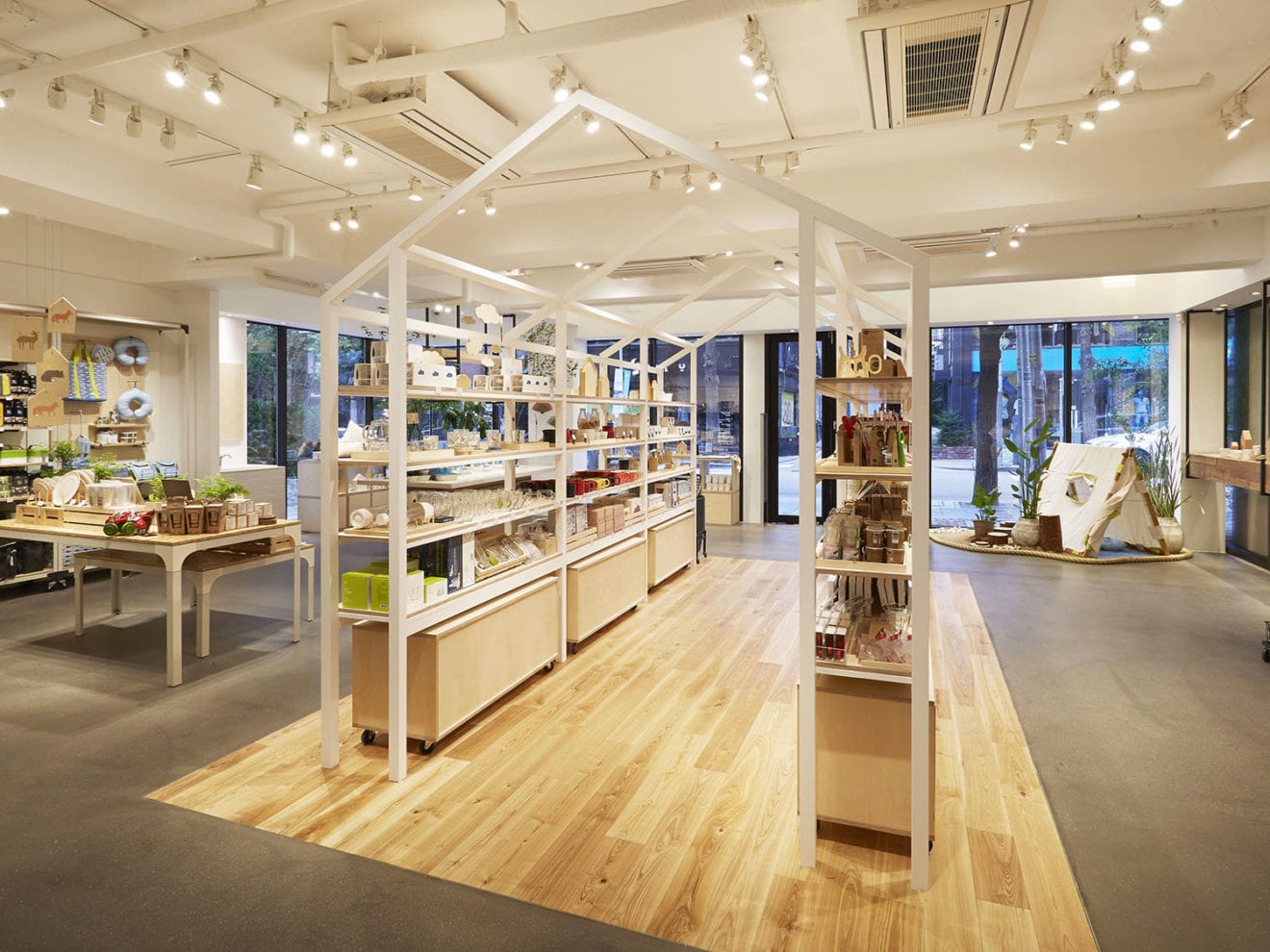
    The flagship store of JAJU, a retail brand by Shinsegae International, is all clean lines, muted colors and minimalist goods.

    Everything from notepads and diffusers to kitchen products, body cushions and clothes are on display for prices that make even the thriftiest shopper comfortable.

    JAJU is the first Korean lifestyle brand by a major conglomerate to offer a huge array of goods including housewares and daily supplies, a segment pioneered by brands like Japan’s Muji.

    Shinsegae International has never explicitly said it hopes to emulate the success of Muji, but the core brand concept – no-frills products at cheap prices – speaks for itself.
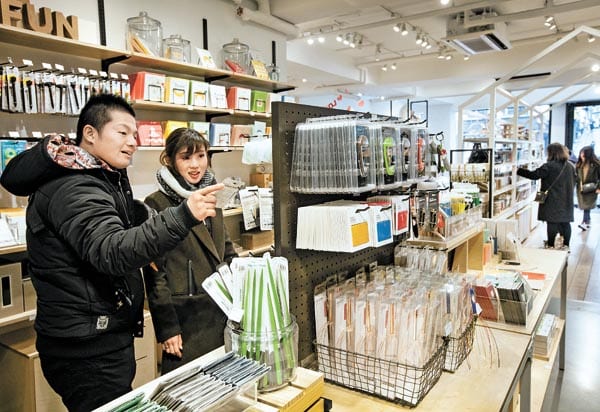
    The combination of simplicity, affordability and decent quality has boosted JAJU’s appeal among local consumers who appreciate a deal, but the similarities with Muji might hinder its expansion into the global market, which is Shinsegae’s ultimate goal.

    The five-story flagship store in the posh Garosu-gil area of Gangnam District, southern Seoul, symbolizes Shinsegae’s ambitions for the brand.

    “An average of 2,500 people visit this store each day on weekdays and some 4,000 to 5,000 people on weekends,” said Han Seung-min, head of the flagship store.

    In terms of sales, JAJU outperforms Muji in Korea thanks to its presence in stores like E-Mart, Shinsegae’s discount supermarket chain, and other shopping outlets.

    JAJU posted 175 billion won ($142 million) in revenue in 2014, while Muji Korea recorded 48 billion won.

    But the sales gap isn’t a big consolation for the local brand, since it operates a drastically larger number of stores.

    Muji has only 14 stores in the country whereas JAJU has 148.

    The brand maintained a humble presence only a few years ago, located solely inside of E-Marts.

    Until 2010, the brand name was Jayeonjui (which translates to “naturalism” in Korean) and was managed entirely by E-Mart.

    But since Shinsegae International, the fashion-oriented affiliate of Shinsegae Group, acquired the brand and changed its name to JAJU, the category of products has expanded.

    The company is also focused on diversifying the location of its stores beyond E-Mart to stave off the perception that JAJU is merely an in-house label.

    Along with the flagship store that opened in 2014, JAJU added an additional branch in the COEX Mall in Samseong-dong, southern Seoul.

    Still, E-Mart remains the largest channel, with 132 branches accommodating the shop.

    “We are looking for different properties to house JAJU to reach different customer bases,” said Park Cho-rong, a public relations representative of Shinsegae International.

    Appeal of simplicity

    The colors, patterns and materials of JAJU products are understated. But the plainness helps keep manufacturing costs low, resulting in lower prices.

    The prices of most goods at JAJU are low even compared to Muji, a major selling point of the brand.

    Muji’s socks start from 4,000 won ($3.25), but those at JAJU are in the 3,000 won range.

    Shinsegae said that the standard design and simple packaging pushes the prices lower, even though 90 percent of the products are made in Korea.

    And the plain-looking goods appear to be appealing to customers’ tastes.

    “When I place plain white dishes and cups together, it gives off a modern and pleasant vibe,” said Choi Hee-young, a 33-year-old woman who was perusing kitchenware at the JAJU flagship store.

    “Because they can form some kind of uniformity, they are easy to match together compared to fancy, carefully designed items with colors.”

    As part of its efforts to enhance design, Shinsegae tapped well-known designer Oh Joon-sik as the creative director for JAJU last year.

    Catering to Korea

    JAJU is trying to carve out a niche for itself by making its products more explicitly “Korean.”

    “Based on the understanding of the Korean lifestyle, JAJU tries to offer quality goods at affordable prices,” said Kim Woong-yeol, head of the sales division at JAJU.

    For example, the brand sells small onggi, or crock pots, designed to better keep traditional dishes such as kimchi and soybean paste. The pots typically come only in big sizes because they are placed outside in bulk.

    “This type of onggi is designed to keep temperatures so that the food inside is better preserved,” said Han, the head of the flagship store.

    “But now the size of households is becoming smaller, and we learned that there is a demand for smaller pots,” she said.

    JAJU stores gained insight into its consumers’ tastes by inviting stay-at-home moms to offer their opinions in the development stage.

    Their thoughts are particularly reflected in kitchenware and kids’ products.

    “Cooking spoons made by overseas manufactures are rather big, which is inappropriate for Korean users,” Han said, “So we surveyed the ideal size of cooking spoon for consumers and adjusted the size.”

    When the retailer revamped its brand in 2010, JAJU added a line of designer furniture, as well as items for kids and travel.

    To boost its furniture collection, JAJU teamed up with global furniture company Fritz Hansen and Sigga Heimis, a former designer for Ikea.

    Of its existing categories, JAJU has boosted aromatherapy, home decor and body care products in response to the growing demand.

    “With the rise of single-person households, we found that products used to decorate houses or as a little treat are really doing well,” Han said.

    “They are not essentials, but the items can cause a little joy or make for a more pleasant atmosphere.”

    Global ambitions

    Shinsegae International said in 2014 that it will develop JAJU into a global brand with annual sales of 500 billion won by 2020.

    The retail unit, headed by Chung Yoo-kyung, a daughter of Shinsegae’s founding family, has yet to elaborate on its global expansion plan.

    Some analysts predict JAJU will focus on local markets for the next year or two because the brand’s revenue drives sales growth for Shinsegae International.

    “JAJU plans to open 10 more stores by the end of this year,” said Yoo Jeong-hyun, an analyst at Daishin Securities.

    “Revenue that comes from each JAJU store is very high, and the combined sales account for 20 percent of Shinsegae International’s sales.”

    But industry insiders say JAJU needs a more distinctive identity and brand strategy to distinguish itself from the better-known Muji.

    The product categories overlap with those of Muji, and some products offer similar functionalities.

    “The key to success in the global market depends on how JAJU can create its own brand concept distinct from Muji,” said a retail analyst who requested anonymity.

    “But right now, the distinction is not enough to pull off the same success as Muji.”
  • Furla Asia-Pacific plans more flagships

    Furla Asia-Pacific plans more flagships

    Luxury Italian brand Furla is planning more flagship stores in Asia as the region delivers strong growth for the 89-year-old family-owned company.

    FURLA CEO_Eraldo PolettoIn an exclusive interview with Inside Retail Asia, Furla CEO Eraldo Poletto explains how the company has bucked the decline in luxury spending in core markets like Hong Kong and Singapore during the past year. Furla achieved 53 per cent growth in total sales (in euro at the current exchange rate) in Asia-Pacific, where it counts 14 markets – Australia, Cambodia, China, Hong Kong, India, Indonesia, Korea, Macau, Malaysia, Singapore, Taiwan, Thailand, The Philippines and Vietnam. Japan, a stand-alone territory in Furla’s accounts, saw sales grow 24 per cent.

    Even discounting sales from new stores, like-for-like growth for Furla Asia-Pacific reached 15.5 per cent last year, yet the region accounts for just 19 per cent of the company’s sales – about €64.4 million ($72.1 million) – suggesting strong growth potential ahead.

    “The consistent strategy we have implemented over the past four years – positioning ourselves as the only Italian and ‘Made-in-Italy’ brand in the premium segment, without accepting compromises in terms of quality – is paying off,” says Poletto.

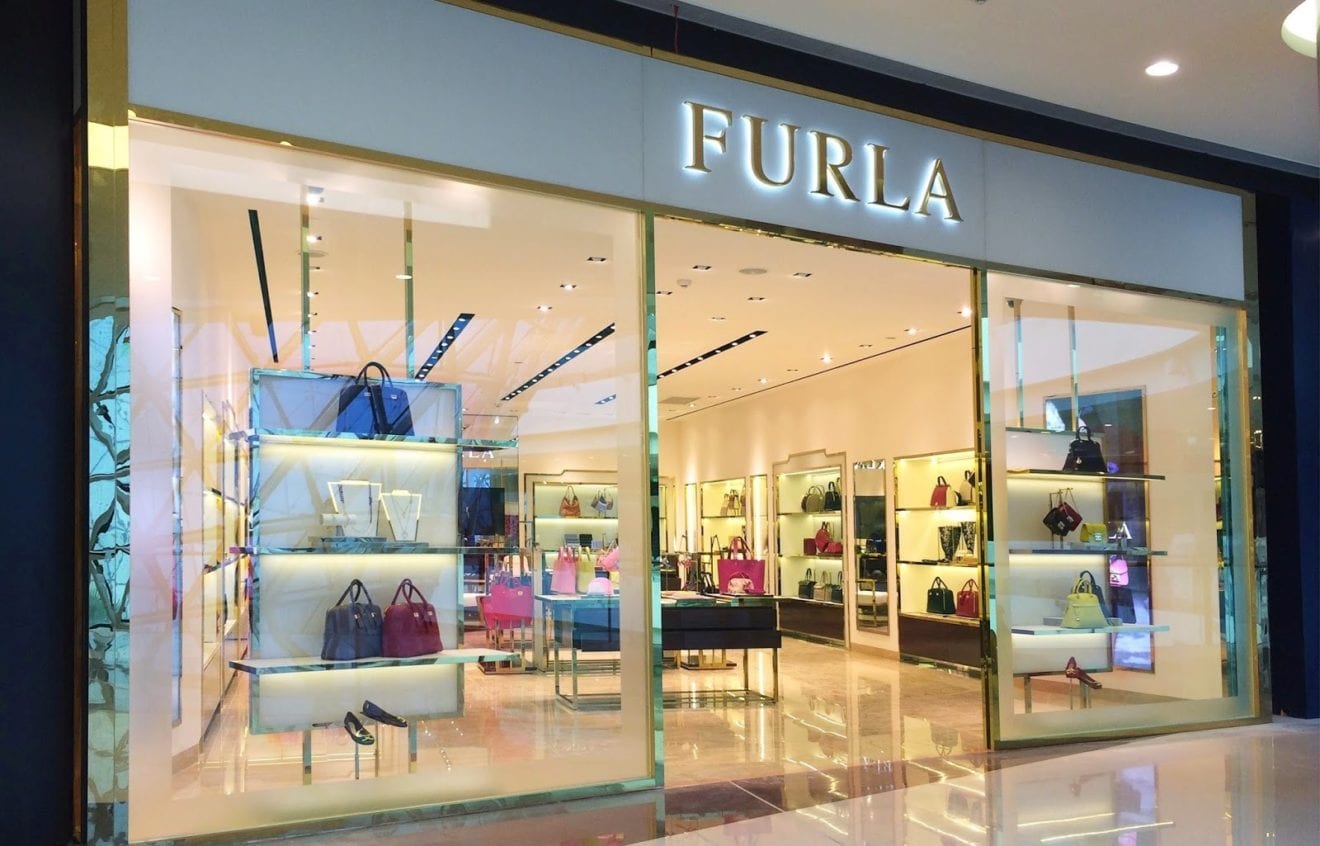
    “We are expanding our footprint with important flagships: Singapore Marina Bay Sands opened in September; Hong Kong Miramall and Shanghai Citic, each with a 300 sqm street facade, opened in December with a luxury retail concept showcasing our full ladies’ and men’s collections.”

    Furla China Flagship Store @ Shanghai Citic Square 4

    He says more flagships will open this year in Australia and Bangkok.

    “Flagships are meant to represent every aspect of the brand in terms of image and product range; however, we are not expecting to open more than five or six flagships in the region, as we are focusing on the profitability of our retail network, and prefer to penetrate the market extensively.”

    In what he terms a “capillary” approach, more standard-sized stores and points of sale will also open across the region.

    Furla China Flagship Store @ Shanghai Citic Square 7

    For the past two years the company has opened or renovated one store a week. It now has 172 points of sale in Asia-Pacific, along with 72 monobrand stores in Japan.

    “In terms of our retail format, our average store size is increasing together with Furla’s total-look collections. Malls and high-street locations complement each other, and in this period of time, rent levels in some markets have decreased substantially because of a drop in demand from luxury, watch and jewellery brands. We are always on the lookout for new opportunities to invest in,” says Poletto.

    “Our retail store concept is also quite special, as it wants to deliver a 360-degree luxury shopping experience while maintaining our the value-for-money approach.”

    Furla China Flagship Store @ Shanghai Citic Square 2

    Asians appear to be embracing Furla’s distinctive quality brand feel and shopping experience. Perhaps surprisingly, the brand has no strategy of differentiating its Asia-Pacific product range from those of other markets.

    “We believe that if a product captures customers’ hearts in one market, its appeal is universal. Our price and product range have always been appealing to a large spectrum of clientele; it is not by chance that our two best-seller styles – Metropolis and Artesia – represent the most affordable and the highest offer of our collection respectively.

    Furla China Flagship Store @ Shanghai Citic Square 6

    “In terms of branding, strong marketing investments – like our collaboration with Mario Testino and a more aggressive digital and outdoor media planning strategy – are making Furla far more visible.”

    Department stores are still an integral part of the Furla sales strategy, especially in China, where that sector is still in its infancy by western standards.

    “The department store culture in Greater China isn’t very strong yet, and there are very few players compared to the shopping mall retail model in western markets. There is most surely room for improvement in this region.

    Furla China Flagship Store @ Shanghai Citic Square

    “The situation is much more developed in Singapore and Australia, and obviously a priority in Korea with Shinsegae, Hyundai and Lotte, where we are present with 10 domestic stores and an aggressive development plan.”

    Furla is also experiencing strong growth in the travel retail sector, which is helping both top-line sales and brand awareness.

    “Travel retail will continue to fuel the growth in APAC,” says Poletto. “Total sales generated by the travel retail channel were up 27 per cent for 2015, and we opened five new locations. We see blooming opportunities in this channel as Asian customers shop worldwide while they travel: it is a great showcase for the brand.”

    In June, Furla will open a directly managed boutique in Hong Kong International Airport.

    Furla China Flagship Store @ Shanghai Citic Square 8

    Southeast Asian focus

    Furla’s strong growth in the region is coming not just from the established markets of Hong Kong, Singapore and Greater China.

    “We have witnessed a significant double-digit growth in Southeast Asia markets including Cambodia, Malaysia, Singapore, Thailand, The Philippines and Vietnam,” says Poletto.

    “In Indonesia, a fast-growing country with a population of 250 million, we have a capillary quality presence with 10 boutiques in five cities. As of today, Furla has 46 stores in Southeast Asia, and we will focus on strengthening our foothold in these markets this year.”

    Furla China Flagship Store @ Shanghai Citic Square 5

    In India, which Furla has entered in a joint venture with Genesis Luxury, the label has three boutiques – one each in Mumbai, Delhi and Calcutta.

    “They are all performing very well with a 50 per cent sales growth increase in 2015,” says Poletto. But the market has considerable challenges.

    “India is a market with very high potential, but also with a huge limits when it comes to infrastructures. There are not enough qualitative shopping malls to cover Indian clients’ high demand for fashion and luxury: this is why Indian consumers represent a key nationality in markets like Dubai, London or Singapore.

    “In terms of expansion, we will tap into all the new relevant real-estate projects.”

    Globally, Furla has 415 monobrand stores, of which 190 are directly owned and 198 franchised. It has 27 travel retail stores and more than 1200 outlets in department stores and multibrand outlets.

    Furla China Flagship Store @ Shanghai Citic Square 10

    Results released today show that Furla’s global turnover reached €339 million last year, up 30 per cent on 2014. The growth was driven across all Furla product categories, including the new men’s collection, women’s footwear collection and eyewear.

    Poletto says that being a family-owned business – an increasingly rare phenomenon in the model luxury retail business – has its advantages.

    “Being 89 years old gives us a great DNA to be around into the future: the real assets are the brand and its heritage, which are translated into equity. The Furlanetto family has very strong values – they have a long-term vision, instead of making opportunistic choices.”

  • Paul & Shark Korea opens first store

    Paul & Shark Korea opens first store

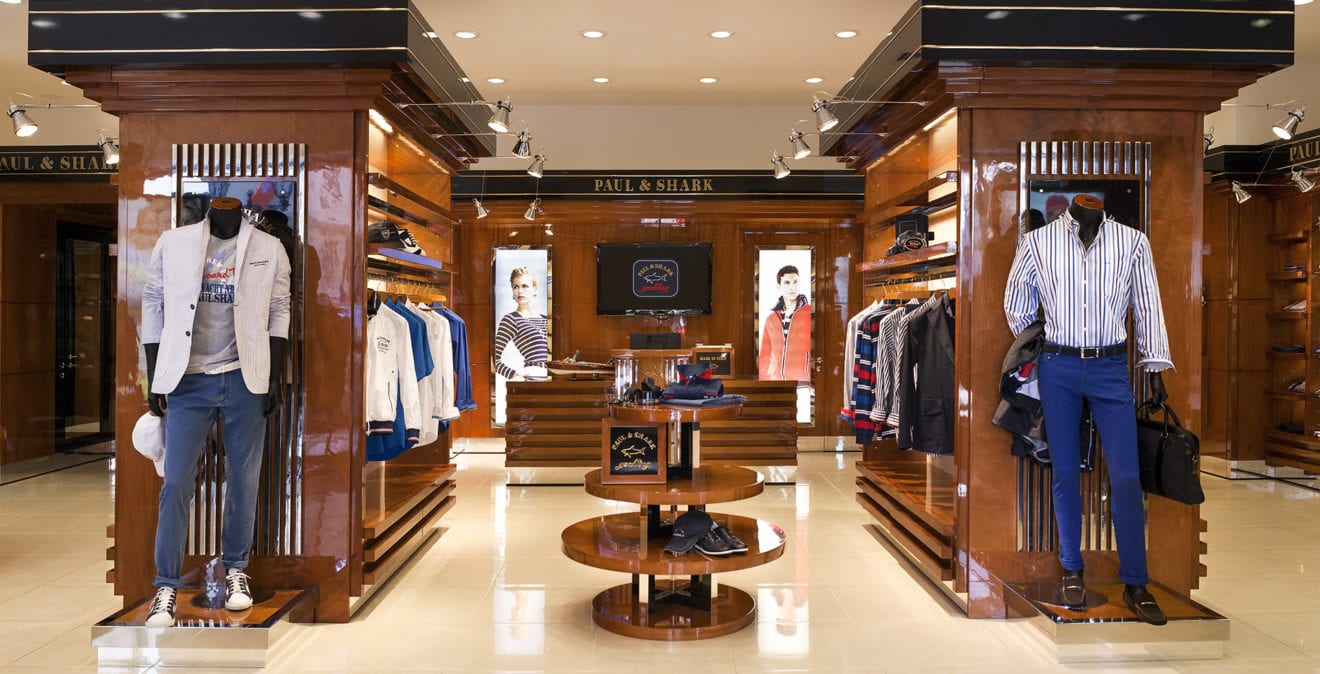
    Luxury Italian lifestyle brand Paul & Shark has opened its first boutique in South Korea, at Incheon International Airport.

    The new Paul & Shark Korea store, run in partnership with Lotte Duty Free, features the brand’s new collections.

    Another two openings are planned for Seoul in the first quarter of this year, according to Paul & Shark global travel retail director Catherine Bonelli.

    Founded in 1976 by the Dini family, Paul & Shark’s men’s, women’s, children’s and accessories collections are available in more than 60 countries.

  • Asian retail outlook: “more cautious”

    Asian retail outlook: “more cautious”

    High operating costs – particularly rents and labor in Asia – will ensure retailers are more cautious this year, concludes real estate specialist CBRE.

    In its annual Asian retail outlook, the company’s research department predicts many retailers will shift their strategic focus from expanding their store networks to rationalisation, improving in-store profitability and upgrading to better locations.

    That trend is expected across the broad Asia-pacific market, including Hong Kong.

    “Leasing activity will diverge across markets, with Australia, Japan and New Zealand the most upbeat, whereas Hong Kong and Singapore will continue to struggle,” CBRE concluded.

    “Driven by ongoing urbanisation and wage increases, Southeast Asia will also see solid leasing activity. Demand across the region will be led by food and beverage retailers, while affordable and niche luxury brands will also be active.”

    CBRE also warns the rise of online shopping will continue to force shopping malls to embrace ‘retail-tainment’ and adjust their trade mix to include more experience-oriented retailers to retain foot traffic. Around 63.8 million sqft of new shopping center supply is scheduled to be completed in 2016. Against the sluggish leasing demand and ample new supply, overall retail rents are forecast to experience a mild correction of below 1 per cent in 2016.

    In a broader property outlook, CBRE forecasts that due to Asia Pacific’s steady economic growth – which will continue to outpace the rest of the world in 2016 – investment activity in the region will remain solid, although activity will be limited by asset pricing and availability.

    “The region’s investment market will continue to see strong demand from real estate funds and institutional investors. Institutional investors will continue to invest in Asia Pacific to increase their exposure to real estate for strategic diversification,” said Dr Henry Chin, head of research, CBRE Asia Pacific.

    “That said, Asia Pacific will enter a period of slower growth in the commercial real estate market with activity likely to moderate over the course of the year as it becomes more challenging to source investable stock able to meet investors’ target returns. Interest rates will remain low in 2016 so yields are largely to remain stable across Asia Pacific. However, we are expecting to see a mild yield expansion in 2017 together with the rise in interest rates.”

    The economic slowdown in China – as well as higher-than-expected US interest hike rates, and currency volatility – will also remain a key concern for investors, given the scale of its impact across the whole region.

    “However, macro trends of urbanisation and the rise of the middle class remain largely unchanged and will continue to drive growth across Asia.

    “There are structural investment-themed opportunities for investors to focus on in 2016, such as the growth of e-commerce, regional tourism and demographic changes. Demographic changes will create opportunities in niche sectors such as self-storage facilities, senior and student housing, and data centers,” said Chin.

    “Regionally, active markets will continue to be led by Australia and Japan, whilst India expects to see a positive year following the relaxation of FDI norms at the end of last year.

    “China will also remain on the radar for most international investors although demand will be largely confined to tier I cities. Overall, the long-term outlook remains positive for the region,” he concluded.

    CBRE’s 2016 APAC Real Estate Market Outlook report can be downloaded here.

  • Korean beauty brands increasingly offering the interactive retail experience

    Korean beauty brands increasingly offering the interactive retail experience

    In a round-up of the immersive, hands-on retail offerings which beauty brands are increasingly offering in the country, the national paper highlighted the rise of smart technology and wearables as the key driver behind the trend.

    “Seeking to offer more interactive and tailored services to consumers, cosmetic brands in Korea are increasingly utilizing high technology and smart gadgets to satisfy diverse consumer needs at one of the largest, trend-sensitive beauty hubs in the world,” the newspaper notes.

    It highlights AmorePacific, Dior and SK-II as key examples of beauty players at the forefront of this retail trend.

    Magic Ring test

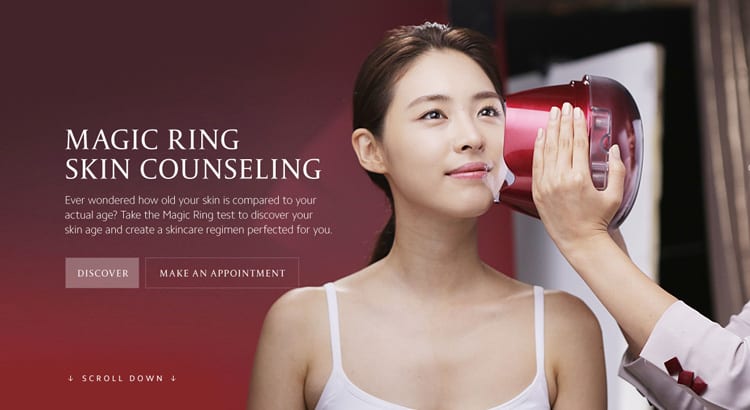
    SK-II’s Magic Ring test (a diagnostics testing process for consumers’ skin), uses a skin imaging machine that tracks details such as the direction and size of pores and wrinkles, offering consumers the personalised product recommendation service they increasingly demand.

    Amore Pacific and Dior are just two of several other major brands reportedly also offering interactive diagnostics services in Korea, and investing in developing bespoke technologies specifically for the immersive retail setting.

    Apps are another key channel boasting interactive opportunities for brands, with L’Oreal reportedly gearing up to launch its MakeUp Genius app (which allows consumers to virtually try on cosmetics) onto the Korean market in the coming months.

    A global trend

    Korea is just the latest in a string of countries in which the beauty industry is adopting the potential of interactive beauty with open arms, to meet the rising demand from young, tech-savvy consumers.

    The Korea Herald report comes hot on the heels of a recent study published by market research firm Euromontior International , which noted that younger generation consumers increasingly demand interactivity.

    Millennials seek out “a curated but interactive sales environment, whether retail or online”, the firm’s analysts confirmed, noting that cosmetics is a rare area in which the consumer group is willing to spend freely.

  • Nation gets first crowdfunding platform

    Nation gets first crowdfunding platform

    As of 6 p.m. on Monday, Marine Techno, a cosmetics company that specializes in products made from marine collagen, successfully gathered 76 million won ($64,000) from retail investors on the nation’s first crowdfunding portal, which had opened earlier in the day.

    A total of 13 investors, including angel investors, the government-led Creative Economy and Innovation Fund, and other retail investors contributed to the biotechnology firm based out of the Jeonnam Creative Innovation Center in Yeosu, South Jeolla.

    Created in 2014, the start-up produces cosmetics by recycling marine byproducts. It owns as many as 30 patents for collagen-producing technologies.

    The company’s success on the crowdfunding platform meant it reached 110 percent of its investment target.

    “I was wondering about this, but we unexpectedly ended up with a good result,” said Hwang Jae-ho, founder of Marine Techno. “We rolled out investor relations activities at many events, and that’s what has led to the good result today.”

    Hwang said the new funds will be used to expand production facilities to meet growing demand.

    Individuals who want to invest in new promising businesses can log in to www.crowdnet.or.kr, operated by the Korea Securities Depositary, to connect with one of the five intermediary firms registered with the Financial Services Commission, the nation’s top financial regulator.

    The five intermediaries that can broker deals with the start-ups online are Wadiz, Ucanstart, OpenTrade, Yinc and Wealth Funding Management.

    On the first day, 18 start-ups, including Marine Techno, attracted investments through the intermediaries.

    The FSC introduced the crowdfunding system as part of its efforts to support the creative economy and financial technology initiatives. The regulator revised the nation’s Capital Market Act in July to provide start-ups with better access to financial resources, hoping to boost the fintech industry and create more jobs for young people.

    Crowdfunding platforms have become increasingly popular, with the U.S.-based Kickstarter attracting as many as 270,000 online investors in just two hours to raise 10.9 billion won for Pebble, a smartwatch maker.

    If they have a crowd funding account with any of the 18 securities firms offering them, retail investors can invest up to 2 million won in a single firm, and up to 5 million won a year. Start-ups are allowed to receive up to 700 million won in total every year through the crowdfunding portal. If a company fails to reach 80 percent of its target by the deadline it has set, the funding will be nullified.

    “There is some concern that the investment limit is too small, but we plan to support the regulator’s move to heat up the mood,” said Kim Young-soo, an executive at Korea Venture Business Association.

    Marine Techno was the only company that surpassed its goal on Monday, with crowdfunding still a foreign concept to many. On the homepage for Yinc, a message reading, “Please be my first investor,” was still flickering at around 5 p.m.

    Still, large financial groups are joining the trend. KB Financial Group launched a matching service for investors and start-ups on Monday. It began to attract investors by using the crowdfunding platform of OpenTrade to help fund four promising start-ups chosen by the group.

  • Kakao launches Hair Shop O2O

    Kakao launches Hair Shop O2O

    Kakao, the Korean internet pioneer, has  selected ‘Hair Shop’ as its first O2O (online to offline) business in the beauty sector.

    Kakao plans to expand its O2O business by releasing new services  – relief drivers and the hair industry.

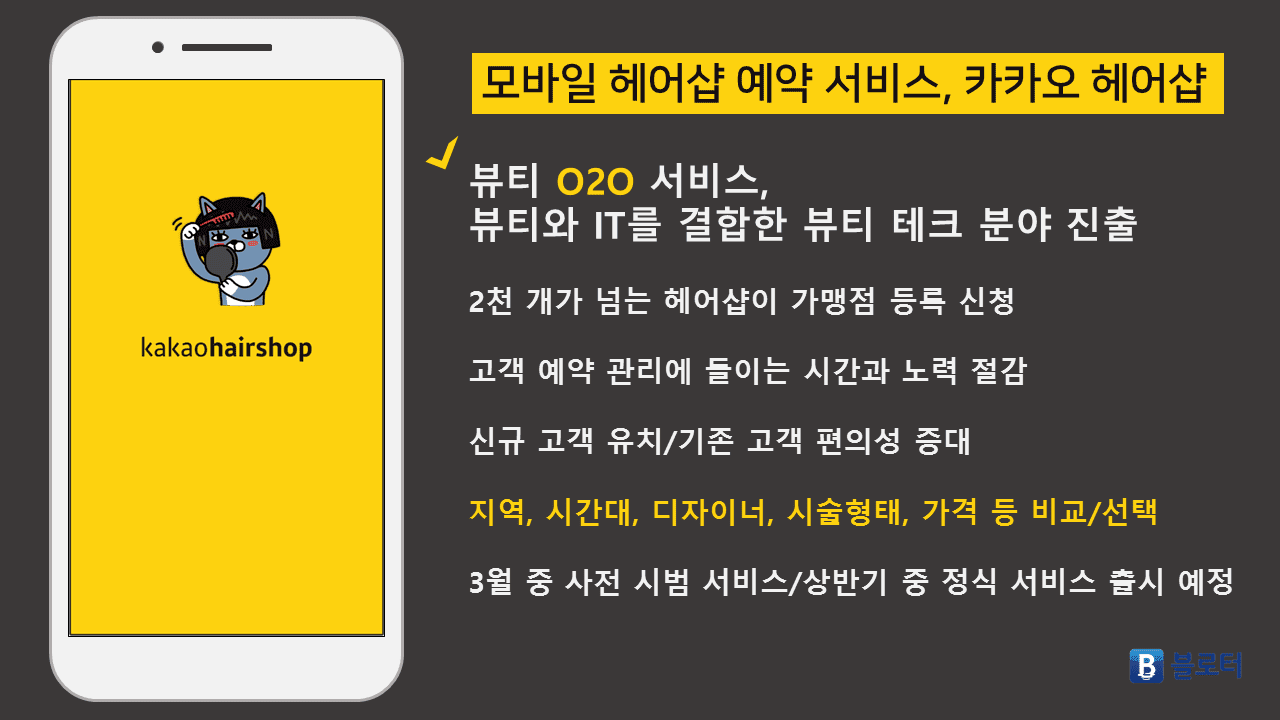
    According to industry analysts, Kakao is planning to launch ‘Kakao Hair Shop’ (working title) during the first half of the year through its affiliate Hasys.

    If Kakao’s Hair Shop is launched, related businesses could use Hasys solutions such as ‘Hair Zzang’ or ‘Beauty Zzang’ to easily build online and mobile reservation systems. Research on consumer satisfaction and marketing education could also be supported.

    Customers could have access to information about various hair shops through a Kakao-based platform, and compare prices at each salon.

    Some predict that Kakao will charge a commission for providing the platform when a user makes a reservation through the Hair Shop application and pays through Kakao Pay. However, Kakao claims that the details of the service have yet to be confirmed.

    Hasys is a beauty solution business Kakao took over in October 2015 through K-Venture Group, an affiliate of Kakao specialising in investments. Hasys has developed and is providing solutions such as ‘Hair Zzang’ and ‘Beauty Zzang’, which manage clients of beauty salons, skin care parlors and nail shops.

    Hasys has 10,000 beauty businesses as members, and ranks at the top of the industry with 69 per cent market share as of September 2015.

    Kakao revealed its intentions to launch O2O services related to the beauty industry at the time it took over Hasys. As a first step, Kakao officially entered the hair industry.

    Kakao officials said the company is planning to concentrate on the Hair Shop business, as it could be a service that is attractive to people of all genders and ages. “We have no other plans to expand our offerings into other beauty businesses.”

    Hasys is currently meeting with owners of hair shops across Korea, explaining about the launch of Kakao Hair Shop. Currently 2000 shops have agreed to become members of the service.

  • 50 Global Superstars To Compete in Miss SuperTalent of the World 2016

    50 Global Superstars To Compete in Miss SuperTalent of the World 2016

    Mark your social calendars as 50 gorgeous and talented ladies from all over the globe will sashay under the spotlight in the sixth edition of Miss SuperTalent of the World 2016. Pageant producer Sutal Group announced that the highly anticipated event will be held in Seoul, South Korea. The star studded grand finale will showcase the world’s most beautiful and talented contestants in a kick-off on April 27 and will culminate in a coronation night on May 13 at the K-Hotel Convention Center.

    It’s going to be a dazzling coronation night as various performances are lined up—from heart-stopping martial arts, K-pop dance performances by the hottest Korean artists, to a unique spectacle of angels in collaboration with Korean wave stars and the pageant contestants.

    This year, Miss SuperTalent of the World 2016 launches an engaging two-hour television special, to be telecast and live streamed via Internet worldwide, highlighting a different format of beauty pageant or supermodel search.

    The event is widely watched worldwide, especially in Asia, where it is partnered with SGX-listed social commerce company YuuZoo Corporation. Through YuuZoo’s access to 110 million registered users and 800 million TV viewers, Miss SuperTalent of the World enjoys an unprecedented global audience reach.

    It’s no surprise that Miss SuperTalent of the World is recognized today as the definitive platform where outstanding young women enter the exciting world of fashion, music, and entertainment to carve out successful careers. Past winners have risen to become influential icons, such as Egypt’s Meriam George and Ukraine’s Diana Starkova.

    Sutal Group CEO Lawrence Choi remarks, “Unlike traditional beauty pageants and supermodel search contests, Miss SuperTalent of the World has its sights firmly set on superstars; film stars, pop icons, and supermodels. With its unique concept of discovering and nurturing talented beauties to become future stars in the global entertainment industry, it has launched the careers of its winners to become the faces of L’Oreal and Bollywood, among others.”

    Check out more details by visiting www.misssupertalentworld.com, www.missstow.com (social site)

  • Kingsdown launches bedMatch system in South Korea

    Kingsdown launches bedMatch system in South Korea

    Top 15 U.S. bedding producer Kingsdown announced the debut of its bedMatch system here. Kingsdown plans to use the retail launch as a starting point for further distribution of bedMatch systems, Kingsdown, and Sleep to Live bedding products throughout the region.

    Kingsdown licensee Navijam partnered with Rentus, a retailer in Songdo, to launch the first bedMatch system in the country. The majority of the Sleep to Live mattresses on the store’s showroom floor are made in South Korea, with some products being imported from the United States.

    “Looking to grow our brand in Asia, we are confident that South Korea is the right location due to their focus on advancements in technology, product quality and styling,” said Kingsdown President and CEO Frank Hood. “As Kingsdown continues to expand, we have seen great success and growth abroad through our innovations in sleep technology. We have also found a partner that not only believes in our product but also shares our company’s vision of providing retailers and their consumers with high quality products from an internationally respected brand.”

    In addition to this South Korean location, Kingsdown is set to open 60 more bedMatch/My Side locations throughout Asia in 2016, the company said.

    Navijam, founded in 2011, is a leading mattress manufacturer in South Korea, officials said.

  • Indonesian bank opens branch in Seoul

    Indonesian bank opens branch in Seoul

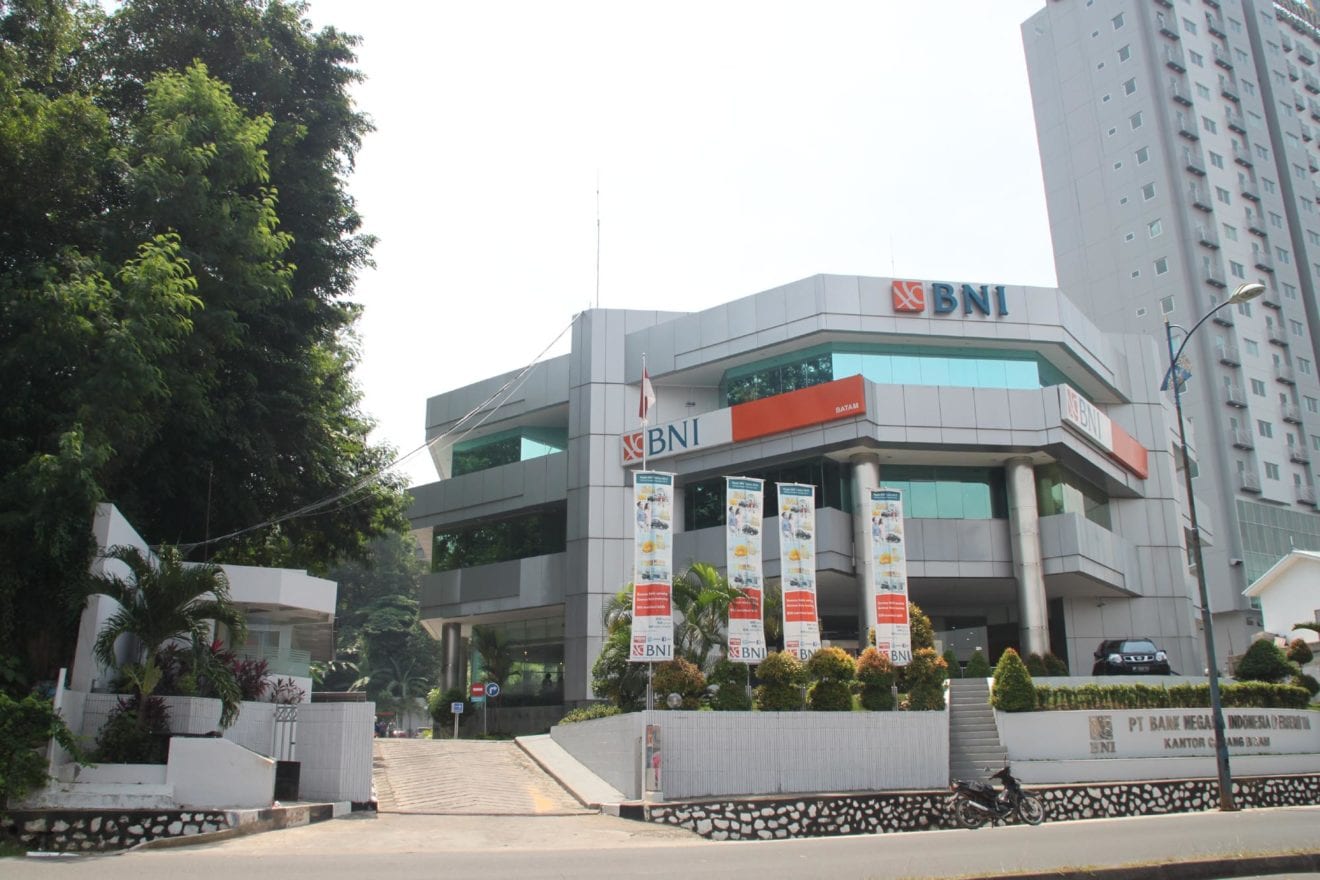
    An Indonesian bank, Bank Negara Indonesia (BNI) 46, opened a branch office in Seoul, South Korea, in Wise Tower, on Monday. It was inaugurated by the Ambassador of Indonesia to South Korea, John A Prasetio and Manager of BNI46 Seoul, Wan Andi Aryati. “The banking industry in South Korea is already shaken, but BNI46 still sees market potential,” Wan Andi said in a statement received by ANTARA here Monday. The BNI46 targets the domestic trade market according to her. “BNI Seoul wants to be a bridge to establish cooperation between Indonesia and South Korea by providing loans and other related banking services,” Wan Andi said.

    The BNI46 also provides services for South Korean businessmen who want to invest in Indonesia, she added.
    “We are also targeting the Indonesian labor market in South Korea, which now reaches 40 thousand people. We are committed to providing the best service for the Indonesias foreign exchange heroes,” she said.

    Meanwhile, Ambassador Prasetio stated that the world economy is still in a state of collapse. The stock market and the value of currency in some countries against the US dollar continues to decline.

    “This shows that the global sentiment has not been encouraging. Uniquely, the Indonesian economy is relatively solid in the middle of the uncertainty shocks,” the ambassador said.

    Cooperation in trade and investment between Indonesia and South Korea are still positive. The demand for Indonesian products and South Koreas investment in the country are progressive, according to him.

    “They respond positively on the economic policies of President Jokowi (Joko Widodo). I believe that the presence of BNI46 in Korea is very important to bridge cooperation between the two countries,” the ambassador said.

    Data from the Investment Coordinating Board (BKPM) shows that South Koreas direct investment in the country in the last five years is ranked fourth with a value of more than US$7 billion. Currently, there are 2,700 South Korean companies in Indonesia.

  • Korean Manufacturers Witnessing More and More Idle Production Facilities

    Korean Manufacturers Witnessing More and More Idle Production Facilities

    It has been found that Korean manufacturing companies’ rate of operation reached a record low since the IMF bailout in 1998 due to the sluggish exports and domestic consumption.

    Under the circumstances, the manufacturers’ investment is forecast to decline to cause an increase in unemployment and the slowdown of the national economy as a whole.

    The Statistics Korea announced on February 11 that Korean manufacturers posted an average rate of operation of 74.2% last year, down 1.9 percentage points from a year ago, with their exports showing no signs of recovery amid the global economic recession. The percentage of 2015 was the lowest since 1998.

    According to the Bank of Korea, Korea’s total exports decreased by no less than 10.5% year-on-year to US$548.93 billion last year. Besides, Korea’s exports to the emerging markets including China, which account for 60% of the total exports, showed a decline of 7.9% in 2015.

    Sluggish domestic consumption is another reason for the low operating ratio of the manufacturing firms. According to the Statistics Korea’s report that was released on January 29, Korea’s retail sales index fell 1% from a month ago in November last year and 0.1% in the following month.

  • Korean department stores offer instant tax refunds to tourist

    Korean department stores offer instant tax refunds to tourist

    South Korean department stores will start offering instant tax refund services to foreign customers from this month as part of an effort to boost sales.

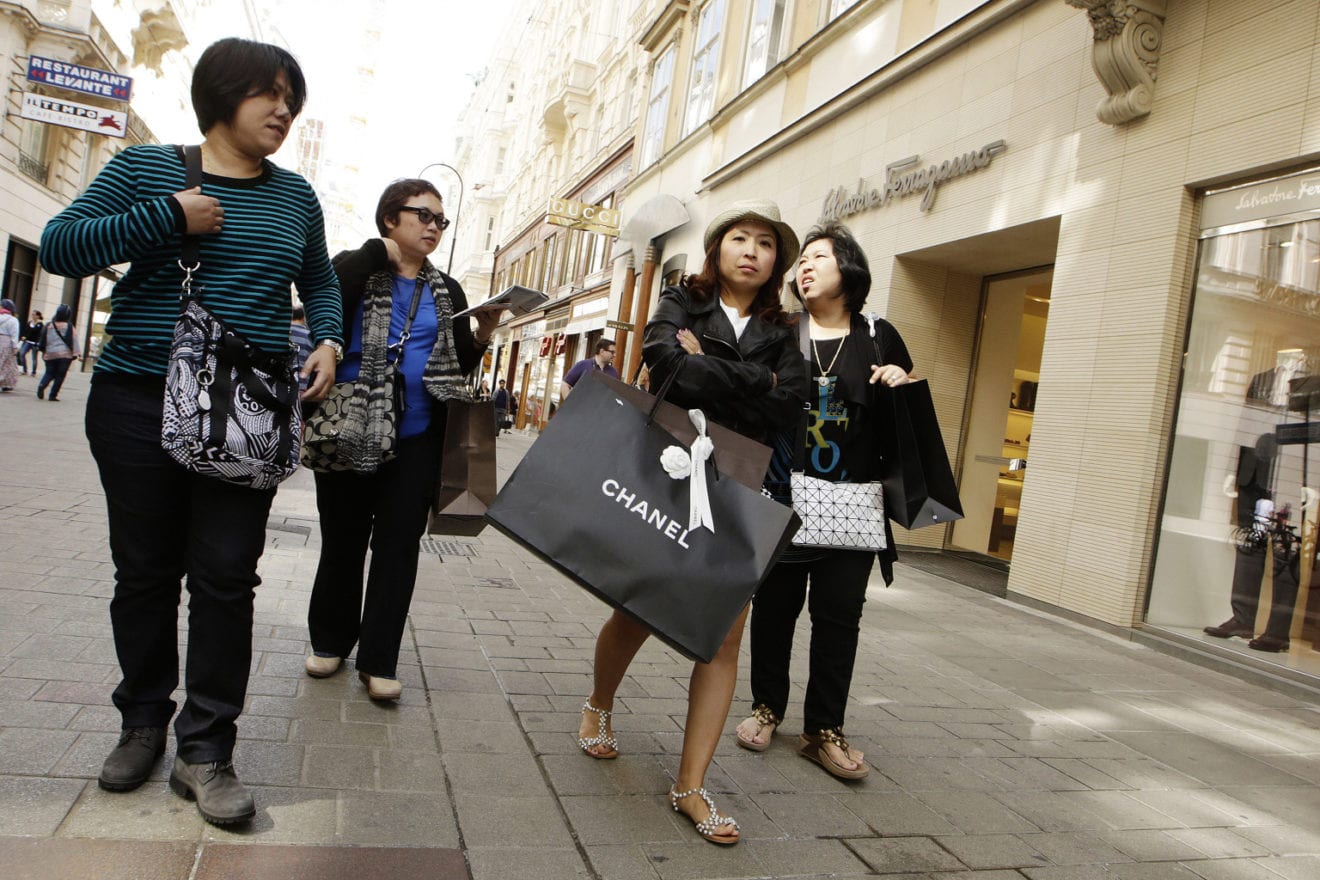
    Under the new program, foreigners can buy products without paying the mandatory 10 per cent value-added tax (VAT) if the item costs 30,000-200,000 won (US$25-166), observers said. Each person can be exempt from VAT for up to the first 1 million won in purchases. Products that cost more than 200,000 won require the buyer to pay the VAT and get a refund later on.

    Seoul announced last year that it would implement changes to the way all local tax-free shops operate in 2016 by making it easier for tourists to spend in the country without the need to hold onto purchase receipts that must be shown at departure to get tax refunds.

    Lotte Department Store, South Korea’s No. 1 luxury retailer, said the instant tax refund will be given at its main Sogong-dong flagship store in downtown Seoul.

    Shinsegae Department Store said its main store in Jung-gu will offer the service to customers, while Hyundai Department Store plans to give immediate tax refunds at its main Apgujeong store and its Coex outlet in southern Seoul.

    Department stores said they picked the stores because they are the most frequented by foreign visitors, with more stores to be added later.

    “Foreign shoppers can buy products minus the 10 per cent VAT so there is no need to keep tabs on receipts or show the product they purchased at the airport when they leave the country,” a Lotte official said. “This can greatly reduce the hassle at airports and should fuel sales at our store.”

    In addition, local department stores said they will kick off promotion sales to attract Chinese tourists who are expected to arrive in large numbers during the Chinese Lunar New Year holiday. The traditional holiday runs from February 3 through February 13 this year.

    Lotte said it will give 50,000 won discounts for purchases exceeding 1 million won, with gift cards equal to 5 per cent of the purchase of the total to be given if the total tops 10 million won. Shinsegae said it too will give upwards of 30 per cent discounts and gifts to foreign tourists that buy items at its stores in February. The retailers said that to get the benefits the shopper needs to show his or her passport when making the purchase.