Retail News CRM

Tag: Online

  • Online marketing essential for enterprises in digital era

    Online marketing essential for enterprises in digital era

    Despite a large number of Internet users, investment for online advertisement in Việt Nam remains modest, a conference heard on Thursday.

    The Institute for Brand and Competitiveness strategy co-ordinated with the Việt Nam Internet Association and Việt Nam Digital Communication Association to organise a conference on building enterprise branding in the digital era in Hà Nội.

    Over the past decade, the Internet boom has had a significant impact on marketing activities, as well as the building and positioning of brands in the market.

    Internet has also created stronger brand awareness than ever before and increased the number of people who know brands. According to the Institute for Brand and Competitiveness strategy, Việt Nam ranks 16th among the top 20 countries with the highest number of Internet users, with nearly 50 million people, of which, 60 per cent are young.

    The Internet has become a popular source of advertising to users who want to search for product information. Seventy-three per cent of Vietnamese consumers seek out information on the Internet before making purchase decisions.

    Most consumers in Việt Nam choose products and services based on brand identities.

    Therefore, experts advised businesses to make changes to their business operations, adjusting brand identity to avoid falling behind compared to rivals.

    To build brands in the digital era, businesses need to increase interaction in different environments, including the online environment, said Nguyễn Quốc Thịnh, an advisor for the National Trademark Programme.

    “Businesses should not skip electronic branding, a strong interactive environment with low associated costs,” said Thịnh.

    Enterprises need to rethink the way they build their brands, not just their logos or advertising in the media, he said.

    Currently, the application of the Internet in general, and digital technology in particular, to create and develop brands is still limited.

    Data from Cimigo, a market research firm, showed that investment for online advertising in Việt Nam was only US$15 million in the past year.

    Meanwhile, according to statistics from TNS Media Vietnam, the cost of online advertising accounts for less than 5 per cent of the total advertising costs, while 95 per cent of advertising spending is still through television, newspapers, magazines, even though these forms are more expensive.

    Vũ Xuân Trường from the Institute for Brand and Competitiveness strategy said that many businesses were paying attention to profits and business strategy, while their strategies for branding remained “vague”.

    Therefore, businesses need a better strategy in branding in the digital era. In particular, businesses should focus on social networks due to their widespread use.

    Experts said that businesses need to take advantage of opportunities afforded by the Internet to build their brands. Enterprises also need to increase connections with consumers, while ensuring the quality of goods and services.


  • Online retailers move to sell new cars on web

    Online retailers move to sell new cars on web

    Brick-and-mortar shops will no longer be the only go-to place for buying new automobiles, as online e-commerce shops are stepping into the industry as well.

    Interpark said Wednesday it would start a retail service for imported vehicles with local company D.parts, which delivers foreign cars to Korean customers and assists with paperwork, tax issues and delivery.

    To avoid conflict with local car dealers, the company will offer models that are not included in the list of products officially imported to Korea.

    “Buying foreign brand cars that are not dealt by official dealers can be a nuisance for general consumers,” said Cho Jin-hyuk, manager for Interpark’s electronics division. “Because our service is based on collaboration with an experienced company, customers can now buy such products with credibility and convenience on the internet.”

    “We’re looking for a way to talk directly with headquarters without going through any intermediate agents,” said a Tmon spokesman.E-commerce site Ticket Monster (Tmon) is also beginning to sell vehicles online, offering inventory from auto manufacturers inside and outside borders. The company’s brief experience in the market may offer clues about demand. The retailer sold Jaguar XE models in August, for which orders were filled in the first three hours. However, only one eventually completed a purchase after Tmon and SK Encar, agent supplier for the project, bumped heads with Jaguar Land Rover’s Korean office and official dealer Aju Networks.

    Online is the main sales channel for the global electric car brand Tesla Motors which has two showrooms in Korea but doesn’t have an official brick-and-mortar store. Tesla’s stores serve only as showrooms and clients must use the website to order. Demand in Korea was evident last year when pre-orders of the automaker’s Model 3 surpassed 325,000 in the first week.

    Although most sales offers are temporary, online retailers are eyeing expansion into domestic car brands. In September, Auction placed 10 models of Chevrolet’s Aveo on its platform, in a deal with GM Korea. The models sold out within one minute, as Auction offered a credit of five million won ($4,195) to buyers on the website.

    “We already saw potential, so the company is open for collaboration suggestions as long as the manufacturer is willing to do so,” said Lee Jin-young, a manager for Auction.

    Starting next year, domestic cars will be sold on television home shopping channels as laws that prohibited the practice were eased in November.

    New sales channels may prove favorable for consumers, as fierce competition will prompt companies to offer discounts or interest-free installment plans, which were common when imported car sales on television were popular in the early 2000s.

    “Online sales of automobiles may be a chance to enhance consumers’ convenience and improve the ambiguous structure of domestic vehicle sales,” said Kim Pil-soo, an automotive engineering professor at Daelim University College.

    Industry insiders, however, say that there are still many obstacles. E-commerce and home shopping networks equally say that although they are interested in launching online auto sales, the final decision is up to manufacturers and official importers.

    Decision makers are not enthusiastic about the idea, as sales online would eventually hurt brick-and-mortar stores and their sales force.

    “Realistically speaking, going online is not an easy option as it is a matter likely to be attacked by our labor union,” said a source from Hyundai Motor. GM Korea employees also criticized the Aveo sale on Auction, calling it a death sentence for sales people.

    Foreign car brands don’t seem too excited about the idea either, even though they may be able to save 15 percent on the commission fees they pay dealers. Most foreign car brands sign contracts with local dealers. One source pointed out that those vehicles require service after the purchase.

    “Dealers have connections to competent car service providers and quality after-service is an essential in this industry, therefore going online may be a risky decision for brand image,” the source added.

  • Malaysia’s Online Hiring Activity Declines By 12%

    Malaysia’s Online Hiring Activity Declines By 12%

    Online hiring activity across various industries in Malaysia declined by 12% in October when compared to the same month of last year.

    However, the production and manufacturing, automotive and ancillary industries were the only ones to not register a decline with flat growth between October 2015 and 2016.

    According to the Monster Employment Index (MEI) by Monster.com, the retail sector continued to record slower growth for online hiring.

    It chalked up a 23% year-on-year decline in online hiring activity in October.

    Monster.com Asia Pacific and Middle East managing director Sanjay Modi said hiring activity remained sluggish as companies were still very wary of possible economic headwinds brought about by external factors.

    “Other companies are watchful of their budget, laying off workers, cutting salaries and reducing costs all around. But, the government is making great efforts to get more foreign direct investments, which will create better job opportunities,” he said in a statement.

    The MEI also revealed that the retail sector’s online hiring improved by 3% from a decline of 26% recorded between September 2015 and 2016.

    The sector is followed closely by the hospitality industry, which posted a 21% year-on-year decline.

    When looking at specific jobs in Malaysia, sales and business development talent continued to witness the strongest year-on-year demand at 20%.

    Customer service professionals, on the other hand, fared the worst in online hiring in October, exhibiting a 55% annual decline from the 49% recorded in September.

  • Online retailer Ymatou expects huge Black Friday sales

    Online retailer Ymatou expects huge Black Friday sales

    Jia Yi, a white-collar employee from Chengdu, the capital city of Sichuan province is passionate about overseas brands and products. She is now considering buying a Coach handbag on the upcoming Black Friday shopping event.

    “The price in the domestic market could reach more than 2,000 yuan ($290), but it is just 848 yuan on the e-commerce platform during Black Friday. It is very cost-effective and I am prepared to buy one,” said Jia.

    China’s cross-border e-commerce has been growing over the past few years. The Shanghai-based cross-border e-commerce site ymatou.com expects the scale of the Black Friday event this year to be 10 times over last year by hiring more than 30,000 overseas buyers.

    The company, which has participated in the biggest retail sales day of the year since 2014, said customers could buy more than 600,000 imported goods from 83 countries, including discounted clothes, shoes, bags, cosmetics, fine jewelry and health care products without leaving the house.

    “There is a trend that consumers from second- and third-tier cities are more willing to buy overseas products. Chinese consumers’ demands have been upgraded as they have diversified and personalized requirements for products and services,” said Zeng Bibo, chief executive officer of Ymatou.

    Zeng added they prefer to buy niche brands from European designers than the mass-market brands in America.

    Black Friday, the day following Thanksgiving Day in the United States, is a busy shopping day with the highest discounts of the year and a major impact on brick-and-mortar retailers, e-commerce players and consumers around the world.

    Ymatou said it is set to ensure that Chinese online shoppers can get the same deals that their Western counterparts enjoy during Black Friday. Buyers can broadcast their shopping process at the online shopping platforms.

    It continues to increase investment in the access threshold of buyers to ensure the authenticity of the goods’ sources. Zeng said they will check the credit status of buyers from time to time, requiring them to offer credentials for long-term living overseas and identifications.

    Furthermore, Ymatou has established an independent logistics company, XLobo, to develop overseas direct mail business.

    XLobo collects and bundles individual parcels at overseas locations and ships them to China as a single consignment. It now owns 15 international logistics centers around the world to ensure the period of direct mail within five days, on average.

    “The number of professional logistics service staff has been doubled. We have expanded the space of warehouses in New York, San Francisco and Osaka, and the investment in equipment and logistics this year has surpassed the total input of last year,” said Zeng.

    It arranges over 90 chartered airplanes each week to transport the goods and other airlines that have cooperative relations with Ymatou will reserve shipping space for XLobo in advance.

    Chinese e-commerce companies, such as Alibaba Group Holdings and JD.com Inc have developed their own cross-border e-commerce businesses.

    Statistics from the China E-Commerce Research Center show that China’s cross-border e-commerce transactions totaled 5.4 trillion yuan ($783 billion) last year, a year-on-year increase of 28.6 percent.

    The generation aged between 20 and 35 old is the major force of cross-border shopping, experts said.

    Cao Lei, director of the China E-Commerce Research Center, said customers need to choose an excellent cross-border e-commerce platform, pay attention to sellers’ reputations or ranking level and customers’ comments, adding they should choose a platform that owns and operates its logistics system.

  • Singapore shoppers look to online shopping for good deals

    Singapore shoppers look to online shopping for good deals

    The extended season will lead to an eleven percent ($9.1 billion) increase in online sales to a total of $91.6 billion, according to Adobe’s 2016 Digital Insights Shopping Predictions report. Large retailers expected to account for the bulk of the growth, with an average growth rate of 16.6% compared to smaller retailers at 7%.

    “We expect to see a five percent spike in online shopping in early November and a record 24 percent increase in the last two weeks of December,” said Mickey Mericle, the vice president of marketing and customer insights at Adobe.

    “‘Click and collect,’ faster shipping and retail promotions starting earlier than ever are all contributing to the extended shopping season. Despite the uptick in sales we expect to see slower growth in total online sales this year,” he says.

    Singapore shoppers

    Closer to home, findings specific to the Singapore market show that consumer budgets are tight and the savvy shopper prefers online shopping due to the higher likelihood of finding good deals and bargains this way.

    Marketers can also expect fewer last-minute shopping rushes as respondents are now shopping slightly earlier in November. This suggests that marketers should make the effort to reach out to these early birds accordingly.

    Notably, consumers report visiting an average of 3-5 sites before making a purchase, which offers marketers a critical chance to target these potential customers once more and bringing them back on-site via remarketing

    Almost half of Singaporean millennials (49%) surveyed value experiences more than material goods, with a sizeable 41% echoing this sentiment when all local consumers who are surveyed are factored into the picture.

    Finally, the study shows that mobile shopping is king as consumers praise retailers for better optimizing their sites for mobile browsing, allowing them to shop on the go with their hectic schedules.

  • How Asia-Pacific is driving global online retail

    How Asia-Pacific is driving global online retail

    The world’s largest and most populous continent, Asia is made up of 48 countries and spans 44,579,000 square kilometres. With a widely diverse population of 5.096 billion people, the continent’s rich historical background offers a wealth of opportunities to explore, from the untouched steppes of Central Asia to the bustling economic centres of China and Japan. Iconic sights such as the Taj Mahal and the Temples of Angkor Wat may draw tourists from around the world, but strong economic growth and up-and-coming markets are providing new footholds for businesses and investors alike.

    The key e-commerce markets in the Asia region are China, India, Indonesia, Japan, Malaysia, Philippines, Singapore, South Korea, Thailand and Vietnam. Together, these countries represent 86 percent of all e-commerce turnover in the Asia Pacific region, a figure which rises to 90 percent when Oceanic countries such as Australia and New Zealand are excluded.

    E-commerce in Asia is flourishing – with $770 billion in transactions annually, the Asia-Pacific region leads the world. An expanding middle class, growing Internet penetration and improving infrastructure means the region will continue to drive global online retail over the next five years.

    Access to financial services is a key stimulus for e-commerce. A lack of banking infrastructure in many countries in the region is exacerbated by barriers caused by geographical and physical access to banking services. Increased Internet penetration will aid in removing these barriers, but with some areas having an account penetration of as low as 2 percent, many countries will continue to rely on cash as the main method of payment for some time to come.

    While, on average, 51 percent of the region’s population has access to an account with a financial institution, the extremely low income level of a significant proportion of the population results in a high overall percentage of unbanked people. In spite of its growing middle class, China’s traditional rural economy and vast territory results in the country accounting for more than 12 percent of the world’s unbanked population.

    The expanding middle class is making a significant contribution to the growth of e-commerce across the Asia region. This group is expected to reach 1.7 billion by the year 2020, with China, India and Indonesia experiencing the greatest growth. With the increase in the number of options that e-commerce brings, consumers are also showing marked personal preferences. This, in turn, is leading to increased competition, with traditional retailers moving to having an online presence (either individually, or by using an online marketplace), and local businesses experiencing pressure from regional and global brands which want a share of the growing sector’s profits. Again, China is a leading force in both the regional and global economy.

    Technology, naturally, is a major factor in changing economic patterns, with internet penetration playing a significant role. Notably, in spite of having the highest B2C e-commerce sales of any region in 2014, Asia has the lowest penetration of all regions globally (although Japan, Singapore and South Korea fall into the global top ten). As infrastructure becomes more ubiquitous, e-commerce will continue to experience high growth as a result; countries with a low penetration rate, such as India, with only 18 percent, are expected to drive future growth.

    The young are traditionally the first to embrace new methods of doing anything, and it is no different in Asia. Millennials are the most active group online, and use social media as their preferred form of communication – Facebook has more than 270 million active daily users in Asia alone. This familiarity with the online environment results in a willingness to embrace cashless payment methods, and this group exhibits different patterns of consumer behaviour to other demographics.

    The use of online payments varies throughout the region according to how developed the local market is. The more mature the market, the more likely it is that consumers in the country will use cards in order to pay for online purchases: for instance, in Japan and South Korea, 63 percent and 83 percent of online purchases respectively are paid by card. In contrast, emerging markets such as India and Malaysia continue to prefer cash based payment methods.

    In China, E-wallets are the most popular form of payment online, being used for 48 percent of transactions. Whereas, in Indonesia, e-wallets and other forms of payment are the least preferred methods, making up 5 percent and 3 percent of transactions respectively. There, bank transfer is used in 39 percent of e-commerce transactions, with card-based purchases accounting for 29 percent.

    The trend, though, we are seeing overall is that cash based payments are increasingly being displaced by electronic payment methods throughout the region.

  • Privacy is paramount to online consumers

    Privacy is paramount to online consumers

    More than half (55%) of consumers globally have decided against buying something online due to privacy concerns, a recent KPMG International survey indicates.

    The survey also revealed that less than 10% of consumers feel they have control over the way organizations handle and use their personal data. Respondents in most countries say privacy controls are more important than the potential convenience gained from sharing personal data.

    “An executive would be at risk of being fired if half their customer base disappeared after they made a crucial business decision,” said Mark Thompson, Global Privacy Lead at KPMG.

    “Failure to embed privacy into the DNA of their business strategy could ultimately lead to the extinction of a business given how closely consumers and regulators alike are paying attention to how organizations collect, store and use personal data.”

    The survey further revealed that 82% are not comfortable with the sale of their data to third-parties in exchange for the speed, convenience, product range, home delivery and price comparison that online shopping offers.

    Over two-thirds of people are not comfortable with smartphone and tablet apps using their personal data. In all markets but one, at least 75% of respondents said they were uneasy with their online shopping data being sold to third-parties.

    About 55% said a free fitness tracking device that monitors the well-being of users and produces a monthly report for them and their employer is also crossing the line.

  • Korean Fashion Struts Authentic Style to Thailand’s Online Shoppers

    Korean Fashion Struts Authentic Style to Thailand’s Online Shoppers

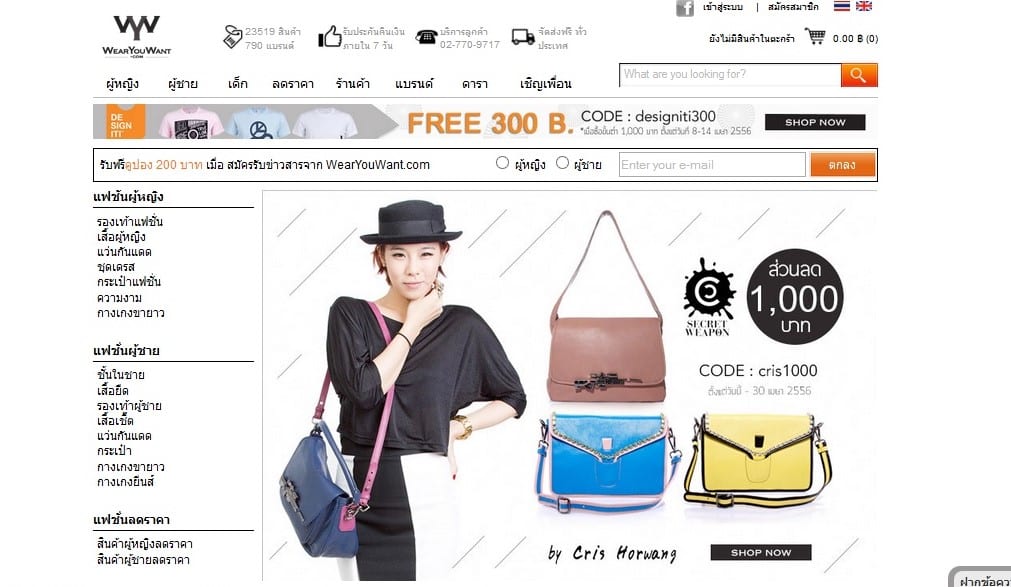
    WearYouWant, Thailand’s leading online fashion and beauty marketplace, is launching a premium, Korean fashion range in Thailand, designed and made in Korea, to satisfy the ever-growing love of Korean brands in the Kingdom. Developing a close relationship with online fashion house, Atria International Style, WearYouWant is sourcing authentic Korean brands, importing these for the Thai market from up-and-coming local Korean designers.

    Just as Korean pop music as captured a huge fan base in Thailand, there is high demand for Korean fashion too. The new Korean range of cool and stylish women’s apparel, accessories, bags and shoes, is to be showcased on WearYouWant. The launch, planned for December 2016, is big news for Thailand’s online shoppers. It is also a sign of growing focus from Korea on Thailand’s rapidly developing e-commerce market; the fastest growing in Southeast Asia.

    The WearYouWant collection is unique in Thailand and has been specially curated by fashion experts to assure quality and to appeal to the country’s online fashion-buying market who are actively seeking out Korean brands. Martin Toft Sorensen, Co-Founder and Co-CEO of WearYouWant confirms that this latest fashion collection launch is part of an ongoing strategy to understand and meet their customers’ needs and a response to the market in Korea too.

    Our decision to move forward with Korean brands is in part due to a general push for designers to expand beyond the saturated markets in Korea. WearYouWant is an ideal platform for this expansion as there is a great amount of passionate interest from our online shoppers for Korean fashions. We pride our success in being ahead of the curve with consumer trends and this is what makes our platform so vibrant, relevant and exciting.”

    This launch follows the Last Mile Fulfilment (LMF) Korea 2016 conference in September 2016, which Martin Toft Sorensen attended. The event focused on the attraction of Thailand’s solid e-commerce market and higher purchasing power for Korean brands looking to grow within Southeast Asia and succeed outside Korea’s competitive markets. Also clearly highlighted was the importance of fashion distributors in assisting Korean brands to spread out within the region and the value that this can bring to outside markets. The WearYouWant launch aims to add value to Thailand’s blossoming ecommerce market where demand is strong and expectations high.

    ATRIA STYLE (www.atriastyle.com), a powerful South Korean platform that sells contemporary fashion and beauty brands all over the world has been working closely with WearYouWant to fuel cross-border fashion and beauty relations in Thailand to build strong commerce presence between these two key retail luxury markets.

    Founder and CEO, Cindy Yun is optimistic about the future success of Korean fashion and beauty brands through the WearYouWant platform.  “Korean designer fashion is forward thinking, high quality and, in terms of production, there is a good lead time in creating output. This means that brands are stylish and affordable which greatly appeals to savvy Thai consumers. For designers looking to expand their collections outside of Korea, WearYouWant is a vital online lifeline and the e-commerce opportunity this launch entails will enable them to realize their true potential.”

  • South Korea is world’s top online FMCG market

    South Korea is world’s top online FMCG market

    South Korea was the world’s top market for online grocery sales for the 12 months preceding June 2016.

    This was the conclusion from the third annual Future of e-Commerce in FMCG (Fast Moving Consumer Goods) study by Kantor WorldPanel, a firm that tracks consumer buying behavior worldwide.

    The report noted that sales of groceries through e-commerce platforms reached $48 billion in the 12 months to June 2016.

    E-commerce now accounts for 4.4% of all FMCG sales. However, despite the growth of e-commerce, the growth of the entire FMCG market was flat performance during the same period, increasing just 1.6%.

    “FMCG growth is slowing, but our data shows that people are looking for more convenience, which can be met by shopping online. Grocery e-commerce, although currently small, with only one in four people shopping online, is growing fast,” said Stéphane Roger, the global shopper and retail director at Kantar Worldpanel.

    “We forecast it will grow to 9% of the market and be worth $150 billion by 2025. With new entrants such as Amazon expanding rapidly, the industry is facing a shake-up,” he said.

    E-commerce growth is also unequal, differing from country to country. Although connectivity plays a part, it is not clear whether it is the primary reason for the growth.

    For example, while South Korea is the world’s largest online FMCG market by value share (16.6%), US consumers only bought 1.4% of groceries online.

    Meanwhile, China’s netizens are catching up. The report noted that the country saw the biggest growth in the last 12 months, 47% – to a value share of 4.2%.

    Meanwhile, Europeans have a relatively low adoption of e-commerce in all countries except the UK with 6.9% of the market and France which has 5.3%.

    According to Kantar WorldPanel, France is a relatively unique e-commerce market with their success with the Drive model, where online purchases are collected from the store.

    Other conclusions:

    • Online buyers tend to continue to keep buying online after their first purchase.
    • Online buyers are less impulsive, based on comparative research across UK, France and China.
    • 50% of FMCG purchases in China is on beauty.
    • Online buyers splurge more on a single visit online.
    • 55% of online shoppers tend to use the same shopping list for the next purchase.
  • Relaunch of Freightbook with new online ratings feature

    Relaunch of Freightbook with new online ratings feature

    Based in the UK, Freightbook Ltd was formed by Rachel Humphrey who has been actively involved with global freight networks since the mid-90s.

    Rachel Humphrey launched Freightbook www.freightbook.net in July 2009 as a new concept of linking forwarders together at a low-cost and as an alternative to a traditional freight network.

    Since then 1500+ companies in 140+ countries have registered and are promoting their services on a global scale whilst at the same time driving traffic to their own websites.

    Today, Freightbook is enjoying an exciting relaunch with a fabulous new feature inspired by the fact that ratings are now an essential element to any online directory.

    “Personally, I always refer to customer ratings before purchasing products online. This applies to service providers too. A recent survey showed that 91% of businesses are influenced by recommendations when making a decision to use a company so we’ve made it super quick and easy to share feedback on our advertisers,” said Rachel Humphrey, Founder.

    She also recently launched v3.0 of their Smartphone Service at m.freightbook.net where forwarders and suppliers to the freight industry can be found quickly on mobile devices

    The online directory costs £50 for 2 years registration and boasts additional benefits including contact details listed in the monthly FB Index, dedicated online news/PR service, direct quote request leads (approved by in-house staff to avoid spam), automatic amendments to profile pages and the ability to post ratings and reviews for fellow advertisers.

    “Freightbook is an online business directory dedicated to the transportation industry. There are no rules, registered users are not governed and Freightbook offers no financial protection or arbitration. There are many freight networks already established but some forwarders dislike the ties that are enforced by membership. Freightbook provides an alternative solution for forwarders to find overseas agents … and to be found,” said Humphrey.

  • SMEs switch to online for branding, expansion

    SMEs switch to online for branding, expansion

    Indonesian small and medium enterprises (SMEs) are taking advantage of the unique methods of engagement that online services offer them and potential customers.

    The owner of Jakarta-based desserts maker PUYO Desserts, Adrian Agus, owes much of his brand’s success to intensive online campaigns through various social media and messaging apps.

    By connecting directly with his customers through these platforms, Adrian has been able to find a quick way for his colorful home-made puddings to capture the public eye.

    Shortly after he started the business in 2013, Adrian found that social media greatly helped his marketing operations at little cost. In the beginning, PUYO’s marketing campaigns mostly centered on Instagram where it slowly gained traction and attracted loyal followers.

    “Social media campaigns have been very effective for the business. Right now, we’re holding a lot of competitions on Instagram,” he told The Jakarta Post on Thursday, elaborating on the creative engagement that Instagram offers between customer and vendor.

    Gradually, PUYO has branched out to Twitter and LINE to help sell its products, with the use of these services’ operational tools such as LINE’s LINE@ service, which enables the user to send mass messages to all customers that follow its LINE account.

    Japanese-based LINE Corporation itself describes the Line@ feature in its messaging app as “the same as broadcast messaging”. The company, however, says that the idea is more specifically aimed at nurturing businesses.

    Currently, PUYO has over 59,600 followers on its Instagram account and has evolved from being a home-based business in 2013 to having 22 outlets across Greater Jakarta.

    Meanwhile, the social apps behind these successes are increasingly aware of their role in the small business sector.

    Apps such as LINE, KakaoTalk, WeChat or WhatsApp have had their purposes extended beyond the simple text message, with some apps gradually rolling out new features that help small businesses thrive or become more efficient.

    LINE Indonesia’s head of marketing Galuh Chandrakirana explained that the rollouts of the company’s newer features such as Line for PC, Line Group Call and Line Today would help small businesses in making their operations more mobile, as mobility is becoming more emphasized in today’s business world, with SMEs able to benefit from these services through trimming their costs.

    “Features such as Line for PC, which can be opened from desktops, are not geared necessarily for SMEs but it serves to help them cut communications costs. However, we do plan to roll out a feature which is specifically designed to help that sector in the next month or two,” she elaborated.

    Currently, LINE has recorded over 1 million downloads in Indonesia comprising small businesses including online shops, offline retailers, specific communities and bloggers. Up to 40 percent of that figure is active businesses who utilize LINE in their practices.

    Indonesia has the highest number of SMEs in Southeast Asia, with over 50 million operating nationwide, however, only 1 percent of these are officially “connected” online.

    Last month, the government announced its cooperation with online SME promotion service Nurbaya Initiatives to explore new ways of encouraging SMEs to tap into the digital era’s potential.

    Collaborating with state-owned postal company PT Pos Indonesia, Nurbaya is targeting to bring 2 million SMEs online within the next two years. The company will assign a facilitator to provide each participating SME with advice on online promotion, including the setting up of online stores and payment platforms.

    Nurbaya will also assign a relationship manager to every online shop, allowing clients to focus on production. “By our collaboration with the postal service, SMEs will have help in terms of logistics and quality control,” Nurbaya’s CEO Andy Sjarif said.

  • Taxing the internet giants: Catch me if you can

    Taxing the internet giants: Catch me if you can

    Southeast Asia is experiencing rapid growth in digital technology, social media, mobile activity and internet usage. Like every other emerging market that is witnessing rapid smartphone adoption, Indonesia is seeing mobile phones increasingly chosen as the platform for digital content consumption. According to US research firm eMarketer, spending on digital advertisement is growing very fast in Indonesia.

    The world consists of hundreds of different nations and legal jurisdictions, each with their own set of tax regulations. In cross-border transactions, the interaction of domestic tax systems can leave gaps that result in income not being taxed anywhere.

    Google is the poster boy of companies successfully practicing “tax optimization”. In the last couple of years, there have been intense discussions on how foreign-based online businesses have apparently failed to pay their “fair share” of tax.

    Multinational internet corporations with the help of their financial advisers used the tax treaty network and international structuring regime to minimize their tax burden through various mechanisms. In the digital era, taxing multinational companies becomes a lot more complicated.

    First, under international tax rules, local corporate tax will usually be levied on a business in its home country. The target country has the right to tax under traditional international tax concepts, if a non-resident business has a permanent establishment.

    Permanent establishment typically requires a relatively strong physical presence or a relatively high number of activities before a state has source-based jurisdiction over income.

    Most online businesses do not need these to do business; their online presence and payment systems are sufficient. It is very easy for businesses to claim that they have no taxable presence in a country. It becomes more difficult to apply traditional concepts to link an item of income with a certain location.

    Second, having a taxable presence is only the beginning of the story; countries then have to determine how much profit is attributable to that entity.

    There is a lack of definite legislation for guidance on this. Tax authorities have often left it to the companies to bargain with them.

    However, while negotiating, both parties will also be looking over their shoulders at their home country.

    Especially companies from the US, such as Google and Facebook, would prefer any tax they pay in other countries to be deductible as a credit against taxes to be paid in the US.

    Another question is how the government could tax a large business that has not yet been monetized, meaning it does not really earn any money, like WhatsApp? It is pretty much playing on the valuation, and taxes are applicable only when the business is sold.

    Third, governments are often slow to adapt their tax laws to technology. Many countries are now struggling with how streaming video services like Netflix fit into their tax structure.

    Historically, the problem with the taxation of digital goods is that the sales tax was designed to be imposed on the sale of tangible personal property.

    The tax base has been expanded over time to include several specific services, but many digital products are a mix of an intangible product and a service. Most transactions do not systematically fit into existing tax laws.

    Indonesia’s government has tried to address some of these problems. The Communications and Information Ministry has issued Decree No. 3/2016, which stipulates that internet companies providing services in the country must establish a permanent establishment.

  • E-Commerce to Take Up 20% of the Indonesian Retail Market

    E-Commerce to Take Up 20% of the Indonesian Retail Market

    The Trade Ministry said that the e-commerce business has a chance of capturing 20 percent of the conventional retail market. The scouring of conventional retail markets is likely to happen given the fact that customers are now more familiar and accustomed with online shopping, due to its time and budget efficiencies.

    “This phenomenon must be supported by adequate policies and infrastructure,” Srie Agustina, the ministry’s acting director general of domestic trading, said during the Indonesian E-Commerce Summit and Exhibition in Serpong, Banten, yesterday.

    Srie estimated that the e-commerce industry will take over 20 percent of the conventional retail market share in the next four years. Right now, e-commerce’s share in the conventional retail market is five percent.

    At the E-Commerce Summit opening yesterday, President Joko Widodo warned local e-commerce businesses about the “attack” of foreign players. According to the President, the acquisition of Southeast Asia’s popular online shopping site Lazada by China’s e-commerce giant Alibaba two weeks ago is something that industry players must keep an eye on. “It’s a warning for everyone.”

    Alibaba announced that it has acquired Rocket Internet’s stake in Lazada worth US$1 billion (Rp13 trillion). The takeover strengthens Alibaba’s position in the e-commerce markets of Asia and the world. The acquisition allows Alibaba to reach 560 million online consumers in Southeast Asia, including Indonesia.

    To boost the quality the domestic e-commerce industry, the Trade Ministry will mandate online trade sites to register with the ministry.

    The Indonesia E-Commerce Association (IDEA) is planning for an accreditation of e-commerce sites, in a bid to improve the quality and credibility of local e-commerce players. The accreditation assessment will begin in June carried out on 200 sites online sales-and purchase businesses. The assessment categories include operational sites, clarity payment, and customer service aspects.

    Earlier, Minister of Communications and Informatics Rudiantara expressed his optimism that the retail e-commerce business this year can record a transactions deals total of US$20 billion or around Rp260 trillion.

  • Removing online commercial curbs can hurt consumers

    Removing online commercial curbs can hurt consumers

    Hong Kong manufacturers and retailers that increasingly use e-commerce may know that their contracts with EU companies may contain vertical restraints on online distribution. Competition authorities across Europe are currently discussing the appropriate treatment of such restraints under competition law.

    This is being done with a view to preventing distributors from imposing more restrictions on online retailers than on their rivals in traditional brick-and-mortar shops, Hong Kong Trade Development Council Research (HKTDC Research) has said in a report.

    The UK’s Competition and Markets Authority (CMA) commissioned a report from independent consultants in order to know why businesses use these restrictions and how these may affect consumers, both positively and negatively. The report surveyed 33 mostly small and medium-sized UK-based manufacturers and retailers. It was released on 30 March 2016 and will prove to be of interest to e-commerce users, HKTDC Research said.

    The businesses interviewed use a wide range of restraints in their contracts, with the most common being selective and exclusive distribution agreements (often excluding online retailers) and recommended retail prices (RRP) for retailers. The participants explained such restrictions by the need “to prevent free-riding” and to “protect brand image”.

    Free-riding may occur when customers visit ‘service retailers’ (e.g. providing free advice on products), but purchase the product from a cheaper retailer that does not provide any service support.

    Participants who mentioned maintenance of brand image said restrictions “helped signal the high quality of the product and maintain the image of the product (particularly for luxury brands)”.

    However, the report further shows that the restrictions are also “attractive because they limit the direct competition faced by the relevant manufacturers or retailers, particularly from online channels”, without any consumer benefit.

    Hong Kong companies may be interested in the conclusions of this report. In the long term, forbidding these restrictions “could bring about lower retail service standards and a poorer quality experience of the underlying product”. This is likely to hurt consumers, especially for high-tech products. On the other hand, especially in the short run, the absence of such restrictions could cut prices and widen product availability.

    The European Commission is also conducting an inquiry into the e-commerce sector. The inquiry was launched on 6 May 2015 and a Preliminary Report is due to be published in mid-2016.

    A sector inquiry is an investigation that is carried out by the European Commission into sectors of the economy and into types of agreements across various sectors, when it believes that a market is not working as well as it should, and that breaches of the competition law rules might contribute to the malfunctioning of that market.

  • Online wine sales in China rising fast

    Online wine sales in China rising fast

    JD.com‘s head of wine business, Zhao Dabin, told in an exclusive interview that the retailer sold 400m yuan (US$61.5m) of wine direct to consumers in 2015. That figure is expected to triple in 2016, he said.

    JD also hosts pages for individual merchants, acting as a gateway to a new generation of mainstream wine consumers in China – beyond the gift-giving between government officials that has been significantly curtailed by the present regime.

    Wine sales through these JD.com-hosted, online ‘shopping malls’ for merchants are expected to hit 1.5bn yuan this year.

    His comments tally with those from several wine importers and merchants in China, which are freeing up investment for e-commerce.

    Total online retail sales of physical, consumer goods in China rose by 32% in 2015, to reach 3.2tn yuan, or US$492bn, according to Chinese government figures. Online sales of tobacco and liquor products increased by nearly 13% versus 2014, to 196bn yuan.

    JD is seeking to compete with larger players in the market, such as Alibaba‘s Tmall and Taobao platforms.

    In wine, JD’s Zhao sees a lot of potential. ‘Most of our wine consumers are still at entry level,’ he said. ‘Only 3% to 4% of our registered users buy wines at the moment. There’s still plenty of room to grow.’