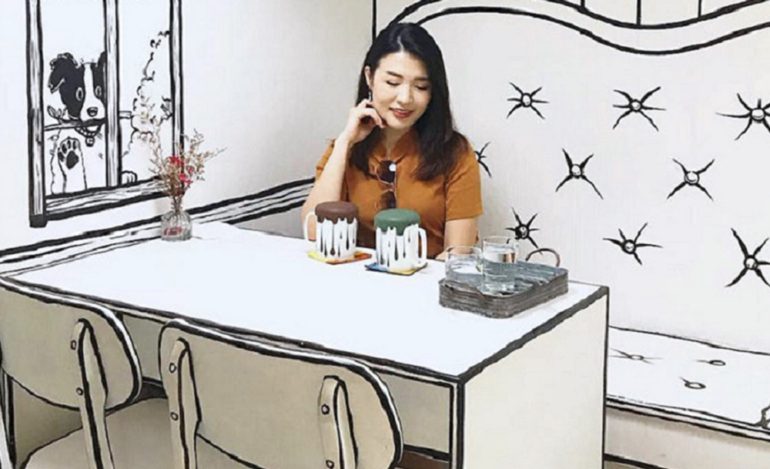
The interior of Cafe Yeonnam-dong 239-20 in Seoul, South Korea makes customers feel as though they’ have stepped into a cartoon world. Most cafe owners know it takes more than just great coffee to create a successful business. From an Instagram-worthy Wes Anderson-esque cafe in the Philippines to a coffee shop shaped like a Rolleiflex camera in South Korea, a space’s design is key to drawing in customers.
One cafe to have recently received hype for its novelty interior is Cafe Yeonnam-dong 239-20 in Seoul. The eatery created an incredible space that makes customers feel as though they’ve stepped into a cartoon world.
The artistic, monochrome design was inspired by Korea’s hit TV show, W by Lee Jong-suk and Han Hyo-joo, in which the characters clash between “two worlds”—the real world and a fantasy world inside a webtoon.
The design of Cafe Yeonnam-dong 239-20 creates a 2D optical illusion, which makes customers feel as though they’ve crossed dimensions into a comic book illustration.
When visitors step through the door, they’re greeted with black and white comic strip furniture, walls, and floors. Even the mugs, dishes, and cutlery look like flat line drawings.
It helps that the owners have created a welcoming environment.
If you want to experience this cafe for yourself, you can find it in the popular Yeonman-dong district in Seoul. If you can’t make it to South Korea, you can still feed your wanderlust by checking out the cafe’s Instagram.
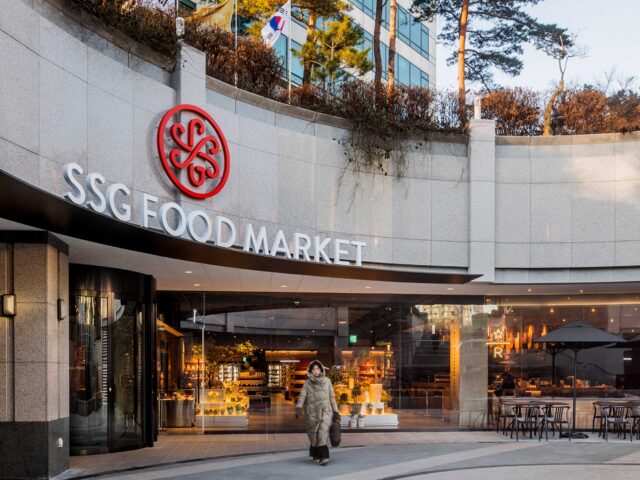
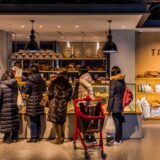
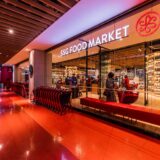
Nestled in the upmarket suburb of Dogok, Seoul, sits the newly opened reinvention of Emart’s “Star Super”: “the SSG Food Market”, designed by Landini Associates. Emart is the leading business of the Shinsegae group, the largest retailer in South Korea, operating multiple brands including department stores, discount to premium supermarkets, and the mighty Emart hypermarkets.
The brief was to create a world class premium supermarket and food hall fusion, and Landini Associates were entrusted to redesign every detail of the new store experience. This included: the built environment, naming and identity, furniture and fixtures, signage and communications, ticketing, menus, POS, advertising style guides, packaging and uniforms. In fact every customer touchpoint.
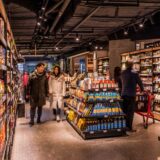
The result is a modern market, a convenient and accessible food lover’s heaven, where locals can do a daily or weekly shop, or dine in with friends at one of the many in-store restaurants and cafes. Attracting a newer younger audience, whilst rewarding its existing, the SSG Food Market is a community epicentre to meet, eat and shop in, throughout the day.
The offer
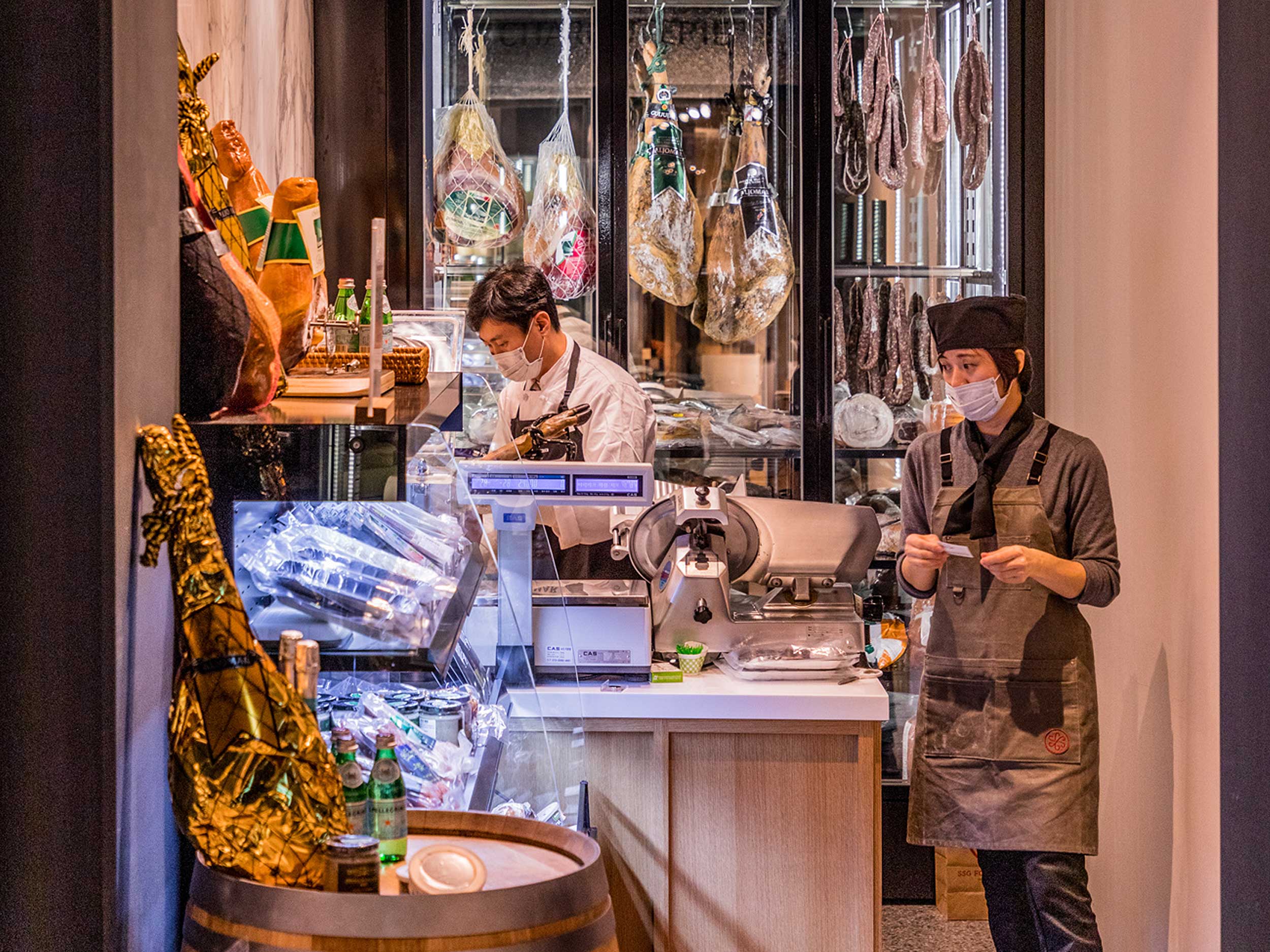
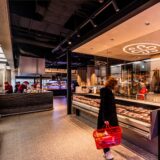
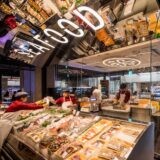
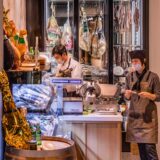
The reinvention enriched and upscaled the existing food and beverage offer to include an extensive fresh department, vegie butcher serving house-made salads and juices, take home meals, Korean deli, bakery (run by hip San Francisco brand Tartine), fishmonger, butcher, Korean traditional street food, café, 200 seater restaurant, sushi restaurant, specialist cheesemaker, western charcuterie, wine and beer department, coffee roastery, dry goods, florist and homewares.
The result is a curated selection of quality products, and a onestop-shop supermarket and refined specialist items. In addition the market is a wonderful meeting place to dine with friends and family, further enriching the retail and community experience.
SSG Food Market Landini Associates Trevor Mein Fruit and Vegetables 45
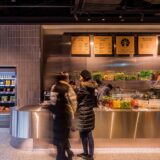
The offer is made up of both SSG run departments, franchises (such as Starbucks, a premium brand in Korea), and third-party retailers. Ensuring that these were all presented as a tangible whole required the design team to be sensitive to multiple design briefs, whilst ensuring that the customer had a seamless experience.
Additionally, the site has a low ceiling which created some challenges for the reticulation of services, and multiple entrances, including a pre-trading public access to a subway station through the heart of the store; a gift to residents from Shinsegae.
Landini’s solution creates a space of intrigue, transparency and exploration by celebrating the food, the people who make it, and its preparation.
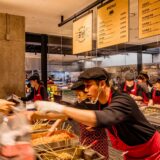
Specialist departments are visible across the restaurant’s open kitchen and include: Korean Traditional Street Food, Korean/ Chinese Noodles and a grill. All the production is exposed, and chefs work in glazed pavilions serviced by counters showcasing this theatre whilst you order. There are also take home meals in the Korean deli prepared daily in its kitchen, or fresh fish and meat cooked to order at the Grill, to take home, or eat in.
As always, and especially because the market is in a basement, the lighting plays a key role in Landini’s design. Chiaroscuro, the contrast between light and shade, creates areas of interest and calm, gently guiding customers on a journey of discovery throughout the store. Perimeter departments use pavement lights to create space, and give sense of the world above.
In the main market hall the interior is paired back, functional yet classic. This “bare bones beauty” of exposed steel beams and concrete bulkheads contrasts with fine marbles, glass and blackened steel, and is balanced by timber fixtures and details. This subtle, considered and classic material palette allows the food to be the hero, and merchandising plays a major role. Long-life departments such as wine and dry-goods have a warmer, more earthy and textural palette, utilising brick and added timber. In the carpark, red floors and walls add vibrancy to the market experience before customers even get out of their car.
The basement site is located below two high-end residential apartment buildings. Visitors can enter from the sunken courtyard on street level, or via the red carpark inside. SSG has created a residents pre opening pedestrian route through the store, a shortcut to the train station to save locals from the blistering cold in winter. Landini designed a set of messaging icons for this route, also.
The graphics
Landini Associates established a tone of voice for the brand to reflect their new food experience. This influenced all store communications including: naming and identity, signage and communications, ticketing, menus, advertising style guides, packaging and uniforms.
The entire site required an ownable, easy to understand signage and graphic messaging system to reflect the brand’s new established tone of voice. The Landini design team evolved the existing SSG logo mark, developing an adaptation on communications applications to collateral and signage.
The design is simple, contemporary yet classic; impacting not overwhelming. The palette is one of debossed concrete, timber, black and whites, and complimentary hits of the brand’s colour, red.
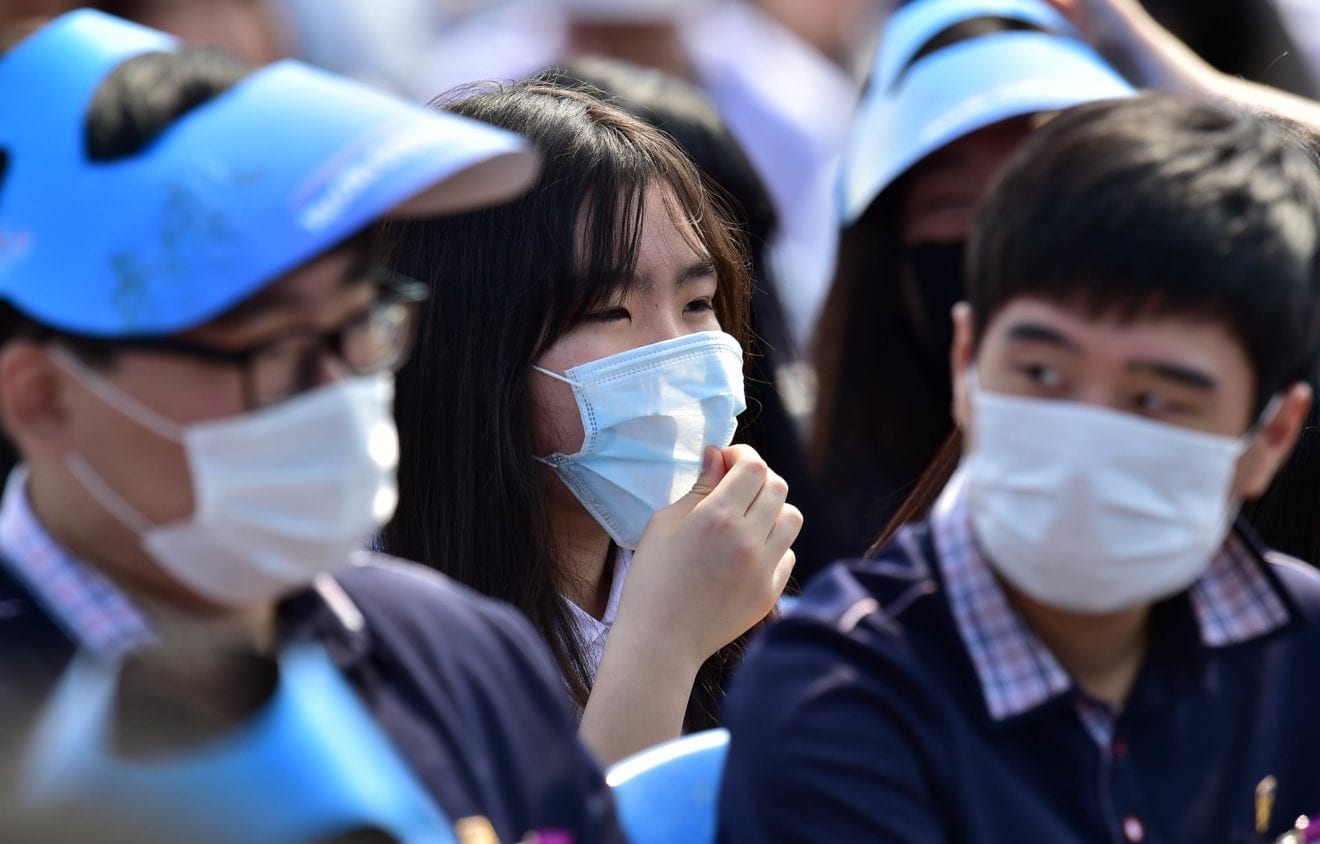
As fine dust blows into Korea, demand for products that defend against pollution spike. According to an Emart study released Friday, mask sales between Jan. 10 and Jan. 16 surged 458 percent from the same period a year earlier while the sales of air purifiers are up 414 percent. Usually, the products are in high demand around late February and in March, when the yellow dust from the northern deserts descend on the Korean Peninsula. But sales this year are already 95 percent of the total usually reported in March.
Sales of consumer appliances that clean clothing, such as LG’s Styler clothes closest, are up 186 percent compared to the same period a year ago, according to the retailer. Sales of dryers have increased 67 percent as the worsening pollution has made it difficult to dry laundry outdoors.
Emart said it will be holding a special sale on fine-dust countering goods through Jan. 30.
It plans to offer discounts on the bulk purchase of masks: 10 percent when buying two and 30 percent when buying three at a time.
The Samsung Electronics air purifier with model number AX6ON5081 WDD will be sold at 379,000 won ($338), a 90,000 won discount, while Coway’s AP-1818C model will be sold at 439,000 won, a 60,000 won discount. The purchase of Coway’s air purifier also comes with 85,000 won worth of additional filters and 50,000 won in gift certificates.
The retailer is also providing discounts on vacuum cleaners, including Dyson’s V10 Fluffy, the LG Electronics A9, which also has a mopping feature, Samsung’s VS8ON8062KKS and Tepal’s Air Force 360.
Online shopping malls are ramping up their marketing of fine dust-related products. Coupang has been promoting 650,000 fine-dust products since Jan. 10.
An exclusive study by the JoongAng Ilbo found that much of the recent air pollution is coming from China.
The Korean Meteorological Administration is forecasting a return of high fine-dust readings. It said the level of concentration of pollutants started rising on Friday and will continue to increase today.
When the concentration is at 15 micrograms per square meter or lower, the government rates the air quality as “good.” When it is between 16 and 35, it is deemed “normal.” When the figure is between 36 and 75, the government rates the air quality as “bad.”
On Jan. 14, the fine-dust concentrations in the greater Seoul area peaked at 122 micrograms per square meter, the highest level since related data was first collected in 2015.
That was two days after air pollution in major areas in China, including Beijing, Tianjin, Tangshan and Hubei Province, peaked.
The Korean Meteorological Administration forecasts air pollution levels dropping from Sunday afternoon.
Kweather, a private weather company, has advised people to stay indoors over the weekend and wear a protective mask when having to go outside.
Sensors on roads will be able to alert cars when people are jaywalking and bus stops will tell buses to slow down in crowded areas when Seoul’s 5G infrastructure is ready, the city’s government and SK Telecom said in a joint statement Thursday. The Seoul Metropolitan Government and SK Telecom have teamed up on an initiative called the Cooperative-Intelligent Transport System, an upgrade of the current transportation system in Seoul. The pilot program will run until the end of 2020 with a budget of roughly 25.4 billion won ($22.6 million).
Seoul already has a digitized public transportation system with signboards at bus stops telling passengers when the next bus is coming and whether it is crowded, and T-Money cards that enable people to transfer between various means of public transportation with little additional cost. The city aims to use 5G to make that transport system even safer.
SK Telecom will supply 2,000 5G devices for buses, taxis and traffic signal controllers so they can connect with the 5G network. The mobile carrier said the devices will be co-developed with Samsung Electronics.
Buses and taxis installed with 5G will constantly share data with bus stops, traffic lights and other traffic infrastructure. SK Telecom and the Seoul government will look for dangerous situations by analyzing the shared data to prevent accidents. As SK Telecom operates the country’s largest navigation app – T Map – the carrier said it will send out warnings through the app to reach the largest number of drivers possible.
SK Telecom said there are about 30 safety services the 5G-based transportation system can offer.
Roads installed with 5G sensors can detect jaywalkers, the mobile carrier said. While cars may have difficulty spotting people in the dark or during bad weather, 5G-connected sensors will alert nearby cars and prevent accidents. In 2017, 9,590 accidents were caused by jaywalkers, the largest cause of road accidents for pedestrians, according to data from the Korea Road Traffic Authority.
The country’s largest telecom company also said 5G connectivity between cars can prevent secondary accidents by sending warning messages to following cars when an accidents occur in areas with poor visibility, such as around a corner or a bend in the road.
As well as partnering on safety services, Seoul and SK Telecom are also preparing to jointly establish an autonomous driving test-bed in Sangam-dong, western Seoul, by the first half of this year. A self-driving vehicle will run back and forth between Digital Media City Station and buildings in the area. The SK Telecom-operated autonomous vehicle will begin running in the area from June at the earliest.
“The Cooperative-Intelligent Transport System project is a futuristic business that combines state-of-the-art digital technologies, like 5G, autonomous driving, artificial intelligence (AI) and the cloud,” said Ryu Young-sang, an executive vice president of SK Telecom. “We hope to offer a range of traffic safety data to Seoul citizens using 5G and reduce traffic accidents.”
Korean tourism authorities were set on January 14 for the official opening of the Korea Grand Sale, an annual event for foreign shoppers with events, promotions and sales across the country. This year’s event, jointly hosted by the Ministry of Culture, Sports and Tourism and the Visit Korea Committee, will be held from January 17 until February 28.
The theme of this year is “Travel, Taste, Touch,” and will offer benefits of varying degrees from 51,497 businesses. According to the ministry, around 850 enterprises will hold sales, including discounts of up to 97 percent on flights to Korea from airlines including Air Seoul.
Up to 25 percent discount will be provided at eateries at the top-notch hotels across the country.
According to a survey on what foreigners did while visiting Korea conducted by the ministry, 72.5 percent of all foreign visitors in 2017 said shopping, while 58.2 percent said eating and tourism.
A tourism program featuring restaurants with over 50 years of history — including “Cheongjinok,” “Ureok,” “Hadongkwan,” “Joseonok” and “Yeolchajib” will be held with Korean celebrity chefs as guides. Other packages include Korean food and temple food for foriengers, and ski packages.
For those who need assistance, a welcome center will be open throughout the festival period at Cheonggye Plaza in Jongno-gu, Seoul from 12 p.m. to 8 p.m. Tour guides will circulate popular tourist areas like Hongdae or Dongdaemun, accompanied by interpretation services.
A welcome booth for foreigners will operate at Incheon International Airport and Gimpo International Airport from February 1-8, to coincide with the Chinese and Korean Lunar New Year holidays.
At the welcome center, Korea Tour Card will be given free to the first 50 visitors every day. The 10,000th visitor will receive a coupon for a stay at a local hotel.
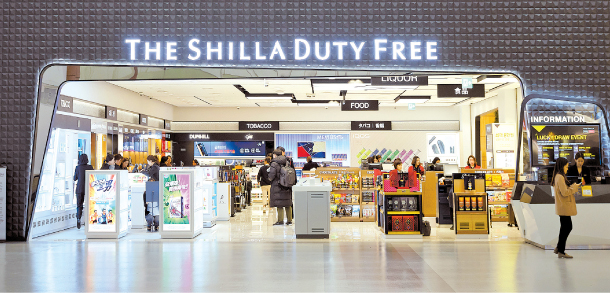
Shilla Duty Free opens at Gimpo International Airport’s international terminal on Wednesday. The duty-free store run by Hotel Shilla was approved by the government in June last year in a bid against Lotte Duty Free. The duty-free store is renting the place for five years.
Storefront, the world’s largest online marketplace for short-term retail space, has officially launched in Seoul. Retail vacancy rates in Korea are on the rise due to a prolonged recession, and more brands are diverting their interests from traditional retail to offer a quality experience to customers in the form of pop-up stores and short-term leases. Storefront has partnered with the Korean marketing and retail firm Kcent to register qualified spaces, sign up leading and emerging brands and give them tools to successfully market their short-term space. The Storefront site will now offer thousands of spaces across Seoul available for pop-up stores, showrooms, and event spaces.
Storefront maintains a global presence with thousands of quality retail spaces across the world’s largest cities from Paris to London, New York and Hong Kong. This advantage allows any brand to pop-up in any location, test new markets and even launch simultaneously in more than one location worldwide.
Retail sales in Korea totaled $343 billion in 2016, and this latest partnership in Seoul signals Storefront’s break into the East Asian market with their brand, technology and insights combined with local talent and market expertise.
“Korea is APAC’s 3rd largest retail market, and most of it is based in Seoul. Pop-up stores and other forms of short-term rentals are already creating a buzz in the trend-savvy Korean market.
All we needed was a transparent and efficient marketplace like Storefront to leverage this trend.” said Jin Yong Kim, Kcent’s CTO.
“Korea has a unique culture and language barrier that make it hard for foreign brands to expand their business here. But if they have the right partner and know how to tell their story to Korean consumers, it can be a matter of a few days before they go viral.” adds Kim.
“Storefront is redefining how companies can locate and activate temporary retail space with its global marketplace for connecting tenants and property owners in an efficient, flexible and transparent way. We are excited to partner with Kcent to bring our expertise to this fast-growing retail capital and introduce the benefits of pop-up stores to thousands of merchants looking to expand into Korea.” said Benoît Clément-Bollée, General Manager, Storefront Asia .
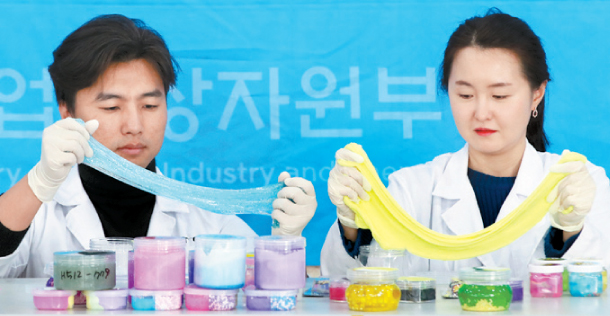
Scientists have discovered potentially dangerous levels of boron in children’s slime. On Wednesday, Seoul National University scientists from the school’s Institute of Health & Environment wrote in a scientific journal that 25 out of 30 slime toys they analyzed were found to contain boron levels that exceeded the European Union limit of 300 milligrams per kilogram (2.2 pounds).
The 25 products were found to contain around 1,000 milligrams per kilogram on average, while one product was found to exceed the limit by seven times.
While boron, which gives slime its gooey consistency, is naturally found in food like nuts and used in medicine, high doses or exposure may lead to possible disruptions in metabolism, stunted development and infertility.
There are currently no domestic regulations on boron limits in toys.
The new findings are throwing parents into a panic, given slime’s massive popularity. Videos of Korean YouTubers playing with slime have garnered millions of views, while over 100 slime cafes have also popped up.
“My kids are already obsessed with slime toys,” wrote one mother in a blog on Thursday. “We need regulations quickly, but nothing is being done.”
“I banned slime from our home some time ago,” wrote another. “Though my kids like them, the slime toys are just balls of germs that my kids touch over and over again, absorbing the bad chemicals into their hands.”
This is not the first time that slime has been under fire for containing hazardous substances. Last year, the Korean Agency for Technology and Standards found that 76 of 190 slime products it tested contained unsafe substances including methylisothiazolinone and chloromethylisothiazolinone, which can cause respiratory issues.
The agency has since ordered a recall for the unsafe products.
In recent years, the term “culture complex” has often been seen on social media. Postings showing people spending time at these spaces are shared often, attached with hashtags that read “culture life,” “leisure time” and “relaxation.” Culture complexes have risen as popular city destinations for young Seoulites. Buildings housing exhibition halls, cafes, restaurants and design shops bill themselves as culture complexes.
According to last year’s “Where to Live,” a book by Yoo Hyun-joon, an architect and professor, the younger generation has been exhibiting their identities on social media by sharing the kind of clothes that they wear and the kind of food that they eat. Now, it is about the space — the kind of spaces where you spend your time.
To satisfy such desires, culture complexes compete to house the trendiest tenants. What also matters is how well such culture complexes go with the neighborhoods they inhabit.
The Wooran Foundation building in Seongsu-dong, eastern Seoul, is a case in point. The neighborhood is often referred to as the Brooklyn of Seoul, as young artists and hipsters have flocked to the old abandoned factories in the area.
The new 12-story building stands out in the generally low-rise neighborhood. But the architectural design shares the Brooklyn mood with layers of gray concrete and an industrial mood.
Cafe Dorrell, a Jeju Island import, on the first floor is one of the trendiest coffee franchises of 2018. The interior is decorated with skateboards, matching the young and hip atmosphere of the area.
The culture complex has five halls for exhibitions and performances, ready to host all genres of artistic activities.
Founded in 2014, the Wooran Foundation, is a cultural foundation that aims to create sustainable arts and culture ecosystem. President Chey Ki-Won is the younger sister of SK Group Chairman Chey Tae-Won.
Some culture complexes serve as showrooms for companies. For example, Simmons Terrace showcases Simmons mattresses while the Monami Concept Store displays the brand’s stationery products.
Flask Namsan in central Seoul is operated by Market m, a lifestyle design select shop. Located near Myeongdong, the first floor space features design products from interior decorations to furniture. Upstairs, visitors can relax with a cup of Moonshine Coffee from Australia.
The cafe lounge on the third floor is a culture space for lectures, seminars and mentoring sessions. The yet-to-open upper part of the building, from the fourth to sixth floor rooftop, will house more showrooms and restaurants.
“In Korea, we usually meet people at cafes and restaurants. While meeting friends, we can visit these shops and share our lifestyles. I get to know more about what others like and what I like, too,” Kim Ji-hye, an office worker her mid-20s in Seoul, said.
“On the other hand, I sometimes wonder why these places call themselves culture complexes, when they are just spaces for businesses,” Kim said. “I feel like they should have something more than just sales.”
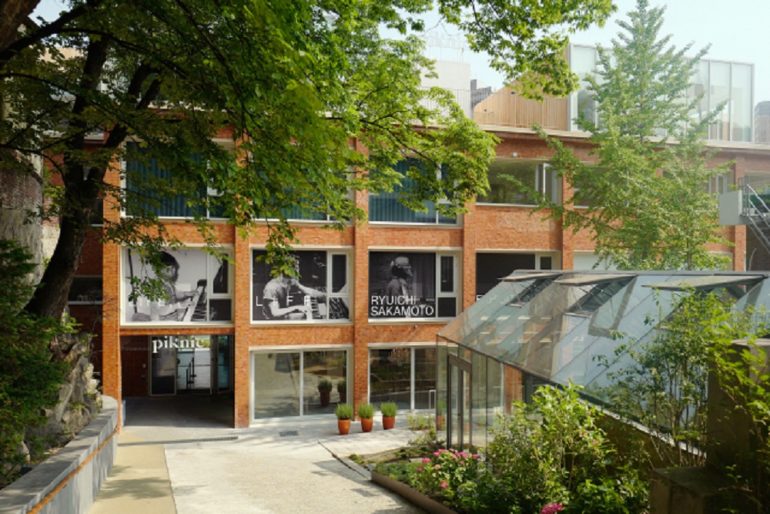
Originally a pharmaceutical company building from the 1970s, Piknic, a culture complex in Hoehyeon-dong, central Seoul, houses Kafe Piknic, a cafe by day and tapas bar by night. Michelin-starred french restaurant Zero Complex is on the third floor.
However, what has made Piknic a popularly recognized name is the exhibition space. Designer brand SJYP held a runway show here during the last Seoul Fashion Week. The space also hosted “Ryuichi Sakamoto: Life Life,” a media art exhibition of the life of the Japanese composer and musician.
The culture space is currently holding “Jasper Morrison: Thingness,” an exhibition of work by the famed British industrial designer. After enjoying the exhibition, visitors can dine at the Kafe Piknic, sitting on a chair designed by Morrison.
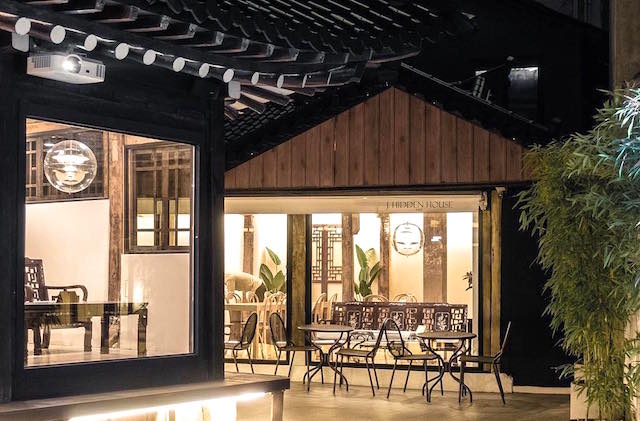
A heritage cafe has been built into the hereditary foundations of a century-old South Korean courtyard house (hanok) in Seoul. J Hidden House cafe opened its doors in the fashion and shopping mecca of Dongdaemun this month, following Seoul’s continued efforts to develop as a trend-setting, global tourist destination. Situated within a spacious 300sqm secluded enclave housing a zen-bamboo garden, the venue blends traditional and modern design and is one of the largest hanoks open to the public today within the traditional inner district of the Chosen dynasty’s (1392–1897) capital, Hanseong – modern Seoul
From a bespoke eight-metre wet bar set in Italian terrazzo tile, J Hidden House offers curated coffees, teas and refreshments, as well as a tailored menu of bakeries and spirits cultivated by Korean food and beverage companies.
J Hidden House’s proprietor Grace Jun said Seoul has become a destination for the world to visit and Korea’s rich culture has so much to offer.
“This establishment is a fusion of our country’s traditional heritage and dynamic modernisation by coupling a cutting-edge modernity within the protected, mindful walls of a ‘hidden’ hanok that was built before the Korean war and has stood the test of time. Our aim is to provide locals and tourists from around the world with a location and a curated food and beverage offering on calibre with any destination cafe in the world, while offering what is uniquely and proudly Korean.”
Located in an exclusive “hidden” but immediately accessible location in downtown Seoul, the destination offers a vision of an earlier and more tranquil age despite being centrally situated in Dongdaemun, one of city’s busiest commercial districts and a major tourist destination for shopping and historical sightseeing.
According to the Korea Tourism Organization, visitors to Korea in the first half of this year increased by 6.9 per cent year on year to 7.22 million. When excluding Chinese visitors, the number of tourists increased 12.2 per cent year on year to 5.05 million people, the largest-ever recorded number of inbound tourists to date.
Korea’s mid-sized cosmetics companies suffered losses in the third quarter of this year as they struggled to reorganize their business structures in the face of tough competition at home, industry sources said Sunday. Able C&C, which operates budget cosmetics brand Missha, swung into the red in the July-September period, posting a net loss of 9.4 billion won ($8.3 million), it said.
Its sales dropped 12.1 percent to 73.1 billion won and operating income swung to a loss of 13.2 billion won. The company said fierce competition in the country’s cosmetics industry, combined with its heavy investment in research and development of new products, led to the poor earnings results.
Tonymoly reported a net loss of 3.5 billion won, with 800 million won in operating losses on a consolidated basis during the cited period, according to the company.
Korea’s mid-sized beauty firms’ profitability deteriorated following a diplomatic row between Seoul and Beijing last year, which led to a sharp drop in the number of tourists coming to Korea. Industry watchers said the expansion of online and duty-free channels has hurt the mid-sized companies, which rely heavily on offline stores. Last month, Skinfood was placed under a Seoul court’s receivership after the company said that it is having temporary difficulty securing liquidity due to excessive debt.
“We are making efforts to improve our profitability and strengthen our online business,” an official from Nature Republic said.
Nature Republic reduced the number of its stores to 680 by the first half of this year from 770 in 2015. The company reported 58.8 billion won in sales and 300 million won in operating income in the third quarter of this year.
As aftershocks of the clampdown on Daigous continue to reverberate through the luxury shopping community in China, e-commerce platforms are rising to fill the gap.
The launch of China’s new e-commerce law, coupled with the 928 Daigou crackdown at the Pudong International Airport in Shanghai, has stirred up uncertainty in the global luxury industry.
In fact, LVMH share prices reportedly fell in early October due to fears of a slowdown in Chinese spending.
Earlier this month, Luxury Society attended the live seminar “Reinterpreting the 300-billion Daigou market” hosted by Tencent media.
During a debate, luxury e-commerce platform OFashion’s CEO Xiao Yu and N5 Venture Capital’s founder Xiao Yiwei shared their insights on how luxury buying will likely evolve in the post-Daigou era.
According to Xiao Yu, the estimated Chinese luxury spending in 2018 is 600 billion RMB and Daigou purchases account for half of that, making it an estimated 300-billion industry.
Without Daigou, what is the next best alternative for Chinese consumers looking to buy authentic luxury goods at lower prices?
First, let’s revisit the 928 daigou crackdown in Shanghai’s Pudong airport and take a look at how China’s 300-billion Daigou industry is in danger.
What Happened During The 928 Daigou Crackdown
September 28 2018 marked an important date in the history of Chinese luxury consumption.
In Shanghai Pudong airport, all passengers returning from Seoul were stopped by Chinese customs for baggage inspection.
Seoul has been a classic shopping destination for Daigous to obtain global brands at a discount. More than 100 passengers from same Seoul-Shanghai flight were found guilty of illegal imports.
It was every Daigou’s living nightmare.
One of them relayed the unfolding events through WeChat text messages. Screenshots of this message thread eventually made its way online.
The messages read,
“In the line to pay my fine”
“I was live streaming in duty free shop during the day, but live streaming fine payment during the night (face palm emoji)”
Source: Sohu, A Daigou’s WeChat record of 928 crackdown got popular online.
Whether as a full-time profession or simply a hobby, the Daigou business is one based on relationships.
In fact, the first clients of most Daigous are generally from his or her own social network.
Since Daigous operate in a legal gray area and rely solely on private transactions, customers often have a hard time verifying the authenticity of their purchases.
Needless to say, seeking redress in the case of fraud is difficult or near impossible.
Within the last decade or so, Daigous have become rather ubiquitous.
Chinese netizens often joke on social media that “everyone has a Daigou friend on his/her WeChat”, or “Daigou is our generation’s best marketing guru”.
Rumors of Daigous making a minimum of $100k USD a year and buying houses while still in college flood the internet, making the Daigou profession both a mysterious and highly coveted one in China.
On September 28, however, this all came to a screeching halt.
Within a night, the image of Daigous as self-made businessmen was reduced to that of illegal importers.
Chinese Luxury Consumers Have Changed
The Daigou business flourished in China largely because of strong domestic demand for global luxury products. This demand is quickly changing.
During the seminar, OFashion’s CEO Xiao Yu offered his observations on shifting consumer tastes by analyzing the purchase data of its platform’s 3 million active buyers.
Here are our major takeaways.
1. Chinese Consumers Love Buying “Hits”
The biggest difference between luxury consumers from China and those from mature markets is that Chinese consumers prefer mainstream “hit” items, while mature market consumers also buy a brand’s long-tail (niche) products.
2. Entry-Level Luxury Sells Best
Out of all the luxury product categories, entry-level items with a price range of 2000-5000RMB (430-730USD) exhibit the strongest sales performance.
3. Consumer Tastes Have Diversified
While Chinese consumers concentrated their research on highly famous luxury brands in the past, they are now much more receptive to niche brands.
Bestselling product styles have also shifted from traditional classics like the Salvatore Ferragamo ballet flat, to streetwear brands.
Additionally, Chinese consumers are now searching more about domestic brands compared to four years ago, when most searches were about established global brands.
4. TheLipstick Effect Doesn’t Quite Apply In China
Considered an entry-level luxury product, lipsticks have been selling like hot cakes in the Chinese market recently.
While the “lipstick effect” – a global economic theory that postulates the correlation between beauty product sales and economic downturns – may hold true in many markets, industry professionals have stressed that it might not necessarily be the case in China.
While China might be in the midst of a lipstick craze, experts have noted that lifestyle brands that are inspiring, soulful, and fun, can still rise to the top of the market quickly.
How Platforms Can Rise To The Challenge
Now with the individual Daigou business in danger, it’s time for luxury cross-border platforms to shine.
As the live seminar’s two speakers noted, inefficiency is still a huge pain point in the cross-border industry.
That said, cross-border solutions aiming to improve efficiency would likely to grow fast.
As the luxury buying business faces tightening controls by regulators, consumers are turning to professional buyers, reliable platforms, or buyer’s platforms — a combination of the former two.
Besides established luxury e-commerce platforms such as Tmall Global, JD’s Toplife, Secoo and VIP, platforms that specialize in serving professional buyers are booming, too.
Tmall Global’s Luxury Direct has turned buyers into consultants and made fashion-consulting service a selling point.
The platform’s “About” page reads, “Our buying team takes orders straight from fashion weeks and selects products from brand official showrooms all across Europe.”
OFashion’s app “Buyer Box”, an app targeting professional buyers, has even a CRM (Client Relationship Management) system for users to personalize a client’s order.
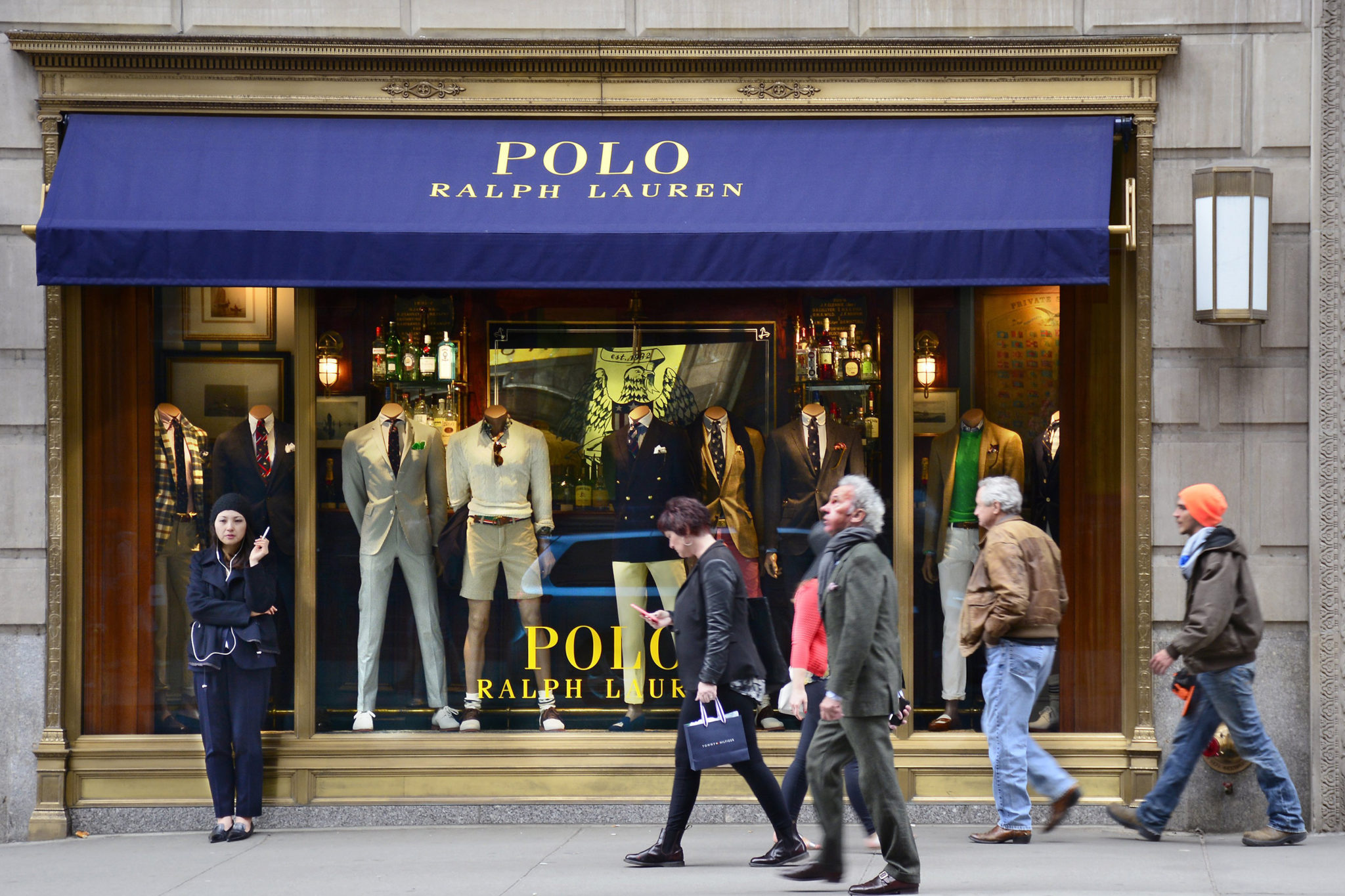
Streetwear label Palace and Polo Ralph Lauren, the luxury fashion brand, have brought their recent collaboration to Seoul after a show in London. The hotly anticipated crossover saw queues forming from the night before its Saturday morning release at the RL Garosu store to secure purchases of premium limited-edition items.
Popular products included a Kickflip Polo Bear knit sweater and teddy bear, both of which were posted online within an hour of selling out at sizeable markups.
Buyers were limited to purchases of one item per product and up to 10 products in total.
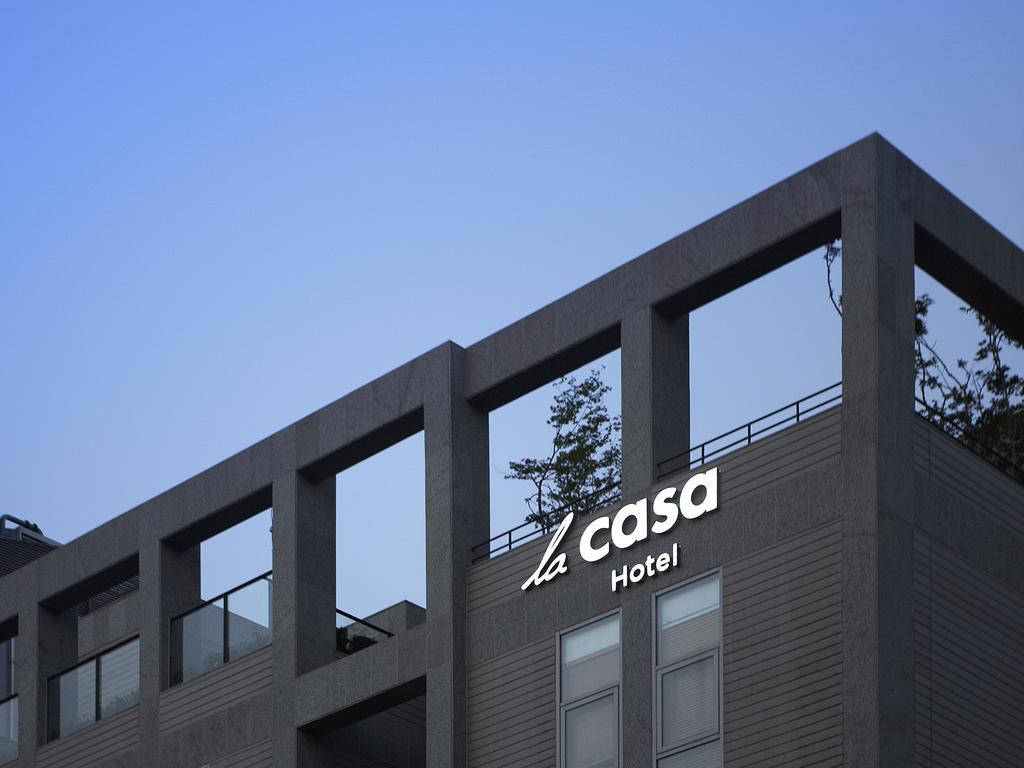
The Lacasa Hotel Gwangmyeong opened its doors on Monday in Gwangmyeong, Gyeonggi. This is the second branch of the boutique hotel brand Lacasa which launched in Sinsa-dong, Gangnam District, southern Seoul in 2011.
It is located inside the Lacasa Tower between the seventh and 16th floors, and has 191 rooms and three penthouses. The hotel offers a green view from its windows. On the seventh floor is an outdoor garden.
“Our goal is to make Lacasa Hotel Gwangmyeong into a comprehensive space for rest, culture, shopping and business,” said Choi Yoon-kyung, the vice president of Lacasa Hotel.
To celebrate the opening, Lacasa will hold a classical music concert for locals on Nov. 17 inside the new venue.
South Korea’s KT has announced plans to expand the reach of its self-developed AI technology with the launch of services for hotels and smart cities in Southeast Asia.
The operator will introduce customized AI solutions for the market, starting with Vietnam.
KT last month entered an agreement with Vietnam’s largest construction company Hoa Binh Construction Group (HBC) JVC for the provision of AI-powered hotel and apartment services in Southeast Asia. The partners have also agreed to subsequently co-operate on smart building and city projects in major metros in the region.
KT used its platform to launch the first hotel in South Korea to offer AI-assisted room services in July – a Novotel Ambassador hotel in Seoul – and plans to open three more smart hotels across Seoul by 2020.
The company’s hotel AI service platform is a customization of KT’s GiGA Genie AI powered smart home media hub, which launched in 2017 and now has more than 1 million subscribers in South Korea.
“It’s a big first step for KT’s AI platform to reach out to the world, thanks to the partnership with HBC,” KT marketing group senior vice president Lee Pil-Jai said. “With great success in South Korea, we will step up efforts to localize our AI hotel service and smart city solutions for Southeast Asia and beyond.”