Retail News CRM

Category: Startups

Retail News Asia is committed to providing both local and global retailers with the latest Startup news throughout the Asian market. This on a daily base.

  • Vietnamese internet startup VNG files for IPO in the US

    Vietnamese internet startup VNG files for IPO in the US

    Vietnamese internet company VNG Corp has filed for an initial public offering (IPO) in the United States via VNG Ltd, a U.S. Securities and Exchange Commission filing showed.

    The listing will make VNG the first technology firm from Vietnam to list in the U.S.

    VNG said in the filing that it planned to offer some 21.7 million shares, with the proposed price range yet to be set.

    IPO proceeds will be used to pay original foreign investors who were direct shareholders of the company and repay outstanding loans, among others, the filing showed.

    The company counts the likes of Chinese social media and gaming giant Tencent and Singapore state investor Temasek as shareholders.

    Founded in 2004, VNG was Vietnam’s first unicorn, or startup valued at $1 billion or more, and it inked a preliminary agreement in 2017 with U.S. bourse operator Nasdaq Inc to explore an IPO.

    The Ho Chi Minh City-headquartered company’s businesses include online games, payments, cloud services and Vietnam’s most popular messaging app, Zalo.

    Citigroup, Morgan Stanley, UBS, and Bank of America are underwriters of the IPO, according to the filing.

    VNG’s IPO follows the recent U.S listing debut by VinFast and could help to add momentum for other Southeast Asian companies seeking IPO in the U.S.

    Philippine real estate company DoubleDragon Corp earlier in August announced that it was considering listing its Singapore-registered unit Hotel101 Global on the Nasdaq via a merger with a special purpose acquisition company (SPAC).

    Southeast Asian used car marketplace Carsome Group was also weighing a listing in the U.S.

    “While the future outcomes of these startups’ IPO plans cannot be guaranteed, the growing interest in international listings and the presence of notable players in the region indicate a promising landscape for Southeast Asian startups seeking to expand their reach and access global capital markets,” said Seth Farbman, chairman and co-founder of New York-based stock transfer agency VStock Transfer.

  • Food tech company Enough raises 40 million euros

    Food tech company Enough raises 40 million euros

    Food technology company Enough, which has partnerships with Unilever and Marks & Spencer, has raised $43.5 million, attracting investment despite signs of a slowdown in the alternative meat and protein sector.

    Enough, which ferments fungi to produce protein for plant-based chicken, mince and dairy products, said the funding round was led by venture capital firm World Fund and CPT Capital, which was an early investor in Beyond Meat and has a stake in Upside Foods.

    Other participants in the fund-raising for Britain- and Netherlands-based Enough included existing investors such as AXA IM Alts and the Olympic Investments company of the Onassis shipping family.

    “Enough has made great strides in the past few years to launch our new factory in the Netherlands and scale up to work with customers across the UK and Europe,” said CEO Jim Laird, a former chief executive of plant-based meat producer Quorn.

    “With this new funding, we will accelerate that growth,” he added.

    Companies involved in producing alternative-sources of meat and protein say they are helping in the battle to protect the climate, since meat from a laboratory has less impact on the environment than traditional farming.

    Nevertheless, there are signs that consumers’ demand for plant-based meat may be waning, with Beyond Meat cutting its annual revenue forecast earlier this month.

  • Motorbike taxi driving unsustainable for laid off workers

    Motorbike taxi driving unsustainable for laid off workers

    More than a few workers made unemployed by increasing layoffs in Vietnam recently have become motorcycle taxi drivers only to realize it’s not a lasting solution.

    After starting his workday at 5 a.m., at 10 a.m. Le Van Manh had completed only one trip, which made him VND40,000 (around $1.7) in cash.

    Manh started working as a motorbike taxi driver four months ago, after two years suffering from his old factory’s unstable business performances.

    “The factory started layoffs, forced us to work overtime, and cut down on our salaries,” he said.

    His income as a factory worker used to be around VND20 million, but was reduced to only half that starting last year. Not being able to get by with that income, he quit his job and turned to ride-hailing applications, hoping for better financial rewards.

    Manh spent around 12 hours a day on the road after his career turning point. Things went smoothly at first, as he was able to earn between VND400,000 and VND500,000 a day during the first two months working as a motorbike taxi driver.

    But the number of drivers has increased over the recent months, and Manh now has to share his customer pool with his new “colleagues,” and thus, earn a lower income of only VND300,000, or even VND100,000 sometimes, per day.

    “I can only complete around 10 trips a day now, compared to over 20 trips a day before,” he said.

    According to data published by the General Statistics Office of Vietnam, more than 149,000 workers lost their jobs in Q1 this year, 13% higher than the previous quarter. Of these laid off workers, most worked in companies in the FDI sector based at industrial areas in and around the provinces of Dong Nai, Binh Duong, Bac Ninh, Bac Giang.

    The Private Sector Development Research Board projected that the layoff wave could continue in this year’s second half, due to both external and internal challenges for businesses.

    Not requiring any educational background or specific skill sets, motorbike taxi drivers are the first career choice for many laid off workers to make a new living.

    Hoang Van Trieu, a former truck driver at a Binh Duong-based wood warehouse, started working as a full-time motorcycle taxi driver three months ago, after becoming unemployed when his company went bankrupt. Having expected that the new occupation would help him cover his living expenses, he got depressed after a while.

    “I spend about 10 to 11 hours a day, in exchange for between VND300,000 and VND400,000,” he said. “I cannot get by if I maintain this as my full-time job.”

    He is now trying to look around for other career opportunities. The best scenario he can think of is being able to find an office job, which allows him to leave at around 4 p.m. or 5 p.m., so that he can hit the road and start the second “working shift” of his day as a motorcycle taxi driver until before midnight.

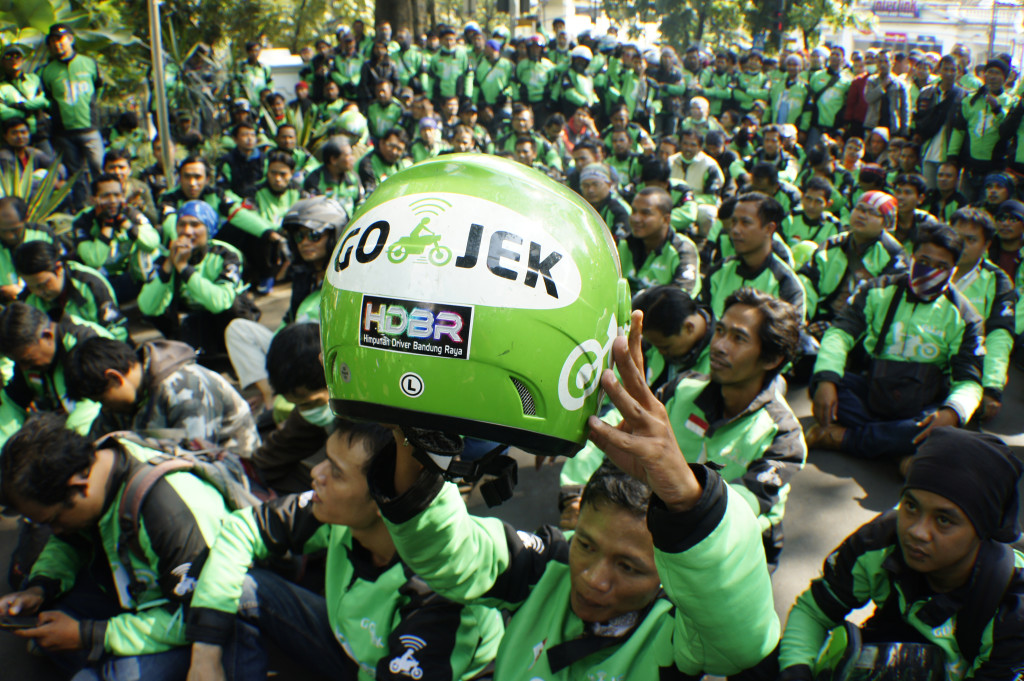
    Ride-hailing applications, of which the most popular in Vietnam are Grab, Gojek, and Be, were once considered a life saver for those that were looking for another occupation, including laid off workers looking for career chances or fresh graduates waiting for a job after finishing school.

    The Vietnam General Confederation of Labor estimated in 2021 that there were over 200,000 partner drivers working with Grab, which rose from around 175,000 in 2018. Of these, around 26% graduated from a higher educational institution or equivalent.

    Gojek reported that the platform surpassed 200,000 drivers in mid-2021, while Be announced that the number of its partner drivers surpassed 100,000 at the beginning of the same year.

    Drivers’ daily income was as high as between VND500,000 and VND600,000 at that time.

    However, things have become harder for drivers recently. The supply of drivers increased and the fees taken out by the applications rose and currently range between 30% and 39% of the amount charged to customers. All of these mean it has become harder for drivers to maintain their income.

    Nguyen Dinh Vuong, former worker at a Hanoi-based leather company, decided to return to his hometown after months of suffering from this “high cost, low reward” job. He spent around 12 hours working a day to get between VND300,000 and VND400,000 in return. With this income, he did not have much left after paying his bills.

    “Motorcycle taxi drivers in Hanoi have to work at least 12 hours to earn enough to get by,” he said. “The cost of living in my hometown Thanh Hoa is lower, so I spend less, and don’t have to work that hard.”

    According to him, many former industrial workers, who were laid off due to the downfall in the orders, are trying their best to get by, in the hope of an economic recovery that will lead to improved business performances and thus, higher demand for labor.

    Dr. Huynh Thanh Dien, an economic expert, made a prediction aligning with this hope. He projected that the labor market would soon retrieve a state of stability and temporary motorcycle taxi drivers would soon be able to return to their occupations.

    He also warned that partner drivers for ride-hailing applications should not be considered a long-term career goal, as the job cannot provide a stable income in the long run. Instead, it should be treated as a temporary “cover” occupation only while the economy follows its natural rhythm and proceeds on its way to recovery.

    In the meantime, these people have no other choices than optimistically enduring.

    “The economy can’t be gloomy forever,” Manh said. “As I heard from the news, the situation is predicted to become better in 2024, so I will try to get by and wait until then.”


  • Fintech startup GIMO completes $17M fund-raising round

    Fintech startup GIMO completes $17M fund-raising round

    Vietnam-based fintech startup GIMO, which seeks to provide flexible salary payments to blue-collar workers, has completed its Series A funding round, raising $17.1 million.

    The final closing, comprised of a mixture of equity and debt financing, is led by venture fund TNB Aura, with participation from the company’s existing backers including Integra Partners, Resolution Ventures, Blauwpark Partners, ThinkZone Ventures, and Y Combinator, according to a press release of the company.

    “We look forward to working closely with the GIMO team in breaking down barriers to financial inclusion for millions of blue-collar workers across Vietnam,” said Charles Wong, founding partner of TNB Aura.

    GIMO offers near-instant payroll to blue-collar workers whenever they need it.

    It allows employees to access their earned salary via a mobile app integrated with the company’s payroll system. Users can also keep track of their workdays and daily earnings.

    GIMO currently serves 500,000 workers from medium to large-sized multinational manufacturing companies across Vietnam.

    Despite the economic slowdown in 2023, the company has demonstrated a solid growth rate of 15% and is on track to reach 2.5 million underbanked employees by 2025.

    The funding will be used to develop its products, increase customer experience, and establish strategic partnerships.

    Research by professional services firm KPMG in 2022 showed that an average user draws their earned pay two to three times per month, almost simulating bi-weekly and weekly pay.

    A flexible pay cycle takes the burden off blue-collar workers’ shoulders by helping them pay for financial emergencies and everyday bills.

  • Sydney startup RecycleSmart raises $1 million on Birchal

    Sydney startup RecycleSmart raises $1 million on Birchal

    Australian investors have poured more than $1 million into plastics recycling service RecycleSmart, as co-founder Marco Prayer says he has invested his entire career to proving the business benefits of the circular economy.

    Sydney-based RecycleSmart provides households with a way to dispose of recyclable plastics that are unsuitable for regular recycling bins, offering to pick up unwanted waste from a customer’s doorstep.

    The startup accepts soft plastics, clothes, shoes, and small e-waste, with those materials sorted and transferred to specialist recycling partners like APR Plastics, Mobile Muster, and the Red Cross, which accepts unwanted but wearable clothing.

    The company claims to have facilitated 115,000 pick-ups since 2019, keeping 400 tonnes of hard-to-recycle waste out of landfill.

    RecycleSmart closed its Birchal equity crowdfunding raise on Thursday night, booking $1.04 million from 965 investors.

    While the business got its start by selling its services to NSW councils, it now hopes to use the new funding to expand in capital cities nationwide, while expanding its DTC and B2B offerings. Co-founder and chief technical officer Marco Prayer says RecycleSmart will use funding from the “astonishing” raise to power its launch in Melbourne, with the goal of covering as many major metro areas as possible by the end of 2023.

    “We need to make sure that the recyclers have the capacity to manage, that we have the right infrastructure in place, that everything is safe, but so far, so good,” Prayer said on Monday.

    Without delving into specific revenue figures, Prayer says RecycleSmart is enjoying “healthy” margins, and states its core business model is scalable, meaning expansion won’t come at too high a cost.

    Reaching more councils remains a priority, but RecycleSmart hopes to diversify by reaching out to household customers, building managers, and even businesses themselves.

    The company says its DTC offering would allow users to schedule pickups for $5 a bag, with a minimum of two bags per pickup.

    Beyond the cost to customers, RecycleSmart is conscious of the need to prove the efficacy and sustainability of its process to would-be customers.

    Australian households are still adapting to the high-profile collapse of the RedCycle soft plastic recycling scheme in 2022, which highlighted the difficulties in recycling some forms of single-use plastic.

    The business is “trying to really deliver as much transparency as possible to our customers,” Prayer said, using social media to show how its partners repurpose the materials RecycleSmart collects.

    “We know very well that the first step is establishing trust with anyone in the waste industry, and if you want to play that role, we know that we have to go an extra mile and verify as much as possible,” he added.

    What appears to captivate Prayer is the possibility of working with major businesses as they adopt a circular economy model.

    Like fellow Australian recycling startup Seabin, RecycleSmart collects data on the types of waste it receives.

    It then passes those findings onto councils, enabling city planners to run education campaigns for residents confused about how to best dispose of their waste.

    But Prayer sees a massive opportunity in providing that same data to businesses, given the increasing push for sustainability and traceability across the supply chain.

    “We strongly believe that there’s going to be an opportunity for businesses to leverage RecycleSmart to really ‘green up’ their operations,” he said.

    Prayer also touts the benefits of integrating the startup’s offerings into a business’s overall operations.

    “A simple example is that we hope shopping online at The Iconic, for example, if you spend more than $100 with them, they give you [cash back] to spend with RecycleSmart for your next pickup.”

    Pointing to businesses like meal delivery service HelloFresh, which prioritises recyclable packaging, Prayer said ensuring packaging circularity is a powerful customer retention tool.

    “That is going to be the game changer,” he added.

    “I mean, I’ve invested basically my professional life into believing that result is definitely achievable.”

    Participants in the equity crowdfunding raise are largely existing supporters, Prayer said, suggesting that building that engaged fanbase — and proving their demand for recycling solutions — could build RecycleSmart’s appeal to brands.

    The $1 million raise comes at a unique point for the equity crowdfunding sector, which has seen a 26% year-on-year decrease in funding value through choppy economic conditions.

    However, Birchal co-founder Matt Vitale today pointed to RecycleSmart, among others, as recent success stories.

    “We are a couple of weeks into the new financial year and Birchal has achieved over $6 million in funding volume across five campaigns already, more than double compared to this time last year,” he wrote on social media Monday.

    The number of successful equity crowdfunding rounds over the last year also surpassed the number of ASX IPOs, Vitale added.

  • Agritech firm FoodMap raises $1M

    Agritech firm FoodMap raises $1M

    Vietnamese agritech company FoodMap has raised $1 million in a bridge round from foreign investors to expand its presence to new markets.

    Founder and CEO Tung Pham said that existing investors including Vulpes Investment Management, Beenext and Wavemaker Partners participated in this round.

    A Singapore family office also joined as a new investor.

    The Ho Chi Minh City-based company has received a total of $4.5 million in funding since its establishment in 2020.

    FoodMap connects farmers and small and medium-size agricultural producers with consumers to provide transparency and traceability of farming products.

    The company offers its services via website and smartphone app.

  • Grab cuts 1000 jobs

    Grab cuts 1000 jobs

    Singapore-based Grab Holdings, Southeast Asia’s leading ride-hailing and food delivery app, is cutting 1,000 jobs or 11 per cent of its workforce, its CEO said on Tuesday, citing the need to manage costs and ensure more affordable services long term.

    In a letter sent to employees late on Tuesday and seen by Reuters, chief executive Anthony Tan said the cuts, the biggest since the start of the pandemic, were not “a shortcut to profitability” but a strategic reorganisation to adapt to the business environment.

    “Change has never been this fast. Technology such as generative AI (artificial intelligence) is evolving at breakneck speed. The cost of capital has gone up, directly impacting the competitive landscape,” Tan said in the letter.

    “We must combine our scale with nimble execution and cost leadership, so that we can sustainably offer even more affordable services and deepen our penetration of the masses.”

    Tan said that even without layoffs, Grab had managed costs and should hit its target for group adjusted EBITDA breakeven this year.

    The “superapp”, founded in 2012, offers deliveries, rides and financial services in eight Southeast Asian countries, including Indonesia, Malaysia, the Philippines, Singapore, Thailand, and Vietnam.

    Its shares were up 4.7 percent premarket after Tan’s announcement to staff. The stock had climbed as much as 5.6 percent premarket, extending earlier gains on a Bloomberg News report of the cuts.

    The layoffs follow a similar move last year by Indonesian tech firm GoTo, which offers rides, e-commerce and financial services. It has undergone strict cost-cutting, including axing 12% of its workforce in 2022. It laid off a further 600 staff in March.

    Its incoming CEO is planning to head the firm only temporarily and quit after improving profitability, sources told Reuters last week.

    In May, Grab reported a quarterly loss of $250 million but said revenue in the first quarter of this year rose 130.3 percent to $525 million from a year ago.

    In February, it issued an upbeat forecast for full-year revenue for 2023 and brought forward its profitability timeline.

    The US-listed Grab’s last job cuts were in 2020, when 360 people were laid off in response to the impact of the pandemic. The company had 11,934 staff as of the end of 2022, including about 2,000 from its acquisition of a grocery chain last year, its latest annual report said.

    In September last year, it said it had no plans to undertake mass layoffs despite the weak market. In December, Tan told staff the company was freezing most hiring, payrises for senior managers, and cutting travel and expense budgets.

  • Indonesian Based Apparel Startup Claude sewn the Seed in Funding

    Indonesian Based Apparel Startup Claude sewn the Seed in Funding

    The fast growing direct-to-consumer apparel company, Claude, that aims to be everyone’s go to brand for going shopping has just announced the closing of its seed round.

    This independent brand that introduces relevant elevated looks has been busy stealing the hearts of the global market, stepping out from the comfort zone of domestic base and successfully penetrate international waters, from Southeast Asia, to Europe, to the United States. Suspected to be one of the first brands from Indonesia that are daring to be global and succeeded. “In this globalized world where technology enables us to cross-border real-time, becoming global immediately enhances your total addressable market hundred times over while simultaneously strengthening the strong brand equity we carefully preserve”, Co-Founder and CEO Tommy Budihardjo says.

    Revolutionary in its business model, Claude uses micro-batches system for new designs and produces more only after the demand is proven, hence minimizing waste while enhancing the speed in offering of new designs. Combined with its own real-time analysis, Claude understand the customers’ behaviour and taste real time and therefore can adapt instantly. “Apparel industry is one of the biggest contributor of waste – especially due to unsold stock – the industry is overdue for a change, and we are happy to lead the charge with our business model that successfully cut finished goods waste by 90% and maximize the revenue and profitability at the same time”, the CEO stated.

    Claude’s latest round will be used to enhance current product offerings and strengthen the market it has already penetrated. The fund was led by one of the early-backers of Tokopedia and Kakao Corp, CyberAgent Capital and supported by the family office Prima Fund I. “Indonesia is one of the largest consumer retail markets in the world. With Claude’s strong brand value along with the experiences brought by the management team, we believe that the company could bring its unique value propositions and be well-accepted by the huge Indonesian and SEA apparel markets.”, says Nobuaki Kitagawa, Managing Director of CyberAgent Capital, Inc.

  • Indian car rental service ZoomCar exits Vietnam

    Indian car rental service ZoomCar exits Vietnam

    Indian car rental platform ZoomCar has quit the Vietnamese market after operating for over a year, citing difficulties and further challenges ahead.

    Addressing car owners in an announcement Tuesday afternoon, it promised, however to fulfill all obligations to them and customers.

    Technicians will schedule with the owners to collect the equipment installed on their vehicles.

    They will be paid their dues by June 30.

    ZoomCar was launched in 2013 in India as a platform connecting people owning cars with renters, and came to Ho Chi Minh City in early 2022.

    It had earlier considered investing US$25 million in Vietnam.

    Within the first four months of coming to Vietnam it had around 1,000 cars for lease, and offered large discounts to both renters and owners.

    But the discounts started to dwindle gradually.

    Ky, an HCMC’s District 8 owner since March last year, said he was surprised to learn about the company’s exit.

    He had been making less and less money from leasing his car on the app since six months ago.

    “The company took a commission of 40% on each trip, which is high, and forced car owners like us to list our vehicle on the platform all the time.”

    Recent economic difficulties have reduced demand, he added.

  • Education startup TEKY raises $5M from foreign investors

    Education startup TEKY raises $5M from foreign investors

    Education startup TEKY Alpha has raised US$5 million from Singaporean investment firm Sweef Capital to expand its operations.

    TEKY plans to expand its educational services at public schools and after-school programmes for children aged five to 18, Sweef Capital said in a statement.

    The startup, founded by Dao Lan Huong in 2016, delivers science, technology, engineering, the arts and mathematics (STEAM) education.

    It operates 16 STEAM coaching academies in five cities and partners with more than 45 schools to deliver STEAM courses to more than 25,000 children.

    “I’m excited about our expansion plan to open more STEAM centers across the country in the next two years and the prospects of a partnership with public schools to integrate the STEAM curriculum and increase accessibility,” Huong said.

    The International Labour Organization has forecast that 137 million workers in Southeast Asia, or a fifth of the region’s population, will lose their jobs because of automation, robots and artificial intelligence in the next two decades.

    Workers around the world are likely to need to switch jobs and learn new skills, but many of the new jobs created by 2030 by technology would not have existed before.

    Vietnamese education must keep pace with these big shifts so that the future workforce could seize the opportunities of the industry 4.0 era, Huong said.

    This is Sweef Capital’s first investment from its Southeast Asia Women’s Economic Empowerment Fund.

    Existing investor Hong Kong-based Strategic Year Holdings also participated in the round.

  • Vietnam edtech startup receives $15M investment

    Vietnam edtech startup receives $15M investment

    MindX, a startup that offers training in technology and programming, has received a US$15 million investment from a group of international funds in the Series B round.

    The funding round was led by Singaporean fund Kaizenvest, which has invested in many famous startups in the field of education technology (edtech), including unicorns Byju’s and upGrad in India, and Yola English Center in Vietnam.

    The other participating investors are Thai education group Aksorn, Japanese human resources group Mynavi, and venture capital funds like Wavemaker Partners and Beacon Fund.

    MindX, founded in 2015 in Hanoi, specializes in technology training for people of various age groups. It has centers in many cities, and also provides training online.

    In November 2021 it had raised $3 million in a Series A round.

    Sandeep Aneja, the founder of Kaizenvest, said the demand for learning technology in Vietnam and Southeast Asia is increasing.

    “This investment is commensurate with the market potential and our belief in today’s growing demand for technology learning.”

    Nguyen Thanh Tung, MindX’s co-founder, and CEO, said being equipped with skills and critical thinking to apply new tools and technologies is the way for Vietnam to have a pioneering generation of innovation, considering how technology is constantly evolving today.

    With the new funding, the company plans to expand its scale and portfolio of products and services and optimize the user experience and data systems.

    MindX is also partnering with more than 200 firms in countries like Singapore, Australia, and Thailand, allowing the world to access Vietnam’s highly skilled digital workforce.

    The $15 million represents one of the largest amounts raised by edtech in Vietnam this year.

    According to the e-Conomy report by Google and Bain&Company, investments for startup projects in Vietnam went down to $0.7 billion in the first half of 2022.

  • Investment in Vietnamese startups down 56%

    Investment in Vietnamese startups down 56%

    Investment in Vietnamese startups reached $634 million in 2022, down 56% over the previous year due to the impact of global economic fluctuations.

    This investment was directed to startups through 134 deals, according to the Vietnam Innovation and Technology Investment 2023 Report, published Thursday by Do Ventures, a venture fund, and the National Innovation Center (NIC).

    Vietnam ranked third in the number of deals and fourth in investment in Southeast Asia last year, the report said.

    “The investment decreased due to the absence of big deals,” said Le Hoang Uyen Vy, managing director of Do Ventures.

    By sector, financial services attracted the most investment, increasing 248%. Retail was the second, despite its capital decreasing by 57%, followed by health and education.

    Vietnamese funds led the way in capital inflows for the first time, with a total of $287 million, followed by investors from Singapore, North America and South Korea. “Amid difficult circumstances, domestic investors are the ones fueling startups,” Vy said.

    Regarding the 2023 outlook, nearly 100% of surveyed investors said they would at least keep the current level of investment, according to the report. In the medium term, Vietnam’s startup ecosystem is still very attractive.

    At the “Vietnam Innovation Forum” on Thursday, Nguyen Anh Quang, senior investment director of SK – a South Korean fund that has invested $2 billion into Vietnam – is interested in consumer and healthcare projects.

    South Korea’s STIC Investment, which has invested $300 million in Vietnam, is interested in startups in the fields of logistics, e-commerce, and healthcare.

    Tran Duy Dong, Deputy Minister of Planning and Investment, said Vietnam’s startup ecosystem still has some areas it needs to improve, such as having few unicorns, startups valued at $1 billion upwards, venture capital funds, and big deals.


  • Ride-Hailing App Cabify Raises $110 Million For Expansion In Latam, Spain

    Ride-Hailing App Cabify Raises $110 Million For Expansion In Latam, Spain

    The company said on Tuesday that the Spanish ride-hailing app Cabify has raised $110 million in financing to accelerate its growth in Latin America and Spain.

    Cabify closed the funding round with participation from investors like Orilla Asset Management and AXIS, through Fond-ICO Next Tech.

    “This commitment by strategic investors is a recognition of Cabify’s positive impact and potential to continue creating long-term value for our investors and the cities in which we operate,” Cabify CEO Juan de Antonio said a statement.

    Cabify, whose business volume jumped 32% in 2022 from the previous year, said the capital injection will help increase its market share in more than 25 cities in Latin America and Spain with populations over 200,000.

    The company, which operates in more than 40 cities in Argentina, Chile, Colombia, Mexico, Peru, Uruguay and Spain, said in November it would invest more than $300 million through 2024 to strengthen its presence in Latin America.

    In December Cabify secured a 40 million euro loan from the European Investment Bank aimed at purchasing electric vehicles. The company aims for all rides through its app to be in zero-emission vehicles by 2025 in Spain and by 2030 in Latin America.

    With over 42 million registered users and 1.2 million drivers, Cabify employees over 1,000 people in Spain and Latin America.

  • Indonesia’s GoTo posts $201.9 million quarterly loss

    Indonesia’s GoTo posts $201.9 million quarterly loss

    Indonesia’s biggest tech firm PT GoTo Gojek Tokopedia Tbk posted a narrower adjusted EBITDA loss for the fourth quarter of 2022 of 3.1 trillion rupiah ($201.89 million), the firm said on Monday.

    GoTo posted 6.5 trillion rupiah in adjusted EBITDA (earnings before interest, tax, depreciation, amortisation and rent) loss in the same period of 2021.

    Its group CEO Andre Soelistyo said the results showed the company was making progress towards profitability through its cost-cutting measures, such as reducing incentives and marketing spending.

    “Although we expect growth to moderate in the short term, we will continue to focus on building the foundational product infrastructure that will drive sustainable, profitable growth over the long term,” he said in the statement.

    GoTo said its growth of gross transaction value in the next quarters will be slowing down as the company reduced its spending on promotion and a high-based effect last year, which saw higher transactions due to COVID-19 public movement restrictions.

    “There will be a normalisation for our food deliveries and e-commerce transactions…and there’s still macrouncertainty that will affect customer spending,” GoTo Group CFO Jacky Lo said in an investors call on Monday.

    GoTo said the group is on track to achieve positive adjusted EBITDA within the fourth quarter this year, while its 2023 adjusted EBITDA loss is expected to be in range of 5.3 trillion rupiah to 4.6 trillion rupiah.

    The results were indicative position and results based on unaudited reports. Audited numbers would be available by the end of March, it said.

    Gross revenue in the last quarter of 2022 was up 19 per cent year-on-year to 6.3 trillion rupiah, while net loss in the quarter was 19.5 trillion, up almost double from 10.2 trillion in the fourth quarter of 2021.

    For the whole year of 2022, it booked a net loss of 40.4 trillion rupiah or up 55.9 per cent from 2021’s net loss of 25.9 trillion rupiah.

    The group said the higher net loss was due to several reasons, including an 11 trillion rupiah goodwill impairment related to the business combination of Gojek and Tokopedia, which are both their units.

    Prior to the 2022 result announcement, shares of GoTo closed 6.9 per cent down or hit their bottom trading limit on Monday to 108 rupiah a piece.

  • Uber To Steal A March On Lyft In Resurgent Rideshare Market

    Uber To Steal A March On Lyft In Resurgent Rideshare Market

    Uber Technologies Inc’s revenue growth is set to outpace that of rival Lyft Inc as the rideshare firm’s presence in major markets around the world gives it the heft to deal with inflationary pressures.

    Ridesharing companies are starting to recover from pandemic lows as offices reopen and following a resurgence in travel on the back of reopening of closed borders and a strong U.S. dollar.

    Dara Khosrowshahi-led Uber operates in multiple regions and has over the years built a massive food and grocery delivery business, while Lyft has mainly focused on rideshare in the United States.

    Uber’s larger scale, reflected in a $67 billion market cap nearly ten times that of its rival, has also allowed it to spend more on incentives to attract drivers when the industry recovery has flooded rideshare firms with demand.

    While Lyft was the first to show glimpses of a profit since rideshare operations began, investors will now focus on adjusted core earnings outlook as the companies have set big targets for 2024 – $5 billion by Uber and $1 billion by Lyft.

    “Lyft is on the losing end of Uber’s mobility and delivery network effect … in a world of increasing focus on profitability, Lyft does not deliver,” MoffettNathanson analyst Michael Morton said.

    Analysts expect a fourth-quarter revenue increase of 19% for Lyft and 47% for Uber, according to Refinitiv data.

    Analysts at UBS pointed to data that showed the time drivers spent on the Lyft app had decreased, while share of driver app downloads increased for Uber in the fourth quarter.

    “When we look at driver time spent data on a 2-year growth basis our concerns on Lyft losing market share are magnified … we come away more concerned about Lyft’s need to invest in incentives,” UBS analyst Lloyd Walmsley said.

    Uber’s food and delivery segment, which makes up for more than a third of its revenue, has so far been resilient in the weakening economy but it faces risks from a pullback in consumer spending.