Retail News CRM

Tag: #growth

  • Lippo Group Launches Web-Based E-Procurement Service Mbiz.co.id

    Lippo Group Launches Web-Based E-Procurement Service Mbiz.co.id

    Mbiz.co.id offers an integrated and web-based e-commerce experience. It offers an electronic catalog of thousands of products in  various categories, ranging from IT products, stationary and industrial tools to groceries, provided by a number of certified vendors in Indonesia.

    “The value of sales from online retail in Indonesia is less than 1 percent of the total [bricks-and-mortar] retail sales,” said Andrew Mawikere, co-founder of Mbiz.co.id, describing the growth potential in the sector.

    Christopher Hartono, head of general services at Bank Nobu, a bank owned by the Lippo Group, said ever since the lender cooperated with Mbiz.co.id since October last year, the company was able to easily acquire any goods it needed.

    “Transactions became more transparent and convenient,” he said.

  • Maxis Q4 profit grows 7.2%

    Maxis Q4 profit grows 7.2%

    Malaysia’s Maxis has reported a 7.2% increase in net profit for the fourth quarter to 477 million ringgit ($115.8 million), on the back of solid revenue gains.

    Service revenue grew 3.2% year-on-year to 2.16 billion ringgit despite intense price-focused competition.

    For the full year, profit after tax grew 0.9% to 1.96 billion ringgit, with service revenue up 3.8% to 8.23 billion ringgit.

    Postpaid revenue was up 2.7% to 3.66 billion ringgit as a result of solid adoption of its MaxisONE plans, which helped compensate for declines in voice and SMS.

    Prepaid revenue meanwhile increased 6.2% year-on-year to 4.18 billion riggit on the back of rising data usage and market share gains in the migrant customer segment.

    During the year the company more than doubled its LTE coverage to span 71% of the population. The company accelerated its infrastructure spending to a total of 1.3 billion ringgit during 2015.

    Maxis CEO Morten Lundal commented that the company plans to push on with its transformation efforts in the year ahead.

    “The first phase of our transformation of becoming a high performing mobile company is more or less done. Now we have a strong foundation to push ahead with the second phase of our transformation of becoming the preferred choice for digital experience seekers,” he said.

  • Risk takers and growth makers look to China

    Risk takers and growth makers look to China

    With a theme of risk takers and growth makers it was inevitable that anecdotes about Australian business and China would feature heavily at The Australian Financial Review Business Summit, presented by BHP Billiton.

    China presents risks that are beyond the pale for boards of directors of most S&P ASX 200 companies and for many influential equity fund managers.

    Insurance Australia Group’s decision to pull the plug on a $1 billion investment in China said a lot about risk aversion on major company boards. The Telstra decision to not invest $1 billion in the Philippines suggests that capital will not be deployed in China even though the country wants to open up its telco market to competition.

    Risks in China that are rarely found in Australia include sudden regulatory changes, the blatant stealing of intellectual property and government decisions tied to China’s increasingly aggressive foreign policy.

    But the growth opportunities on offer in the world’s fastest-growing economy are so extraordinary that many smaller companies believe the rewards far outweigh the risks.

    That was the clear message from a range of speakers and panellists on the first day of the Financial Review Business Summit in Melbourne on Tuesday.

    Power of social media

    The most stunning anecdote came from Richard Henfrey, chief operating officer of Blackmores, the vitamins company which has stormed the Chinese market thanks to its “clean and green” image.

    Henfrey says sales of a Blackmores Vitamin E cream were running at about 3000 tubes a month when Chinese film star, Fan Bingbing, was photographed with a tube in her handbag.

    The photo was shared on social media and within weeks sales of the cream soared to 100,000 tubes a month. Today sales are running at about 500,000 tubes a month and still growing.

    Henfrey says the incident highlighted the power of social media in China. Blackmores has not had to pay the film star any money for her public endorsement of the product.

    But when asked by Chanticleer about the expansion of other Australian companies in China, Henfrey expressed surprised that others had not followed in the footsteps of Blackmores.

    He says other Australian vitamins companies had not invested in people and infrastructure inside the country.

    Blackmores has 25 people in its office in Shanghai and Henfrey is confident that staff numbers will grow to more than 100 within a year. He says Australians need to get over their fear of investing on the ground in China.

    In carving out a profitable niche in the Chinese vitamins market, Blackmores has had to navigate through tricky government regulations.

    Its success is partly due to bypassing tough government regulations in relation to medicines. Many of its vitamins are classified as food rather than medicines and this has helped to clear the way to its sales success.

    Its products are sold in about 10 per cent of the 50,000 pharmacies in China.

    Free trade zone a catalyst

    Henfrey says the establishment of the Shanghai Free Trade Zone had delivered a significant increase in sales because Blackmores could now used bonded stores to directly import products not covered by local regulations.

    This carries a strong message for other companies in Australia pondering expansion into China. The Shanghai Free Trade Zone, which was established on a pilot basis in 2013, presents growth opportunities for financial services companies.

    These opportunities were outlined in a recent paper by Jeff Schubert on behalf of the Australian Chamber of Commerce in Shanghai.

    However, the focus of discussion at the summit on Tuesday was in relation to food, tourism, education and property transactions.

    The enormous opportunities for Australian food companies in China were laid out in compelling presentation by Shaun Rein, managing director of China Market Research Group.

    Rein meticulously dissected the major drivers of consumer demand in China ranging from the impact of pollution on shopping habits to the shift in luxury purchasing habits from Louis Vuitton bags to international travel.

    He provided several embarrassing examples of international firms that had attempted to crack the Chinese market with ill-thought through advertising campaigns that showed a total misunderstanding for local consumer culture.

    Rein says CMR research showed that Polo Ralph Lauren totally missed the mark with its ads featuring blonde American models. These turned off Chinese buyers who thought the clothes would not fit.

    GAP made the same mistake by using a male model with tattoos, which are normally associated with Triad gangsters.

    He says one high-profile global manufacturer of fast moving consumer goods had made a grievous error by lowering its production standards in its Chinese factories with the inclusion of carcinogens banned in the United States.

    Pollution huge issue

    Pollution, according to Rein, is the single biggest issue transforming shopping habits in China. The air in Beijing and to a lesser extent Shanghai is often so toxic that it has forced an increasing number of people to shop online.

    Rein says that switch in consumer behaviour has not necessarily been reflected in the retail sales numbers published in China. He says traditional retail sales measures underestimate the strength of demand.

    Rein said research by CMR of people in China with a minimum of $10 million in assets showed that at least 60 per cent were making preparations to leave China, partly because of the fear that the pollution problem would get much worse.

    Pollution, says Rein, is one reason why Chinese do not trust products made in their own country. It is this distrust which is driving the demand for Australian beef, dairy and honey products.

    Raymond Yeung, a senior economist, Greater China Economics with ANZ Banking Group, told the summit that consumers now accounted for more than half of economic growth in China. He agreed with Rein that tourism presented a good opportunity for Australia.

    Australia must welcome Chinese tourists

    About 5 million Chinese visited Japan last year, about 6 million visited Korea but  only 1 million visited Australia.

    Simon Henry, the co-chief executive and founder of the top international real estate website in China, Juwai.com, says he is horrified at the low number of Chinese tourists visiting Australia.

    Juwai.com facilitated an estimated US$4.2 billion ($5.5 billion) in Chinese international real estate purchases in the 2013 calendar year, according to Henry.

    Henry’s contribution to the discussion related mainly to China’s insatiable appetite for foreign real estate. He has not found any lessening in demand despite the gradual decline in China’s economic growth.

    Demand for foreign property, according to Henry, has risen from $US5 billion in 2010 to $US52 billion in 2015. He says demand will reach $US220 billion by 2020.

    He says there are only two assets that are trusted by China’s “mum and dad” investors – gold and property. That is why the recent stock market gyrations had no impact upon demand for property.

    Yeung from ANZ provided a sobering assessment of the likely Chinese response to the possible election of Donald Trump as president of the United States.

    He says it is no surprise that China’s international priority over the past two years has been the One Belt, One Road infrastructure strategy. This policy focuses on Chinese investment in infrastructure in about 65 countries, most of which are to the west of the country.

    In fact that One Belt One Road strategy presents partnership opportunities for Australia’s major construction and engineering companies based on the experience of General Electric.

    John Rice, vice chairman of GE, told Chanticleer that GE did a deal at the end of last year in Pakistan which involved a Chinese electric power company, Chinese financing and a gas turbine from France.

    “The EPC was a Chinese company we have done business with for 20 years – Harbin – so we can bring partnerships we have established over decades in some cases to bear to win deals along the One Belt, One Road,” he said.

    “It was good for GE, good for the customer in Pakistan and good for China.”

     

  • China aims for +6.5% growth for 2016 to 2020

    China aims for +6.5% growth for 2016 to 2020

    There will be no ‘hard landing’ for the Chinese economy, despite growth forecast cuts, according to Xu Shaoshi, the Head of China’s state planning agency, commenting on the draft outline of the 13th Five-Year Plan on national economy and social development at the 12th National People’s Congress (NPC).

    This message was delivered loud and clear in the Great Hall of the People in Beijing last Saturday, despite Asia’s leading economic powerhouse missing its growth target of around 7% last year. The economy is said to have grown by 6.9% in 2015 – the lowest level in 25 years – according to the Chinese Government’s official news arm, the Xinhua News Agency.

    At the same time, Chinese Premier Li Keqiang pointed to lower growth expectations in his opening speech and more challenging times. He also announced a lowering of the economic growth target for this year to between 6.5% to 7% – a level most nations and economies around the world would obviously welcome, although this range over five years is much slower than the rates seen over the last 25-30 years.

    However, Xinhua reports that the bottom end of this new target figure is understood to represent the ‘minimum growth required’ for China to attain its stated target of doubling its 2010 GDP and per capita income level within four years by 2020.

    RISING TO NEW ECONOMIC CHALLENGE
    Li Keqiang also announced that China’s GDP is now forecast to be in excess of CY92.7 trillion ($14.2 trillion) in 2020, compared with CY67.7 trillion in 2015, according to the draft, submitted to the National People’s Congress (NPC) annual session, which opened Saturday, for review.

    The new five-year plan contains a number of important new policy measures, including the amazing prediction that China will create more than 50m new urban jobs in the next five years.

    Xinhua also points to the Chinese Premier’s promise to try and help improve the quality of life for poverty-stricken rural residents, as well as reduce the number of heavily polluted days in large cities by 25%. However, this last aim will require a cap on industrial factory output that the country has so far been slow to implement.

    Meanwhile, on the transport front, China is expected to complete its target of 30,000km of high-speed railways to link 80% of big cities nationwide. This is expected to take more pressure off the country’s airports where domestic flights are routinely delayed and many airports suffer from severe congestion.

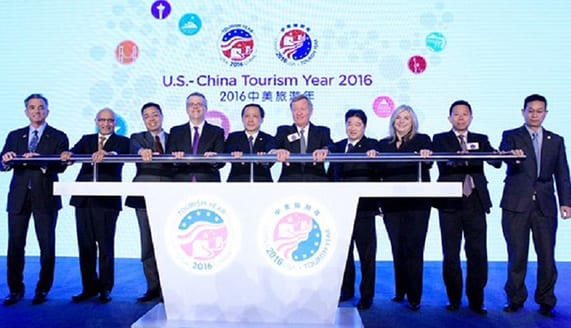
    China-US-Tourism-Year-2016-Opening

    CHINA-US TOURISM YEAR: This year (2016) is China-US Tourism Year, with Chinese President Xi Jinping sending a message of welcome to a high-powered tourism delegation from the US last week. He said: “I hope we’ll take this opportunity to expand personnel exchange, reinforce cultural exchange and foster a more solid social basis for bilateral relations development. American tourists are welcome to China. I wish 2016 China-U.S. Tourism Year a complete success.” US President Barack Obama reciprocated with his message: “Please get ready for more and more Americans are travelling to China. I also look forward to and welcome more Chinese to the United States. I believe that the more we understand each other, the more we can work with each other.”(Photo Credit: China National Tourist Office).

    The recent announcement related to the creation of more duty free arrivals shops in China is also entirely in line with these ‘readjustments’ to the Chinese duty free regulations, as predicted last year and reported last month.

    This follows the Chinese Government’s move to reign in a bigger share of high duty free spending levels by its Chinese nationals abroad, by authorising multiple duty free arrivals shop openings at leading airports and border points.


  • 2016 China Fixed-Asset Investment Growth Target at Around 10.5%

    China’s economic planning agency said Saturday that it aims to realize around 10.5% growth in fixed-asset investment this year.

    Beijing had set a 15% growth target for fixed-asset investment in 2015, but actual growth came in slower at 10% as the world’s second-largest economy lost momentum.

    The National Development and Reform Commission also said it expected retail sales to increase by 11% in 2016, compared with a target of 13% in 2015. Last year, China’s retail sales rose 10.7% from a year earlier.

    China attracted $126.27 billion in foreign direct investment in 2015, up 6.4% from a year earlier, and it reported $ 118.02 billion overseas direct investment last year, up 14.7% year-over-year.

  • Singapore economy grew 2% in 2015, weakest since 2009

    Singapore economy grew 2% in 2015, weakest since 2009

    The Republic’s economy expanded by 2 per cent in 2015, the weakest annual growth since 2009 when the economy was hit by the global financial crisis, according to figures released by the Ministry of Trade and Industry (MTI) on Wednesday (Feb 24).

    The figure was a sharp drop from the 3.3 per cent growth the previous year, and was revised downwards from the 2.1 per cent growth initially projected.

    Growth was mainly supported by the wholesale and retail trade, and finance and insurance sectors, according to MTI.

    For the fourth quarter, the economy expanded by a slower-than-expected 1.8 per cent from a year ago, after industrial production in December suffered its biggest year-on-year slump in eight months. The initial estimate was for a growth of 2 per cent.

    On a quarter-on-quarter seasonally-adjusted annualised basis, the economy expanded by 6.2 per cent in the fourth quarter, MTI said.

    The MTI has maintained its forecast of growth between 1 per cent and 3 per cent this year.

    “Even though global growth is expected to improve, the continued slowdown in China, the services-driven nature of growth in the US, as well as the trends of in-sourcing in China and the US, may mean that external demand for our exporters may not see a significant boost this year,” said MTI’s Permanent Secretary Ow Foong Pheng.

    “Lower oil prices have weakened the prospects for new rig orders for firms in the marine and offshore segment, and heightened the risks of further deterrents and cancellations of existing orders,” she added.

    The economic data also showed that labour productivity, as measured by value added per worker, grew by 0.5 per cent in the fourth quarter – the first improvement since the first quarter of 2014 – driven by the wholesale and retail trade, and construction sectors.

    For 2015 as a whole, overall labour productivity fell by 0.1 per cent, marginally improving from the decline of 0.5 per cent in 2014.

  • Facebook Co-Founder Saverin Among Investors in Indonesia’s Orami

    Facebook Co-Founder Saverin Among Investors in Indonesia’s Orami

    Facebook Inc. co-founder Eduardo Saverin, who’s been stepping up his investments in Southeast Asian technology startups, joined a $15 million round of financing for Indonesian e-commerce startup Orami.

    Other investors included the technology-focused investment arm of Indonesia’s Sinar Mas Group, Shanghai-based Gobi Partners Inc., Velos Partners and Ardent Capital LLC, according to a statement Wednesday. Orami is the new brand for the female-focused business formed through the merger of Moxy and Bilna and is led by Chief Executive Officer Jeremy Fichet. It plans to expand to other countries in the region.

    “The Orami team is on top of its game with a laser focus on the intersection of social commerce, content and women,” Saverin said in the statement. “Between Thailand and Indonesia, where more than five million babies are born a year, women not only serve as the gate to the home but are the key drivers of rapidly growing economy and future generation.”

    Saverin’s recent investments include online news site Tech in Asia, car rental service Silvercar, and Hopscotch, a shopping site for Indian moms.

    Orami now has almost 500 employees in Indonesia and Thailand. Some 75 percent of its customers are women and the startup gets about three million visits a month.

  • China Consumption Growth To Stay Strong In 2016

    China Consumption Growth To Stay Strong In 2016

    China’s consumption will grow at a quick pace in 2016, the country’s Minister of Commerce Gao Hucheng assured investors Tuesday, while tackling issues such as impact of yuan devaluation, building more free trade zones and the U.S.-led Trans-Pacific Partnership (TPP) at a news conference.

    A slowdown in China’s traditional economic drivers — heavy industries and manufacturing — last year sent jitters in global financial markets and commodity markets, as China’s policymakers look to shift the balance of the economy toward a consumption-led growth.

    “China realized a major transformation of economic growth, from growth mainly driven by investments and foreign trade to one mainly driven by domestic demand, especially by consumption,” the minister said. In terms of consumption, China’s total retail sales of consumer goods rose 10.7 percent to hit 30.1 trillion yuan ($4.59 trillion) in 2015, he added.

    Consumption accounted for 66.4 percent of China’s GDP growth in 2015, the Chinese statistics bureau said in January.

    A weaker yuan has not had a direct impact on China’s foreign-trade growth, Gao said, adding: “I don’t believe yuan exchange-rate volatility since the August reform can have big impact on our trade.” The renminbi, has declined by a further 3 percent against the U.S. dollar after China devalued its currency by nearly 2 percent on Aug. 11 last year.

    Earlier in February, China had announced monthly trade figures that missed expectations with exports slipping 6.6 percent in January compared to a year earlier, while imports fell 14.4 percent year-on-year.

    China’s trade decline in 2015 was much lower than those of its main trading partners and the world in general, Gao said Tuesday.

    Gao also said that the ambitious TPP agreement, signed earlier in February among twelve Pacific Rim countries — of which China is not a member — and the China-led Regional Comprehensive Economic Partnership, are moving in the same direction.

    “Bejing does not think that the (TPP) targets China,” Gao said.

  • Hong Kong to post surplus even as economy grapples with China slowdown

    Hong Kong to post surplus even as economy grapples with China slowdown

    Hong Kong is forecast to post a healthy fiscal surplus in its annual budget on Wednesday, with a series of one-off sweeteners expected to help businesses hurt by a slowdown in China, including the hard-hit retail and tourism sectors.

    Hong Kong’s longstanding Financial Secretary John Tsang isn’t expected, however, to unveil any sweeping new initiatives amid concerns the government’s reliance on one-off measures are failing to bolster the city’s economic fundamentals as it enters a period of slower growth and heightened political tensions.

    Tsang wrote on his official blog on Sunday that while sweeteners may only account for 1 percent of Hong Kong’s annual budget, they provide an important boost for the local economy and job market, and play an important “stabilising” role.

    A night-long riot shook the city after the authorities tried to remove illegal street stalls during the Lunar New Year, the worst violence since pro-democracy protests in 2014.

    While Hong Kong has tended to post healthy surpluses over the past decade, pressures are mounting on some of the economy’s biggest drivers. Mainland Chinese tourists who power the territory’s all-important retail sector stayed away from the city last year, leading to the worst annual decline in sales since 2002.

    Hong Kong officials have also sought to integrate more closely with China through Beijing’s “One Belt, One Road” blueprint to deepen regional economic co-operation, though the details remain sketchy.

    Four economists surveyed by Reuters expect fourth quarter growth to slow to a seasonally adjusted 0.1 percent from 0.9 percent in the third. From a year earlier, growth was forecast at 2 percent, down from 2.3 percent in the third quarter.

    Six economists estimated the economy would expand 2.3 percent in 2015, slightly less than the official forecast of 2.4 percent.

    The global financial hub’s economy is highly reliant on China which is grappling with its slowest growth in nearly 25 years.

    The government is forecasting a surplus of HK$36.8 billion while professional services firm Deloitte expects HK$80 billion.

    Despite a recent softening in the city’s sky-high property prices, analysts expect cooling measures implemented over the past few years to stay in place. Standard & Poor’s has forecast a 10 to 15 percent drop in property prices in 2016.

    Hong Kong’s economic pressures come on top of an increasingly fraught political environment, including the disappearances and feared abductions by Chinese agents of several Hong Kong booksellers, and lingering tensions towards Beijing’s refusal to allow full democracy in Hong Kong after protesters occupied major roads for 79 days in late 2014.

    The former British colony, with a population of 7.3 million, returned to Chinese rule in 1997 under a “one country, two systems” framework that gave it a large degree of autonomy although its leaders ultimately defer to Beijing.

  • Will escalating China woes derail CRCT’s growth story?

    Will escalating China woes derail CRCT’s growth story?

    It will benefit from increased consumption.

    CapitaLand Retail China Trust is still poised for growth despite China’s slowing economy, according to a report by DBS.

    Although investors are currently fearful of the slowdown in China’s GDP growth, DBS said that RCT should remain well positioned as it should benefit from China’s move towards a consumption-based economy. This trend is illustrated by the 10.7% jump in retail sales for FY15, faster than the overall GDP growth of 6.9%.

    “Going forward, we understand CRCT remains confident of generating positive rental reversions (in the “single-digit range), although lower than the 15-20% achieved over the past few years,” DBS said.

    The lower level of rental reversion is also due to CRCT making a strategic decision to attract certain tenants as part of its constant tenant remixing to sustain the performance of its malls in the long term, DBS noted.

    “CRCT’s earnings have been negatively impacted by the road closures surrounding Minzhongleyuan over the past two years. As these works are scheduled to be completed by end-2016, we believe we are approaching an inflection point for the mall’s earnings,” the report added.

  • Indonesia’s growth in 2015 slows for fifth consecutive year

    Indonesia’s growth in 2015 slows for fifth consecutive year

    Growth in South East Asia’s largest economy, Indonesia, has come in at 4.76% for 2015, marking the fifth consecutive yearly decline. Weaker commodity prices and consumer spending, together with a slowdown in its key trading partner, China, has hurt growth. Towards the end of last year, however, the economy expanded by just over 5%, boosted by government spending. President Joko Widodo had promised to lift annual growth to 7% on average.

    However, the country has seen an average of just under 6% growth over the past decade and analysts have said growth is unlikely to improve for some time.

    “The fourth quarter data is a positive surprise,” economist Tony Nash told.

    “But unfortunately the uptick will likely be short lived. We expect deterioration in the first quarter and it’ll be tough to regain growth momentum before 2017,” he added.

    Mr Widodo made his promise to raise growth when his five-year term began in 2014, but he has faced problems boosting government spending and has seen several large infrastructure projects delayed.

    A $5.5bn high-speed railway project, funded by China, was signed last year and is scheduled to be up and running by 2019.

    But the project has faced widespread objections from transport experts and its long-term viability has been questioned.

    Mr Widodo has also faced international condemnation for the country’s man-made forest fires, which have caused serious economic and environmental damage.

    In December, the World Bank said Indonesia’s forest fires last year had likely cost the country more than twice the amount spent on reconstruction efforts after the 2004 Aceh tsunami.

    In its quarterly report, the bank said the fires had cost some 221tn Indonesian rupiah ($15.72bn; £10.5bn).

    It added that regional and global costs would be much higher.

  • Competition that hit Alibaba down

    Competition that hit Alibaba down

    Alibaba appears to be facing increasingly stiff competition from rival JD.com, which like Alibaba has worked to boost sales from foreign retail companies in China. While Alibaba has talked in recent months of the potential of reaching consumers in rural China, JD.com has focused on reaching the more affluent shoppers in urban areas.

    While it’s true that e-commerce is increasingly important in more remote areas of China, income there remains low, as does spending, and China’s recent economic turmoil is likely slowing down growth.

    In addition to its focus in more rural areas, Alibaba continues to face problems over sales of counterfeit items, more so than JD.com, an issue of increasing important not just to retailers abroad and the U.S. government, but also to wealthier Chinese shoppers.

    And JD.com enjoys a positive, Amazon-like reputation for fulfillment.

    “[JD] have faster shipping speeds, and the quality is more trustworthy,” Zoe Li, who works at a tech start-up in Beijing.

  • Philippine growth short of target at 5.8 percent in 2015

    Philippine growth short of target at 5.8 percent in 2015

    The government initially forecast growth of 7-8 percent for 2015 but later lowered its projection to 6-6.5 percent.

    “Though this is lower than what we targeted for the year, this growth is respectable given the difficult external environment,” Economic Planning Secretary Arsenio Balisacan said Thursday.

    The Philippines has been one of the fastest growing economies in Asia for several years. Despite increased government efforts to raise living standards, the country of more than 100 million still faces considerable challenges including its vulnerability to typhoons and other natural disasters, poverty, corruption and poor infrastructure.

    The economy expanded 6.3 percent in the last quarter of the year, the fastest for 2015. It was up from 6.1 percent the previous quarter but down from 6.6 percent in the same period of 2014.

    Balisacan said growth has averaged 6.2 percent in the past six years, which is the best performance since the late 1970s. The growth has not been due to unsustainable borrowings like in the 1970s and short-lived portfolio capital but fueled by investments that create jobs and increase incomes, he said.

    He said last year’s growth was driven by much stronger domestic demand and government spending that grew 9.4 percent compared to the previous year’s 1.7 percent. Growth in public and private investments more than doubled, primarily led by public construction.

    Service industries were also robust, growing 6.7 percent in 2015 from 5.9 percent in 2014. Industry expanded 6.0 percent while agriculture grew a tepid 0.2 percent.

    Finance Secretary Cesar Purisima said the Philippines was well-positioned to withstand turbulence in financial markets caused by uncertainty about the strength of the global economy.

    He said foreign exchange reserves are more than healthy at $80.6 billion as of the end of last year, enough to cover 10.3 months of imports and equivalent to more than six times the country’s external short-term funding requirements.

  • Burberry sees return to sales growth in China

    Burberry sees return to sales growth in China

    Luxury fashion group Burberry on Thursday announced a return to retail sales growth in China despite an economic slowdown, boosting overall results in its third quarter.

    The British handbag and clothing company reported overall retail sales of £603 million ($866 million, 794 million euros) in the October through December period, “as (sales in) mainland China returned to growth”, Burberry said in an earnings statement.

    China is in sharp focus for markets amid an overall slowdown for the world’s second largest economy.

    In the three months to the end of 2015, Burberry saw total underlying retail sales growth of 1.0 percent, an improvement on the 4.0-percent decline in its second quarter.

    Burberry’s financial year runs from April to the end of March

    On the downside, sales in Hong Kong fell by more than 20 percent owing to long-standing protests against China.

    All of Burberry’s Hong Kong stores remain profitable however thanks to cost controls, the company said in the statement.

    “The outlook for our sector remains uncertain,” said chief executive Christopher Bailey.

    “However, we are anticipating and responding to these changes through an intense focus on new growth opportunities.”

    Chief financial officer Carol Fairweather told a conference call with reporters that Burberry’s performance in France had been impacted by fewer tourists visiting from China and the Middle East following the Paris terrorist attacks in November.

  • E-commerce market on path of growth

    E-commerce market on path of growth

    Computer and electronics, beauty and cosmetics as well as fashion are potential categories for e-commerce in Thailand. The Thai e-commerce market in 2014 was valued at Bt2.03 trillion, with business-to-business (B2B) deals worth Bt1.23 trillion, business-to-consumer (B2C) valued at Bt0.41 trillion and business-to-government (B2G) valued 0.31 trillion.

    Surangkana Wayuparb, the chief executive officer of Electronic Transactions Development Agency (ETDA), said that the agency has spent seven months conducting the e-commerce survey, covering all industries in Thailand, representing 502,676 people from eight sectors: manufacturing, retail and wholesale, transport, accommodation, information and communication, insurance, art, entertainment and recreation as well as other services.

    B2B e-commerce was valued at Bt1.230 trillion, a contraction of 0.33 per cent over 2014, while B2C was valued at Bt474,648.91 million, a growth of 15.29 per cent over 2014 and B2G was valued at Bt402,883.74 million, growing 3.96 per cent year on year.

    “It is a huge opportunity for e-commerce business in Thailand since the new Thai generation believes in shopping via online channels. The 4G will also be a factor in driving the growth of the e-commerce market in Thailand,” said the CEO.

    The e-commerce market in Thailand was worth Bt2.03 trillion in 2014 of which B2B was worth Bt1.234 trillion or 60.69 per cent, followed by B2C Bt411,715 million or 20.25 per cent and B2G valued Bt387,552 million.

    In 2015, the top three industries expected to generate the most e-commerce are accommodation services, worth Bt658,909.76 million or 38.4 per cent, followed by manufacturing, valued at Bt350,286.83 million or 20.4 per cent, as well as retail and wholesale industry, valued at Bt325,077.48 million or 19 per cent.

    She also said that the top three industries that |gained the highest e-commerce value in 2014 were accommodation services valued at Bt530,159.13 million or 38.1 per cent, followed by manufacturing valued at Bt440,614.78 million, gaining 26.6 per cent, and information and communications valued at Bt264,863.74 million, growing 19.11 per cent.

    Computer and accessories, cosmetics and beauty as well as fashion are the three top categories for online retail and wholesale business.

    Art and entertainment business, games online, music and e-movies are the main categories in the online entertainment business.

    Surangkana said that the global and domestic economies are factors in driving the e-commerce market in Thailand and the government incentives or tax privileges will play a part in driving the e-commerce market of the country as a whole.

    She said that the top four online transactions for e-commerce business in 2014 were e-banking at 54.25 per cent, followed by credit and debit card 22.39 per cent, mobile payment at 14.53 per cent, and others at 8.83 per cent.

    However, mobile payment has high potential for growth because the modern lifestyle will mean using mobiles to pay transaction fees in the near future.

    She said that the total US B2C e-commerce market was valued at US$359.3 billion in 2014. Meanwhile, China’s B2C market was worth $322.1 billion. Japan and Korean were valued at $118.59 billion and $25.4 billion, respectively.

    Thailand and Malaysia had B2C market valued at $11.7 billion and $9.6 billion respectively.