Retail News CRM

Tag: Shinsegae

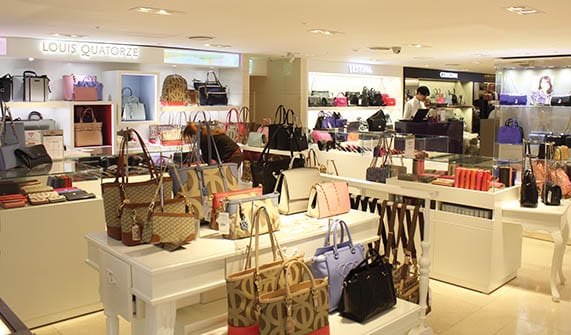
  • South Korean department stores set to smash sales record

    South Korean department stores set to smash sales record

    South Korean department stores are tipped to chalk up sales of more than 30 trillion won (US$25.6 billion) for the first time this year.

    That would make if 86 years since the country’s first department store opened in 1930.

    Industry commentators say the figure reflects the retail category’s emergence from “years of stagnation” to return to growth as they pursue new alliances, an expanded food offer and eCommerce.

    Lotte, Hyundai and Shinsegae account for 80 per cent of the Korean department stores market with Galleria, AK Plaza and smaller brands hold the remainder.

    Just seven years ago, department store sales surpassed the 20 trillion won barrier – this year’s projection is 31 trillion, a remarkable growth rate by any measure, especially considering sales stagnated at 29 trillion won for the last four years.

    “Despite the prolonged economic slowdown and changing consumption trend, the domestic department store market is expected to post growth this year thanks to new concept stores and the expansion of online channels,” a Shinsegae Department Store official said.

  • Boom time for Korean convenience store sector

    Boom time for Korean convenience store sector

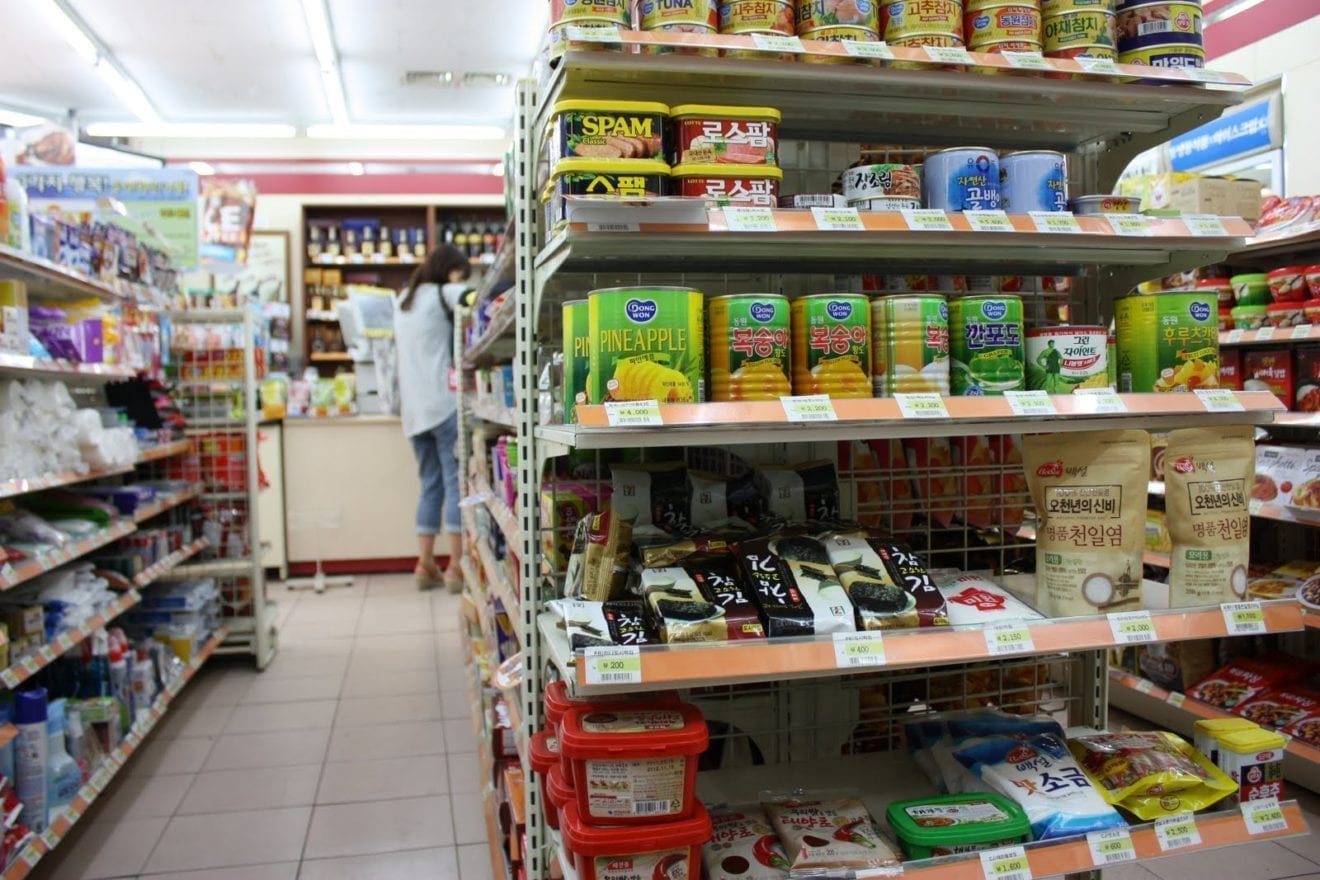
    The Korean convenience store sector is experiencing rapid growth as heavyweights battle for market share.

    The number of convenience stores in South Korea surpassed 33,000 as of the end of October this year, marking a rapid growth since the opening of the first store 27 years ago, according to industry data.

    That’s a significant increase from the 28,994 counted at the end of last year.

    CU had the most with 10,634, followed by GS25 with 10,486 and 7-Eleven with 8486. Japan-affiliated brand Mini Stop had 2326, and With Me, a chain operated by Shinsegae Group, had 1615. There are some 100 others that are not part of franchises, according to the Korea Association of Convenience Store Industry.

    South Korea’s first convenience store opened in southern Seoul in May 1989.

    The rising number of single-person households and aging society are funneling consumers to convenience stores that are near their homes and sell small portions, industry watchers say. Convenience stores have been quick to adapt to such a customer base, expanding from conventional shelf goods, such as snacks and beverages, to lunch boxes and other kinds of meals for singles who don’t want to cook, as well as services, including delivery and financial transactions.

    The sector grew 11.4 per cent last year, visibly comparable with 1.2 per cent growth in 2013 and 4.7 per cent in 2014. Sales increased from 12.8 trillion won (US$10.96 billion) in 2013 to 13.8 trillion won in 2014 and to 17.2 trillion won last year.

    Industry watchers expect sales this year to exceed 20 trillion won, with room for more growth until 2030, considering that South Korea’s per-store sales is only about one-fourth of that in Japan. Japan currently has about 55,600 convenience stores.

  • Incheon negotiates e-commerce law for T2 tender

    Incheon negotiates e-commerce law for T2 tender

    Kim Bum Ho, Deputy Executive Director of IIAC’s Commercial Marketing Group, said this morning that although Incheon Airport has planned to issue its T2 tender on schedule [in the first week of December], there could be a delay if the debate surrounding a change in e-commerce regulation – among a few other issues – continues.

    Operators at South Korea’s Incheon International Airport (ICN) are currently not permitted to offer online duty free shopping due to regulation that stipulates that downtown DF operators alone command this privilege.

    But Kim is all too aware of the increasing importance of e-commerce in South Korea, confirming that online sales growth continues to soar. “In South Korea the increased rate of online duty free shopping is now almost 50%-60% year-on-year…it’s so huge.”

    Kim says that many local residents now prefer to only shop online. “So if you go to the downtown duty free store at this hour (evening in South Korea) you will only see Chinese people; no Koreans, no local people. Local people like to shop online. It’s such a big trend.”

    In order to attract the most competitive bids (and retailers), Kim is trying to get the current e-commerce regulation for airport duty free operators changed…but it’s not been easy.

    A-large-jewellery-and-watches-counter-at-Incheon-International-Airport
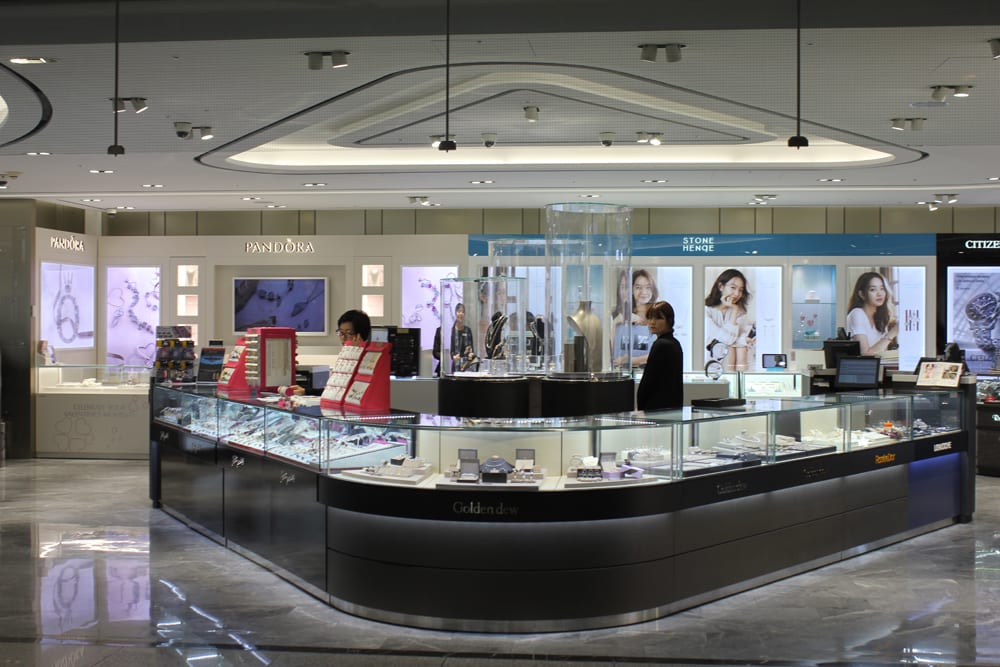
    A large jewellery and watches counter at Incheon

    “The duty free sales do not match the passenger growth rate unfortunately, but we think at this moment the duty free business has increased by 15% compared to last year,” says Kim.

    “We are now talking…it is one of the issues we need to talk with the government about…So we are trying to [eliminate] the barriers to have e-commerce for airport duty free operators. I do think we can solve the problem for T2 operators…We have officially asked the Korean Customs office to permit the e-commerce business for airport duty free operators.”

    Kim reveals that IIAC should find out if this is possible in two weeks time. In fact, he plans to write this into the terms of the T2 tender, if negotiations with the Korean Customs Service (KCS) go to plan.

    TERMINAL 2 TERMS

    “I think it will be determined in two weeks. It’s one of the conditions for the bidding. So yes we are planning to open the tender in early December, but we have to negotiate with the Korean Government Customs office before it opens…if it is takes longer we’ll need more weeks before we open. Anyway, our target date is early in December.”

    Kim confirms that most local Korean operators such as Lotte, Shilla, Shinsegae, Hanwha and Doosan are interested in the Terminal 2 tender. Regarding the international operators he admits that two have already approached him, but he cannot reveal the company names at this stage.

    T2 TO OPEN IN LATE 2017

    Of course once the results have been announced, the retailers can begin to fit out the stores ready to commence trading in late 2017 when the new $5bn terminal opens.

    “T2 will be opened late in 2017,” confirms Kim. “We spent almost $5bn on constructing it. It’s a totally new and unique place…we have centralised the duty free shops more…and it will be a more market and customer-oriented place. We can provide a good business environment.”

    This year Incheon Airport says it has witnessed a very healthy increase in passengers of around 19%, however unfortunately duty free sales have not kept pace, as Kim concedes.

    “The duty free sales do not match the passenger growth rate unfortunately, but we think at this moment the duty free business has increased by 15% compared to last year.”

    Of course, Kim says that it’s difficult to make a direct comparison with last year, as the airport and the whole country suffered from the impact of MERS.

    “It’s not best to compare directly with last year, but when we compare with two years ago (2014) we had about 10% increase in duty free sales.”

    Incheon-International-Airport
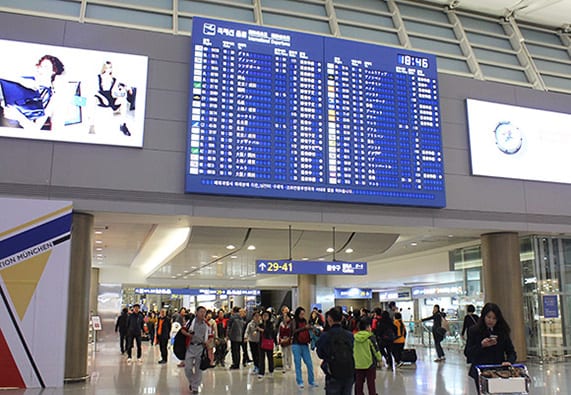
    This year Incheon Airport says it has witnessed a very healthy increase in passengers of around 19%.

    $2BN SALES TARGET STILL IN SIGHT

    Kim also strongly believes that the airport can still achieve the $2bn sales total it predicted earlier this year. “We can hit $2bn again. Last year in 2015, we couldn’t because of the MERS…but this year in 2016 I think we can hit $2bn again.”

    As the world’s biggest duty free market, many are interested to see what sort of sales South Korea can register in 2016. As reported, duty free sales rose +36% to $7.9bn in the first nine months of this year.

    Kim gave us his updated forecast this morning: “I think the duty free business can hit about $9bn or $10bn in South Korea this year, so there is amazing growth actually.”

    However, Kim also admits that for the last few months – maybe even as early as April this year – the growth in the number of Chinese inbound visitors has decreased, for which Kim says ‘there are many reasons’.

    CHINESE INBOUND GROWTH SLOWS

    One of these could be the new luxury goods import tax introduced by the Chinese Government earlier this year in a bid to protect home-grown businesses. Of course political tension could also be a factor.

    [There were earlier concerns that the South Korean Government’s plan to plug into the US’ Terminal High-Altitude Air Defence (THAAD) system by the end of 2017 might cause a drop off in Chinese visitors, considering Beijing’s stiff opposition to the deployment].

    LOTTE WILL BID AGGRESIVELY

    “Duty free operators, including Lotte and Shilla are worrying about the Chinese changes…they spend less and they visit less.”

    Kim believes this is more of a problem for the downtown duty free business and maintains that ‘the airport business is very stable compared to the downtown business’.

    “Incheon is the gateway to South Korea and almost all the Chinese visitors have to come through Incheon Airport. It’s the national gateway…so it’s very stable, though their spending per passenger is now decreasing.”

  • Korean duty-free stores suffer losses

    Korean duty-free stores suffer losses

    Korean duty-free stores newly opened in Seoul are losing money as heavy marketing costs erode profits.

    A review of financial documents from the major players show heavy competition is taking its toll on all players.

    Five duty-frees stores opened new shops in the capital city after winning licenses in two bids — one in July and the other in November 2015 — in hopes of courting deep-pocketed Chinese customers, but none of them has reached the break-even point since opening.

    Shinsegae Duty Free, which opened in mid-May, posted 121.2 billion won (US$103.8 million) in sales over the past four months, but it accumulated 37.2 billion won of operating losses, its regulatory briefing showed.

    Galleria Duty Free 63, a duty-free store run by Hanwha Galleria, said it booked 193.4 billion won of sales between December 28 and September 30, but the operating deficit reached 30.5 billion won over the period.

    HDC Shilla Duty Free, a joint venture between Shilla Hotel and Hyundai Development, said it posted 228.7 billion won and 16.7 billion won in sales and operating deficit, respectively, in the January-September period.

    SM Duty Free, a unit by leading tour agency Hana Tour, said it logged 71.1 billion won in sales and 20.8 billion in operating losses from its opening on February 15 to September 30.

    Doota Duty Free, a unit by power equipment and construction conglomerate Doosan Group, logged 10.4 billion won in sales and 16 billion won in operating losses in the first half of this year. It has not yet disclosed the third quarterly report.

    Business prospects remain grim for the fledgling operators as the government is set to give out four new operating licenses in Seoul as a way to promote tourism.

    The Korea Customs Service earlier said it will pick the winners next month, but it remains unclear as a snowballing influence-peddling scandal involving the business community has prompted investigation into the companies that donated funds to two sports foundations, involving those vying for duty-free shop licenses.

  • Offline stores turning crisis into opportunity

    Offline stores turning crisis into opportunity


    Will offline stores disappear?

    When consumers began online shopping in 1994, most of them could hardly imagine that offline stores might disappear. Online shopping was a mere subsidiary to offline stores, selling only a few items then.

    However, the volume of e-commerce has grown explosively over the past 20 years, blurring boundaries between online and offline.

    A sense of crisis in the retail business is different from the past. Mobile platforms dominate more than 40 percent of e-commerce sales, being the key to online-to-offline (O2O) commerce.

    Amazon, the world’s top e-commerce firm, has twice as many customers than offline No. 1 Walmart which has over 6,000 stores worldwide.

    In Korea, the sales of online markets between January and August this year hit 42 trillion won ($37 billion), rising 21 percent year-on-year, according to Statistic Korea (KOSTAT).

    If the current growth rate continues, its sales this year will reach 65 trillion won, about 5 percent of Korea’s gross domestic product (GDP) for the year. This figure surpasses Korea On-Line Shopping Association’s (KOLSA) early estimate of 60 trillion won. In 2001, the same figure was 3.3 trillion won.

    On the other hand, the growth of offline retail, conducted at department stores and discount chains, has been slow since 2013.

    Although saturating offline stores and governmental regulations on retail giants are some of the causes for the slump, a more important reason is the rapid growth of the online market.

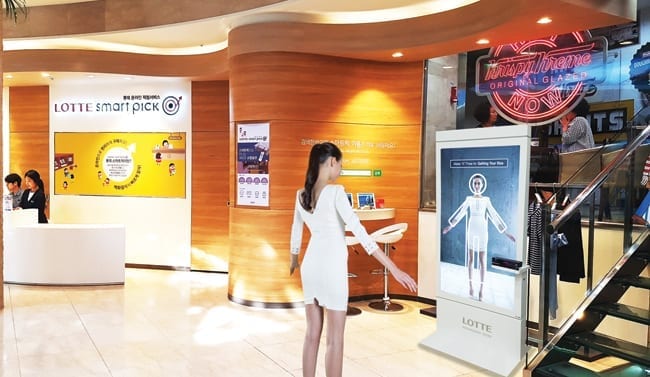
    A virtual reality Nike shop located in Hyundai Department Store, Pangyo.
    /Courtesy of Hyundai Department Store

    Retail giants stepping into online

    To survive this trend, retail giants, the main concern of which are offline stores, began to expand their online platforms, as their offline channels have been left behind by fast growing e-commerce firms, such as Gmarket and Coupang.

    Korea’s largest retailers ― Shinsegae, Hyundai and Lotte ― have been focusing on the O2O business platforms which combine online markets with their existing retail networks. They have adopted the latest technology with their O2O businesses.

    Shinsegae Department Store released a mobile application “SHOP@” in February, promoting it as a “department store to be enjoyed by the eyes.”

    This application offers a panorama of the department store and shows dressed images of models, as well as photos of products which have been commonly offered by online shopping malls, including its own “SSG.com.”

    Unlike other e-commerce applications, SHOP@ customers can feel like they are in the store, because photos of products are taken as they are displayed at the offline store.

    More than 400 brands at Shinsegae Department Store are displayed by the application, as Shinsegae employees have taken pictures of the products and directly uploaded them to the application.

    Hyundai Department Store opened a virtual reality (VR) men’s wear store at the Jungdong store, Gyeonggi Province, Oct. 9.

    Customers can look around the department store and see mannequins dressed in whole outfits by accessing Hyundai’s online shopping mall “thehyundai.com” and following the arrows on the screen.

    If customers want to visit a certain brand shop, they just need to click the door icon and check details of the products at the VR store.

    Hyundai opened VR stores of Nike and Adidas at its Pangyo store, Gyeonggi Province, on a trial basis in July.

    The stores offered a full 360-degree view of the offline stores providing simple information of products. Hyundai Department Store plans to offer a 360-degree view of each product and to open a full VR department store by 2019.

    A Hyundai Department Store official said, “Our department store will provide different experiences, shifting offline stores to online.”

    Lotte Department Store introduced a 3D foot scanner in July. The Swedish-made scanner measures a customer’s foot size and analyzes conditions of the customer’s foot. Shoemakers can recommend and make the most suitable shoes for the customer. More than 1,800 customers had their feet scanned and over 800 ordered shoes as of September.

    Once their feet are scanned, customers can use the data at both online and offline stores.

    “Our department store has a 3D virtual fitting room and foot scanner, as examples of our new omni-channel service which connects online and offline,” a Lotte Department Store official said. “We will develop mobile applications for our customers to buy clothes and shoes with their smart phones.”

    Fighting fire with fire

    Although retail giants are expanding their online platforms, they are also finding ways to attract customers to their offline stores. Those giants are developing offline stores through experience which is hardly achieved in online markets.

    Heads of retail giants have recently stressed the importance of experience, targeting customers who seek to spend their leisure time shopping.

    “Shopping malls with experience are the future of offline stores,” said Hyundai Department Store CEO Kim Young-tae during the press conference at the opening ceremony of Hyundai City Outlet Dongdaemun in March. “Online shopping malls only display the products, but offline stores enable customers to touch and enjoy the products during their shopping.”

    Shinsegae Group Vice Chairman Chung Yong-jin said, “Customers want to gain both products and value, staying longer at a place where they have a reason to visit,” at the opening ceremony of Starfield Hanam in September.

    Lotte Mart CEO Kim Jong-in emphasized last year that discount chains should provide customers with new lifestyle experience. He said Lotte Mart will find an answer from “a space” which online malls lack.

    The latest technologies enable customers to experience offline stores without actually being there.

    Shinsegae Starfield Hanam attracts customers with “VR Fitness” at Sports Monster. Customers can enjoy scientific digitally-based exercises, such as VR fitness and bike-racing, at the recreational space.

    “Sports Monster and Aqua Field are advanced concept entertainment spaces that Starfield Hanam has been preparing for a long time,” a Shinsegae official said. “We expect those spaces to become new attractions, providing our customers with differentiated value through various exercises and experiences which they have never seen.”

    Lotte Department Store introduced the “Smart Shopper” service at its grocery stores at the Bundang store on Oct. 4.

    Customers can go shopping with barcode scanners and they do not have to push their shopping carts. If they scan items with their “Shopper” scanners, products are automatically added to their virtual cart.

    Customers can check added products on “Order Viewer” screens installed at several places in the store and can remove unnecessary items at automatic counters. Purchased items can be delivered to their home.

    Smart Shopper enables customers to check the actual products at offline stores, while resolving inconveniences of carrying them home.

    Duty free shops aim to provide experiences for customers with technology as well.

    HDC Shilla Duty Free plans to make an IT converged duty free shop, if its bid to open a new duty free shop will be successful.

    A state-of-the-art duty free shop with merged reality (MR), artificial intelligence (AI) and machine learning technologies is the company’s goal. The duty free shop plans to show hologram images, installing media walls and digital signage in the lobby.

    Examples in other countries

    Meanwhile, retail giants abroad have already gone through similar changes amid the crisis of offline stores.

    In 2014, British retailer Tesco unveiled its VR store which enables customers to look around the virtual store and purchase goods from there.

    The U.S. retailers Neiman Marcus and Nordstrom introduced smart mirrors for virtual dressing last year.

    The North Face stores in the U.S. have provided extreme VR experiences to attract customers to offline stores. If customers select clothes and wear VR devices, they can virtually wear selected clothes and experience extreme sports, such as jumping off a 128-meter cliff in the Grand Canyon.
     

  • Duty-free sales climb 36% in Korea so far in 2016

    Duty-free sales climb 36% in Korea so far in 2016

    Duty-free sales from South Korea’s retailers increased 36.4% year-on-year to W8.9trn ($7.9bn) in the first nine months of 2016, according to local media reports. This is compared with W6.55trn a year ago.

    Sales growth in particular is driven by the rise in foreign tourists, with Chinese travellers comprising nearly 43% of all travellers. Chinese spend per passengers reached a total of $350, while Koreans spent $106, according to The Korea Times.

    According to the publication, despite the increase in sales many retailers in the country are facing deficits, with the exception of Lotte Duty Free and The Shilla Duty Free, which reportedly saw profits totalling W232bn and W38bn in the first half the year, respectively.

    Galleria Duty Free Shop of Hanwha was reported to have suffered a W17bn loss, while Doosan’s Doota Duty Free saw a W16bn loss for the same period.

    Despite this, there is still room for optimism, with potential for annual duty-free sales to top W10trn by the end of the year. Retail real-estate developments such as Hanwha Galleria’s launch of the Galleria Duty Free 63 store in July, and buoyant figures reported by retailers like Shinsegae, add to the country’s potential for a possible positive rebound.

    Photo of KTO

  • Lotte, Shinsegae address Korean gender employment issues

    Lotte, Shinsegae address Korean gender employment issues

    Korean retail giants Lotte and Shinsegae are competing to improve employment conditions for women.

    The two companies are pushing forward with efforts to provide more opportunities for women to move up in their corporate hierarchies and implementing women-friendly systems as part of their company policies. Korean gender employment issues are of growing concern in a traditionally male-dominated business culture.

    According to industry watchers, Shinsegae’s discount store franchise E-Mart instituted a shortened work-hour system for all of its pregnant employees starting in April, with employees eligible regardless of whether they apply for the benefits or not, and offering them 100 per cent of their wages. Under the arrangement, pregnant employees have their work day shortened by two hours.

    The system had been difficult for female workers to take advantage of given both the company atmosphere which tended to discourage the practice, as well as reduced wages, said a company official.

    In addition, E-Mart announced in March a new leave of absence policy for employees having difficulties with pregnancy, and it also plans to implement its own maternity leave system that allows employees to take up to a year of maternity leave, on top of the legally-guaranteed period of 20 months (eight months for maternity, 12 for childcare). The latter has already been implemented by another Shinsegae franchise, Shinsegae Department Store.

    In contrast, Lotte’s women-friendly policies focus more on employing a greater number of women as new recruits.

    Since 2006, Lotte has been increasing the number of female employees at its affiliate enterprises by hiring more women through its recruiting process. In 2015, 35 per cent of new recruits were women, a rate that the group plans to increase to 40 per cent this year.

    Furthermore, Lotte also operates a special recruiting platform specific to retired female officers from the military, an endeavor which took off in 2011 with cooperation from the defense ministry.

    As a result, the number of women at Lotte with positions as section chiefs or higher now stands at 870, an increase from 95 in 2008, and 19 of the group’s board members are also female.

    Meanwhile, Lotte established eight additional daycare centers for its employees in the first half of 2016 for working mothers, while allowing women to automatically take their year-long childcare leave right after their maternity leave, so they won’t have to face unnecessary guilt or unwelcome comments from colleagues or bosses.

    “Chairman Shin Dong-bin seems to be taking extra attention to nurture female employees and their talent,” said a Lotte official. “Our goal is to create a work environment where women can work without facing gender discrimination.”

  • South Korea August dept store sales rise for 3rd month

    South Korea August dept store sales rise for 3rd month

    South Korea’s department store sales rose for a third straight month in August thanks to widespread discounting ahead of a major public holiday this month, government data showed on Thursday.

    Combined sales at department stores run by Hyundai Department Store, Lotte Shopping and Shinsegae Co rose 4.1 percent on-year, data from the Ministry of Trade, Industry and Energy said.

    This followed a 7.0 percent jump in July.

    Sales of all individual categories at department stores rose in August, with the exception of men’s clothing.

    The same data showed August sales at discount stores fell 1.3 percent from a year ago after rising for two months previously. In August, sales rose 2.1 percent.

    The decline was attributed to a 14.8 percent slump in sports-related goods as the unusually hot summer weather this year discouraged customers from seeking them out, the monthly report said.

    Online open market sales growth at websites owned by eBay Korea Co Ltd and others slowed slightly to 22.4 percent in August from 31.2 percent in July.

    Retail sales overall in August mainly saw demand for household electronics like air conditioners and gifts ahead of the Chuseok holiday season, the data said.

  • Convenience stores tapping into overseas market with PB products

    Convenience stores tapping into overseas market with PB products

    Amid a stagnant domestic economy, Korea’s convenience store chains are tapping into markets abroad to sell private brand products, industry sources said Tuesday.

    Major convenience store chain CU is exporting its self-branded cheese-flavored and red pepper-flavored instant noodles to Jumei, a Chinese online retailer.

    GS25, meanwhile, has been selling its own Chinese-style instant noodle product Gonghwachun in Australia and New Zealand. The product was made in partnership with a Chinese cuisine franchise.

    Last year, 7-Eleven Korea was the first Korean retailer to sell dried laver and low-price, self-branded snacks produced in cooperation with small and medium-sized manufacturers.

    Shinsegae’s convenience store unit With Me began selling hangover-cure ice cream Gyeondyeo Bar in Russia in May, according to a company source.

    “Private brand goods’ sales abroad will not just find a way out for retail giants. This will be an opportunity for small and medium-sized enterprises to develop inroads into overseas markets,” a source said.


  • Korean department stores trigger restaurant battle

    Korean department stores trigger restaurant battle

    Korean department stores have become the new battleground for Korean restaurant chains.

    Restaurants have long been a lucrative business for department store operators – accommodating hundreds of weary shoppers every day, they have sometimes been referred to as a ‘goose that lays a golden egg’.

    However, until now, opening such a restaurant had been a near-impossible task without deep connections to the store’s higher-ups.

    According to retail industry sources, several new restaurants are set to open next month in the food court section of Lotte’s flagship department store in Myeongdong, which is currently being renovated. Of note, the new owners didn’t have to lobby Lotte management or be a member of a Lotte family to open their establishments.

    Lotte faced significant criticism in June when the media spotlighted Seo Mi-kyung, Lotte founder Shin Kyuk Ho’s third wife, and her company Yuki Co, which operates a bibimbap restaurant (Yukyung),  naengmyeon restaurant (Yuwonjeong) and coffeehouse (Margaret) at the Lotte’s Myeongdong store.

    “We’re in the middle of clearing up our business with Seo’s company,” said the department store official. “We plan to operate our food court based on the popularity of restaurants and their competitive advantage.”

    A high-end sushi restaurant, Sushi Chohi, Chinese restaurant Luii, and European casual restaurant Elbon Grand Cafe operated by chef Choi Hyun-seok are among the new eateries that will open in mid-September.

    Hyundai Department Store, once criticised for giving favors to its subsidiary Hyundai Green Food, is also rearranging the food courts at its stores to accommodate popular restaurants from across Korea. And although it still operates Hyundai Green Food-owned restaurants like Bonga Sushi and Hansol Naengmyeon at its branches, it’s now focusing its efforts on attracting other popular restaurants.

    “Bonga Sushi and Hansol Naengmyeon have made a name for themselves, and their inclusion is not necessarily due to the Hyundai family relationship,” said a Hyundai Department Store official. “We’re concentrating more on attracting well-known restaurants to our food courts, because restaurants with no competitive edge aren’t likely to survive.”

    Italian restaurants Le Jiu and Signature Lab opened their latest locations at the Samseong-dong branch, while Amorino, an Italian gelato franchise, opened a new eatery at Hyundai’s Apgujeong branch.

    Shinsegae Department Store also introduced new restaurants this year. Youth-driven restaurants from Gangnam and Hongdae, including Chinese cuisine franchise Choma, steakhouse restaurant Fukuoka Hambageu, and premium tteokbokki restaurant Villa de Spicy, according to Shinsegae, were met with high acclaim.

    Shinsegae also said that new restaurants tend to attract more customers to its stores.

    “Department stores are no longer solely a place for shopping. They’re transforming into one integrated living space for consumers to spend their free time,” said a retail industry official. “Given the circumstances, the stores will continue with their efforts to accommodate more popular and competitive restaurants.”

  • Huawei tests Samsung-Shinsegae ties

    Huawei tests Samsung-Shinsegae ties

    Huawei, China’s top-tier handset and networking infrastructure business operator, is basking in the limelight for its partnership with Shinsegae, a former Samsung Group affiliate and the nation’s second-largest retailer.

    The partnership is also eye-catching as Huawei has icy relations with its rival Samsung Electronics following a series of lawsuits between the two.

    Shinsegae, which separated from Samsung Group in 1991, had been a decades-long retail services operator of Samsung. Shinsegae Group Chairman Lee Myung-hee is the younger sister of Samsung Group Chairman Lee Kun-hee.

    The partnership was announced last week when Huawei officially named Shinsegae I&C, the IT-based platform service affiliated with the retail giant, as its sole distributor in Korea, to speed up penetration into the market here.

    Given that Samsung and Huawei are engaging in legal battles, critics said the partnership is quite “unexpected.”

    In May, Huawei filed a patent lawsuit against Samsung Electronics in the U.S. District Court for the Northern District of California, claiming that the Korean electronics firm infringed on Huawei’s wireless patents without licensing.

    In response, Samsung Electronics countersued Huawei and a department store in Beijing last month, claiming some $24.14 million in damages.

    Amid the chilly relationship, Huawei held a press conference last week to launch the sales of its two-in-one portable PC, MateBook, in Korea. The company also announced its partnership with Shinsegae I&C whose retail clients include renowned global information and communication technology (ICT) companies such as Google, Hewlett-Packard and JBL.

    “Huawei joined hands with Shinsegae I&C, as the Chinese company appreciates our capability in managing global ICT firms,” said a Shinsegae manager. “We have nothing to comment on why Huawei chose the former Samsung affiliate despite its current estranged relationship with Samsung Electronics.”

    He said the partnership came as Shinsegae has a nationwide foothold to distribute devices by using its e-mart discount chains.

    Huawei established its Korean branch in 2007, but has so far failed to attract huge attention with its consumer electronics products — including smartphones and laptops. Expectations are that the Chinese handset giant aimed to stop the decade-long weak profile here by signing a partnership with the strong retail giant, regardless of its relationship with Samsung.

    There are only a few “hit” Huawei products here — including its budget handset Y6 introduced earlier this year. But the phone failed to gain wider interest, as the country’s smallest mobile carrier LG Uplus was the exclusive distributor for the smartphone.

    Huawei Korea officials were unavailable for comment over the specific reasons for the partnership.

  • Tesla may open first dealership in Korea

    Tesla may open first dealership in Korea

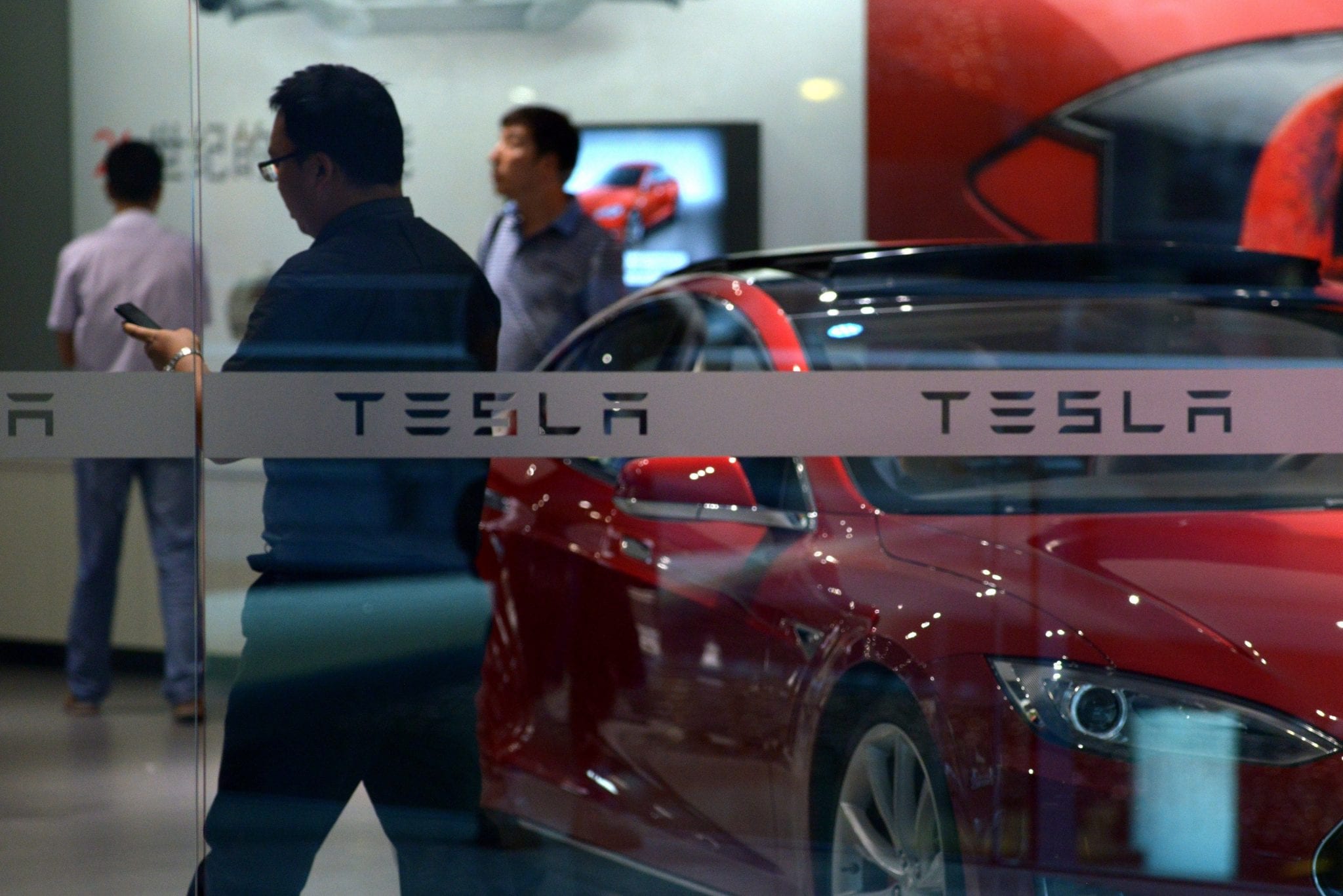
    Tesla Motors, the Silicon Valley-grown electric vehicle manufacturer, may open its first Korea dealership in a Shinsegae Group shopping complex within this year.

    “The talks are positive, for sure, but the final confirmation has yet to be reached,” said a Shinsegae Group spokesperson.

    “If the final confirmation is made, Shinsegae Property, which is pursuing the deal with Tesla, will give us notice,” he added.

    According to industry sources Thursday, if negotiations succeed, Tesla will open its first Korean dealership in Shinsegae’s Starfield Hanam shopping complex in Gyeonggi as early as November. The complex is a 30-minute drive from Seoul’s Gangnam District.

    Tesla CEO Elon Musk also confirmed Seoul as one of his next targets along with Taipei and Mexico City for the company’s high-end electric vehicles.

    “We are also accelerating store openings and plan to add a new retail location every four days on average during the remainder of Q3 and through Q4,” said Musk in an earnings report distributed Wednesday.

    “We are adding stores in new population-dense markets like Taipei, Seoul, and Mexico City, while also adding stores in our most mature markets like California,” he added.

    Scheduled to open early next month, Starfield Hanam is Shinsegae Group Vice Chairman Chung Yong-jin’s ambitious project to make a retail complex that includes not only shopping venues but all sorts of entertainment- and leisure-related facilities such as a waterpark, cinema and aquarium. Korea doesn’t have such a complex.

    In addition to offering some 750 retail brands, the complex will also house Asia’s first BMW dealership that handles both the original BMW and Mini vehicles. Luxury motorcycle brand Harley Davidson will have a store that displays not only vehicles but also its clothes and accessories lines.

    Since last December, Tesla has been gearing up to enter Korea by registering the corporate name Tesla Korea Limited and sending out job advertisements for car dealers and mechanics.

    Korea’s retail giants have been sending out feelers to the prestige car company, counting on its attractiveness to the general public.
    Lotte World Mall in Jamsil District, eastern Seoul was considered a candidate to house a Tesla shop, but the negotiation fell apart early this year.

    Opening an independent dealership in Gangnam District was raised as another possible choice and Tesla is still reported to be considering that option.

    Tesla is known for a unique way of directly operating and managing its branches, instead of franchising dealerships as most carmakers do.

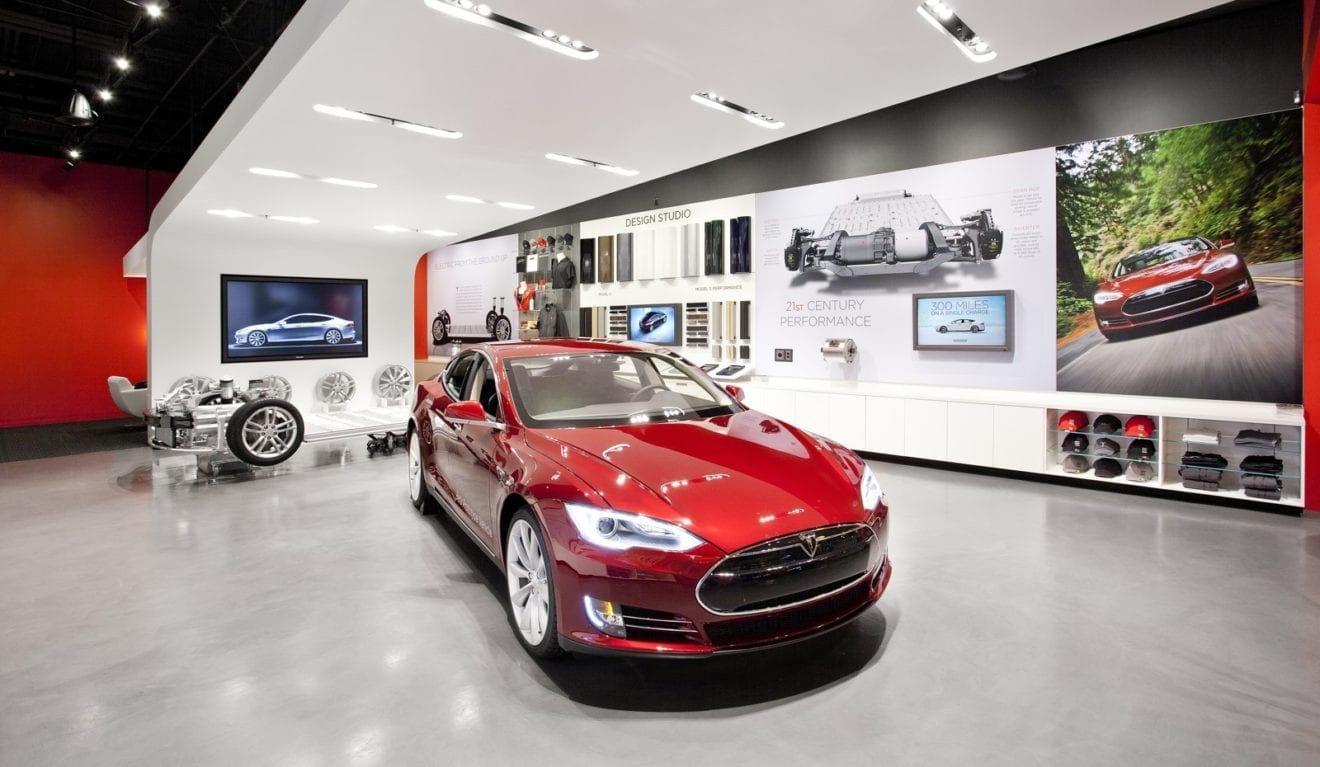
    Its first New York showroom, which Musk located in the funky Red Hook neighborhood of Brooklyn earlier this year, symbolizes the concept. It shows that a Tesla shop is not exclusively for car shoppers but is open to anyone interested in futuristic car technology. That also explains why many Tesla dealerships are in U.S. shopping malls.

    “The quality of our new locations is also improving as many shopping malls now consider us the new standard for an anchor tenant based on the amount of foot traffic that we draw and our very high revenue per square foot,” said Musk in the earnings report released Wednesday.

    If Shinsegae’s negotiations with Tesla succeed, its shop in Starfield Hanam will operate as a display until the Korean government allows the luxury electric vehicles on Korean roads

    In the meantime, Tesla’s second quarter earnings announced on Wednesday fell short of analysts’ expectations. It posted a $293 million net loss in the second quarter, a more than 60 percent drop compared to last year’s Q2 operating loss of $184 million.


  • Korean retail sales rise

    Korean retail sales rise

    Korea retail sales rose in June according to government data measuring major department stores and discount chains.

    The government said the year-on-year increase was fuelled by more holidays.

    The combined sales of three department stores – Hyundai, Lotte and Shinsegae – increased 11.8 per cent on-year in June, while those of major discount retailers – E-Mart, Lotte Mart and Home Plus – edged up 0.9 per cent during the same period, according to the data compiled by the Ministry of Trade, Industry and Energy.

    The ministry said sales went up as the number of holidays increased by one day from a year earlier.

    Sales at convenience stores jumped 18 per cent on-year last month, boosted by “a dramatic rise in food sales”, mostly of instant food. Convenience stores have retained double-digit growth rates since the last quarter of 2014 amid rising single-person households.

    The number of single-person households was estimated at 5.06 million in 2015, 7.7 times higher than the 661,000 households of 1985, according to the report by the state-run Korea Institute for Health and Social Affairs.

    Meanwhile, sales at hypermarkets, mostly run by large retailers, slid 7.8 per cent on-year.


  • Tesla in talks for store in Korea’s biggest mall

    Tesla in talks for store in Korea’s biggest mall

    Tesla Motors Inc. is in talks to open its first store in what will be South Korea’s biggest mall, according to the shopping complex’s owner Shinsegae Group.

    The two parties are negotiating over an outlet at Starfield Hanam, which is set to be the country’s largest mall when it opens in September, according to Shinsegae Group. Built jointly by Shinsegae Group and Taubman Asia, the four-story complex occupies an area the equivalent of 70 football fields and is located about six miles east of Seoul.

    Premium automakers including BMW are opening showrooms in retail districts to attract walk-in customers who wouldn’t otherwise visit car dealerships. Shinsegae Group owns Shinsegae Co. and E-MART Inc. and is South Korea’s second-largest retail conglomerate, behind Lotte Group.

    Atsuko Doi, a spokeswoman for Tesla in Tokyo, didn’t immediately reply to an email request for comment. Tesla said last month it plans to set up an office in Seoul, without giving further details. The U.S. electric vehicle maker advertised positions in sales, engineering, service and marketing in Seoul on its website. South Korea would be Tesla’s fourth market in Asia after China, Hong Kong and Japan.

    Separately, Hyundai Motor Co. said in an email that it will open its first premium Genesis brand store in the Starfield mall later this year.

  • End of Growth for Hypermarkets?

    End of Growth for Hypermarkets?

    Hypermarkets, which offer a wide range of products under one roof, once prospered in Korea. Recently, however, sales growth has stagnated with a rapid change in consumer behavior. 

    According to industry watchers, hypermarkets in Korea anticipated high growth this year, following poor performance in 2015 from widespread public fear of MERS in June. But their high hopes have proven to be overly optimistic. 

    Lotte Mart, one of Korea’s leading hypermarket franchises, only saw 0.2 percent year-over-year sales growth in June. Homeplus, Korea’s second largest retailer, even showed negative sales growth. 

    E-mart, a subsidiary of Shinsegae, and the largest retail hypermarket in Korea, also recorded negative growth in May (4.4 percent), but improved its performance in June, although not as much as anticipated. 

    “We can’t disclose our growth rate for June because of government regulations, but considering the base effect caused by the MERS incident, the rate is far from our expectations,” said an E-mart official. “The industry itself is at risk, and its low growth has become a fixated phenomenon.” 

    Among the three retail giants, Homeplus has been suffering most from negative growth in recent years, and starting this year the company decided not to disclose its monthly growth rate in order to avert potential negative influence that it may further pose in the industry.

    “The company policy is not to disclose monthly growth rates,” said a Homeplus official. “But it’s true that the industry is suffering.” 

    Industry experts point to changing consumer trends, with preference rapidly shifting from offline to online purchasing. 

    “There are so few customers at these hypermarkets nowadays,” said an industry official. “Department stores, on the other hand, are more crowded because they often deal with high-end products. But a rising number of consumers are shifting over to e-commerce platforms to purchase daily necessities, which are the main products offered by hypermarkets.”