Tag: Strategic

  • HSBC’s $2B Singapore Insurance Unit Sale to Allianz: A Strategic Boost for Both Giants

    HSBC’s $2B Singapore Insurance Unit Sale to Allianz: A Strategic Boost for Both Giants

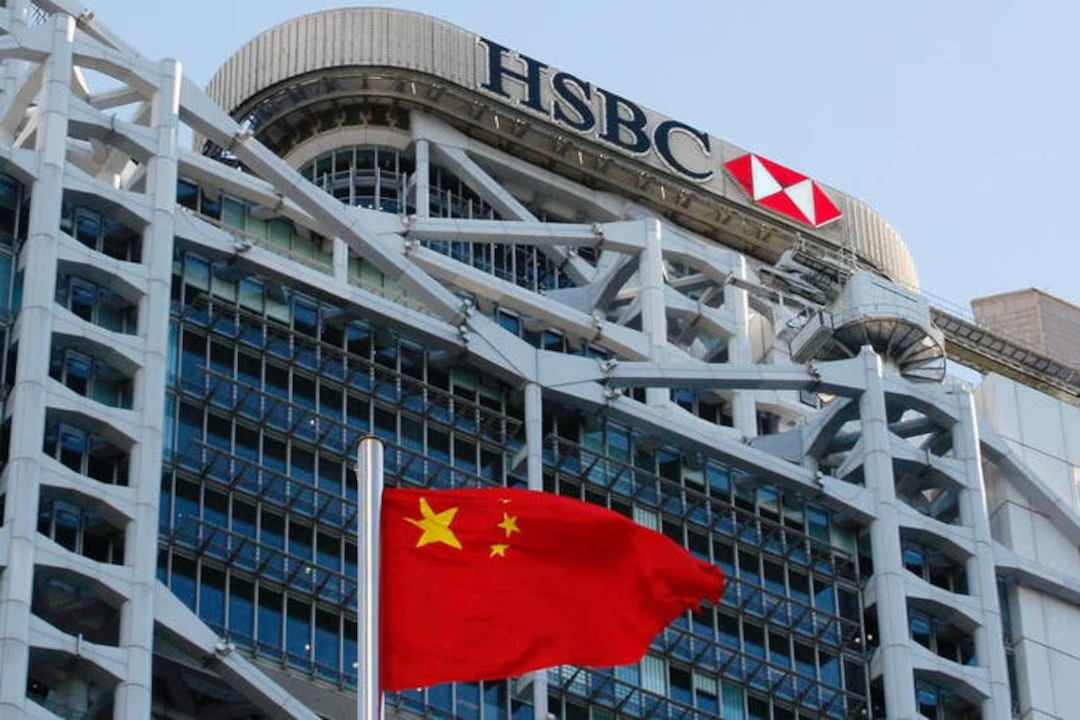
    HSBC has announced that it will sell its life and health insurance division in Singapore to Germany’s Allianz. The deal, which values the unit at SGD2.7 billion (US$2.09 billion), is expected to produce a pre-tax gain of US$1.8 billion for HSBC and potentially enhance the HSBC Group’s common equity tier 1 ratio by up to 15 basis points.

    Simplifying Operations and Boosting Capital Returns

    This sale signifies another move in HSBC CEO Georges Elhedery’s strategy to streamline operations at Europe’s largest bank and reinvest capital into sectors and markets that promise better yields. Simultaneously, he aims to maintain Singapore’s position as a vital hub for wealth and wholesale banking.

    The deal presents Allianz with a unique chance to expand in Singapore, a wealthy, strictly regulated market where distribution networks and bank-insurance partnerships carry high value. Anusha Thavarajah, Allianz’s Asia Pacific Regional CEO, states that the transaction underscores her company’s confidence in Singapore and recognizes HSBC Life Singapore’s fast-growing business, local expertise, and solid reputation among customers and partners.

    The planned divestment, set to occur in early 2027, will lead HSBC to enter a 15-year bank-insurance distribution agreement with Allianz. This agreement involves selling insurance products in Singapore, supported by an upfront payment of SGD200 million.

    Expanding Insurance Business

    The deal arrives in the wake of HSBC’s broader expansion in the insurance sector. Despite the bank’s ongoing effort to reshape its global footprint and focus on core Asian wealth and corporate banking markets, insurance income has seen a 16% year-on-year rise in the first quarter. This trend has contributed to an 18% boost in quarterly wealth revenue.

    Past investment interests include HSBC Holdings’ acquisition of French insurer Axa’s Singapore assets for US$529 million in 2022. However, the bank is also known for trimming smaller or less scalable retail and insurance operations in parts of Asia, while fiercely vying for affluent clients in the region.

    This sale follows Singapore’s Overseas-Chinese Banking Corp’s announcement in May of its Indonesian unit’s acquisition of certain HSBC wealth and premier banking portfolio assets and liabilities. HSBC is currently also reviewing its retail operations in Turkey, Australia, and Egypt.

    Questions & Answers

    What is the value of the deal between HSBC and Allianz?
    The deal values HSBC’s Singapore life and health insurance unit at SGD2.7 billion (US$2.09 billion).

    What will be HSBC’s strategy after the planned divestment in 2027?
    HSBC plans to enter into a 15-year bancassurance distribution agreement with Allianz to sell insurance products in Singapore.

    What has been the trend in HSBC’s insurance income?
    HSBC’s insurance income has seen a 16% year-on-year rise in the first quarter.

  • Vicca Ng Steps into COO Role at Hextar Retail: Driving Expansion and Strategic Partnerships

    Vicca Ng Steps into COO Role at Hextar Retail: Driving Expansion and Strategic Partnerships

    Vicca Ng has been appointed as the Chief Operating Officer (COO) of Hextar Retail, a Malaysian retail conglomerate. Ng’s new role takes effect immediately and she will continue to supervise the group’s retail operations, in addition to serving as an executive director.

    Vicca Ng’s Role in Hextar Retail

    Ng has been instrumental in the expansion of Hextar Retail. She has successfully managed the brand’s growth, fostered strategic partnerships, and developed retail operations across a growing portfolio. Her background encompasses business expansion, retail operations, and commercial development. In her new role as COO and Executive Director, Hextar Retail looks forward to Ng’s continued leadership as the company evolves and expands.

    Hextar Retail, initially established in 1988 as Classic Scenic Berhad, was rebranded in 2024. The company is a subsidiary of the larger Malaysian conglomerate, the Hextar Group. The Hextar Retail portfolio covers a range of sectors, including lifestyle, apparel, food and beverage, as well as convenience retail sectors.

    Questions & Answers

    What is the new role of Vicca Ng in Hextar Retail?
    Vicca Ng has been appointed as the Chief Operating Officer and will function as an Executive Director. She will supervise the group’s retail operations.

    What role has Vicca Ng played in the expansion of Hextar Retail?
    Ng has been instrumental in the company’s expansion, overseeing brand growth, fostering strategic partnerships, and developing retail operations across the growing portfolio.

    What sectors does Hextar Retail’s portfolio cover?
    Hextar Retail’s portfolio spans a wide range of sectors, including lifestyle, apparel, food and beverage, and convenience retail sectors.

  • British Sportswear Giant Castore Bags Historic Brand Grenson Shoes: A Strategic Move to Boost Profitability

    British Sportswear Giant Castore Bags Historic Brand Grenson Shoes: A Strategic Move to Boost Profitability

    UK-based sportswear retailer Castore has recently announced its acquisition of the longstanding footwear brand Grenson Shoes. This strategic move is aimed at bolstering Castore’s financial stability and expanding its product portfolio.

    Embracing Heritage Brands

    According to Thomas Beahon, co-founder of Castore, the acquisition of Grenson, a 160-year-old brand, underlines the company’s belief in the value of heritage brands. Grenson has built a diverse customer base over the years and has successfully partnered with some of the most renowned global brands.

    Beahon highlighted that the rich heritage that brands like Grenson possess is one of the key factors contributing to their enduring appeal. He believes that the historical legacy, born out of years of dedication, love, and passion, is an element that cannot be artificially recreated or replaced by advanced technologies like AI.

    Grenson, which is based in Northampton, England, has earned international acclaim for its high-quality leather shoes. Among its wide range of styles, the brand’s signature wingtip shoes are especially popular.

    Overcoming Common Challenges

    Throughout Castore’s decade-long journey, Beahon has observed that many brands grapple with similar issues, such as balancing growth and profitability, deciding between short-term and long-term goals, developing multi-channel distribution, and strategizing international expansion.

    He pointed out that it’s challenging for brands to achieve profitable growth without seeking external funding, which often leads to the dilution of the brand’s unique identity and values.

    However, Beahon argued that Castore’s new approach of investing in premium and established brands has effectively addressed the common issue of cash flow that many similar brands face. Moreover, he emphasized that Castore’s strategy is primarily focused on yielding long-term returns.

    He expressed his strong belief in the potential of great brands to continually strengthen over time with the right nurturing and management. As a company, Castore is deeply committed to promoting British brands’ competitive edge on the global platform.

    Questions & Answers

    Why has Castore acquired Grenson Shoes?
    Castore’s acquisition of Grenson Shoes is part of a strategic move to enhance its financial health and broaden its product range.

    What is Castore’s view on heritage brands?
    Thomas Beahon, co-founder of Castore, holds a high regard for heritage brands. He believes that their rich history and legacy, achieved over many years of dedication, love, and passion, contribute significantly to their lasting appeal.

    What are the common challenges that brands face according to Beahon?
    Beahon identified several common challenges that many brands face, including balancing growth and profitability, deciding between short-term and long-term goals, developing multi-channel distribution, and strategizing for international expansion.

  • Delivery Hero CEO Niklas Ostberg Announces Planned Departure amid Strategic Shift

    Delivery Hero CEO Niklas Ostberg Announces Planned Departure amid Strategic Shift

    Niklas Ostberg, the founder and CEO of Delivery Hero, has announced that he will be stepping down from his executive role after 15 years steering the global food delivery enterprise. The company has initiated a hunt for Ostberg’s successor, aiming to fill the position by March 31 of the coming year. The complete transition is expected to be finalized by the end of the year.

    Ostberg believes that this is the optimum time to initiate the transition as Delivery Hero is entering a new phase of strategic development and operational emphasis. “This is the appropriate moment to commence the process of transitioning the company into its future stage,” stated Ostberg. He also added that the long-term course was set during the Strategic Review, which was announced in December. The focus of this review was to deepen the market penetration, enhance the customer experience, and improve the consumer offering under the Everyday App strategy.

    Started in 2011, Delivery Hero has broadened its reach to more than 60 markets via brands like Foodpanda, Glovo, and Talabat. In a significant move, earlier this year, the Singapore-based multi-service platform, Grab, acquired Delivery Hero’s Foodpanda delivery business in Taiwan. The cash deal, which amounted to US$600 million, marked Grab’s first expansion beyond Southeast Asia.

    Questions & Answers

    Why is Niklas Ostberg stepping down from his role as CEO of Delivery Hero?
    Ostberg believes the timing is right as Delivery Hero is poised to enter a new phase of strategic development and operational focus. He wishes to allow the company to transition smoothly into its future stage under new leadership.

    What is Delivery Hero’s future strategy post-Ostberg’s departure?
    The company’s long-term strategy is to deepen its market penetration, enhance customer touchpoints and improve consumer offerings under the Everyday App strategy.

    How has Delivery Hero expanded its operations?
    Delivery Hero operates in more than 60 markets via brands like Foodpanda, Glovo, and Talabat. Additionally, its Foodpanda delivery business in Taiwan was recently acquired by Grab, marking the latter’s first expansion beyond Southeast Asia.

  • OCBC and Australia Aim to Double Trade and Investment in Southeast Asia by 2030: A New Strategic Partnership

    OCBC and Australia Aim to Double Trade and Investment in Southeast Asia by 2030: A New Strategic Partnership

    Overseas-Chinese Banking Corporation (OCBC) and the Australian High Commission in Singapore have recently launched a five-year strategic alliance aimed at fortifying trade and investment flow between Australia and Southeast Asia. The partnership is designed to considerably boost these economic currents by 2030, with OCBC setting their sights on a surge of over 200%.

    Focus on Key Sectors

    The strategic partnership aligns with Australia’s ambitious Southeast Asia Economic Strategy towards 2040, known as ‘Invested’. The focus of the collaboration will be on pivotal sectors such as energy transition, infrastructure, green transportation, fintech, and digital innovation.

    The cooperation brings together OCBC’s robust regional banking network and formidable financing ability, alongside the policy know-how of the Australian government. It also encompasses collaboration with various Australian departments including External Affairs and Trade, Export Finance and the Australian Trade and Investment Commission. This synergistic effort aims to pave the way for Australian companies to grasp lucrative opportunities sprouting across Southeast Asia.

    Celebrating its 40th anniversary of operation in Australia this year, OCBC reported significant growth in its Sydney branch in recent times. The surge in growth can be attributed to thriving sectors such as real estate, energy, utilities, and digital infrastructure.

    Creating Opportunities for Expansion

    Elaine Lam, Head of Global Corporate Banking at OCBC, expressed that the strategic collaboration is set to form a potent platform for Australian enterprises and investors looking to spread their wings into Southeast Asia. She identified burgeoning opportunities in the region, particularly in energy transition, infrastructure development, and green transportation.

    Notably, big Australian players like Lendlease and Qantas are among the companies supported by OCBC. The bank has recently provided backing for Qantas’ fleet renewal financing programme and has also lent support to several Lendlease developments situated in Singapore, Sydney, and Kuala Lumpur.

    Questions & Answers

    What is the goal of the strategic partnership between OCBC and the Australian High Commission in Singapore?

    The partnership aims to substantially enhance trade and investment flows between Australia and Southeast Asia by 2030.

    What sectors will the cooperation focus on?

    Key sectors encompass energy transition, infrastructure, green transportation, fintech, and digital innovation.

    Which Australian companies are currently supported by OCBC?

    OCBC is currently backing major Australian companies such as Lendlease and Qantas.

  • Malaysia Contemplates Axing Fuel Subsidies for Wealthier Citizens: A Strategic Move Towards Economic Resilience

    Malaysia Contemplates Axing Fuel Subsidies for Wealthier Citizens: A Strategic Move Towards Economic Resilience

    The Malaysian government is currently evaluating a proposal aimed at revising petrol subsidies for the country’s high-income households. This proposition was initially presented roughly four weeks ago and has been under close scrutiny by the respective authorities over the past three weeks.

    Government’s Standpoint on the Proposal

    Malaysia’s Prime Minister, Anwar Ibrahim, disclosed that a final resolution has not yet been reached on the matter. Although, he emphasized that fundamentally, the government concurs with the necessity to reassess the subsidy system for higher-income Malaysians. The government is expediting efforts to finalize the proposal at the earliest.

    The consideration of this revision comes in response to increasing demands for the realignment of the nation’s fuel subsidy policy. The goal is to ensure that aid is appropriately directed towards the deserving recipients.

    Public voices are advocating for the exclusion of high-income groups from receiving subsidies on RON95 petrol. They suggest that this support should be redirected towards middle- and lower-income groups who are feeling the brunt of escalating living expenses.

    The Need for Proposal in Present Economic Climate

    The proposal is seen as a critical requirement in the prevailing economic environment. It is expected to aid in effectively utilizing national resources and bolstering the country’s resilience against global economic uncertainties.

    Questions & Answers

    Why is the Malaysian government considering a revision of petrol subsidies for high-income earners?
    The government is considering the revision in response to increasing calls for a realignment of the fuel subsidy policy, aiming to ensure aid is properly directed towards deserving recipients.

    What are some of the reasons driving the demand for this revision?
    Public voices have been advocating for the exclusion of high-income groups from receiving subsidies on RON95 petrol. They suggest that this support should be redirected towards middle- and lower-income groups who are comparatively more affected by the rising cost of living.

    What is the expected outcome of this proposal?
    The proposal is expected to aid in the effective utilization of national resources and strengthen the country’s resilience against global economic uncertainties.

  • Ikea’s Strategic Shift: Smaller Stores Propel China Expansion

    Ikea’s Strategic Shift: Smaller Stores Propel China Expansion

    Swedish furniture giant, Ikea, is intensifying its expansion strategy in China by launching a more compact store model in the eastern part of Beijing. This move is part of the company’s shift from its traditional large-scale stores towards smaller and more accessible locations.

    The New Small-Format Store

    The new Ikea outlet is managed by the Ingka Group and situated in Beijing’s Tongzhou District. It spans over an area of approximately 1,500 square meters, quite a downsize from the standard Ikea store which generally covers around 30,000 square meters. Despite its smaller size, the store still offers an impressive assortment of about 3,000 products.

    Ikea’s latest outlet puts more emphasis on services like home planning, rather than maintaining a large-scale inventory on-site. This innovative approach marks Ikea’s fifth presence in Beijing, and its inaugural location in the city’s eastern region. It also signifies a broader shift in the way the company is tackling the market.

    Shifting from Megastores to Compact, Accessible Locations

    Instead of depending on large-scale destination stores, Ikea is pivoting towards smaller, more accessible locations that are in closer proximity to residential areas.

    Javier Quiñones, the global commercial manager at Ingka Group, commented on this strategic shift. He noted, “The one-size-fits-all approach no longer applies. This makes our current expansion more relevant. We are getting closer to more people than ever, and continually learning how to fine-tune our offerings and presence.”

    This compact store model has already been successfully piloted in Shenzhen, with plans to introduce similar outlets across other major cities.

    Ikea’s Global Expansion

    So far in the current year, Ikea has inaugurated 21 new outlets worldwide, with sizes ranging from a few hundred square meters to over 4,000 square meters. These new outlets are spread across Europe, North America, and Asia. The company also plans to unveil additional locations in forthcoming months.

    Questions & Answers

    What is the size of the new Ikea store in eastern Beijing?

    The new Ikea store in eastern Beijing covers approximately 1,500 square meters.

    What differentiates the new Ikea store from the traditional ones?

    The new Ikea store emphasizes more on services like home planning rather than maintaining a large on-site inventory, and it’s located closer to residential areas.

    How many new Ikea locations have opened globally this year?

    Ikea has opened 21 new locations globally this year.

  • Singapore Amplifies Integrated Professional Services: A Strategic Alliance Between ISCA and LawSoc

    Singapore Amplifies Integrated Professional Services: A Strategic Alliance Between ISCA and LawSoc

    In an effort to establish itself as a leading regional hub for integrated professional services, Singapore is taking significant strides. This endeavor has been demonstrated through a recent formal collaboration between the Institute of Singapore Chartered Accountants (ISCA) and the Law Society of Singapore (LawSoc). This strategic partnership aims to harmonize the skills of lawyers and accountants to better meet the complex, multi-jurisdictional business needs that are arising as companies expand across borders and the demand for comprehensive advice in legal, financial, and governance disciplines escalates.

    Transition from Compliance to Coordination

    The dynamics of professional services firms are undergoing a structural transformation. Clients are now seeking integrated solutions rather than isolated expertise, especially when it comes to managing risk, facilitating transactions, or expanding into new markets. The alliance between ISCA and LawSoc is a direct response to this shift. The initiative is designed to bring the legal and accountancy professions closer together, to promote multidisciplinary collaboration and to unlock new growth opportunities for firms operating in the region.

    ISCA’s President, Teo Ser Luck, views this collaboration as a vital step towards developing a cohesive ecosystem, saying, “This partnership is of great significance for both organizations. We are in the process of establishing a Professional Services Centre that will connect businesses with the legal and accounting expertise they need to confidently manage the risks associated with operating across borders.”

    Digital Learning as a Cornerstone

    Talent development is a key aspect of this collaboration. ISCA and LawSoc plan to co-develop a digital learning platform tailored to the needs of modern professional workflows. This platform will offer on-demand modules that are accessible at any time and from anywhere. It will also promote cross-disciplinary learning, enabling lawyers to understand more about accounting, finance and governance, and accountants to deepen their knowledge of legal concepts relevant to transactions and advisory work.

    NTUC LearningHub is supporting this initiative by facilitating funding options such as SkillsFuture Credit and the Union Training Assistance Programme (UTAP). They plan to roll out Continuing Professional Development (CPD) courses later this year via NTUC LearningHub’s Learning eXperience Platform.

    A New Professional Services Centre

    Beyond skills development, the partnership between ISCA and LawSoc also has an institutional dimension. They are considering the establishment of a Professional Services Centre in Singapore. This centre would serve as a one-stop platform that connects companies with coordinated legal and accounting expertise. It will be particularly beneficial in assisting foreign investors interested in Singapore, as well as Singapore-based firms looking to expand overseas.

    Strengthening Singapore’s Regional Role

    This collaboration comes at a time of geopolitical uncertainty and economic fragmentation, where Singapore is striving to maintain its position as a reliable and trusted business hub. The Economic Development Board (EDB) views this partnership as a way to reinforce Singapore’s competitive edge in professional services.

    A Model for the Region?

    As cross-border deal flow and regulatory complexity in Asia are expected to increase, Singapore’s integrated approach could serve as a model for other markets. By aligning legal and financial expertise, investing in digital learning, and building institutional support structures, the ISCA–LawSoc partnership signals a broader evolution of the professional services industry—one that prioritizes collaboration over specialization in isolation.

    Questions & Answers

    What is the aim of the collaboration between ISCA and LawSoc?
    The partnership aims to harmonize the skills of lawyers and accountants to better meet the business needs of clients as companies expand across borders and demand for comprehensive advice in legal, financial, and governance disciplines rises.

    What are some key components of this collaboration?
    The collaboration includes aligning legal and financial expertise, developing a digital learning platform for on-demand, cross-disciplinary education, and considering the establishment of a Professional Services Centre in Singapore.

    What does this partnership signify for the professional services industry in Singapore and potentially the region?
    The partnership signifies a broader evolution of the professional services industry, one that prioritizes collaboration over specialization in isolation. It could serve as a model for other Asian markets as cross-border deal flow and regulatory complexity increase.

  • HSBC Bolsters China Wealth Management with Strategic Duo Appointment: Max Xu and Samuel Chen

    HSBC Bolsters China Wealth Management with Strategic Duo Appointment: Max Xu and Samuel Chen

    HSBC, the London-based financial institution, recently announced two significant additions to its Chinese wealth management and private banking sector.

    New Leaders at the Helm

    Max Xu has been appointed the head of international wealth and premier banking (IWPB) at HSBC China, with the appointment effective from April 1. In this pivotal role, he will answer to Mark Wang, the CEO of HSBC China and, on a functional level, to Kai Zhang, the head of IWPB in Asia.

    Xu, who holds the current position of head of premier banking at IWPB China, has been a part of HSBC since 2025. His expansive career spanning more than 20 years is marked by his experiences in institutional and consumer banking, making him an ideal fit for this role.

    Strengthening HSBC’s Private Banking Sector

    Simultaneously, Samuel Chen has been entrusted with the role of head of the private bank at HSBC China, effective from April 1. He will report to Xu and will work closely with Lok Yim, the regional head of HSBC Private Bank in the Asia Pacific region.

    Chen has a rich banking career extending nearly 20 years, including nine years with HSBC Private Bank in crucial client-facing roles. His expertise will be invaluable in expanding the private banking sector of HSBC in China.

    Advancing HSBC’s Agenda in China

    These noteworthy appointments of Xu and Chen are a strategic move by HSBC to enhance its leadership team as it furthers its wealth and private banking operations in mainland China.

    Kai Zhang stated that these appointments solidify their dedication to achieving sustainable growth and delivering a superior client experience across the Premier, Premier Elite, and Private Bank continuum in China.

    Questions & Answers

    Who has been appointed the head of international wealth and premier banking at HSBC China?
    Max Xu, a veteran with over 20 years of banking experience, has been appointed to this role.

    Who will serve as the head of the private bank at HSBC China?
    Samuel Chen, who has almost 20 years of banking experience, including nine years in senior client-facing roles at HSBC Private Bank, will assume this role.

    What do these appointments signify for HSBC’s operations in China?
    These appointments reflect HSBC’s commitment to expanding its wealth and private banking services in mainland China, with a focus on sustainable growth and superior client service.

  • Cotton On Group Dissolves Inactive Singapore Entity in Strategic Asian Restructuring Move

    Cotton On Group Dissolves Inactive Singapore Entity in Strategic Asian Restructuring Move

    The Australian fashion retail giant, Cotton On Group, has announced the shuttering of its regional division, Cotton On Asia. This decision comes in the wake of a resolution passed by shareholders that approved the winding up of the business and the appointment of liquidators.

    Despite the closure of this regional subsidiary, Cotton On Group has no intentions of withdrawing from the Asian market. Cotton On Australia’s main office has clarified that the liquidated entity was not responsible for operating any stores or hiring employees.

    “We have no plans to exit the Asia region,” a company representative stated.

    It was further explained that Cotton On Asia was an inactive holding company and its existence was no longer necessary. The closure will not affect customers, team members, stores, suppliers or operations within the Asian region in any way.

    Official documents from the Government Gazette reveal that the Singapore-based entity has entered a creditors’ voluntary liquidation. This action was a result of an extraordinary general meeting where members passed a special resolution under the Insolvency, Restructuring and Dissolution Act 2018.

    This move is reportedly part of a more extensive restructuring of the group’s corporate setup in Asia. Although the details have not been specified, it is generally believed that such actions are intended to streamline legal structures and enhance operational efficiency across different markets.

    Cotton On was first established in Singapore in 2007 and over the years have expanded its brand portfolio. The group now includes a variety of brands such as Cotton On, Cotton On Body, Cotton On Kids, Typo, and Rubi.

    The company was founded by Nigel Austin, who still maintains control over the business operations.

    Questions & Answers

    What is the reason behind Cotton On Group closing its regional division, Cotton On Asia?
    The closure is part of a broader restructuring strategy of the group’s corporate setup in Asia, aimed at streamlining legal structures and enhancing operational efficiency across different markets.

    Will the closure of Cotton On Asia affect the company’s operations in the region?
    No, the company has made it clear that the closure of this division will not impact customers, team members, stores, suppliers, or operations within the Asian region.

    Who founded Cotton On Group, and who currently oversees its operations?
    The Cotton On Group was founded by Nigel Austin, who continues to control the business operations.

  • DFI Retail Group Triumphs with 35% Profit Surge Amid Strategic Overhaul – An In-depth Look at the 2025 Fiscal Year

    DFI Retail Group Triumphs with 35% Profit Surge Amid Strategic Overhaul – An In-depth Look at the 2025 Fiscal Year

    DFI Retail Group, a prominent pan-Asian retailer, has confirmed the efficacy of its ongoing strategic alterations, following a successful 2025 fiscal year. The group reported a substantial 35% increase in underlying profits to US$270 million, despite no growth in its year-end revenue stream, which remained consistent with the 2024 figure at $8.8 billion.

    Strategic Execution and Profitability

    The robust financial performance and enhanced shareholder returns in 2025 have been attributed to the effective implementation of strategic initiatives. DFI Retail Group’s Chairman, Lincoln Pan, emphasized that this was achieved despite the challenging circumstances in the retail industry. Significant strides in portfolio simplification have notably increased the group’s investment capabilities. This shift has facilitated the prioritization of strategic initiatives, providing greater value for customers and paving the way for sustainable growth and returns through accretive inorganic opportunities.

    Portfolio Adjustments and Performance

    In an effort to adapt to changing market conditions and consumer preferences, DFI Retail Group has made adjustments to its brand portfolios. As part of this strategy, 7-Eleven, one of the group’s brands, has shifted its focus towards higher-margin, non-cigarette categories. Ready-to-eat offerings now account for 24% of convenience sales for the brand in 2025, highlighting a considerable change in product focus.

    Financial Performance

    The group’s strong financial performance is also reflected in its operating cash flow. After making lease payments, the operating cash flow for the group stood at $430 million, marking a 30% increase from the previous year. In addition, the group’s free cash flow saw a remarkable year-on-year increase of 78%.

    Questions & Answers

    What were the underlying profits for DFI Retail Group in the fiscal year 2025?
    In the fiscal year 2025, DFI Retail Group reported underlying profits of US$270 million.

    What strategical changes did 7-Eleven, a brand under DFI Retail Group, adopt in 2025?
    7-Eleven shifted its focus towards higher-margin, non-cigarette categories. Ready-to-eat offerings constituted 24% of the brand’s convenience sales.

    How did the operating cash flow of DFI Retail Group fare in 2025?
    After lease payments, DFI Retail Group’s operating cash flow in 2025 stood at $430 million, which was a 30% increase from the previous year.

  • Robust Growth for Luckin Coffee Driven by Strategic Network Expansion and New Store Openings

    Robust Growth for Luckin Coffee Driven by Strategic Network Expansion and New Store Openings

    Luckin Coffee, a reputable coffee chain, has disclosed another quarter of impressive double-digit revenue growth. This growth is mainly attributed to the company’s strategic focus on expanding its reach across various regions.

    Growth Metrics

    In the fourth quarter, which concluded on December 31, the company’s net revenues climbed by 32.9 per cent, reaching RMB12.7 billion (US$1.8 billion). The primary driver of this growth was the net opening of 1834 new stores, of which 1792 are in China, 13 in Singapore, 25 in Malaysia, and four in the United States. By the end of the quarter, the total count of stores stood at 31,048. This includes 20,234 company-operated stores and 10,814 locations in partnership.

    The same-store sales of company-operated outlets grew by 1.2 per cent. This presents a significant improvement from the 3.4 per cent decrease experienced in the same period last year.

    During the quarter, the Gross Merchandise Value (GMV) witnessed a 32.8 per cent rise. Concurrently, the average number of monthly transacting customers surged by 26.5 per cent.

    Financial Performance

    However, the GAAP operating income demonstrated an 18 per cent fall, amounting to RMB821.4 million. Additionally, the net income decreased by 39 per cent to RMB518.2 million.

    For the entire year, the net revenues escalated by 43 per cent, reaching RMB49.2 billion. This increase was accompanied by the opening of 8708 net new stores. The net income demonstrated a 22 per cent rise, standing at RMB3.6 billion.

    Leadership Insights

    Jinyi Guo, the co-founder and CEO of Luckin Coffee, offered insights into the company’s performance. Guo highlighted the strength of the company’s execution focused on scale, which enabled it to achieve robust growth amidst fluctuating market dynamics.

    Guo stated, “We concluded the year on a strong note, achieving the milestone of our 30,000th store and expanding our cumulative transacting customer base to over 450 million.”

    He further noted that the company’s increased scale strengthened its market leadership and boosted its capability to harness the structural tailwinds of China’s coffee market.

    Questions & Answers

    What contributed to Luckin Coffee’s impressive growth in the fourth quarter?
    The company’s significant growth was primarily driven by the net opening of 1834 new stores across various regions.

    How did the company’s financial performance fare in this period?
    Despite the impressive revenue growth, Luckin Coffee saw a decrease in GAAP operating income by 18 per cent and net income by 39 per cent.

    What does the company’s expansion signify?
    The expansion of Luckin Coffee’s scale has fortified its market leadership and equipped it to tap into the structural tailwinds of China’s coffee market effectively.

  • DoorDash Bids Farewell to Singapore and Japan Markets: A Strategic Re-focus on Sustainable Growth

    DoorDash Bids Farewell to Singapore and Japan Markets: A Strategic Re-focus on Sustainable Growth

    DoorDash, the leading food delivery platform, has announced the discontinuation of its operations in Singapore and Japan to concentrate on markets with higher priorities.

    Singapore Shutdown

    In Singapore, DoorDash will be closing down its Deliveroo service on March 4, thus drawing a curtain over its 11-year long tenure in the city-state. The firm has indicated that services will remain operational until the shutdown, advising customers to exhaust any residual credits and gift cards before the cessation of operations.

    Exiting Other Markets

    In a related development, the company has also confirmed the planned closure of Deliveroo and Wolt services in Qatar, Uzbekistan, and Japan. This decision was reached following an extensive evaluation of market conditions spanning several months. According to DoorDash, the exit strategy is hinged on factors specific to each of these countries and is aligned with the company’s strategic thrust to focus on markets that offer the greatest potential for sustainable growth and long-term dominance.

    Despite describing the decision as a challenging one, the firm has committed to closely collaborating with relevant local stakeholders to effect a seamless transition in the immediate future.

    DoorDash’s Contributions and Gratitude

    Miki Kuusi, the Head of DoorDash International, CEO of Deliveroo and co-founder of Wolt, expressed gratitude to all who have been a part of their journey. He remarked, “Over the last 11 years, we have been proud to shape food delivery in Singapore, granting consumers access to an extensive range of restaurant and grocery partners. To all our employees, customers, partners, and riders who have accompanied and supported us on this journey – thank you.”

    It’s worth noting that in the previous year, Deliveroo also withdrew from the Hong Kong market on April 7, after operating there for nine years. This followed an agreement to sell some of its assets to Foodpanda.

    Questions & Answers

    Why is DoorDash discontinuing its operations in Singapore and Japan?
    DoorDash is discontinuing operations in Singapore and Japan to focus on markets with higher priorities.

    What will happen to the remaining credits and gift cards of customers in Singapore?
    Customers are advised to exhaust any remaining credits and gift cards before DoorDash ceases operation on March 4.

    Can we expect further market exits from DoorDash?
    While not explicitly stated, the company’s strategic focus on markets where it sees a clear path to sustainable scale and long-term leadership might lead to further market exits.

  • UBS Unveils New Managing Directors: A 11% Drop from Last Year Reveals Strategic Shift

    UBS Unveils New Managing Directors: A 11% Drop from Last Year Reveals Strategic Shift

    UBS, the banking behemoth based in Zurich, has unveiled its new cohort of managing directors. With a total of 155 appointments, this year’s list is smaller than the preceding year’s, representing an 11% drop from the 174 managing directors appointed last year.

    The geographic distribution of the new managing directors reveals a global spread. Switzerland had the highest number, with 43 individuals, closely followed by the Asia Pacific region, which had 40. Europe, the Middle East, and Africa had a combined total of 36, as did the Americas. In a noteworthy mention, 92 financial advisors in the Americas have been elevated to the position of managing director within the wealth management division.

    In a statement from the bank, it was noted that the new managing directors embody the robust culture of the institution, as well as uphold the three key tenets of success. The bank emphasized the pivotal role these directors will play in strengthening the firm. The efforts will focus on consolidating the bank’s industry-leading position and delivering superior value for its clients.

    Questions & Answers

    How many new managing directors have been appointed by UBS this year?
    UBS has announced the appointment of 155 new managing directors.

    How does this year’s number of new managing directors compare to last year?
    This year has seen an 11% decrease in the number of managing directors compared to the previous year, which had 174 appointments.

    Which regions have the most significant number of new managing directors?
    Switzerland leads with 43 appointments, followed by Asia Pacific with 40, and Europe, the Middle East and Africa, and the Americas, each with 36.

  • CJ Olive Young & Sephora Join Forces to Propel K-Beauty Brands Globally: A Strategic Expansion in Key Markets

    CJ Olive Young & Sephora Join Forces to Propel K-Beauty Brands Globally: A Strategic Expansion in Key Markets

    CJ Olive Young, a leading beauty retailer in South Korea, has embarked on a significant global partnership with Sephora, an entity of LVMH, to broaden the international presence of Korean beauty brands. Their strategy primarily revolves around leveraging existing retail networks.

    The Launch of K-beauty Zones

    As part of the partnership agreement, Olive Young will curate dedicated Korean beauty (K-beauty) sections on Sephora’s online platforms and within select physical outlets. These areas are set to be launched in the latter half of the current year.

    Initial Rollouts and Future Expansion

    The initial phase of the rollout is anticipated in Singapore, Malaysia, Thailand, Hong Kong, the United States, and Canada. This will then be followed by an expansion into additional markets in the subsequent year, including the United Kingdom, Australia, and the Middle East.

    Strategic Collaboration

    Youngah Lee, Chief Strategy Officer at CJ Olive Young, highlighted the global fascination with K-beauty as a driving force behind the partnership. Lee emphasized that this collaboration is a significant step towards enhancing the international presence of Korean beauty brands in key global markets.

    Olive Young’s Global Aspirations

    This partnership aligns with Olive Young’s larger international ambitions. The company also recently announced its intention to open its first standalone store in Los Angeles, United States, later this year as part of its expansion strategy.

    Questions & Answers

    What is the goal of the partnership between CJ Olive Young and Sephora?
    The partnership aims to expand the international presence of Korean beauty brands by leveraging Sephora’s established retail networks.

    When and where will the initial rollouts of the K-beauty zones take place?
    The initial rollout of the K-beauty zones on Sephora’s online platforms and selected physical stores is planned for the second half of this year in Singapore, Malaysia, Thailand, Hong Kong, the US, and Canada.

    What are Olive Young’s broader international plans?
    Apart from the partnership with Sephora, Olive Young has also announced plans to open its first standalone store in Los Angeles, USA, sometime this year.