Tag: Retailer

  • Chinese e-commerce policy to benefit foreign sellers

    Chinese e-commerce policy to benefit foreign sellers

    The Chinese government last week announced that it will improve its e-commerce retail import policy to boost consumption. “We need to take a holistic approach, exercise prudent yet accommodating regulation to fully unleash the growth potential of cross-border e-commerce,” Li Keqiang, Premier of the State Council of the People’s Republic of China, said at a cabinet meeting on November 21, when the policy was laid out.

    The policy has been cheered by Australian exporters to the market, such as AuMake, the ASX-listed retail company that connects local suppliers with Chinese personal shoppers, daigous, who buy and ship products on behalf of friends, family and customers in China.

    The retailer released a statement on Friday saying the new policy is expected to stimulate daigou activity through 2019.

    The new policy ensures that China’s existing approach to cross-border e-commerce continues, and no new requirements around licensing, registration or record-filing for first-time imports will apply to sales through cross-border e-commerce platforms, as was expected to apply from January 1, 2019. Instead, these goods will continue to receive the more relaxed regulation for personal use imports.Adtech Ad

    The Chinese government is also expanding its preferential import duties to another 63 tax categories of high-demand goods and increasing the quota of goods eligible from 2000 yuan to 5000 yuan per transaction, and from 20,000 yuan to 26,000 yuan per head per year. This quota will be further adjusted in light of an individual’s personal income.

    “AuMake welcomes the latest development to further stimulate the CBEC [cross-border e-commerce] with the continuation of current licensing requirements, extension of tariff/VAT/consumer tax concessions and value per transaction/head limit also being increased,” the retailer said in a statement.

    “These measures are anticipated to increase the total size of the CBEC and it is anticipated that legitimate cross border e-commerce participants, including AuMake and professional daigou, will increase their market share as illegitimate operators are phased out with increased regulation.”

  • Stocking up on Digitalization to Increase Share-of-Basket

    Stocking up on Digitalization to Increase Share-of-Basket

    With the rise of e-Commerce, Asian retailers are under tremendous pressure to continuously push traditional boundaries and embark on digital transformation to engage consumers. Keeping up with the latest trends in providing the best consumer experience have retailers looking to tech innovations, particularly digital technologies, to play a key role in capturing and keeping customers’ attention and loyalty.

    Technologies such as the cloud, Internet of Things (IoT), mobility solutions, and augmented reality (AR) are driving customer-facing innovations such as digital marketing, smart shopping carts, couponing, and mobile apps – that bring people into the store and keep them coming back. Cloud applications also make it easier for store associates and corporate staffers alike to collaborate and take care of back-office needs.

    The reality is that retailers need to embrace digital transformation and use technology in innovative ways to enhance the customer experience if they want to remain competitive.

    Technology Challenges

    However, rapid adoption of digital in retail not only improves outcomes but ignites new challenges for IT administrators in retail organizations. Among the challenges are how to:

    • Support increased customer engagement with in-store technologies that have high-bandwidth demands
    • Support increasing use of applications in the cloud with a resilient and secure network
    • Ensure connectivity and provide secure access for point-of-sale (POS) applications and electronic payment transactions
    • Ensure performance for real-time applications such as voice, video, and unified communications

    Taking on one of these efforts in the past may have required every resource, but now all of these must be accomplished by the same IT staff.  Also, these changes must be deployed across hundreds and even thousands of store locations spanning vast geographical regions.

    Yet the connective element that brings everything together for retailers –  existing networks are now too complex, too expensive, and frankly, too outdated to support the challenges and opportunities that come from digital transformation. A new approach to the retail network is required.

    With a Virtual Cloud Network, retailers can create an end-to-end software-based network architecture that delivers services to applications and data wherever they are located at global scale from edge to edge, with consistent, pervasive connectivity, and security.

    Faster service delivery on the cloud

    Alfamart in Indonesia is an example of a retailer that embarked on digital transformation by adopting cloud and mobility solutions, and reaped the benefits of a modernized, connected business network.

    Faced with a vast network of over 10,300 minimarts spread across the Indonesian archipelago and basic internet infrastructure in many far-flung areas, it was difficult for Alfamart to convey information in a timely manner across its network.

    The slow flow of information impeded the business’ ability to make critical decisions in a timely manner,  resulting in them not being able to react quickly enough to customer feedback or market trends, and affected overall competitiveness.

    Alfamart decided to connect all of its store employees and partners with a bring your own device (BYOD) strategy and an enterprise mobility management platform over the cloud.

    All store employees are now equipped with the most up-to-date product information, prices and stock level at their fingertips, enabling them to act quickly to meet market trends, and manage peaks in demand for the fast-moving perishable goods they provide.

    This has improved their speed-to-market, reduced training costs by 20 per cent, enhanced mobility across device and platforms, and improved internal communications between management and employees. Customer satisfaction levels have also gone up.

    Keeping systems up and goods in stock at all times

    City Mart in Myanmar is another retailer which benefited from modernizing its legacy IT infrastructure by adopting virtualization. Lengthy downtimes were a common occurrence under their old IT system, which affected their supply chain and resulted in unfulfilled customer orders, negatively impacting revenues.

    The supermarket network implemented a software-defined IT infrastructure and automated certain IT processes, which not only eliminated server downtime but also cut operational expenses by half. Predictive analytics and smart alerts also helped improve the system performance.

    With a new inventory management system, City Mart is now able to gain visibility of their stock across their entire network of 180 stores, whether on storeshelves or in the warehouse. This enabled them to better understand changing consumer demand patterns across different stores, ensure that goods are in stock at all times, and build stronger relations with suppliers.

    Ultimately, the virtualized IT infrastructure supports City Mart’s expanding business, enabling the retailer to meet the needs of Myanmar’s growing consumer class.

    Networking for Retail 2020

    The future of networking is software, and the network of the future is the Virtual Cloud Network. Virtual Cloud Networks allow retailers to create a digital business fabric for connecting and securing applications, data, and users across the entire network in a hyper-distributed world. In this way, retailers can simplify networking and wide area network management, optimize cloud access from all locations, assure high performance for even the most demanding applications, and enforce security and compliance across the network in every store location.

  • Global Brands expects massive loss this year

    Global Brands expects massive loss this year

    A big swing to a loss is expected by apparel group Global Brands Group Holding for its latest 12 months, to the end of March.

    A preliminary assessment of its accounts indicates a net loss attributable to shareholders of between US$70 million and $75 million.

    This compares to a net profit attributable to shareholders of about $90 million for the previous 12 months.

    Global Brands says the expected loss is primarily the result of one-off impairment charges from the write-off of a receivable arising from a loan made by the company, as well as impairment charges on various intangible assets. Also, a major licence expired during the year. Exceeding $100 million, the impairment charges and receivable write-off were non-cash adjustments.

    The company expects to release its annual results late next month.

  • New Zealand Consumer spending finished stronger in 2017

    New Zealand Consumer spending finished stronger in 2017

    Consumer spending growth accelerated to five per cent year-on-year in the three months to the end of December last year, with retail trade picking up momentum over the holidays, new National Australia Bank data has revealed.

    Up from three per cent growth y/y in the third quarter, NAB’s latest quarterly customer spending report, which measures around 2.7 million daily transactions through the bank’s facilities, has tracked spending increases across the entirety of metro and regional Australia.

    Retail trade increased 3.4 per cent y/y in Q417, up from 2.4 per cent in the third quarter, while accommodation and food services spending was 10.4 per cent, up 3 per cent.

    The Northern Territory was the strongest growth state for retail trade, up six per cent, offsetting a 0.6 per cent decline in Western Australia.

    Retail trade spending growth was 4.7 per cent in Victoria and 3.3 per cent in NSW. Across the entire economy Victoria was the strongest performer, while NSW and NT lagged.

    Average monthly customer spending during the quarter was up $166 to $2306 in metro areas and up by $104 to $2089 in regional areas.

  • Ho Chi Minh City to crack down on tax-evading Facebook retailers

    Ho Chi Minh City to crack down on tax-evading Facebook retailers

    The tax man is threatening to shut down social media accounts, but savvy retailers know that it’s an empty threat. Ho Chi Minh City sent out tax demands to nearly 13,500 Facebook retailers over a month ago, but a representative from the city’s Tax Department told that so far only around 1,000 of them have responded.

    As a result, the city’s tax authorities have decided to work on tougher solutions to crack down on potential tax-evading online retailers, and have asked the Ministry of Finance to finalize regulations regarding tax declarations and deductions at source, as well as the supervision of online business activities.

    The city’s tax department also said it is considering a name-and-shame approach to individuals and organizations that refuse to pay tax.

    To combat retailers that open multiple Facebook accounts to avoid detection, the department claimed it had come up with multiple solutions, such as closing down accounts or sending officials posing as customers to confront them in person.

    It also said it would ask the State Bank of Vietnam for copies of retailers’ bank statements to determine their incomes, and courier companies would be asked to provide information on the quantity and value of the goods they transport for them.

    However, many online retailers say that the tax man has no authority over Facebook.

    Nguyen Thi Cuc, who chairs the Vietnam Tax Consultants’ Association, also told that Vietnam does not have a comprehensive tax policy for online businesses, and that collecting taxes is difficult because most transactions are conducted in cash.

    Many retailers claim they already have business licenses and have declared tax, and only use Facebook to advertise their products, while others say they earn less than VND100 million ($4,400) annually so they are not required to declare tax by law.

  • Bad news for Japan’s retailers as Chinese tourists cut back on buying

    Bad news for Japan’s retailers as Chinese tourists cut back on buying

    They’re still coming in droves — but no longer buying in spades. After propping up sales for overseas retailers over the past decade with a shopping-driven tourism agenda, Chinese visitors are no longer returning home with suitcases bulging like before.

    A new survey by consultancy Oliver Wyman shows Chinese tourist numbers and holiday expenditure continuing to rise last year, even as shopping during overseas travel dropped 17 percent from a year earlier.

    The average Chinese tourist spent about 6,705 yuan ($986) on shopping when traveling, down from 8,050 yuan in 2015. But overall holiday spending — including on hotels and sightseeing — rose 3.5 percent to 20,317 yuan from 19,635 yuan, according to the survey of 2,000 travelers from the mainland.

    The sea change in spending habits is dealing a blow to retailers from Parisian department stores to Japanese duty-free operators and Hong Kong jewelers, but bigger numbers of wealthier Chinese may create other opportunities for leisure and entertainment operators in popular overseas destinations.

    “Businesses globally have to adjust their strategy to think about how to capture the new Chinese tourist dollar,” said Oliver Wyman’s Shanghai-based partner, Hunter Williams. “It’s less about the outlet mall now and more about the national park.”

    One reason for the change is the easier access to foreign goods in mainland China due to a booming $60 billion cross-border e-commerce market.

    Imported items can now be ordered online and delivered in as quickly as a day, often exempt from taxes levied on goods from store shelves.

    That’s damped the practice of buying overseas for the purpose of reselling locally, and the survey showed such resales falling to 3 percent of shopping expenditures from 8 percent in 2015.

    Chinese outbound spending still ranks highest in the world. In 2016, travelers from the country spent $261 billion, a fifth of the global total, up from $249.8 billion in 2015, according to the World Tourism Organization.

    But the portion contributed by shopping has fallen to 33 percent of overall travel expenditure, from 41 percent in 2015, the Oliver Wyman survey showed.

    Chinese consumers no longer need to travel overseas to stock up on items from Playtex bras to Christian Dior lipsticks and Blue Nile diamond rings, which are now available on online portals run by firms like Alibaba Group Holding Ltd. and JD.com Inc. With foreign brands increasingly using the internet to reach Chinese buyers, foot traffic to malls and outlet stores in popular overseas destinations is slumping.

    Duty-free retailer Laox Co. reported a 33 percent fall in revenue for 2016 as Chinese tourists spent less, while U.S retailer Macy’s Inc. is shutting 14 percent of its stores to stem sales declines.

    Luxury houses like LVMH Moet Hennessy Louis Vuitton SE and Cie Financiere Richemont SA and brewer Kirin Holdings Co. have pointed to sales pressures from fewer Chinese shoppers visiting stores globally, said Bloomberg Intelligence retail analyst Catherine Lim.

    The survey also showed that more Chinese tourists are traveling with children and spouses rather than going alone or with friends. That could benefit destinations that offer unique leisure experiences or entertainment options, said Oliver Wyman’s Williams.

    “The number of Chinese tourists is still rising rapidly and at quicker pace than their overall spending,” he said. “This should give industry players some pause to think about how to make up for the loss of shopping-related spending through volume.”

  • Asian Retailers use mobile engagement to grow sales

    Asian Retailers use mobile engagement to grow sales

    Mobile devices have become an essential tool for retailers across Asia looking for more effective ways to engage their customers. Whether using a smartphone or tablet, and whether comparing products and prices, reading product reviews, or making purchases, consumers’ always-on mobile devices are now a pivotal feature of the retail experience. Mobile is now the logical centrepiece for enhanced customer engagement.

    A recent global study by Nielsen found that Asia Pacific leads the way when it comes to mobile shopping, with use above the global average for every mobile shopping activity.

    Customers are engaging more of the in-store experience on their mobile devices, with Nielsen finding that more than half of shoppers use their mobile device when shopping to compare prices or look up product information.

    Progressive retailers are embracing cross-channel engagement strategies, which extend the physical contact that customers have with the store into all possible digital touch points. 

    Two of the main ways that retailers across Asia are using mobiles to engage their customers are for promotional offers to drive sales, and for after sales support and feedback capture to continuously improve the customer experience.

    Driving sales

    Based on customer preferences and purchase history, retailers may send rich, on-brand offers to customers, refined by attributes like market segment, location or social media interaction. These can include text updates announcing upcoming sales as well as discount codes sent directly to native apps or rich messages within the phone browser. Geolocation allows timely, contextual offers to be sent to customers when they are actually in-store, prompting high, immediate redemption rates.

    Nielsen found that almost half of shoppers use their device to look for coupons or deals (44%), make better shopping decisions (42%) or make shopping trips quicker or more efficient (41%).

    Mobile messaging allows an unprecedented level of real-time contact with customers and it’s vital to maintain trust and add value when communicating this way. Giving customers the ability to opt in and out of contact, as well as setting their personal preferences ensures that contact is both welcome and relevant. 

    Customer satisfaction

    Given the general preference for rapid, easily accessed communication, SMS is a viable initial channel for customer service, lowering costs, and keeping contact concise and focused.

    More complex conversations can readily be facilitated by seamlessly pivoting from SMS into mobile web, app, phone or email, allowing customers to engage further via their preferred contact paths when it suits them. This provides immediate options for customers to feed back negative responses for action, reducing risk of social media venting, and brand impact.

    Best practice mobile engagement insights

    There are a few elements that all retailers should consider when designing effective mobile management to grow sales and improve customer service.

    1. Multi-channel communication – send messages to customers in the way that suits them, whether that’s voice, SMS, push, social media, rich messages or email, to improve the rates of delivery. Knowing that customers will almost always have their mobiles close allows retailers to provide messages on all these channels
    2. Geolocation – GPS-enabled smartphone applications allow users to share real-time location information, with relevant data and offers matching the customer’s location.
    3. Automated and integrated messages – incorporating messaging systems with other customer facing and internal technologies such as CRM, marketing and billing systems reduces the need for manual intervention, providing a range of automated, high value communications options, including: customer surveys for generating instantaneous feedback; voucher and barcode downloads; loyalty program offers; time based offers; multilingual support options; and mobile catalogues. 
    4. Consolidate and simplify communications – combining communications streams into a single platform, provides a single view of the customer engagement, regardless of their preferred medium or location, while vastly reducing cost and complexity of managing diverse communications tools.
  • Toshop creditors are owed at least A$35m after Australian collapse

    Toshop creditors are owed at least A$35m after Australian collapse

    The creditors of Austradia Pty Ltd, which operated Topshop and Topman in Australia before its voluntary administration filing, are owed at least A$35 million following the collapse of the business, it has emerged.

    But Myer, the Australian department stores giant that held a 20% stake and also hosts Topshop and Topman concessions in its stores, is not listed among theAsia  creditors.

    The Australian Financial Review reported that rescue negotiations with the UK brand owner Arcadia Group are dragging on with no resolution yet in sight.

    The first creditors’ meeting saw the Commonwealth Bank of Australia emerging as the biggest creditor on A$12.1 million with Arcadia itself claiming A$8.8m (just over £5 million).

    But while Myer is not on the list, it it believed to be owed several million dollars and had already written down its A$9.2 million equity stake to A$7.2 million, with further losses linked to the failure a possibility.

    Although negotiations have not yet concluded, Arcadia is expected to take over the Australian business and buy back around A$12 million worth of inventory as part of a deal. It is unclear how much creditors would get back.

    The Australian market is as tough as many other global markets at the moment and while Topshop was an early mover in the foreign invasion of its retail sector, the size of its operation was dwarfed by that of global giants H&M and Inditex.

    With estimates that per capita spend on clothing in the country has risen just 0.1% in the past year, and that H&M, Uniqlo and Zara have been behind most of that, it is unsurprising that other retailers have struggled.

  • Avoiding Supplier Sustainability Scandals Through Better SRM

    Avoiding Supplier Sustainability Scandals Through Better SRM

    Corporate ethics are under greater scrutiny than ever before; any failing is rapidly exposed on social media and very soon hits the global headlines. Investigative media – be that online, on television, or on paper – will eagerly expose the latest scandal, whether it’s to do with child labour, slave workers or bribery in high places, while Governments, which must be seen to act, respond with public inquiries, new legislation, or prosecutions. But it’s not just about protecting brand reputation and adhering to regulations, it’s also about being able to reassure and cater for customers.

    Daniel Weston, Chief Operating Officer (Europe), Adjuno, discusses how best to implement effective Supplier Relationship Management (SRM) to help avoid nasty surprises.

    Conscious Consumers
    Many of today’s shoppers want to know exactly where the items they buy come from and that they are sourced sustainably and ethically. Is that garden furniture made from illegally logged rainforest teak rather than the FSC (Forest Stewardship Council) variety from sustainable plantations? Can you trust the supplier to have honestly labelled it as such? As various scandals in recent years have highlighted, what certain suppliers say about their products is not always strictly true, and when the deception hits the headlines then most members of the public will remember the retailer’s name – not the lesser known supplier.

    Our global world is also highly competitive: consumers are increasingly demanding with across to cross-border ecommerce commonplace, while product life cycles grow ever shorter. Add to that concerns over rapidly changing business-to-consumer (B2C) dynamics as well as the total “cost to serve” – as competition and consumer demand increase pressure on high-level services – and the need for good supplier relations becomes ever more significant.

    Implementing Supplier Relationship Management
    Supplier relationship management is all about strategic collaboration with suppliers to add value, minimise risk and ensure consistent and compliant governance. Any SRM implementation should start small with a pilot project involving a handful of key strategic suppliers before embarking on more significant developments.

    Implementing an SRM process is made a lot simpler when following a step structure, such as in the following checklist.

    1. Define objectives and priorities.
    2. Analyse the activities involved, process change needed and the necessary toolkit.
    3. Identify and define the necessary roles and responsibilities.
    4. Assess the maturity of your procurement department and their ability to cope with change.
    5. Establish the internal competences needed and give training where required.
    6. Identify suppliers and their core competencies.
    7. Segment suppliers: identify the strategic with whom to develop SRM.
    8. Examine existing and needed technology.
    9. Establish parameters for measuring and improving supplier performance.
    10. Establish systems to identify and mitigate risk.
    11. Select meaningful KPIs relevant to both you and your strategic supplier.
    12. Ensure both partners in the relationship are committed and all stakeholders throughout the
    13. Don’t expect a one- size-fits all solution: relations with each strategic supplier may take on a organisation aligned unique character.

    Overcoming Obstacles

    Putting a set of standardised, open and transparent SRM tools in place, plus a rigorous and consistent management approach can help improve the chances of SRM success. But there are still several pitfalls to consider and avoid when setting up SRM, three key ones are:

    1. Placing too much focus on costs rather than value
      Effective SRM demands attributes, such as change management, team leadership, and the long-term planning necessary to develop lean and agile supply chains. Too much preoccupation with short-term cost control and it’s back to those old adversarial combats with buyers pushing down the price while disgruntled suppliers watch their profits evaporate.
    2. Lack of specific SRM competencies and skills
      While the right software tools can ease SRM implementation, it is more than just an electronic filing cabinet. The success also depends on the people and processes across both supplier and buyer organisations. For example, this new way of operating may be challenge for those transitioning from traditional procurement departments that have previously been responsible for running sourcing projects and have specialised in taking an adversarial approach to negotiation. Extra training will help to combat any of these sorts of issues.
    1. Non compatible strategic objectives
      SRM also requires that both supplier and buyer adopt a complementary strategy: developing long-term collaborative partnerships will not work if either side is still in combative mood looking for weaknesses to exploit. The decision to introduce and develop SRM needs good executive leadership and agreement from selected strategic suppliers so that they, too, are comfortable with such an approach.

    Conclusion
    There are lots of benefits to supplier relationship management, as well as more sustainable processes and improved customer satisfaction, they generate better access to technological innovations, improved on-time delivery, reduction on inventories, higher responsiveness to customer demand and more product innovation opportunities.

    SRM is not a quick-fix solution, it is a long-term game and involves a strategic approach to business improvement. Success requires commitment and persistence. Especially, in the global economy with ever-increasing competition, where securing a reliable and supportive supplier base is essential: if businesses do not become the “customer of choice” then it is very likely that one of their competitors will. Equally, if procurement departments maintain a traditional adversarial stance, the performance management is poorly monitored or contracts are buried deep in a filing cabinet, then the likelihood of supply chain breakdown increases – and brands will have no excuse when the ethical failings of their suppliers become public knowledge and damage their hard earned reputation.

  • Hong Kong retail market enters post-correction era

    Hong Kong retail market enters post-correction era

    Hong Kong’s retail sector is transitioning into a period of normality. After several years of correction, the retail market is showing genuine signs of stability and renewed tenant activity.

    The driver is, simply, cost. In the first half of 2017, rental costs of core shopping areas have finally come down to a level considered acceptable from a tenant perspective. Significantly, with this normalization, low-to-middle range retailers are now confident and less likely to succumb to outlandish rental costs and fierce competition with luxury jewelry stores for retail space. Higher up the value chain, landlords of shopping malls and street shops have become so nimble with their portfolio strategy that a more diversified market has brought in a new era of retail.

    The change is conspicuous. Major streets in Hong Kong are no longer dominated by jewelry shops, pharmacies or luxury brands.

    Outside forces are increasingly influencing this retail shift; Chinese tourists’ diminishing consumption have changed the consumer profile. And as a result, landlords have to cater to the needs of a more local clientele. To reflect the transition in the market, landlords are actively leasing to more trendy tenants such as affordable luxury brands, diversified fashion concepts, cosmetics stores and food & beverage establishments.

    The change is also occurring away from the street level. Most shopping malls have transformed or are about to transform their tenant mix by adding unique restaurants, niche fashion brands, international lifestyle stores or sports-related gadget shops. In addition to cinemas, landlords are signing boutique-style gyms as alternative tenant anchors. They are successfully attracting footfall, complemented with a sports brand added to the trade-mix.

    But retailers have still not fully regained their confidence and a meaningful recovery in Hong Kong will take time. Signs of a more measured rebound are more obvious with well-established brands who are still regrouping from their extensive expansion across Greater China. As such, newer brands are taking advantage of the situation and are actively acquiring.

    Innovative hybrid concepts, mingling entertainment with dining, have been imported from the overseas market into Hong Kong. As opposed to previous cycles, international operators of these new concepts have found space in revitalized industrial buildings. Some of these family-friendly restaurants, like Mr. Tree and Crazy Car Cafe in Lai Chi Kok, have become so sought-after that customers have to book one month in advance to secure a place for a child’s birthday party.

    Nonetheless, the current retail market is at its healthiest it has been in the last ten years. Hong Kong’s landlords are now adopting proactive and flexible strategies to attract tenants and foot traffic, paving the way for the long term development of the retail industry. Only time will tell.

  • Retail offers banks a lifeline

    Retail offers banks a lifeline

    Retail customers offer a silver lining for banks amid tepid demand in corporate lending and the fragile state of small and medium-sized enterprises (SMEs), says Kasikorn Research Center (KResearch).

    Lending to individual customers in 2017 is expected to continue to outshine overall loan growth and the traditional mainstay of Thai lenders — commercial loans — said the research unit of Kasikornbank (KBank) in a report.

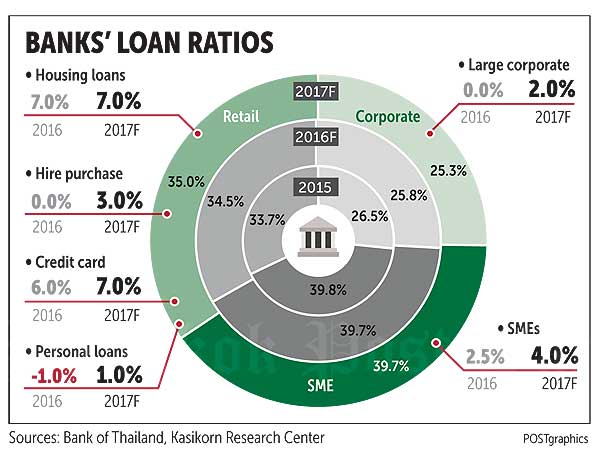
    KResearch forecasts 5.5% growth in retail loans this year, compared with 3% in commercial loans and 4% in overall lending.

    Over the past few years, retail lending also grew at a faster pace than overall and commercial loans. Retail loans rose by 6.2% in 2015 and 4.5% in 2016, well above 2.9% and 1.5%, respectively, for commercial loans those two years and 4.0% and 2.5% for overall lending, according to KResearch data.

    Thai banks’ exposure to retail loans is expected to climb to 35% this year from 34.5% last year, with SME loans steady at 39.7%, said the report. The share of large corporate loans or so-called wholesale banking is projected to fall to 25.3% from 25.8%.

    As Thailand’s economy has struggled with subpar growth since 2013, it is not a surprise banks have pushed into the retail banking business — mortgages, credit cards and personal loans in particular — as companies’ investment projects have stalled. Companies have also turned to debt instruments to raise capital because of low interest rates.

    Retail banking business offers a better profit margin than corporate loans, but carries lower default risks than loans to SMEs struggling with the uneven economic turnaround.

    Moreover, retail borrowers, white-collar workers in particular, on average have seen their income continue to grow slowly, while the unemployment rate remains low at less than 1%.

    “We expect retail lending will deliver the strongest growth in that segment this year as large corporates move toward the capital market for fund mobilisation, while only a handful of banks, especially large lenders, have expertise in SMEs lending,” said Thanyalak Vacharachaisurapol, deputy managing director of KResearch.

    “Even though retail loan growth is expected to increase at a fast clip, overall lending will only record single-digit growth as banks remains cautious amid high household leverage. However, the end of the lock-up period for the first-time car buyer scheme will add to consumer purchasing power this year.”

    The lock-up period is five years for most cars bought under the excise tax rebate scheme. KResearch estimates some 320,000 car owners, representing 30% of those in the first-time car buyer scheme, will have their lock-up period end this year, and some may consider replacing their cars.

    Auto-hire purchase is expected drive retail lending growth this year, said the report.

    KResearch predicts auto loans will expand 3% this year, up from zero last year, while housing loans — accounting for more than half of retail lending — are expected to grow steadily at 7%.

    Although banks will likely focus on retail banking business this year, lenders’ focus areas will be diverse, said the report.

    Krungthai Bank (KTB) and Siam Commercial Bank plan to pay more attention to the wealth customer segment to offset fee-based income expected to be hit by PromptPay, electronic money transfer under the government’s national e-payment scheme.

    KTB, the country’s second-largest lender by total assets, aims to increase assets under management (AUM) for wealthy clients by 25% this year from 600 billion baht. Its provincial customer base is the bank’s strength for expanding both its wealthy client numbers and its AUM.

    KBank, the country’s fourth-largest lender by assets, set a total loan growth target of 4-6% and retail loan growth of 5-7%, with mortgages contributing the highest growth among other retail lending.

    Bank of Ayudhya (BAY) targets double-digit growth for its retail banking business this year compared with total loan growth of 6-8%. The bank recorded the highest loan growth among its industry peers last year at 11.2%, with retail blazing the trail, increasing 15.9%.

  • Luxury Brands Advised to Reassess Physical Store Strategy

    Luxury Brands Advised to Reassess Physical Store Strategy

    Luxury brands looking to assess their global brick-and-mortar strategies would do well to remember it’s not a one-size-fits-all approach.

    A recent study by management consulting firm Boston Consulting Group and Bernstein research advises luxury labels to optimize existing physical locations, determine how best to cater to both tourists and locals, and consider streamlining stores in cases for which ecommerce would suffice.

    Looking at retail geographically, the report says some regions are oversaturated while others are ripe for expansion. For luxury brands with multiple stores in New York, Tokyo, London, Paris, Seoul and Hong Kong, the findings show retail is poised to remain strong, as tourists and locals support flagships and secondary locations, respectively.

    The report cautions against adding new doors in top Asian cities like Tokyo, Seoul, Hong Kong, Shanghai, Beijing, Singapore and Taipei where there are already too many locations and the size of the footprints outstrip demand.

    For brands looking to expand, research shows that the U.S. is still a solid market. While luxury companies may find opportunities for new locations in key hubs, the focus in those cities should be on drawing more shoppers into stores, the report said. Opening new stores could be the best approach in second-tier cities where the local population could offer consistent traffic and sales. But first, it’s up to brands to determine which cities represent their best prospects.

    “Brands must continue to invest in the tools and techniques that help them get better and better at segmenting markets and uncovering pockets of demand,” said Oliver Abran, a partner and managing director at BCG’s Paris office and the global leader of the firm’s luxury, fashion and beauty topic area. “Analytics software can be invaluable but it still needs the talent to make it effective and the processes to properly gauge potential markets.”

  • When a gold retailer starts selling sunglasses

    When a gold retailer starts selling sunglasses

    Warmer than expected Christmas weather appears to be providing little comfort for Hong Kong’s retail sector this year. Business has been cold at many outlets despite a projected rebound in mainland visitor arrivals.

    Otherwise, what can explain a gold shop branching out into sunglass sales and news that the city’s biggest karaoke operator is scaling down its operation?

    Let’s talk about the gold retail chain first.

    I’m referring to Luk Fook Jewellery, which has just opened its first eyewear store — “Vision Gallery”.

    The new venture comes after the company announced last month a 31.5 percent slide in same-store sales for the six months ended September compared to the same period a year ago.

    The eyewear store has been put up in a prime location, next to an H&M outlet, on Dundas Street in Mongkok.

    Luk Fook is said to have signed a two-year lease for the 600-square-foot retail space, offering a monthly rental of HK$128,000.

    Though the rent is just half what the previous tenant, bankrupt home appliance chain DSC, was paying earlier, there is still this question: why an eyewear shop, instead of another gold store?

    Well, the answer lies in economics.

    Chairman Wong Wai-sheung told Ming Pao that a 1,000-square-foot gold shop, in terms of costs, would be equivalent to opening 10 eyewear stores.

    Guess what? Luk Fook, which currently has 47 gold shops in Hong Kong, has earmarked HK$20 million to open 10 eyewear stores next year, with a focus on the middle class.

    Last year, the company had 50 gold shops in the city.

    To boost Christmas sales at the new eyewear outlet, Luk Fook is giving away a pair of pearl earrings to the customers.

    We are not sure if this is a nice cross-selling idea but would reckon this is a defensive move.

    Luk Fook as well as its competitors such as Chow Tai Fook and Tse Sui Luen have seen their same-store sales fall steeply this year, with 20-30 percent slide in many cases.

    In comparison, an eyewear retailer such as Stelux Holdings has seen its sales dip just 5 percent.

    During its interim results, Luk Fook said it will strive to broaden its income sources, enhance the operational efficiency and reduce costs in order to minimize the impact of the business downturn.

    The foray into eyewear retail is part of that strategy.

    Elsewhere in the city, Karaoke operator Neway has also come up with a new way to survive.

    Rather than open a new venture, Neway is leasing the 4,000 square-feet lobby and first floor at its Causeway Bay flagship store CEO Neway, according to Apple Daily.

    By sub-leasing 30 percent of the original floor area, Neway is trying to shore up revenues which have been hit by a decline in night-time singing parties at its karaoke outlets.

    The plan will also help the company save some HK$1.8 million in monthly rental.

    The sub-leasing of Causeway Bay shop space comes after the group shut down an 18,000-square-foot Mongkok facility last year.

    As much as we miss the grand lobby of CEO Neway and the good old days of group singing, we cannot help but admit that Karaoke outlets are now a bit out of fashion after they dominated the social scene for about twenty years.

    This year, one of the best-selling items at the Golden Computer Arcade in Sham Shui Po is a microphone with karaoke function that sells at no more than HK$500.

    The made-in-China product, which connects through bluetooth with iPad and the home stereo system, has become an immediate hit and is now a must-have during family gatherings.

    If you can get the same kick at home, why bother spending money on a karaoke shop? This seems to be the view of a growing number of people.

    Given this reality, Neway may need to find something else to sell other than songs.

  • Online retailer Ymatou expects huge Black Friday sales

    Online retailer Ymatou expects huge Black Friday sales

    Jia Yi, a white-collar employee from Chengdu, the capital city of Sichuan province is passionate about overseas brands and products. She is now considering buying a Coach handbag on the upcoming Black Friday shopping event.

    “The price in the domestic market could reach more than 2,000 yuan ($290), but it is just 848 yuan on the e-commerce platform during Black Friday. It is very cost-effective and I am prepared to buy one,” said Jia.

    China’s cross-border e-commerce has been growing over the past few years. The Shanghai-based cross-border e-commerce site ymatou.com expects the scale of the Black Friday event this year to be 10 times over last year by hiring more than 30,000 overseas buyers.

    The company, which has participated in the biggest retail sales day of the year since 2014, said customers could buy more than 600,000 imported goods from 83 countries, including discounted clothes, shoes, bags, cosmetics, fine jewelry and health care products without leaving the house.

    “There is a trend that consumers from second- and third-tier cities are more willing to buy overseas products. Chinese consumers’ demands have been upgraded as they have diversified and personalized requirements for products and services,” said Zeng Bibo, chief executive officer of Ymatou.

    Zeng added they prefer to buy niche brands from European designers than the mass-market brands in America.

    Black Friday, the day following Thanksgiving Day in the United States, is a busy shopping day with the highest discounts of the year and a major impact on brick-and-mortar retailers, e-commerce players and consumers around the world.

    Ymatou said it is set to ensure that Chinese online shoppers can get the same deals that their Western counterparts enjoy during Black Friday. Buyers can broadcast their shopping process at the online shopping platforms.

    It continues to increase investment in the access threshold of buyers to ensure the authenticity of the goods’ sources. Zeng said they will check the credit status of buyers from time to time, requiring them to offer credentials for long-term living overseas and identifications.

    Furthermore, Ymatou has established an independent logistics company, XLobo, to develop overseas direct mail business.

    XLobo collects and bundles individual parcels at overseas locations and ships them to China as a single consignment. It now owns 15 international logistics centers around the world to ensure the period of direct mail within five days, on average.

    “The number of professional logistics service staff has been doubled. We have expanded the space of warehouses in New York, San Francisco and Osaka, and the investment in equipment and logistics this year has surpassed the total input of last year,” said Zeng.

    It arranges over 90 chartered airplanes each week to transport the goods and other airlines that have cooperative relations with Ymatou will reserve shipping space for XLobo in advance.

    Chinese e-commerce companies, such as Alibaba Group Holdings and JD.com Inc have developed their own cross-border e-commerce businesses.

    Statistics from the China E-Commerce Research Center show that China’s cross-border e-commerce transactions totaled 5.4 trillion yuan ($783 billion) last year, a year-on-year increase of 28.6 percent.

    The generation aged between 20 and 35 old is the major force of cross-border shopping, experts said.

    Cao Lei, director of the China E-Commerce Research Center, said customers need to choose an excellent cross-border e-commerce platform, pay attention to sellers’ reputations or ranking level and customers’ comments, adding they should choose a platform that owns and operates its logistics system.

  • Indonesian government taking steps to tackle growth of e-commerce industry

    Indonesian government taking steps to tackle growth of e-commerce industry

    The volume of e-commerce transactions in Indonesia is still relatively small but the government is taking anticipatory steps in the face of e-commerce industry growth as it is developing as a global trade model.

    Indonesias e-commerce transactions still account for about one to two percent of retailer transactions or much lower than the global average of eight percent. However, it is predicted that e-commerce transactions in Indonesia will increase drastically from US$12 billion in 2014 to about US$24.6 billion this year.

    Therefore, the government sees that the e-commerce industry is one of the business sectors that has good prospects in the future, and for this it is issuing an e-commerce development roadmap through an economic policy package.

    The roadmap is appearing in the 14th economic policy package announced by the government on Thursday, November 10, 2016.

    “The policy package is aimed at encouraging people all over Indonesia to expand their economic activities efficiently and to connect them to the rest of the world. With this roadmap, they will be able to enhance their business in a better way,” Coordinating Minister for Economic Affairs Darmin Nasution said while announcing the package at the Presidential Office along with Communication and Information Minister Rudiantara and Cabinet Secretary Pramono Anung.

    Therefore, the next economic policy package is expected to sufficiently address the issue.

    “E-commerce should not be treated as a general form of trading. The tariff should be lower as it is a fledgling industry, an early adopter,” Industry Minister Airlangga Hartarto underlined while speaking on the sidelines of the launch of a book on “Developing Populist Economy and Winning ASEAN Economic Community” recently.

    Indonesian businesses hope that the tax tariff for e-commerce business will be lower than that of the non-e-commerce industry.

    The Indonesian Employers Association (Apindo) hailed the issuance of the package. Businesses badly need the governments support, particularly on the fiscal system with regard to the issuance of the economic policy package on e-commerce, Fredy Ongko Saputro, chairman of Apindo for East Nusa Tenggara, said.

    “The tax tariff should be lower than non-e-commerce because this is a new industry. We hope the tax traffic is set at a modest rate,” the Apindo chairman for East Nusa Tanggara, said.

    The regulation to be issued would determine the success of e-commerce in Indonesia as it has the potential to guarantee the survival of fledgling businesses using e-commerce, economic observer Agustinus Prasetyantoko said, elaborating the point.

    Agustinus is also of the opinion that tax exemption would help boost e-commerce in the country.

    “In certain cases, tax could even be abolished during the start-up phase,” he underscored.

    Singapore could be used as the reference country to study ways to develop and expedite the expansion of e-commerce. It provides tax facilities and a low tax for start-ups in addition to assistance in the form of access to cheap capital.

    The e-commerce market has begun to grow in Indonesia. In 2014, transactions were valued at $12 billion. E-commerce spending in Indonesia was only 1 to 2 percent of the total retail sales as against 16 percent in South Korea, 12 percent in the United States and the world average of 8 percent.

    However, it is worth noting that the performance in 2014 represented a significant increase from $8 billion in 2013. In 2016, the value of transactions is predicted to rise to $24.6 billion.

    Therefore, it is being predicted that Indonesia would be among the top ranked countries in e-commerce in the future after China and India in Asia, which is why the government drew up a roadmap.

    Chief Economic Minister Darmin Nasution expressed the hope that the roadmap for the development of e-commerce industry will encourage younger generations to come up with new and innovative products and services.

    The roadmap is also expected to induce certainty in business besides facilitating the e-commerce industry. Therefore, with strategic direction and guidance, the electronic-based national trade system can be put in place during the 2016-2019 period, he noted.

    The roadmap is also expected to accord priority to and protect the national interests, particularly the interest of small and medium entrepreneurs and startups, he commented.

    “It will also help the human resources and e-commerce agents to improve their knowhow. Also, it will provide terms of reference to the government and all stakeholders for determining or adjusting sector-based policies as part of the effort to develop the e-commerce industry,” he explained.

    Darmin pointed out that the policy package deals with at least eight issues, including funding, taxation, consumer protection, human resource development and education besides cyber security.

    Meanwhile, Communication and Information Minister Rudiantara underlined that digital economy has a huge potential in Indonesia.

    “The Indonesian digital economy is so huge that all transaction services using digital technology will continue to develop,” he observed.

    He reminded that the package also covers several provisions to address seven key issues, including human resources and education, access to capital, tax incentives, consumer protection, cyber security, logistics and communication infrastructure.