Retail News CRM

Tag: uber

  • Apps race to attract customers with sweet deals

    Apps race to attract customers with sweet deals

    E-wallets, food-delivery and online shopping apps are offering a range of Tet (Lunar New Year Festival) promotions to widen their customer base. On January 21, e-wallet cashless payment platform MoMo experienced a temporary freeze of its network shortly after launching a promotion that gives customers a chance to receive gifts when using the app to send money.

    Shortly after the promotion was launched, MoMo recorded an additional 500,000 downloads and registrations of its app, forcing the platform to upgrade its capacity immediately.

    At the time of the freeze, MoMo reported a record of over 1 million customers who had logged on at the same time for a chance to receive something from MoMo’s pool of gifts worth over VND100 billion ($4.32 million).

    About 2 days later, ZaloPay, another e-payment platform also entered the race by encouraging users to make deposits, payments and money transfers to receive bonus points and redeem vouchers from a pool of VND10 billion ($431,995).

    The promotion heat has also spread to the food delivery industry, where Grab, the Singaporean-based ride hailing and food delivery app, has announced its expansion to an additional 12 provinces and cities, to make “food ordering easier during Tet“.

    Tet, or Lunar New Year Festival, will be celebrated from February 2-10 this year.

    Demi Yu, GrabFood regional director for Thailand, Malaysia, Vietnam and Philippines, revealed that the number of GrabFood orders increased has increased 25 times since it was launched in Vietnam last October.

    “With our extensive driver partner network, we’ve been able to lower average delivery time to 20 minutes in central Hanoi and HCMC, making us the fastest food delivery service in Vietnam,” she said.

    A survey published by Vietnamese market research firm GCOMM earlier this month showed that 99 percent of those surveyed said they used online food ordering services at least 2-3 times per month. 39 percent said they ordered through these apps 2-3 times a week.

    According to this survey, the 6 most popular apps are GrabFood, Foody, GoFood, Lala, Vietnammm and Lixi. However, because of the fierceness of competition, just a few days before the study was announced, Lala withdrew from the food delivery market to focus on providing software solutions to restaurants.

    “Demand for delivery is growing in Hanoi and HCMC. I think in the next 5 years, it will thrive in the 10 largest cities. There are about 100,000 delivery orders each day in HCMC and Hanoi combined, whereas there was virtually no demand for this service 3 years ago.

    The delivery market is now worth $500 million, but is expected to grow to $2 billion in 5 years,” said Luong Duy Hoai, founder of GHN, a courier service with over 7,000 staff.

    According to a recent report by South Korean commercial giant Lotte, the number of orders and visits by online shoppers rose by 80 percent and 200 percent respectively in 2018.

    Kim Kyou Sik, general director of Lotte.vn, the group’s online outlet, said: “Late 2019 will be a major battle for all e-commercial sites to establish market share. We aspire to become one of Vietnam’s top 4 e-commerce sites by the end of the year.”

    According to research by Nielsen Vietnam, with 53 percent of the population using the Internet, nearly 50 million numbers registered on smartphones, most online shoppers being from 25-29 years old, the e-commerce market in Vietnam is full of potential despite growing at 22 percent per year.

    The e-Conomy SEA 2018 report by Google and Singaporean investment firm Temasek also revealed that e-commerce, along with three other areas, namely online advertising, online travel and ride hailing dominate Vietnam’s Internet economy.

    In 2018, the Internet economy had an estimated total worth of $9 billion. Earlier this year, the two companies collaborated in a report which revealed that gross merchandise volume of Vietnam’s Internet economy amounted to 4 percent of its GDP.

  • ​Vietnam’s FastGo eyes US, Brazil expansion

    ​Vietnam’s FastGo eyes US, Brazil expansion

    Vietnamese ride-hailing company FastGo plans to enter the U.S. and Brazil this year as it seeks to quickly expand overseas. Its CEO Nguyen Huu Tuat said that he is keen to compete with other ride-hailing apps in foreign countries. “Our investors are located in the U.S. and Brazil, that’s why we have chosen those places as the next markets,” he said without disclosing who they are.

    The announcement comes a month after it expanded into Myanmar. FastGo now has over 1,000 partner drivers in Yangon and Tuat wants to have 2 million users in Myanmar this year.

    But the company wants to expand even faster to other markets this year, with Indonesia, where ride-hailing Go-Jek is based, being the first location.

    “We plan to start operating in Jakarta in March, and will also expand to Singapore this year,” Tuat said.

    The investors want the company to “go global as soon as possible,” he said to explain the rapid expansion plans.

    The company hopes to raise $50 million in the second round by June this year possibly from investors in South Korea and the U.S., he said.

    “Grab and Uber might have deep pockets, but FastGo wants to grab market share by offering better options to customers.”

    FastGo does not collect commissions from drivers but instead charges them an amount of money if they earn a minimum amount per day. FastGo also claims to not increase fees during rush hour but allows users to tip drivers.

    It became Vietnam’s first home-grown ride-hailing app last June and now has 40,000 drivers in 12 cities and provinces.

    FastGo last August received $3 million from Vietnamese fund VinaCapital Ventures, according to reports.

  • Singaporean ride-hailing startup TADA launches in Vietnam

    Singaporean ride-hailing startup TADA launches in Vietnam

    Singapore-based tech firm Mass Vehicle Ledger (MLV) launched its ride-hailing app TADA in Ho Chi Minh City Monday. HCMC is the third Southeast Asian market that the firm is entering after Singapore and Cambodia. Instead of billing commissions from drivers like other major players Grab and Go-Viet, the app aims to profit off advertising as well as fees from B2B (business to business) partners that participate in their ecosystem.

    This ecosystem will operate on blockchain technology to store records such as payments and vehicle maintenance, and will engage transport-related companies such as traditional taxis, insurance, repair services, and car dealers.

    Kay Woo, the South Korean founder of MLV, said that among its current partners are Lotte Rental, a rental company of cars and equipment belonging to South Korean conglomerate Lotte Group, local insurance provider PTI and local taxi firm Vinataxi.

    The app will also not offer promotions like its rivals.

    “They throw promotions everyday but this won’t last forever, and prices will eventually go up. We focus on stability, and without commission our prices will be lower.”

    The MLV founder revealed that over 2,000 drivers had signed up with the company. After HCMC, the firm plans to expand the app to Hanoi and Da Nang.

    TADA plans to get 25,000 drivers to register this year but has no plans to join the motorcycle segment in the near future.

    Currently, MVL is registered as a technology company in Vietnam. Operations manager Peter Nguyen explained that because it does not charge drivers, it is only a technological solution. However, the company is willing to comply with transport tax and regulatory guidelines should they apply, he said.

    TADA, which means “let’s ride” in South Korean, opened in Cambodia just last month, and in Singapore in July 2018.

    MVL Technology Co., Ltd, formerly known as MVL Foundation Pte. Ltd, was founded in March 2018 in Singapore by Kay Woo.

    It aims to connect different sectors in the car industry.

    TADA has over 25,000 registered drivers and made more than 970,000 trips in the last 6 months.

    Vietnam’s ride-hailing market has seen new entrants after Uber’s departure early this year, including Vietnamese firm FastGo, GoViet – a subsidiary of Indonesia’s Go-Jek, Aber, Be Group, and the latest, TADA.

    Grab, which counts Chinese ride-hailing firm Didi Chuxing and Japan’s SoftBank Group Corp among its backers, had 175,000 drivers and bikers in Vietnam as of last September and is the most prominent player in Vietnam after it pushed out Uber.

    Rival GoJek entered Vietnam last August, eyeing to grab a share of the fast-growing market. Vietnam has 95 million people, most of whom use smartphones.

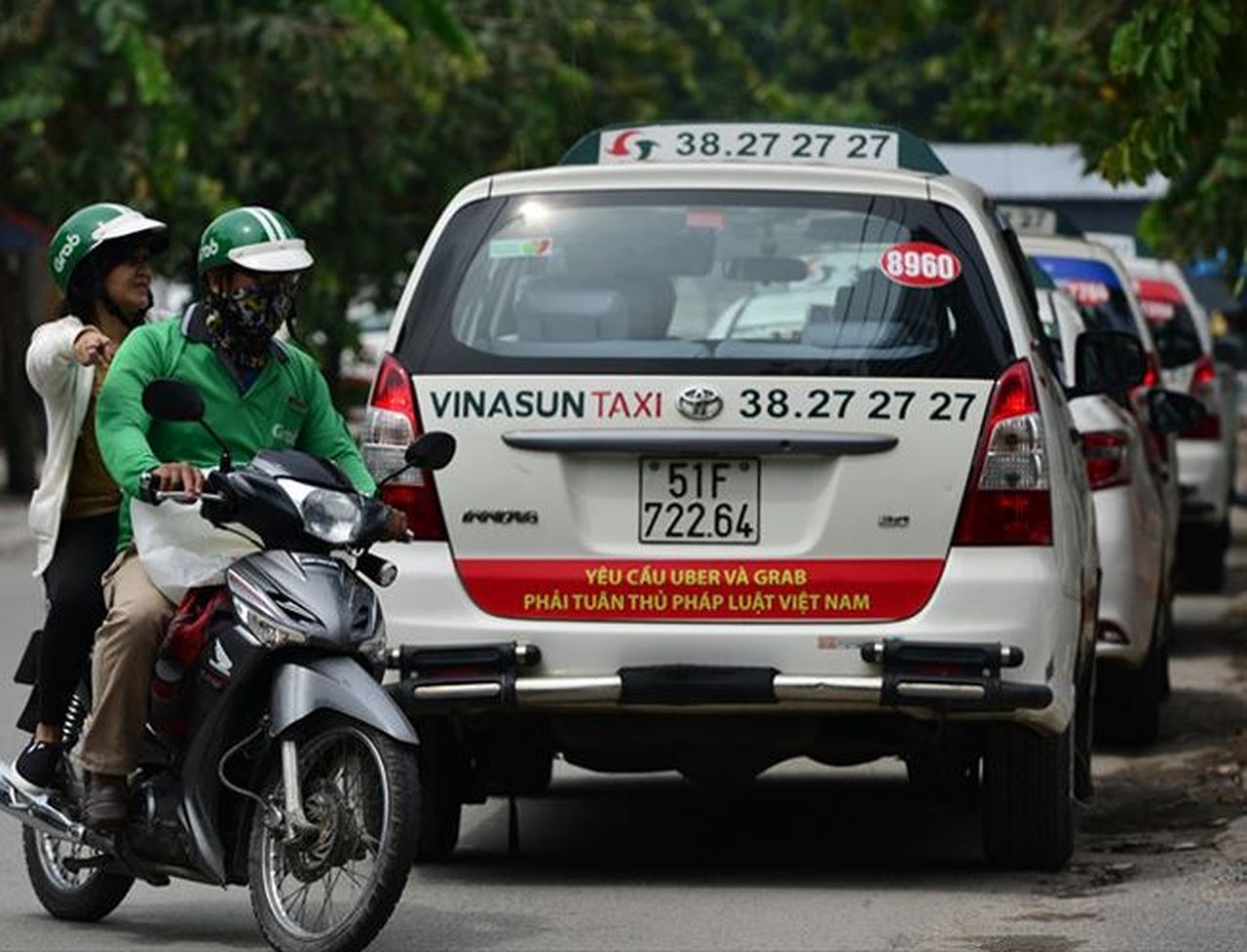
    A number of local taxi companies in Vietnam have come together to compete against ride-hailing firms, Grab has been in a legal battle for more than a year with local taxi firm Vinasun Corp.

  • Grab appeals $208,000 Vinasun compensation ruling

    Grab appeals $208,000 Vinasun compensation ruling

    Grab has appealed a verdict by a Vietnamese court to pay compensation to domestic taxi firm Vinasun for causing it losses. Arguing that the order to pay VND4.8 billion ($208,000) by the first instance court was unlawful, the Singapore-headquartered Grab has asked the appellate court to quash the case. It wants the court to quash the verdict on the ground that the HCMC People’s Court had seriously violated procedures and dismiss the case. The court had no jurisdiction to hear the case, handed a verdict that exceeded the scope of the lawsuit and did not summon the witnesses it had sought, the company said.

    The ride-hailing firm maintained it did not commit any wrong against Vinasun. If the appellate court is not willing to dismiss the case, it should at least amend the earlier ruling, ruling that Grab does not carry on a transportation business and has not violated any laws, and dismissing Vinasun’s claims.

    Grab said the court did not fully and objectively evaluate the facts and evidence of the case, but instead relied on biased information based on an inaccurate assessment of losses done by a court-appointed inspection company.

    “Vinasun could not prove its actual damages and/or the causal link between any of Grab’s alleged violations and Vinasun’s alleged damages,” Grab said in the statement.

    The court verdict came after an 18-month battle between Grab and Vinasun since last June when Vinasun filed a suit saying Grab’s illegal activities had caused it nearly VND42 billion ($1.8 million) in losses.

    The latest draft of a Ministry of Transport decree requires firms offering taxi services to register as taxi firms before they can apply ride-hailing technology.

    This means Grab and other ride-hailing firms have to register afresh as taxi businesses and comply with legal requirements related to operating licenses, drivers’ profiles and taxes.

  • Yamaha to invest $150 million in Grab Vietnam

    Yamaha to invest $150 million in Grab Vietnam

    Yamaha Motors has announced a $150 million investment in Grab to collaborate on motorcycle ride-haling. The collaboration will be for Southeast Asia in general and Indonesia in particular. Through this partnership, Yamaha Motors and Grab aim to “develop next-generation mobility services by implementing solutions and innovations,” Grab said in a press release issued Thursday.

    The two companies aim to leverage Yamaha Motor’s technology and knowhow to boost safety as well as make it easier for Grab’s driver partners to buy motorbikes.

    Yamaha Motors also aims to leverage Grab’s customer base in Southeast Asia and knowledge of the motorcycle ride-hailing business for future product development.

    The Southeast Asian ride-hailing firm is teaming up with global investors to expand its reach after forcing Uber out of Southeast Asia earlier this year.

    Toyota Motor Corp. had said in June it was investing $1 billion in Grab, and Hyundai Motor Co. last month agreed to put an additional $250 million into the company as well as sell Grab a fleet of electronic vehicles.

    The focus on Indonesia may mean that Grab is intensifying its push against local ride-hailing platform Go-Jek. Both companies now compete in the Vietnamese market after the Jakarta-based start-up commenced operations in Vietnam under the name Go-Viet some months ago.

    Grab entered Vietnam early in 2014, but is currently under an antitrust investigation after acquiring Uber’s services in March.

  • Grab Vietnam says Uber deal ‘no breach of competition laws’

    Grab Vietnam says Uber deal ‘no breach of competition laws’

    Ride-hailing firm Grab has asserted that it did not breach Vietnam’s competition laws, contesting authorities’ definitions and interpretations. The assertion was a response to the Ministry of Industry and Trade, which said Wednesday that it had evidence that Grab’s acquisition of Uber violated Vietnam’s Competition Law .

    In a statement released Thursday, Jerry Lim, country head of Grab Vietnam, said that the transaction between Grab and Uber earlier this year was conducted “in the good faith belief that there is no breach of competition laws, after diligent consultation with legal counsels.”

    Lim explained that the issue has become contentious because of differences in the authorities’ and Grab’s definitions of relevant market and what constitutes a competitive playing field.

    He said that the entrance of new ride-hailing companies into Vietnam shows that they believe there is a chance to succeed, with some of them claiming high market shares.

    In June, Vietnam’s first ride-hailing services FastGo and Aber were launched. Go-Viet, an affiliate of Indonesia’s Go-Jek, entered Vietnam in August, claiming to take 15 percent of the market share in Ho Chi Minh City within two weeks of launching.

    Vietnam’s top taxi operator Mai Linh and second-ranked Vinasun have also invested in a ride-hailing service to compete with Grab.

    Grab said that a ride-hailing app was just one of many options for customers. It cited a third-party survey, without revealing details, which said more than 59 percent of Vietnamese car ride-hailing users and 62 percent of motorbike ride-hailing users surveyed would switch to a different transport service other than ride-hailing if there was a 10 percent increase in prices.

    Lim also said that Grab was not the only ride-hailing company in the market, as the Vietnamese government has granted ride-hailing pilot licenses to nine other companies, including established taxi companies, to operate services in five cities and provinces.

    Both customers and drivers can respectively decide to switch to other forms of transport and join other companies if prevailing conditions such as pricing and income are not favorable to them.

    “The power of choice remains in the hands of customers,” Lim said.

    He said Grab has fully cooperated with the Vietnamese authorities for the purpose of a fair investigation and recommendation. “We fully understand that all governments seek to protect the best interests of consumers. Grab truly shares the same goals.”

    Lim said he hopes that the final verdict of the Vietnam Competition Committee will take into account the “vibrancy and contestability of the current Vietnamese market landscape and support the competitive business environment brought about by technology application and innovation.”

    Singapore-based Grab acquired Uber in Southeast Asia in return for a 27.5 percent stake in the U.S. company, with Uber CEO Dara Khosrowshahi joining Grab’s board.

    The 2004 Competition Law requires any merger or acquisition that results in a company gaining a 30 percent market share to be reported to competition authorities.

    If a company gains a 50 percent market share from the deal, it can only be implemented with express permission from the authorities.

    Preliminary investigations by Vietnamese authorities have found that Grab’s market share in Vietnam was in excess of 50 percent after Uber quit the market last April.

    But Grab has countered this, saying that since its combined market share with Uber in Vietnam was less than 30 percent, it did not have to “inform the competition authority before proceeding and completing this transaction in the country.”

  • Kakao’s carpooling app goes live in beta test

    Kakao’s carpooling app goes live in beta test

    Kakao’s carpooling service was introduced Friday for beta testing and will be officially rolled out Dec. 17. The start of the service comes after months of battling fierce opposition from local taxi services. They staged a strike on Oct. 18, two days after the IT company started accepting applications from carpool drivers.

    With the beta service, the Kakao T mobile app, a platform for all of Kakao’s mobility services from taxi hailing to navigation, was upgraded to enable the “Carpool” button on its main screen. The beta service will not be accessible to everybody.

    “The beta service is aimed at increasing the stability of the technology and collecting opinions,” Kakao said in a statement. “For that reason, it will only be offered to some users.”

    The selection of testers will be random and independent of age and location. Anyone upgrading the Kakao T app Friday will see the new “Carpool” button, but only the selected users will be able to input words in the destination box. Those who weren’t selected will see an image with the words “This service will launch soon.”

    The base fare is set at 3,000 won ($2.68) for the first 2 kilometers (1.24 miles), the same as for regular taxis. After that point, the fare will increase proportional to the driving time and distance. The company did not disclose details, but a spokesman said the cost will be equivalent to around 70 to 80 percent of regular taxi fares.

    Kakao’s carpool drivers are allowed to offer carpooling services twice a day at any time of the day. The twice-a-day rule is due to the domestic law that limits carpooling to commuting purposes. More than 50,000 drivers who met Kakao’s requirements have been selected so far.

    A government-led task force composed of lawmakers from the ruling Democratic Party, public officials and taxi companies met Friday to discuss carpooling. Executives from Kakao Mobility, the affiliate in charge of the IT company’s transportation services, decided to launch the same day,

    Kakao acquired the Luxi carpooling app in February and completed preparations for its service later in the year.

    The official launch was postponed previously as the task force failed to reach an agreement on the service’s details, including the fare and limits on use. During a task force meeting held Thursday, some government officials opposed Kakao’s request to release the service that same day, demanding more time to find common ground.

    Korea has been a difficult place for carpooling. Uber closed down its service in 2014, and Seoul’s local government questioned the legality of carpooling app Poolus in 2017.

  • Uber Eats appoints Alia Bhatt as India brand ambassador

    Uber Eats appoints Alia Bhatt as India brand ambassador

    Uber Eats, the food delivery arm of ride-hailing major Uber, Thursday said it has appointed actor Alia Bhatt as its brand ambassador in India. India is the first country for Uber Eats globally where the company has appointed a brand ambassador, Uber Eats said in a statement.

    “Alia is an inspiration to Indian millennials and we are thrilled to have her on board. The youth today relates to her easy-going, carefree and energetic personality. “She is known for her unique style and agility as an actor – the same qualities are an integral part of the Uber Eats DNA; thus making her the perfect fit to represent our brand in India,” Bhavik Rathod, India and South Asia Head, Uber Eats said.

    Uber Eats was launched in India in May 2017. The food delivery service is available across 37 cities compared to 31 cities where the American company operates its rides business. Uber Eats started in 2014 as a small delivery pilot in Los Angeles and was launched as a separate application in Toronto in December 2015. It is now available as a stand-alone app in over 350 cities globally.

    The US-based company has been aggressively investing in its Uber Eats business globally. Earlier this month, Uber said gross bookings from Uber Eats grew more than 150 percent in September quarter to US$ 2.1 billion (excluding Southeast Asia and Russia) over the year-ago period.

  • Starbucks Tokyo Reserve opening date revealed

    Starbucks Tokyo Reserve opening date revealed

    The planned Starbucks Tokyo Reserve Roastery will open on February 28 next year. The outlet will launch in the Nakameguro district as the brand’s fifth global Reserve Roastery, designed and constructed in partnership with architect/Kuma Lab founder Kengo Kuma.

    Starbucks will build 100 new stores in Japan every year over the following three years, bringing its total stores to 1700 within the territory.

    Starbucks president and CEO Kevin Johnson said: “We continue to thoughtfully evolve within Japan’s elevated coffee culture to maintain a leadership position and achieve profitable growth for the long-term.”

    The firm recently launched a delivery program in Japan in partnership with Uber Eats, as well as a partnership with Japanese social media platform Line that is expected to result in a digital payment system.

  • Uber Eats India, CCD partner for virtual restaurant network

    Uber Eats India, CCD partner for virtual restaurant network

    Food delivery app Uber Eats in partnership with Cafe Coffee Day (CCD) on Friday launched a network of virtual restaurants that will offer more choices of ‘delivery-only’ restaurant brands. The first restaurant brand under this partnership is scheduled to launch in mid-November on Uber Eats app, the company said in a statement.

    “We are thrilled to partner with CCD – the pioneers of cafe culture in India,” said Jason Droege, Vice President of UberEverything, Uber Technologies.

    “Using experience and lessons learnt in the virtual restaurant space from our global operations, we hope to provide our Indian restaurant partners greater growth opportunities,” Droege added.

    Uber Eats is currently present in 37 cities in India while CCD has a network of 1,742 cafes across 246 cities in India.

  • Vietnamese taxi firm to get support in lawsuit against Grab

    Vietnamese taxi firm to get support in lawsuit against Grab

    Prosecutors have argued in a trial in HCMC that Grab must pay Vinasun compensation for losses it caused through “unhealthy competition.” At a hearing Tuesday the city People’s Procuracy rejected ride-hailing firm Grab’s argument that the court had no jurisdiction over the case, saying it does since it is a commercial dispute.

    Prosecutors also asked the judges to deny Grab’s request to summon representatives of Vietnam’s Ministry of Transport, other companies participating in the ministry’s pilot scheme for ride-hailing services and the company responsible for estimating Vinasun’s losses.

    As for Grab’s claim it is a tech firm and not a taxi company, they said since the firm directly assigns drivers, sets fares, sets regulations for drivers, and offers promotions, there is enough reason to dismiss this too.

    “Vinasun’s demand for compensation for reduced profits is well founded since Grab was dishonest in its business declaration and ran promotions in contravention of regulations, causing over 70 percent of Vinasun’s customers to switch to Grab due to lower fares.”

    Vinasun’s after-tax profit was nearly VND320 billion ($13.7 million) in 2015 and VND295 billion ($12.63 million) in 2016, but dropped to VND53 billion ($2.27 million) in the first half of 2017, by which time over 8,000 drivers had quit and hundreds of cars had stopped running due to a lack of drivers.

    Prosecutors asked the court to accept Vinasun’s petition for compensation of VND42 billion (nearly $1.8 million) in one payment.

    Grab continued to insist the case did not come under the court’s jurisdiction and that it is a tech firm.

    Dismissing the claim it had caused losses to Vinasun, Grab cited market research purporting Vinasun has been losing customers due to other reasons such as driver’s attitude, long waiting time and declining car quality.

    Vinasun filed the suit against Grab at the HCMC People’s Court in June last year accusing the Malaysia-based firm of abusing the Ministry of Transport’s pilot scheme and committing violations.

    Claiming Grab’s illegal activities had caused damages to it, Vinasun claimed to have suffered losses of nearly VND76 billion ($3.25 million) in 2016 and the first half of 2017, of which nearly VND42 billion (nearly $1.8 million) was caused by Grab.

    The trial began last February, but was first adjourned a month later due to the need for more evidence and again last month when Grab protested against the evaluation of Vinasun’s losses and refused to attend.

    The court is scheduled to hand down its verdict next Monday.

  • FastGo drives into provincial markets in Vietnam

    Vietnamese ride-hailing app FastGo has expanded its services to provinces in Vietnam like Dong Nai and Binh Duong, provinces neighboring HCMC. FastGo aims to cater to high travel demand within the southern provinces and for commutes between the provinces and Ho Chi Minh City

    Nguyen Huu Tuat, general director of FastGo Vietnam, said that Bien Hoa City in Dong Nai and Binh Duong were two municipalities next to HCM City with large traffic flows and number of commuters.

    The introduction of the app in these localities will make it more convenient for customers to travel, as well as reduce wasteful ‘empty miles’ for local cabs, he added.

    Currently, FastGo has about 1,000 drivers operating in these two cities.

    The company plans to expand its presence into Ha Long City in the north and Nha Trang City in the center early next month. By the end of the year, it will also introduce food delivery and “On Demand Shopping” services.

    Launched in June 2018, FastGo now operates in Hanoi, Ho Chi Minh City and Da Nang with more than 30,000 drivers. It has already completed “over one million kilometres of service.”

    At the end of August, the company received funding from VinaCapital, and is planning to mobilize up to $50 million for a second expansion phase that will target Indonesia and Myanmar.

    FastGo has three core services: Fast Car – a four-wheel drive app for private contractors wanting to make additional income; Fast Taxi – a service linked with existing taxi companies who can receive orders on the app; and Fast Luxury – a semi-luxury car service.

    FastGo last month said it has 15,000 taxi and motorbike partner drivers in Hanoi and Ho Chi Minh City, but they are still not a common sight on the streets, unlike the ubiquitous red and green uniforms of Go-Viet and Grab drivers.

    Tuat said he wants FastGo to become one of Southeast Asia’s top 3 ride-hailing apps in the future.

    A report quoted the company as saying it hopes to make its service available in 20 cities in Vietnam and five other Southeast Asian markets, including the Philippines, Cambodia and Thailand, by the end of next year.

    FastGo Vietnam Joint Stock Company was established in April 2018 with its headquarters in Hanoi. The company belongs to a wide network of services provided by Nexttech – a leading tech firm in Vietnam.

  • Aber ride-hailing service hits the road in Hanoi

    Aber ride-hailing service hits the road in Hanoi

    Aber, the second Vietnamese ride-hailing service, launched its Hanoi operations Friday, four months after making its HCMC debut. The ride-hailing market has seen new entrants after Uber’s departure, including Vietnamese firm FastGo, GoViet – a subsidiary of Indonesia’s Go-Jek, and the latest Aber. Aber estimates it will attract 5,000 taxi drivers and 5,000-10,000 motorbike drivers in Hanoi this year.

    In HCMC, the company is working with 7,000 drivers serving  more than 60,000 customers. Aber general director Huynh Le Phu Phong said the company was not afraid of major competitors such as Grab because it offers a wide variety of transport services.

    The firm will offer similar rates as other competitors, but give better benefits to its drivers, he said.

    “We do not force drivers to only work for Aber. They can also work for other companies to increase their income and improve their lives,” Phong said.

    In its latest update, Aber has added new features including a navigation system and accurate positioning to each alley, village, district and province in Vietnam.

    Vietnamese engineers designed the software.

    Next year, the company will focus on expanding its services, including Aber Express for delivery services, Aber Track for freight services, Aber Business for companies and Aber Travel for travel services, Phong said.

    Aber focuses on serving individual customers to help them save money, as well as drivers, when their vehicles are vacant, he added

    Instead of having to drop off items at the post office or delivery centers, drivers will come and pick things up right at the customer’s house.

    Current market dominator Grab has expanded its service to include GrabFood and GrabCar Business, the latter targeting the corporate sector. These moves pose further challenges for local long-standing taxi firms like Mai Linh, Taxi Group and Vinasun.

  • Taxi or not? Vietnam debate rages over Grab status

    Taxi or not? Vietnam debate rages over Grab status

    Transport authorities and taxi associations have reiterated that ride-hailing firm Grab should be treated as a taxi service, but experts disagree. Nguyen Cong Hung, vice chairman of the Vietnam Automobile Transportation Association (VATA), said at a recent meeting that it was incorrect to identify Grab as an electronic contract service firm.

    Hung said that legal experts have affirmed that Grab and other ride-hailing services are taxi services, and ordering a car service via a phone call or a phone app are only superficially different modalities.

    While some people believe that calling Grab a taxi service will hinder the development of technology, Hung disagreed.

    “Identifying a car service as traditional taxi or technology taxi will guarantee authorities management power and fairness in terms of their responsibilities. Whichever service applies technology will have higher profits,” he added.

    Echoing Hung, chairman of the Ho Chi Minh City Taxi Association, Ta Long Hy, said that any service which sets transport fees collects money and spends a large amount of money on discounts is a transportation service, and not merely a software company.

    Hy said that all car services that are 9-seaters or lower are taxi services in nature. “The Ministry of Transport should not create an exclusive playing field for a service that is basically a taxi service.”

    He proposed that 9-seater or lower car services, whether Grab or traditional taxis, be identified by a mark on their license plates or a larger registration label on the car’s windshield.

    Earlier this month, the Transport Ministry released the latest draft of a transportation management decree under which under 9-seater car services be registered as taxi firms before they can apply ride-hailing technologies.

    This means that Grab and other ride-hailing firms would have to register their services again as a taxi business and comply with corresponding legal responsibilities regarding their operating licenses, drivers’ profiles and tax duties.

    Should the decree be passed, Grab and other ride-hailing cars will have to put a sticker labeled “taxi” on their windshields and carry a taxi legend on the top.

    The draft goes against many experts’ requests to treat ride-healing services as a new business model that is different from traditional taxi service.

    Nguyen Dinh Cung, director of the Central Institute of Economic Management (CIEM), had said earlier that firms that primarily used software cannot be called a transportation business.

    Cung said that the government should encourage new investment forms or business models with an open and fair environment in keeping with Industry 4.0 trends.

    Lawyer Truong Thanh Duc said that the Ministry of Transport has been making changes with recent drafts without having a consistent viewpoint.

    The fact the ministry wants to identify ride-hailing services as taxi firms is against the government’s policy of prioritizing technology development in the Fourth Industrial Revolution, he said.

    Marketing expert Do Hoa said that Grab and other ride-hailing services should be managed under a new law specifically written for technological services.

    Traditional regulations related to taxi firms are not appropriate for Grab, as it is not a transport company, he said.

    The heated debates and struggles between ride-hailing cars and traditional taxis have not cooled after the exit of Uber from the Southeast Asian market in March. Taxi firms have continued to complain about the unfair competition they are facing.

    They have also joined hands to fight the market onslaught of ride-hailing firms.

    Grab has consistently been denying that it is a taxi firm, saying it only provides technological solutions to transport services.

    The debate over Grab’s status as transport company is hardly new in Vietnam. Vietnam’s top taxi company Vinasun sued Grab for $1.84 million in losses, citing “unhealthy competition”.

    In Vietnam, local cab firms like Mai Linh and Vinasun have to pay value added tax (VAT) of 10 percent and corporate income tax of 20 percent, while Grab only have to pay some 3 percent.

    The ride-hailing market in Vietnam has seen new entrants after Uber’s departure, including Fastgo and GoViet, which is an affiliate of Indonesia’s Gojek.

    Current market dominator Grab has expanded its services to include GrabFood, a food delivery service, and GrabCar Business, targeting the corporate sector.

    These moves pose further challenges for long-standing taxi firms like Mai Linh, Taxi Group and Vinasun.

  • Kakao starts carpool recruitment

    Kakao starts carpool recruitment

    Kakao Mobility has opened recruitment for its carpool app, infuriating taxi drivers who are vehemently opposed to the move. According to the mobility company that operates taxi-hailing app Kakao T, recruiting drivers is one of the crucial steps in preparation for the launch of its carpool service. The hiring process opened on Tuesday with the launch of a driver registration app, dubbed Kakao T Carpool for crews.

    Kakao Mobility was quick to point out that recruitment does not mean it will immediately launch a carpool app, adding that there is no set date for release. Instead, Kakao is looking to move drivers registered on Luxi to the new Kakao app, although this process will mean that it has a pool of drivers readily available, allowing it to immediately launch the app whenever it wants.

    Kakao Mobility has actually been attempting to launch its own carpool service since it acquired Luxi for 25.2 billion won ($22.4 million) in February. At the time, the company made it clear that it would only use the carpool service to cover shortages in taxis during peak hours, “within the legal boundaries.”

    Kakao’s statement did little to appease taxi drivers back in February, and they’re not any happier with the service now. Korea’s taxi drivers are fiercely opposed to ride-sharing apps, which they consider an unlicensed threat to business.

    This is the main reason why popular international ride-hailing companies like Uber are illegal in Korea under Article 81 of the Passenger Transport Service Act, which says that personal vehicles cannot be exploited for business purposes.

    Carpooling services, however, have been operating by taking advantage of a loophole that says that carpooling during commuting hours is permitted. Still, the vagueness of the term “commuting hours” has caused conflicts between carpool service providers and taxi drivers.

    Taxi drivers argue that Kakao is taking work away from them. As Kakao operates Kakao T, which thousands of taxi drivers rely on for work, the feeling of betrayal is even stronger.

    “It feels as if we are being backstabbed by Kakao, who we have been thinking of as a business partner,” said a spokesperson from the Korea National Joint Conference of Taxi Association, a group representing over 100,000 corporate taxi drivers nationwide, in a phone call Tuesday. “I can’t believe Kakao is making this announcement without delivering any message to drivers who have been holding a series of rallies against the company’s plan to start the carpool business.”

    The drivers held two rallies in Pangyo, Gyeonggi, where the Kakao Mobility office is located, on Oct. 4 and 11. About 500 people gathered at the second rally from four taxi driver unions, including the Korea National Joint Conference of Taxi Association. Tomorrow, a bigger protest is due to take place in Gwanghwamun Square in central Seoul at 2 p.m.

    To participate in tomorrow’s rally, about 4,000 drivers from Incheon, about half the city’s taxis, are expected to walk out, according to Incheon’s taxi association. About 2,000 taxis in Jeonju, the capital city of North Jeolla, are also due to stop operations for the rally, according to the city’s government.

    Some other cities are also facing similar problems as taxi drivers say they will leave for the rally.

    Despite the controversy, Kakao Mobility maintained Tuesday that carpool apps could be a great complementary service for taxis, citing data that on Sept. 20 there were 205,000 calls for taxis on the Kakao app from 8 a.m. to 9 a.m., but only 37,000 taxis were available.